

 |
市場調查報告書
商品編碼
2061332
航太微控制器市場:市場機會、成長促進因素、產業趨勢分析及未來預測(2026-2035)Aerospace Microcontroller (MCU) Market Opportunity, Growth Drivers, Industry Trend Analysis, and Forecast 2026 - 2035 |
||||||

2025年全球航太微控制器市場價值為15億美元,預計2035年將以8.4%的複合年成長率成長至33億美元。
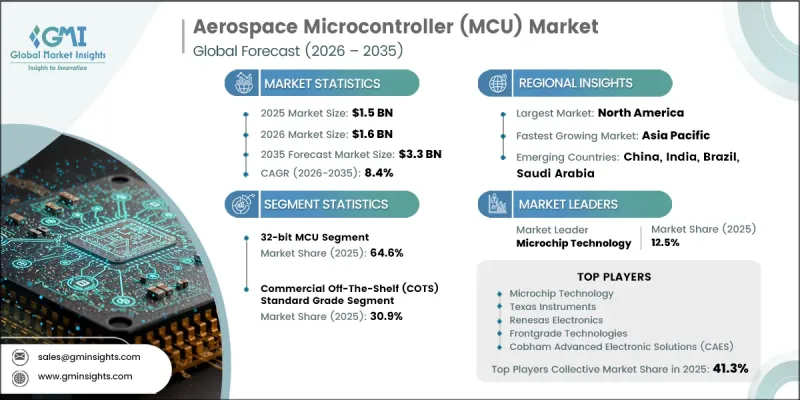
航太微控制器產業的整體成長主要得益於飛機製造活動的活性化、衛星星系部署的擴展以及北約成員國和印太地區主要經濟區域國防航空電子系統的持續升級。航太系統中對處理能力、可靠性和即時操作能力要求更高的先進電子架構的日益普及,也對市場產生了積極影響。航太製造商正擴大將微控制器單元整合到導航系統、環境監控系統、電源管理平台和飛行控制技術中,這顯著提高了每架飛機對微控制器的需求。同時,業界也越來越多採用人工智慧賦能的航太微控制器,以支援飛行中資料分析、智慧故障監控、自主運作能力和增強的感測器處理能力。對更高運算效率的需求也在加速向多核心微控制器架構的轉變,尤其是在航空電子系統日益軟體主導和資料密集的情況下。這些趨勢鞏固了航太微控制器在民航、國防平台、衛星電子設備和無人駕駛航空器系統中作為關鍵組件的地位。
| 市場範圍 | |
|---|---|
| 開始年份 | 2025 |
| 預測期 | 2026-2035 |
| 初始市場規模 | 15億美元 |
| 市場規模預測 | 33億美元 |
| 複合年成長率 | 8.4% |
到2025年,32位MCU市佔率將達到64.6%。其強勁的市場地位得益於民用航空電子設備、軍用嵌入式系統和衛星處理應用領域的廣泛採用,這些應用需要高度可靠的即時運算效能,遠超低位架構的能力。該細分市場持續成長,原因在於其兼具先進的處理能力、高能源效率以及與認證軟體生態系統、即時作業系統環境和航太級開發框架的廣泛相容性。隨著航太系統日益網路化和軟體依賴性增強,32位元微控制器仍將是下一代航空電子設備開發專案的首選架構。
預計到2025年,標準級商用現成(COTS)微控制器市佔率將達到30.9%,這主要得益於其在成本敏感型航太應用中的廣泛應用,而這些應用通常無需具備抗輻射加固能力。由於其快速供貨、價格優勢和靈活的採購方式,這些微控制器在非關鍵航太電子設備中得到廣泛應用。它們能夠在滿足更廣泛的環境和運作要求的同時保持較低的採購成本,這持續推動其在多種航太應用中的普及。對可擴展的商用半導體解決方案日益成長的依賴,進一步推動了全球對COTS級航太微控制器的需求。
預計到2025年,北美航太微控制器市佔率將達到46.6%,主要得益於該地區飛機製造商、國防相關企業和衛星技術公司的高度集中。此外,該地區市場擴張還得益於航太電子產品嚴格的認證要求以及對先進航空電子設備現代化項目的持續投資。美國聯邦航空管理局(FAA)實施的監管標準不斷加強對機載電子設備的合規性要求,從而支持了新飛機項目和電子系統升級對經認證的航太微控制器解決方案的需求。加拿大也透過其國內航空航太電子技術的擴張以及參與私營和政府支持的衛星舉措,為區域市場成長做出了顯著貢獻。
目錄
第1章:分析方法和範圍
第2章執行摘要
第3章業界考察
- 產業生態系分析
- 供應商情況
- 利潤率
- 成本結構
- 每個階段增加的價值
- 影響價值鏈的因素
- 中斷
- 影響產業的因素
- 促進因素
- 民航機生產的擴張增加了對航空電子設備用先進微控制器的需求。
- 國防現代化計畫的擴展正在加速全球航太領域嵌入式電子設備的採用。
- 衛星發射量的增加推動了全球對抗輻射航太微控制器的需求。
- 無人機的日益普及推動了對緊湊型、高性能航太MCU的需求成長。
- 嚴格的航空安全法規正在推動高可靠性航太電子系統的升級。
- 產業潛在風險與挑戰
- 航太領域嚴格的認證要求延長了產品開發和商業化。
- 半導體供不應求為全球採購航太微控制器帶來了挑戰。
- 市場機遇
- 新的太空探勘任務對高抗輻射能力的微控制器產生了需求。
- 電動飛機的發展壯大為節能型航太MCU創造了新的機會。
- 促進因素
- 成長潛力分析
- 監理情勢
- 波特五力分析
- PESTEL 分析
- 技術與創新展望
- 最新科技趨勢
- 新興技術
- 價格趨勢
- 按地區
- 依產品
- 定價策略
- 新興經營模式
- 合規要求
- 專利和智慧財產權分析
第4章 競爭情勢
- 介紹
- 公司市佔率分析
- 按地區
- 市場集中度分析
- 主要公司的競爭分析
- 財務績效比較
- 收入
- 利潤率
- 研究與發展(R&D)
- 產品系列比較
- 產品線寬度
- 科技
- 創新
- 區域擴張比較
- 全球擴張分析
- 服務網路覆蓋
- 市場滲透率:依地區分類
- 競爭定位矩陣
- 領導者
- 挑戰者
- 追蹤者
- 小眾玩家
- 戰略展望矩陣
- 財務績效比較
- 主要趨勢
- 企業合併(M&A)
- 夥伴關係和聯盟
- 技術進步
- 擴張與投資策略
- 數位轉型(DX)計劃
- 新興企業競爭公司和新創企業的發展趨勢
第5章 市場估算與預測:依產品類型分類(2022-2035 年)
- 8位元微控制器
- 16位MCU
- 32位MCU
- 64位MCU
第6章 市場估算與預測:依輻射耐受等級分類(2022-2035 年)
- 抗輻射(TID 100 kRad 或更高)
- 耐輻射(TID 30-100 kRad)
- 非抗輻射增強型(0 kRad/擴展溫度範圍)
- 市售現成產品(COTS)(標準級)
第7章 市場估計與預測:依平台分類(2022-2035 年)
- 民航機
- 軍用/國防飛機
- 衛星
- 太空船和運載火箭
- 無人機/無人飛行器
- 其他
第8章 市場估計與預測:按地區分類(2022-2035 年)
- 北美洲
- 美國
- 加拿大
- 歐洲
- 德國
- 英國
- 法國
- 西班牙
- 義大利
- 亞太地區
- 中國
- 印度
- 日本
- 澳洲
- 韓國
- 拉丁美洲
- 巴西
- 墨西哥
- 阿根廷
- 中東和非洲
- 南非
- 沙烏地阿拉伯
- UAE
第9章:公司簡介
- 全球主要公司
- Microchip Technology
- Texas Instruments
- Renesas Electronics
- STMicroelectronics
- NXP Semiconductors
- Infineon Technologies
- Intel
- 該地區的主要公司
- 北美洲
- Honeywell Aerospace
- AMD
- Analog Devices
- onsemi
- VORAGO Technologies
- 亞太地區
- NanoXplore
- 歐洲
- BAE Systems
- Cobham Advanced Electronic Solutions(CAES)
- Teledyne e2v
- 北美洲
- 小眾公司和顛覆者
- Frontgrade Technologies
The Global Aerospace Microcontroller Market was valued at USD 1.5 billion in 2025 and is estimated to grow at a CAGR of 8.4% to reach USD 3.3 billion by 2035.
Growth across the aerospace microcontroller industry is fueled by rising aircraft manufacturing activity, increasing deployment of satellite constellations, and continuous upgrades of defense avionics systems throughout NATO countries and major Indo-Pacific economies. The market is also benefiting from the growing use of advanced electronic architectures in aerospace systems that require faster processing, higher reliability, and enhanced real-time operational capabilities. Aerospace manufacturers are increasingly integrating microcontroller units into navigation systems, environmental monitoring systems, power management platforms, and flight control technologies, significantly increasing MCU demand per aircraft. In parallel, the industry is adopting AI-enabled aerospace microcontrollers that support onboard data analysis, intelligent fault monitoring, autonomous operational functions, and enhanced sensor processing. Demand for higher computing efficiency is also accelerating the transition toward multicore microcontroller architectures, particularly as avionics systems become more software-driven and data-intensive. These developments continue to position aerospace microcontrollers as a critical component across commercial aviation, defense platforms, satellite electronics, and unmanned aerial systems.
| Market Scope | |
|---|---|
| Start Year | 2025 |
| Forecast Year | 2026-2035 |
| Start Value | $1.5 Billion |
| Forecast Value | $3.3 Billion |
| CAGR | 8.4% |
The 32-bit MCU segment accounted for 64.6% share in 2025. Its strong market position is supported by widespread adoption across commercial aviation electronics, military embedded systems, and satellite processing applications that require highly reliable real-time computing performance beyond the capabilities of lower-bit architectures. The segment continues to gain momentum due to its combination of advanced processing power, energy efficiency, and broad compatibility with certified software ecosystems, real-time operating environments, and aerospace-grade development frameworks. As aerospace systems become increasingly connected and software-dependent, 32-bit microcontrollers remain the preferred architecture for next-generation avionics development programs.
The commercial off-the-shelf standard grade segment held a 30.9% share in 2025 due to its extensive use in cost-sensitive aerospace applications where radiation-hardened specifications are not essential. These microcontrollers are widely adopted in non-critical aerospace electronics because they offer faster availability, competitive pricing, and flexible sourcing options. Their ability to meet extended environmental and operational requirements while maintaining lower procurement costs continues to support their growing adoption across multiple aerospace applications. Increased reliance on scalable and commercially available semiconductor solutions is further strengthening demand for COTS-grade aerospace microcontrollers worldwide.
North America Aerospace Microcontroller Market captured 46.6% share in 2025, supported by the region's strong concentration of aircraft manufacturers, defense contractors, and satellite technology companies. Market expansion in the region is also driven by strict aerospace electronics certification requirements and continued investments in advanced avionics modernization programs. Regulatory standards introduced by the Federal Aviation Administration continue to reinforce compliance requirements for airborne electronic hardware, sustaining demand for certified aerospace microcontroller solutions across new aircraft programs and electronic system upgrades. Canada also contributes significantly to regional market growth through its expanding domestic space electronics capabilities and participation in commercial and government-supported satellite initiatives.
Major companies operating in the Global Aerospace Microcontroller Market include AMD, Analog Devices, BAE Systems, Cobham Advanced Electronic Solutions (CAES), Frontgrade Technologies, Honeywell Aerospace, Infineon Technologies, Intel, Microchip Technology, NanoXplore, NXP Semiconductors, onsemi, Renesas Electronics, STMicroelectronics, Teledyne e2v, Texas Instruments, and VORAGO Technologies. Companies active in the aerospace microcontroller market are adopting several strategic initiatives to strengthen their market position and expand their competitive advantage. Leading players are increasing investments in research and development to introduce high-performance aerospace-grade microcontrollers with improved processing efficiency, AI capabilities, and enhanced reliability for harsh operating environments. Many manufacturers are also focusing on multicore architecture development to address the growing complexity of avionics and autonomous aerospace systems. Strategic partnerships with aircraft manufacturers, defense contractors, and satellite developers remain a key growth strategy to secure long-term supply agreements and accelerate product integration into next-generation aerospace platforms. In addition, companies are expanding production capabilities, strengthening semiconductor supply chains, and pursuing regulatory certifications to improve product acceptance across commercial aviation, defense, and space applications.
Table of Contents
Chapter 1 Methodology and Scope
- 1.1 Market scope and definition
- 1.2 Research design
- 1.2.1 Research approach
- 1.2.2 Data collection methods
- 1.3 Data mining sources
- 1.3.1 Global
- 1.3.2 Regional/Country
- 1.4 Base estimates and calculations
- 1.4.1 Base year calculation
- 1.4.2 Key trends for market estimation
- 1.5 Primary research and validation
- 1.5.1 Primary sources
- 1.6 Forecast model
- 1.7 Research assumptions and limitations
Chapter 2 Executive Summary
- 2.1 Industry 360° synopsis, 2022 - 2035
- 2.2 Key market trends
- 2.2.1 Product type trends
- 2.2.2 Radiation hardness level trends
- 2.2.3 Platform trends
- 2.2.4 Regional trends
- 2.3 TAM Analysis, 2026-2035
- 2.4 CXO perspectives: Strategic imperatives
Chapter 3 Industry Insights
- 3.1 Industry ecosystem analysis
- 3.1.1 Supplier Landscape
- 3.1.2 Profit Margin
- 3.1.3 Cost structure
- 3.1.4 Value addition at each stage
- 3.1.5 Factor affecting the value chain
- 3.1.6 Disruptions
- 3.2 Industry impact forces
- 3.2.1 Growth drivers
- 3.2.1.1 Expanding commercial aircraft production increasing demand for advanced avionics microcontrollers.
- 3.2.1.2 Rising defense modernization programs accelerating aerospace embedded electronics deployment globally
- 3.2.1.3 Growing satellite launches driving demand for radiation-tolerant aerospace microcontrollers worldwide
- 3.2.1.4 Increasing UAV adoption boosting requirement for compact high-performance aerospace MCUs
- 3.2.1.5 Stringent aircraft safety regulations encouraging reliable aerospace electronic system upgrades
- 3.2.2 Industry pitfalls and challenges
- 3.2.2.1 High aerospace certification requirements extending product development and commercialization timelines
- 3.2.2.2 Limited semiconductor supply creating procurement challenges for aerospace-grade microcontrollers globally
- 3.2.3 Market opportunities
- 3.2.3.1 Emerging space exploration missions creating demand for advanced radiation-hardened microcontrollers
- 3.2.3.2 Increasing electric aircraft development opening opportunities for energy-efficient aerospace MCUs
- 3.2.1 Growth drivers
- 3.3 Growth potential analysis
- 3.4 Regulatory landscape
- 3.4.1 North America
- 3.4.2 Europe
- 3.4.3 Asia Pacific
- 3.4.4 Latin America
- 3.4.5 Middle East & Africa
- 3.5 Porter's analysis
- 3.6 PESTEL analysis
- 3.7 Technology and Innovation landscape
- 3.7.1 Current technological trends
- 3.7.2 Emerging technologies
- 3.8 Price trends
- 3.8.1 By region
- 3.8.2 By product
- 3.9 Pricing Strategies
- 3.10 Emerging Business Models
- 3.11 Compliance Requirements
- 3.12 Patent and IP analysis
Chapter 4 Competitive Landscape, 2025
- 4.1 Introduction
- 4.2 Company market share analysis
- 4.2.1 By region
- 4.2.1.1 North America
- 4.2.1.2 Europe
- 4.2.1.3 Asia Pacific
- 4.2.1.4 Latin America
- 4.2.1.5 Middle East & Africa
- 4.2.2 Market concentration analysis
- 4.2.1 By region
- 4.3 Competitive benchmarking of key players
- 4.3.1 Financial performance comparison
- 4.3.1.1 Revenue
- 4.3.1.2 Profit margin
- 4.3.1.3 R&D
- 4.3.2 Product portfolio comparison
- 4.3.2.1 Product range breadth
- 4.3.2.2 Technology
- 4.3.2.3 Innovation
- 4.3.3 Geographic presence comparison
- 4.3.3.1 Global footprint analysis
- 4.3.3.2 Service network coverage
- 4.3.3.3 Market penetration by region
- 4.3.4 Competitive positioning matrix
- 4.3.4.1 Leaders
- 4.3.4.2 Challengers
- 4.3.4.3 Followers
- 4.3.4.4 Niche players
- 4.3.5 Strategic outlook matrix
- 4.3.1 Financial performance comparison
- 4.4 Key developments
- 4.4.1 Mergers and acquisitions
- 4.4.2 Partnerships and collaborations
- 4.4.3 Technological advancements
- 4.4.4 Expansion and investment strategies
- 4.4.5 Digital transformation initiatives
- 4.5 Emerging/ startup competitors landscape
Chapter 5 Market Estimates and Forecast, By Product Type, 2022 - 2035 (USD Million)
- 5.1 Key trends
- 5.2 8-bit MCUs
- 5.3 16-bit MCUs
- 5.4 32-bit MCUs
- 5.5 64-bit MCUs
Chapter 6 Market Estimates and Forecast, By Radiation Hardness Level, 2022 - 2035 (USD Million)
- 6.1 Key trends
- 6.2 Radiation-hardened (TID >100 krad)
- 6.3 Radiation-tolerant (TID >30 to 100 krad)
- 6.4 Non-rad ruggedized (0 krad/ extended temp)
- 6.5 Commercial off-the-shelf (COTS) (standard grade)
Chapter 7 Market Estimates and Forecast, By Platform, 2022 - 2035 (USD Million)
- 7.1 Key trends
- 7.2 Commercial aircraft
- 7.3 Military & defense aircrafts
- 7.4 Satellites
- 7.5 Spacecraft & launch vehicles
- 7.6 UAVs & drones
- 7.7 Others
Chapter 8 Market Estimates and Forecast, By Region, 2022 - 2035 (USD Million)
- 8.1 Key trends
- 8.2 North America
- 8.2.1 U.S.
- 8.2.2 Canada
- 8.3 Europe
- 8.3.1 Germany
- 8.3.2 UK
- 8.3.3 France
- 8.3.4 Spain
- 8.3.5 Italy
- 8.4 Asia Pacific
- 8.4.1 China
- 8.4.2 India
- 8.4.3 Japan
- 8.4.4 Australia
- 8.4.5 South Korea
- 8.5 Latin America
- 8.5.1 Brazil
- 8.5.2 Mexico
- 8.5.3 Argentina
- 8.6 Middle East and Africa
- 8.6.1 South Africa
- 8.6.2 Saudi Arabia
- 8.6.3 UAE
Chapter 9 Company Profiles
- 9.1 Global Key Players
- 9.1.1 Microchip Technology
- 9.1.2 Texas Instruments
- 9.1.3 Renesas Electronics
- 9.1.4 STMicroelectronics
- 9.1.5 NXP Semiconductors
- 9.1.6 Infineon Technologies
- 9.1.7 Intel
- 9.2 Regional key players
- 9.2.1 North America
- 9.2.1.1 Honeywell Aerospace
- 9.2.1.2 AMD
- 9.2.1.3 Analog Devices
- 9.2.1.4 onsemi
- 9.2.1.5 VORAGO Technologies
- 9.2.2 Asia Pacific
- 9.2.2.1 NanoXplore
- 9.2.3 Europe
- 9.2.3.1 BAE Systems
- 9.2.3.2 Cobham Advanced Electronic Solutions (CAES)
- 9.2.3.3 Teledyne e2v
- 9.2.1 North America
- 9.3 Niche Players/Disruptors
- 9.3.1 Frontgrade Technologies

 美國微控制器(MCU):市場佔有率分析、行業趨勢和統計數據、成長預測(2026-2031 年)中國MCU:市場佔有率分析、產業趨勢與統計、成長預測(2026-2031年)微控制器(MCU):市場佔有率分析、產業趨勢與統計數據、成長預測(2026-2031)
 物聯網微控制器市場-2026-2032年全球市場預測
 微控制器 (MCU) 市場預測至 2034 年—按產品類型、架構、記憶體類型、分銷管道、應用、最終用戶和地區分類的全球分析
 2026-2030年全球微控制器(MCU)市場
 2026年全球金屬氧化物半導體(MOS)微控制器(MCU)市場報告物聯網微控制器:市佔率分析、產業趨勢與統計及成長預測(2026-2031 年)物聯網微控制器市場預測至2034年:按組件、位元深度、記憶體、應用和地區分類的全球分析
 物聯網微控制器市場報告:按產品、應用和地區分類(2026-2034 年)