


 |
市場調查報告書
商品編碼
2119629
中國MCU:市場佔有率分析、產業趨勢與統計、成長預測(2026-2031年)China MCU - Market Share Analysis, Industry Trends & Statistics, Growth Forecasts (2026 - 2031) |
||||||

※ 本網頁內容可能與最新版本有所差異。詳細情況請與我們聯繫。
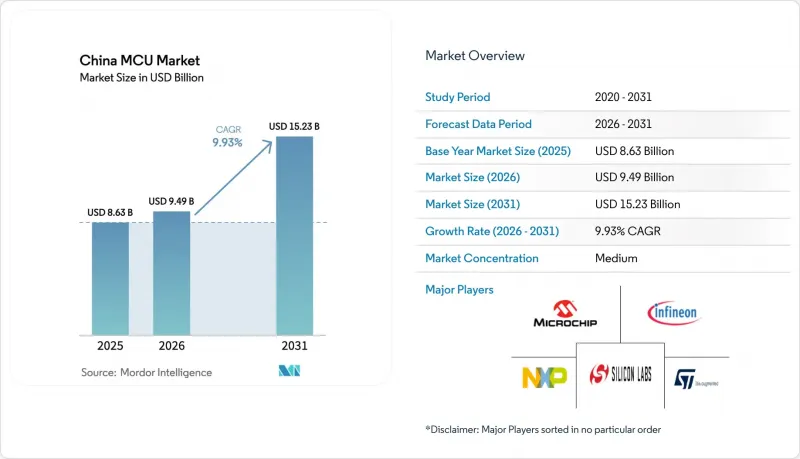
據 Mordor Intelligence 稱,2025 年中國 MCU 市值為 86.3 億美元,預計到 2031 年將達到 152.3 億美元,而 2026 年為 94.9 億美元,預測期(2026-2031 年)的複合年成長率為 9.93%。
本報告依架構(8 位元、16 位元、32 位元、64 位元)、核心 IP(ARM Cortex-M 系列、RISC-V 核心等)、製程節點(90 奈米以上、65-90 奈米、40-60 奈米、28-40 奈米、28 奈米以下)和應用程式領域(消費性汽車、醫療保健領域(消費設備、醫療設備)市場預測以美元 (USD) 為單位。
中國MCU市場趨勢與分析
中國電動車產量的爆炸性成長正在推動對高可靠性汽車MCU的需求。
2024年,新能源汽車產量突破1,100萬輛,國內市場滲透率超過40%。這導致每輛車的MCU平均成本飆升至900-1000美元。同年,L2+級駕駛輔助系統的滲透率達到62.5%,推動了對基於多個高性能MCU的冗餘域控制器的需求,這些控制器用於感測器融合和煞車控制邏輯。雖然像兆易創新這樣的中國廠商正在努力實現ISO 26262 ASIL-D認證,但許多廠商仍專注於車身ECU,而非安全關鍵的動力傳動系統總成模組。在32位獲得認證的汽車控制器領域,國外廠商仍保持優勢,但隨著國內產能的擴大和政策的支持,差距正在縮小。因此,中國MCU市場正經歷AEC-Q100認證組件的快速成長、更嚴格的網路安全要求以及更長的產品生命週期,這為擁有強大功能安全工具鏈的供應商創造了有利的環境。
國家物聯網+策略正在推動連網型設備。
北京的「物聯網+」計畫已推動到2024年建成超過8,000個5G+工業網際網路項目,刺激了對用於即時機器控制的專用32位MCU的需求。預計到2024年,中國AIoT市場規模將達到1.7兆元人民幣,其中人工智慧設備將佔出貨量的55%,預計到2027年這一比例將達到80%。藍牙低功耗模組(Bluetooth Low Energy,簡稱BLE)是真無線耳機和穿戴式裝置的關鍵組件,預計到2025年,其全球市場規模將超過10億美元,年複合成長率約為15%,這將推動無線通訊核心整合到MCU中。邊緣側推理正在滲透到工廠和消費性電子設備中,迫使控制器廠商將神經網路處理單元(NPU)和安全元件整合到引腳相容的封裝中。這種政策主導的智慧節點激增正在鞏固中國MCU市場作為全球互聯物聯網平台量產引擎的地位。
美國出口限制使得先進EDA和微影術工具的取得受到限制。
美國實施的監管限制了中國獲取極紫外光刻機和先進EDA套件,導致中芯國際5nm製程的預期成本比台積電同類產品高出40-50%,而良率僅為目前最先進水平的三分之一左右。極紫外線設備的短缺迫使企業採用深層紫外線多重圖形化,增加了光罩數量和週期時間。對於需要高邏輯密度的MCU設計(例如以AI邊緣節點和車載資訊娛樂系統的MCU),每瓦效能正在下降。儘管國內工具鏈正在進步,但在時序收斂和功耗最佳化方面仍落後於全球領導者。這種技術落後阻礙了中國高階MCU市場的成長,並延緩了14nm以下製程節點的普及。
細分市場分析
預計到2025年,中國32位市場規模將達到46.4億美元,佔總營收的53.78%。邊緣AI工作負載、環景顯示拼接和高速工業視覺等應用正在加速64位元技術的普及,該細分市場正以10.88%的複合年成長率成長。雖然16位元和8位控制器仍然應用於注重成本的消費性電子產品和小型感測器節點,但隨著28nm 32位元產品價格的下降,它們的總合正在逐年減少。蘇州國信的CCR4001S將230MHz RISC-V核心與0.3 TOPS NPU相結合,展現了這家國內廠商將控制和推理功能整合於單晶片上的雄心。汽車製造商為車身領域指定多核心、鎖步 32 位元組件,為數位駕駛座叢集指定雙 A76 64 位元 SoC,進一步加強了中國 MCU 市場的分層架構藍圖。
由此產生的另一個結果是,記憶體密度和計算吞吐量之間的匹配變得更加嚴格。隨著電容式觸控人機介面(HMI)在消費性電子產品中的應用,韌體大小已膨脹至兆位元組級別,片上快閃記憶體成為關鍵的差異化因素。因此,廠商正在將2-4 MB的eFlash整合到中階32位元MCU中。同時,64位元控制器正在整合LPDDR4 PHY,從而實現神經網路權重的串流。這些進步共同推動著中國MCU市場逐步朝向在受限功耗範圍內進行異質運算的新典範轉移。
預計到2025年,ARM將佔據61.05%的市場佔有率,但得益於政府津貼和開放原始碼工具鏈的支持,免版稅的RISC-V核心實現了兩位數的成長。振華風光於2025年1月完成了首款完全自主研發的32位RISC-V MCU的流片,並計劃在年底前進行試生產。售價約0.1美元的超低成本RISC-V元件正在重振入門級物聯網節點市場。其高度靈活的設計使得國內企業無需支付授權費即可添加用於電機控制的客製化DSP模組或用於數位人民幣錢包的加密加速器。然而,轉型仍面臨諸多障礙,例如IDE的成熟度、中間件的豐富性以及安全認證庫的不足,這些因素仍然支撐著ARM在中國MCU市場的主導地位。
傳統的8051核心仍應用於電能表和基礎照明控制設備,在90奈米以上的製程節點上實現了確定性的週期時序和極小的晶片尺寸。然而,隨著ODM廠商圍繞成本相當的32位元單元標準化工具鏈,對新型8位元插槽的需求正在下降。因此,中國MCU市場日益兩極化,64位元RISC-V在高效能應用領域佔據主導地位,而低成本的32位元ARM產品則在大眾市場控制應用中獲得市場佔有率。
其他好處:
- Excel格式的市場預測(ME)表
- 3個月的分析師支持
目錄
第1章:引言
- 研究假設和市場定義
- 調查範圍
第2章:調查方法
第3章執行摘要
第4章 市場狀況
- 市場概覽
- 市場促進因素
- 中國電動車產量的爆炸性成長正在推動對高可靠性汽車MCU的需求。
- 政府的物聯網+策略正在推動連網設備用微控制器的出貨量。
- 政府補貼加速中國採用MCU(中國製造)產品(中國製造2025)
- 隨著中小企業維修到工業 4.0,32 位元工業 MCU 的採用率正在不斷提高。
- RISC-V 開放式指令集架構在中國 MCU 市場的出現降低了進入門檻。
- 與數位人民幣相容的硬體錢包的部署,為安全微控制器(MCU)創造了一個全新的細分市場。
- 市場限制因素
- 美國出口限制使得先進EDA和微影術設備的取得受到限制。
- 40 奈米和 28 奈米節點的晶圓級供應短缺問題依然存在。
- 符合 ISO 26262 標準的 MCU 設計功能安全領域人員短缺。
- 一級汽車OEM廠商國產MCU可靠度認證面臨的障礙
- 產業價值鏈分析
- 監理情勢
- 技術展望
- 波特五力分析
第5章 市場規模與成長預測
- 以建築學為例
- 8 位元
- 16 位元
- 32 位元
- 64 位元
- 核心IP
- ARM Cortex-M系列
- RISC-V 內核
- 8051/MCS-51
- MIPS 和其他
- 按行程節點
- >90 奈米
- 65~90 nm
- 40~60 nm
- 28~40 nm
- 小於 28 奈米
- 透過使用
- 消費性電子產品
- 車
- 工業自動化
- 通訊和物聯網
- 醫療保健和醫療設備
- 其他
第6章 競爭情勢
- 市場集中度
- 策略趨勢
- 市佔率分析
- 公司簡介
- Microchip Technology Inc.
- NXP Semiconductors NV
- STMicroelectronics NV
- Texas Instruments Incorporated
- Renesas Electronics Corporation
- Infineon Technologies AG
- GigaDevice Semiconductor Inc.
- Nuvoton Technology Corporation
- Holtek Semiconductor Inc.
- Silicon Laboratories Inc.
- Nordic Semiconductor ASA
- Espressif Systems(Shanghai)Co., Ltd.
- Shanghai MindMotion Microelectronics Co., Ltd.
- Shanghai ChipON Micro-Electronics Co., Ltd.
- Wuhan Eastsoft Embedded System Co., Ltd.
- Nationz Technologies Inc.
- Hangzhou C-SKY Microsystems Co., Ltd.
- Actions Technology Co., Ltd.
- Sanechips Technology Co., Ltd.
- Hangzhou ASR Microelectronics Co., Ltd.
- Shenzhen Beken Corporation Ltd.
- Qingdao Eastsoft Microelectronics Co., Ltd.
- Zhuhai Abov Microelectronics Co., Ltd.
- Austriamicrosystems AG
- Chongqing Sino-MCU Technology Co., Ltd.
第7章 市場機會與未來展望
According to Mordor Intelligence, the China MCU market size was valued at USD 8.63 billion in 2025 and estimated to grow from USD 9.49 billion in 2026 to reach USD 15.23 billion by 2031, at a CAGR of 9.93% during the forecast period (2026-2031).
This report is Segmented by Architecture (8-Bit, 16-Bit, 32-Bit, and 64-Bit), Core IP (ARM Cortex-M Series, RISC-V Cores, and More), Process Node (above 90nm, 65-90nm, 40-60nm, 28-40nm, and Less Than 28nm), Application (Consumer Electronics, Automotive, Industrial Automation, Communication and IoT, Healthcare and Medical Devices, and More). The Market Forecasts are Provided in Terms of Value (USD).
China MCU Market Trends and Insights
Explosive Growth in China's EV Production Triggering High-Reliability Automotive MCU Demand
New-energy vehicle production broke the 11 million-unit mark in 2024 and delivered over 40% domestic penetration, sharply lifting MCU content per car to USD 900-1,000. Level 2+ driver-assistance systems reached 62.5% penetration the same year, pushing demand for redundant domain controllers built on multiple high-performance MCUs for sensor fusion and braking logic. Chinese vendors such as Zhaoyi Innovation advanced toward ISO 26262 ASIL-D compliance, though most still focus on body ECUs rather than safety-critical powertrain blocks. Foreign suppliers maintain the lead in qualified 32-bit automotive controllers, yet rising domestic capacity and policy support are narrowing the gap. The China MCU market is therefore experiencing a rapid uptick in AEC-Q100-qualified parts, tighter cybersecurity requirements, and longer product lifecycles that favor suppliers with robust functional-safety toolchains.
National "IoT+" Strategy Spurring Connected-Device MCU Volumes
Beijing's IoT+ blueprint underwrote more than 8,000 5G+Industrial-Internet projects by 2024, catapulting specialized 32-bit MCU demand for real-time machine control. China's AIoT sector reached RMB 1.7 trillion in 2024, with AI-enabled terminals accounting for 55% of shipments and headed toward 80% by 2027. Bluetooth Low Energy modules, integral to TWS earbuds and wearables, are projected to top USD 1 billion worldwide by 2025, expanding at mid-teen CAGRs and anchoring MCU integration of wireless cores. Edge-side inferencing is permeating factory and consumer devices, forcing controller vendors to embed NPUs and secure elements into pin-compatible packages. This policy-driven proliferation of smart nodes cements the China MCU market as a volume engine for globally aligned IoT platforms.
U.S. Export Controls Curbing Access to Advanced EDA and Lithography Tools
Restrictions enacted by the United States hamper Chinese access to EUV scanners and advanced EDA suites, lifting projected 5 nm costs at SMIC by 40-50% versus TSMC peers while yields sit at roughly one-third of leading-edge benchmarks. Lack of EUV machinery forces DUV multi-patterning, inflating mask counts and cycle times. MCU designs targeting AI edge nodes or in-vehicle infotainment that need high logic density face performance-per-watt penalties. Domestic toolchains are progressing but still trail global incumbents in timing-closure and power-optimization depth. This technological drag tempers top-end growth of the China MCU market and slows adoption of sub-14 nm nodes.
Other drivers and restraints analyzed in the detailed report include:
- Government Subsidies to Accelerate Domestic MCU Design-in (Made-in-China 2025)
- Industrial 4.0 Retrofits in SMEs Raising Adoption of 32-bit Industrial-Grade MCUs
- Persistent Wafer-Level Supply Bottlenecks in 40 nm and 28 nm Nodes
For complete list of drivers and restraints, kindly check the Table Of Contents.
Segment Analysis
The China MCU market size for 32-bit devices reached USD 4.64 billion in 2025, equating to 53.78% revenue share. Edge AI workloads, surround-view stitching, and high-speed industrial vision accelerate 64-bit adoption, lifting that segment at an 10.88% CAGR. Sixteen-bit and eight-bit controllers linger in cost-sensitive appliances and small sensor nodes, yet their combined share slips yearly as 28 nm 32-bit pricing compresses. Suzhou Guoxin's CCR4001S marries a 230 MHz RISC-V core with a 0.3 TOPS NPU, demonstrating domestic ambition to migrate control and inference onto one die. Automotive OEMs specify multicore lock-step 32-bit parts for body domain and dual-A76 64-bit SoCs for digital cockpit clusters, reinforcing a tiered architecture roadmap within the China MCU market.
Second-order effects include tighter alignment between memory density and compute throughput. As capacitive-touch HMIs enter appliances, firmware swells into the megabyte range, making on-chip flash a differentiation point. Vendors thus bundle 2-4 MB of eFlash in mid-range 32-bit MCUs. Concurrently, 64-bit controllers integrate LPDDR4 PHYs to stream neural-network weights. These advances collectively edge the China MCU market toward heterogeneous compute paradigms inside constrained power envelopes.
ARM retained 61.05% of 2025 revenue, but royalty-free RISC-V cores chalked up double-digit growth, aided by government grants and open-source toolchains. Zhenhua Fengguang taped out its first fully indigenous 32-bit RISC-V MCU in January 2025, positioning for pilot production by year-end. Ultra-low-cost RISC-V parts priced near USD 0.10 invigorate entry-level IoT nodes. Design freedom enables domestic firms to add custom DSP blocks for motor control or crypto accelerators for digital-yuan wallets without paying license fees. However, migration hurdles include IDE maturity, middleware depth, and safety certification libraries, factors that still buttress ARM's lead in the China MCU market.
Legacy 8051 cores persist in power meters and basic lighting controls, offering deterministic cycle timing and tiny die sizes on above 90 nm nodes. Yet new 8-bit sockets dwindle as ODMs standardize toolchains around 32-bit units with cost parity. The net result is an increasingly bifurcated China MCU market where premium performance leans toward 64-bit RISC-V and mass-market control consolidates on low-cost 32-bit ARM alternatives.
Complete Report Scope:
- By Architecture
- 8-bit
- 16-bit
- 32-bit
- 64-bit
- By Core IP
- ARM Cortex-M Series
- RISC-V Cores
- 8051 / MCS-51
- MIPS and Others
- By Process Node
- above 90 nm
- 65 - 90 nm
- 40 - 60 nm
- 28 - 40 nm
- less than 28 nm
- By Application
- Consumer Electronics
- Automotive
- Industrial Automation
- Communication and IoT
- Healthcare and Medical Devices
- Other Applications
List of Companies Covered in this Report:
- Microchip Technology Inc.
- NXP Semiconductors N.V.
- STMicroelectronics N.V.
- Texas Instruments Incorporated
- Renesas Electronics Corporation
- Infineon Technologies AG
- GigaDevice Semiconductor Inc.
- Nuvoton Technology Corporation
- Holtek Semiconductor Inc.
- Silicon Laboratories Inc.
- Nordic Semiconductor ASA
- Espressif Systems (Shanghai) Co., Ltd.
- Shanghai MindMotion Microelectronics Co., Ltd.
- Shanghai ChipON Micro-Electronics Co., Ltd.
- Wuhan Eastsoft Embedded System Co., Ltd.
- Nationz Technologies Inc.
- Hangzhou C-SKY Microsystems Co., Ltd.
- Actions Technology Co., Ltd.
- Sanechips Technology Co., Ltd.
- Hangzhou ASR Microelectronics Co., Ltd.
- Shenzhen Beken Corporation Ltd.
- Qingdao Eastsoft Microelectronics Co., Ltd.
- Zhuhai Abov Microelectronics Co., Ltd.
- Austriamicrosystems AG
- Chongqing Sino-MCU Technology Co., Ltd.
Additional Benefits:
- The market estimate (ME) sheet in Excel format
- 3 months of analyst support
TABLE OF CONTENTS
1 INTRODUCTION
- 1.1 Study Assumptions and Market Definition
- 1.2 Scope of the Study
2 RESEARCH METHODOLOGY
3 EXECUTIVE SUMMARY
4 MARKET LANDSCAPE
- 4.1 Market Overview
- 4.2 Market Drivers
- 4.2.1 Explosive growth in China's EV production triggering high-reliability automotive MCU demand
- 4.2.2 National "IoT +" strategy spurring connected-device MCU volumes
- 4.2.3 Government subsidies to accelerate domestic MCU design-in (Made-in-China 2025)
- 4.2.4 Industrial 4.0 retrofits in SMEs raising adoption of 32-bit industrial-grade MCUs
- 4.2.5 Emergence of RISC-V open ISA in Chinese MCUs lowering entry barriers
- 4.2.6 Digital-yuan hardware wallet roll-out creating an all-new secure-MCU niche
- 4.3 Market Restraints
- 4.3.1 U.S. export controls curbing access to advanced EDA and lithography tools
- 4.3.2 Persistent wafer-level supply bottlenecks in 40 nm, 28 nm nodes
- 4.3.3 Scarcity of functional-safety talent for ISO 26262-compliant MCU designs
- 4.3.4 Reliability certification hurdles for domestic MCUs in Tier-1 auto OEMs
- 4.4 Industry Value Chain Analysis
- 4.5 Regulatory Landscape
- 4.6 Technological Outlook
- 4.7 Porter's Five Forces Analysis
- 4.7.1 Threat of New Entrants
- 4.7.2 Bargaining Power of Suppliers
- 4.7.3 Bargaining Power of Buyers
- 4.7.4 Threat of Substitutes
- 4.7.5 Competitive Rivalry
5 MARKET SIZE AND GROWTH FORECASTS (VALUE)
- 5.1 By Architecture
- 5.1.1 8-bit
- 5.1.2 16-bit
- 5.1.3 32-bit
- 5.1.4 64-bit
- 5.2 By Core IP
- 5.2.1 ARM Cortex-M Series
- 5.2.2 RISC-V Cores
- 5.2.3 8051 / MCS-51
- 5.2.4 MIPS and Others
- 5.3 By Process Node
- 5.3.1 above 90 nm
- 5.3.2 65 - 90 nm
- 5.3.3 40 - 60 nm
- 5.3.4 28 - 40 nm
- 5.3.5 less than 28 nm
- 5.4 By Application
- 5.4.1 Consumer Electronics
- 5.4.2 Automotive
- 5.4.3 Industrial Automation
- 5.4.4 Communication and IoT
- 5.4.5 Healthcare and Medical Devices
- 5.4.6 Other Applications
6 COMPETITIVE LANDSCAPE
- 6.1 Market Concentration
- 6.2 Strategic Moves
- 6.3 Market Share Analysis
- 6.4 Company Profiles (includes Global level Overview, Market level overview, Core Segments, Financials as available, Strategic Information, Market Rank/Share, Products and Services, Recent Developments)
- 6.4.1 Microchip Technology Inc.
- 6.4.2 NXP Semiconductors N.V.
- 6.4.3 STMicroelectronics N.V.
- 6.4.4 Texas Instruments Incorporated
- 6.4.5 Renesas Electronics Corporation
- 6.4.6 Infineon Technologies AG
- 6.4.7 GigaDevice Semiconductor Inc.
- 6.4.8 Nuvoton Technology Corporation
- 6.4.9 Holtek Semiconductor Inc.
- 6.4.10 Silicon Laboratories Inc.
- 6.4.11 Nordic Semiconductor ASA
- 6.4.12 Espressif Systems (Shanghai) Co., Ltd.
- 6.4.13 Shanghai MindMotion Microelectronics Co., Ltd.
- 6.4.14 Shanghai ChipON Micro-Electronics Co., Ltd.
- 6.4.15 Wuhan Eastsoft Embedded System Co., Ltd.
- 6.4.16 Nationz Technologies Inc.
- 6.4.17 Hangzhou C-SKY Microsystems Co., Ltd.
- 6.4.18 Actions Technology Co., Ltd.
- 6.4.19 Sanechips Technology Co., Ltd.
- 6.4.20 Hangzhou ASR Microelectronics Co., Ltd.
- 6.4.21 Shenzhen Beken Corporation Ltd.
- 6.4.22 Qingdao Eastsoft Microelectronics Co., Ltd.
- 6.4.23 Zhuhai Abov Microelectronics Co., Ltd.
- 6.4.24 Austriamicrosystems AG
- 6.4.25 Chongqing Sino-MCU Technology Co., Ltd.
7 MARKET OPPORTUNITIES AND FUTURE OUTLOOK
- 7.1 White-space and Unmet-Need Assessment

 美國微控制器(MCU):市場佔有率分析、行業趨勢和統計數據、成長預測(2026-2031 年)微控制器(MCU):市場佔有率分析、產業趨勢與統計數據、成長預測(2026-2031)
 物聯網微控制器市場-2026-2032年全球市場預測
 微控制器 (MCU) 市場預測至 2034 年—按產品類型、架構、記憶體類型、分銷管道、應用、最終用戶和地區分類的全球分析
 2026-2030年全球微控制器(MCU)市場
 2026年全球金屬氧化物半導體(MOS)微控制器(MCU)市場報告
 航太微控制器市場:市場機會、成長促進因素、產業趨勢分析及未來預測(2026-2035)物聯網微控制器:市佔率分析、產業趨勢與統計及成長預測(2026-2031 年)物聯網微控制器市場預測至2034年:按組件、位元深度、記憶體、應用和地區分類的全球分析
 物聯網微控制器市場報告:按產品、應用和地區分類(2026-2034 年)