


 |
市場調查報告書
商品編碼
1885843
藻類蛋白濃縮物市場機會、成長促進因素、產業趨勢分析及預測(2025-2034年)Algae Protein Concentrates Market Opportunity, Growth Drivers, Industry Trend Analysis, and Forecast 2025 - 2034 |
||||||

2024 年全球藻類蛋白濃縮物市場價值為 4.802 億美元,預計到 2034 年將以 7.8% 的複合年成長率成長至 10 億美元。
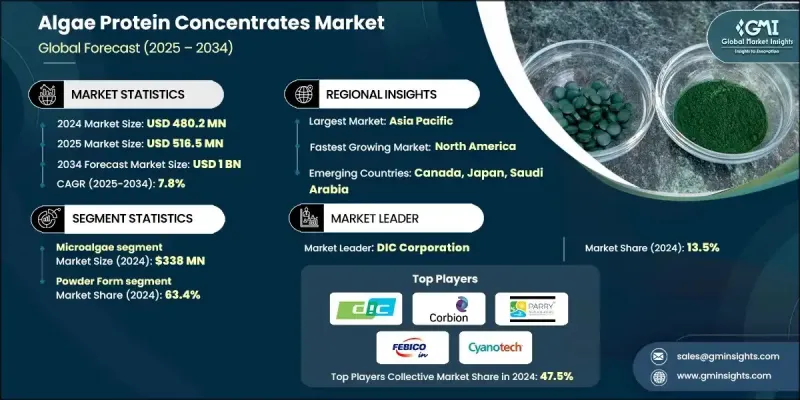
藻類蛋白濃縮物源自藻類,一種營養豐富的植物來源。微藻,即微小的藻類,因其高蛋白含量和豐富的營養成分而備受推崇。它們正日益被視為動物性蛋白質和其他植物性蛋白質的替代品,推動全球食品和飼料產業的廣泛應用。消費者對永續和環境友善食品的需求不斷成長,推動了全球對藻類蛋白的興趣,因為消費者越來越關注傳統畜牧業對生態環境的影響,包括溫室氣體排放、土地利用和水資源消耗。各國政府積極推廣永續食品體系,也促進了藻類蛋白的普及。此外,健康飲食的趨勢也支撐著市場成長,因為藻類蛋白富含必需胺基酸、抗氧化劑和維生素,為尋求功能性、高價值成分的消費者提供了營養豐富的選擇。
| 市場範圍 | |
|---|---|
| 起始年份 | 2024 |
| 預測年份 | 2025-2034 |
| 起始值 | 4.802億美元 |
| 預測值 | 10億美元 |
| 複合年成長率 | 7.8% |
2024年,微藻市場規模達3.38億美元,憑藉其高蛋白含量、快速生長、高效產出和易於培養等優勢,佔據市場主導地位,成為經濟高效且可擴展的解決方案。螺旋藻和綠藻等微藻富含必需胺基酸,廣泛應用於保健食品、膳食補充劑和功能性飲料。它們能夠在有限的空間中利用成熟的培養方法實現高產量,進一步鞏固了其市場領先地位。除了蛋白質之外,微藻還因其富含抗氧化劑和ω-3脂肪酸等其他健康益處而備受青睞,這些成分深受注重健康的消費者歡迎。
由於其穩定性好、保存期限長,便於儲存和運輸,粉狀藻類蛋白濃縮物在2024年佔據了63.4%的市場。製造商青睞粉狀產品,因為它用途廣泛,可用於製作冰沙、零食和膳食補充劑等。這種形態便於產品加工,有助於提高生產效率,並提升產品品質和一致性。
預計2025年至2034年間,北美藻類蛋白濃縮物市場將以8%的複合年成長率成長。人們對植物性飲食和永續營養的日益關注正在推動該地區藻類蛋白的普及。消費者將藻類蛋白視為傳統動物性蛋白質的一種創新且環保的替代品,而不斷成長的健康和素食主義趨勢也進一步促進了產品開發和市場擴張。養殖、收穫和萃取技術的進步提高了效率、成本效益和規模化生產能力,從而推動了區域市場的成長。
全球藻蛋白濃縮物市場的主要企業包括Allmicroalgae、DSM-Firmenich、Parry Nutraceuticals、Cargill、Corbion NV、DIC Corporation、Cyanotech Corporation、Algenuity、Brevel和遠東生物技術有限公司。市場參與者正透過產品組合多元化、加大研發投入以提升口感、功能性和營養價值,以及與食品飲料品牌建立策略夥伴關係來鞏固其市場地位。他們還利用永續發展資格和清潔標籤聲明來吸引注重健康的消費者。地理擴張、藻類培養和提取技術的創新,以及與零售商和製造商的合作,是提升市場佔有率和推動長期成長的關鍵途徑。
目錄
第1章:方法論與範圍
第2章:執行概要
第3章:行業洞察
- 產業生態系分析
- 供應商格局
- 利潤率
- 每個階段的價值增加
- 影響價值鏈的因素
- 中斷
- 產業影響因素
- 成長促進因素
- 對永續和植物性蛋白質的需求不斷成長
- 水產養殖業的發展及飼料蛋白需求
- 提高消費者對營養益處的認知
- 產業陷阱與挑戰
- 高昂的生產和加工成本
- 擴展性挑戰和基礎設施限制
- 市場機遇
- 功能性食品和飲料領域的新興應用
- 生物煉製與循環經濟的融合
- 成長促進因素
- 成長潛力分析
- 監管環境
- 北美洲
- 歐洲
- 亞太地區
- 拉丁美洲
- 中東和非洲
- 波特的分析
- PESTEL 分析
- 技術與創新格局
- 當前技術趨勢
- 新興技術
- 價格趨勢
- 按地區
- 來源
- 未來市場趨勢
- 專利格局
- 貿易統計(HS編碼)(註:僅提供重點國家的貿易統計資料)
- 主要進口國
- 主要出口國
- 永續性和環境方面
- 永續實踐
- 減少廢棄物策略
- 生產中的能源效率
- 環保舉措
- 碳足跡考量
第4章:競爭格局
- 介紹
- 公司市佔率分析
- 按地區
- 北美洲
- 歐洲
- 亞太地區
- 拉丁美洲
- MEA
- 按地區
- 公司矩陣分析
- 主要市場參與者的競爭分析
- 競爭定位矩陣
- 關鍵進展
- 併購
- 合作夥伴關係與合作
- 新產品發布
- 擴張計劃
第5章:市場估算與預測:依來源分類,2021-2034年
- 主要趨勢
- 微藻
- 螺旋藻
- 小球藻
- 擬球藻
- 四鞭毛蟲
- 柵欄
- 雨生紅球菌
- 其他
- 大型藻類
- 褐藻
- 紅藻
- 綠藻
第6章:市場估算與預測:依形式分類,2021-2034年
- 主要趨勢
- 粉末
- 液體
- 膠囊/片劑
- 其他
第7章:市場估計與預測:依應用領域分類,2021-2034年
- 主要趨勢
- 食品和飲料
- 植物肉替代品
- 乳製品替代品
- 烘焙食品和糖果
- 飲料和功能飲料
- 義大利麵和麵條
- 零食和蛋白棒
- 其他
- 膳食補充劑
- 片劑和膠囊
- 粉末和飲料沖劑
- 軟膠囊
- 運動營養補充品
- 其他
- 動物飼料和水產養殖
- 水產養殖飼料(魚蝦飼料)
- 家禽飼料
- 豬飼料
- 寵物食品及伴侶動物營養
- 其他
- 化妝品及個人護理
- 保養品
- 護髮產品
- 抗衰老配方
- 其他
- 製藥和營養保健品
- 生物活性胜肽和功能性成分
- 醫學營養
- 治療應用
- 其他
- 其他
第8章:市場估算與預測:依地區分類,2021-2034年
- 主要趨勢
- 北美洲
- 美國
- 加拿大
- 歐洲
- 德國
- 英國
- 法國
- 西班牙
- 義大利
- 歐洲其他地區
- 亞太地區
- 中國
- 印度
- 日本
- 澳洲
- 韓國
- 亞太其他地區
- 拉丁美洲
- 巴西
- 墨西哥
- 阿根廷
- 拉丁美洲其他地區
- 中東和非洲
- 沙烏地阿拉伯
- 南非
- 阿拉伯聯合大公國
- 中東和非洲其他地區
第9章:公司簡介
- Algenuity
- Allmicroalgae
- Brevel
- Cargill
- Corbion NV
- Cyanotech Corporation
- DIC Corporation
- DSM-Firmenich
- Far East Bio-Tec Co., Ltd.
- Parry Nutraceuticals
The Global Algae Protein Concentrates Market was valued at USD 480.2 million in 2024 and is estimated to grow at a CAGR of 7.8% to reach USD 1 billion by 2034.
Algae protein concentrates are derived from algae, a nutrient-rich plant source. Microalgae, microscopic species of algae, are particularly valued for their high protein content and dense nutritional profile. They are increasingly recognized as an alternative to both animal proteins and other plant-based sources, driving adoption across food and feed industries worldwide. Rising demand for sustainable and environmentally responsible food is fueling global interest in algae proteins, as consumers become more conscious of the ecological impact of traditional animal farming, including greenhouse gas emissions, land usage, and water consumption. Governments are actively promoting sustainable food systems, contributing to the popularity of algae proteins. Additionally, the trend toward health-focused diets supports market growth, as algae proteins are rich in essential amino acids, antioxidants, and vitamins, offering nutritious options for consumers seeking functional, high-value ingredients.
| Market Scope | |
|---|---|
| Start Year | 2024 |
| Forecast Year | 2025-2034 |
| Start Value | $480.2 Million |
| Forecast Value | $1 Billion |
| CAGR | 7.8% |
The microalgae segment accounted for USD 338 million in 2024 and dominates the market due to their high protein content, rapid growth rate, efficient output, and ease of cultivation, making them a cost-effective and scalable solution. Species such as spirulina and chlorella are rich in essential amino acids and are widely used in health foods, dietary supplements, and functional beverages. Their ability to produce high yields in compact spaces with established cultivation methods reinforces their market leadership. Beyond protein, microalgae are valued for additional health benefits, including antioxidants and omega-3 fatty acids, which appeal to health-conscious consumers.
The powdered algae protein concentrates segment held 63.4% share in 2024 due to their stability and long shelf life, which simplifies storage and transportation. Manufacturers prefer powders for their versatility in various applications, including smoothies, snacks, and dietary supplements. This form allows easy integration into products, supporting efficient production processes and enhancing product quality and consistency.
North America Algae Protein Concentrates Market is projected to grow at a CAGR of 8% between 2025 and 2034. Rising awareness of plant-based diets and sustainable nutrition is driving the adoption of algae proteins in the region. Consumers perceive algae protein as an innovative, environmentally friendly alternative to traditional animal protein, while growing health and vegan trends further support product development and market expansion. Advances in cultivation, harvesting, and extraction technologies have improved efficiency, cost-effectiveness, and scalability, fueling regional growth.
Leading companies in the Global Algae Protein Concentrates Market include Allmicroalgae, DSM-Firmenich, Parry Nutraceuticals, Cargill, Corbion N.V., DIC Corporation, Cyanotech Corporation, Algenuity, Brevel, and Far East Bio-Tec Co., Ltd. Market players are strengthening their position by diversifying product portfolios, investing in research and development to enhance taste, functionality, and nutritional content, and forming strategic partnerships with food and beverage brands. They are also leveraging sustainability credentials and clean-label claims to appeal to health-conscious consumers. Geographic expansion, technological innovation in algae cultivation and extraction, and collaborative initiatives with retailers and manufacturers are key approaches to increase market presence and drive long-term growth.
Table of Contents
Chapter 1 Methodology & Scope
- 1.1 Market scope and definition
- 1.2 Research design
- 1.2.1 Research approach
- 1.2.2 Data collection methods
- 1.3 Data mining sources
- 1.3.1 Global
- 1.3.2 Regional/Country
- 1.4 Base estimates and calculations
- 1.4.1 Base year calculation
- 1.4.2 Key trends for market estimation
- 1.5 Primary research and validation
- 1.5.1 Primary sources
- 1.6 Forecast model
- 1.7 Research assumptions and limitations
Chapter 2 Executive Summary
- 2.1 Industry 360° synopsis
- 2.2 Key market trends
- 2.2.1 Source trends
- 2.2.2 Form trends
- 2.2.3 Application trends
- 2.2.4 Regional trends
- 2.3 TAM Analysis, 2025-2034
- 2.4 CXO perspectives: strategic imperatives
- 2.4.1 Executive decision points
- 2.4.2 Critical success factors
- 2.5 Future outlook and strategic recommendations
Chapter 3 Industry Insights
- 3.1 Industry ecosystem analysis
- 3.1.1 Supplier landscape
- 3.1.2 Profit margin
- 3.1.3 Value addition at each stage
- 3.1.4 Factor affecting the value chain
- 3.1.5 Disruptions
- 3.2 Industry impact forces
- 3.2.1 Growth drivers
- 3.2.1.1 Rising demand for sustainable & plant-based proteins
- 3.2.1.2 Growing aquaculture industry & feed protein requirements
- 3.2.1.3 Increasing consumer awareness of nutritional benefits
- 3.2.2 Industry pitfalls and challenges
- 3.2.2.1 High production & processing costs
- 3.2.2.2 Scaling challenges & infrastructure limitations
- 3.2.3 Market opportunities
- 3.2.3.1 Emerging applications in functional foods & beverages
- 3.2.3.2 Biorefinery & circular economy integration
- 3.2.1 Growth drivers
- 3.3 Growth potential analysis
- 3.4 Regulatory landscape
- 3.4.1 North America
- 3.4.2 Europe
- 3.4.3 Asia Pacific
- 3.4.4 Latin America
- 3.4.5 Middle East & Africa
- 3.5 Porter's analysis
- 3.6 PESTEL analysis
- 3.7 Technology and Innovation landscape
- 3.7.1 Current technological trends
- 3.7.2 Emerging technologies
- 3.8 Price trends
- 3.8.1 By region
- 3.8.2 By source
- 3.9 Future market trends
- 3.10 Patent landscape
- 3.11 Trade statistics (HS code) ( Note: the trade statistics will be provided for key countries only)
- 3.11.1 Major importing countries
- 3.11.2 Major exporting countries
- 3.12 Sustainability and environmental aspects
- 3.12.1 Sustainable practices
- 3.12.2 Waste reduction strategies
- 3.12.3 Energy efficiency in production
- 3.12.4 Eco-friendly initiatives
- 3.13 Carbon footprint consideration
Chapter 4 Competitive Landscape, 2024
- 4.1 Introduction
- 4.2 Company market share analysis
- 4.2.1 By region
- 4.2.1.1 North America
- 4.2.1.2 Europe
- 4.2.1.3 Asia Pacific
- 4.2.1.4 LATAM
- 4.2.1.5 MEA
- 4.2.1 By region
- 4.3 Company matrix analysis
- 4.4 Competitive analysis of major market players
- 4.5 Competitive positioning matrix
- 4.6 Key developments
- 4.6.1 Mergers & acquisitions
- 4.6.2 Partnerships & collaborations
- 4.6.3 New product launches
- 4.6.4 Expansion plans
Chapter 5 Market Estimates and Forecast, By Source, 2021-2034 (USD Million) (Kilo Tons)
- 5.1 Key trends
- 5.2 Microalgae
- 5.2.1 Spirulina
- 5.2.2 Chlorella
- 5.2.3 Nannochloropsis
- 5.2.4 Tetraselmis
- 5.2.5 Scenedesmus
- 5.2.6 Haematococcus
- 5.2.7 Others
- 5.3 Macroalgae
- 5.3.1 Brown Algae
- 5.3.2 Red Algae
- 5.3.3 Green Algae
Chapter 6 Market Estimates and Forecast, By Form, 2021-2034 (USD Million) (Kilo Tons)
- 6.1 Key trends
- 6.2 Powder
- 6.3 Liquid
- 6.4 Capsules/tablets
- 6.5 Others
Chapter 7 Market Estimates and Forecast, By Application, 2021-2034 (USD Million) (Kilo Tons)
- 7.1 Key trends
- 7.2 Food & beverages
- 7.2.1 Plant-based meat alternatives
- 7.2.2 Dairy alternatives
- 7.2.3 Bakery & confectionery
- 7.2.4 Beverages & functional drinks
- 7.2.5 Pasta & noodles
- 7.2.6 Snacks & protein bars
- 7.2.7 Others
- 7.3 Dietary supplements
- 7.3.1 Tablets & capsules
- 7.3.2 Powders & drink mixes
- 7.3.3 Soft gels
- 7.3.4 Sports nutrition supplements
- 7.3.5 Others
- 7.4 Animal feed & aquaculture
- 7.4.1 Aquaculture feed (fish & shrimp)
- 7.4.2 Poultry feed
- 7.4.3 Swine feed
- 7.4.4 Pet food & companion animal nutrition
- 7.4.5 Others
- 7.5 Cosmetics & personal care
- 7.5.1 Skin care products
- 7.5.2 Hair care products
- 7.5.3 Anti-aging formulations
- 7.5.4 Others
- 7.6 Pharmaceutical & nutraceutical
- 7.6.1 Bioactive peptides & functional ingredients
- 7.6.2 Medical nutrition
- 7.6.3 Therapeutic applications
- 7.6.4 Others
- 7.7 Others
Chapter 8 Market Estimates and Forecast, By Region, 2021-2034 (USD Million) (Kilo Tons)
- 8.1 Key trends
- 8.2 North America
- 8.2.1 U.S.
- 8.2.2 Canada
- 8.3 Europe
- 8.3.1 Germany
- 8.3.2 UK
- 8.3.3 France
- 8.3.4 Spain
- 8.3.5 Italy
- 8.3.6 Rest of Europe
- 8.4 Asia Pacific
- 8.4.1 China
- 8.4.2 India
- 8.4.3 Japan
- 8.4.4 Australia
- 8.4.5 South Korea
- 8.4.6 Rest of Asia Pacific
- 8.5 Latin America
- 8.5.1 Brazil
- 8.5.2 Mexico
- 8.5.3 Argentina
- 8.5.4 Rest of Latin America
- 8.6 Middle East and Africa
- 8.6.1 Saudi Arabia
- 8.6.2 South Africa
- 8.6.3 UAE
- 8.6.4 Rest of Middle East and Africa
Chapter 9 Company Profiles
- 9.1 Algenuity
- 9.2 Allmicroalgae
- 9.3 Brevel
- 9.4 Cargill
- 9.5 Corbion N.V.
- 9.6 Cyanotech Corporation
- 9.7 DIC Corporation
- 9.8 DSM-Firmenich
- 9.9 Far East Bio-Tec Co., Ltd.
- 9.10 Parry Nutraceuticals

 藻類蛋白市場報告:趨勢、預測及競爭分析(至2035年)
 藻類蛋白市場-全球產業規模、佔有率、趨勢、機會、預測:按類型、原料、應用、地區和競爭格局分類,2021-2031年
 藻類蛋白市場預測-全球按類型、原料、形態、應用、最終用戶、通路和地區分類的分析——2034年
 全球藻類蛋白市場規模、佔有率、趨勢和成長分析報告(2026-2034年)
 藻類蛋白市場機會、成長動力、產業趨勢分析及 2025 - 2034 年預測
 藻類蛋白市場規模、佔有率和成長分析(按類型、來源、產品形式、應用和地區)- 2025-2032 年產業預測藻類蛋白市場 - 2024 年至 2029 年預測