


 |
市場調查報告書
商品編碼
1885836
汽車遠端資訊處理服務市場機會、成長促進因素、產業趨勢分析及預測(2025-2034年)Automotive Telematics Services Market Opportunity, Growth Drivers, Industry Trend Analysis, and Forecast 2025 - 2034 |
||||||

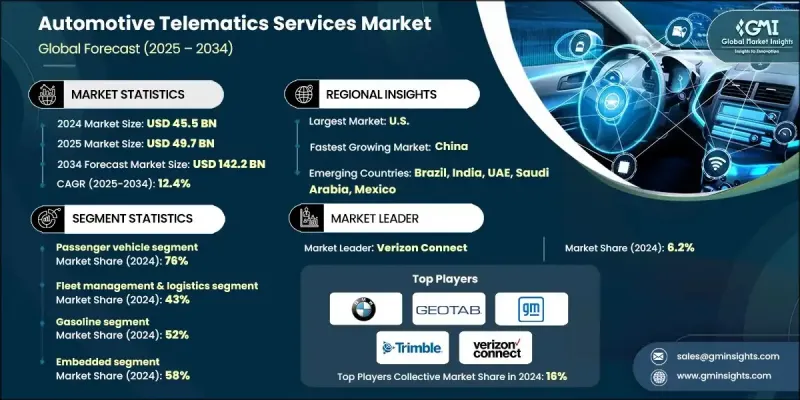
2024 年全球汽車遠端資訊處理服務市場價值為 455 億美元,預計到 2034 年將以 12.4% 的複合年成長率成長至 1,422 億美元。
隨著商業車隊、出行營運商和運輸服務提供商擴大依賴遠端資訊處理技術來減少停機時間、最佳化路線、管理維護和控制燃油支出,遠端資訊處理技術的應用正在加速發展。先進的診斷、預測性故障檢測、自動服務警報和行為洞察等功能日益廣泛地用於提升營運效率和實現強勁的投資回報,從而增強了對定期服務訂閱的需求。汽車製造商正在將遠端資訊處理功能嵌入到新的車輛平台中,以滿足法規、遠端監控需求和空中升級帶來的安全、合規和互聯要求。隨著越來越多的車輛在出廠時就配備了遠端資訊處理技術,基於訂閱的服務正在迅速擴張。保險公司也高度依賴遠端資訊處理資料來支援基於使用量的保險模式,對風險模式、里程和駕駛行為的即時洞察,為連網設備和資料平台創造了穩定的需求。隨著商業客戶和個人投保人轉向基於行為的保險,遠端資訊處理生態系統持續擴展,並鞏固其長期收入基礎。
| 市場範圍 | |
|---|---|
| 起始年份 | 2024 |
| 預測年份 | 2025-2034 |
| 起始值 | 455億美元 |
| 預測值 | 1422億美元 |
| 複合年成長率 | 12.4% |
2024年,乘用車市佔率達到76%,預計到2034年將以12.7%的複合年成長率成長。由車載資訊服務支援的嵌入式安全功能,包括碰撞警報、緊急回應通訊、防盜追蹤和持續監控,已成為消費者購車的關鍵促進因素。汽車製造商正在將互聯系統標準化應用於各種乘用車車型,以滿足監管要求並增強用戶信心。
2024年,車隊管理和物流領域佔據43%的市場佔有率,預計2025年至2034年間將以12%的複合年成長率成長。不斷上漲的燃油成本和日益增加的營運費用正促使物流業者採用遠端資訊處理工具,以追蹤燃油效率、測量怠速時間並最佳化路線。數據驅動的洞察能夠幫助車隊降低營運成本、提高利用率並提升生產力,從而使遠端資訊處理成為競爭激烈的運輸營運中的關鍵技術。
美國汽車遠端資訊處理服務市場佔據86%的市場佔有率,預計到2024年將創造155億美元的收入。由於安全系統、排放監管、電子日誌記錄和車輛診斷等方面的監管要求,該技術的應用正在快速發展。聯邦和州政府的合規壓力持續推動全國各地的製造商和車隊營運商部署先進的互聯平台。
全球汽車遠端資訊處理服務市場的主要公司包括寶馬、通用汽車、博世、大陸集團、Geotab、Verizon Connect、Ituran、採埃孚、Trimble 和 Samsara。這些公司正透過擴展雲端平台、改進人工智慧驅動的分析以及為車隊和消費者建立統一的儀表板來鞏固其競爭地位。他們還與汽車製造商、保險公司和旅遊服務提供者建立策略合作夥伴關係,將資料豐富的遠端資訊處理功能整合到更廣泛的生態系統中。網路安全、預測性維護能力和即時監控工具的投資,為終端用戶提供了更強大的價值主張。各公司正在擴展訂閱模式、增強空中下載更新系統,並開發適用於不同車型細分市場的模組化遠端資訊處理單元。這些策略有助於公司增加經常性收入、提高客戶留存率,並在互聯汽車領域保持長期競爭力。
目錄
第1章:方法論
- 市場範圍和定義
- 研究設計
- 研究方法
- 資料收集方法
- 資料探勘來源
- 全球的
- 地區/國家
- 基準估算和計算
- 基準年計算
- 市場估算的關鍵趨勢
- 初步研究和驗證
- 原始資料
- 預測模型
- 研究假設和局限性
第2章:執行概要
第3章:行業洞察
- 產業生態系分析
- 供應商格局
- 利潤率分析
- 成本結構
- 每個階段的價值增加
- 影響價值鏈的因素
- 中斷
- 產業影響因素
- 成長促進因素
- 互聯汽車和軟體定義汽車的普及率不斷提高
- 擴展基於使用量的保險(UBI)和數據驅動的風險模型
- 商業車隊和物流數位化快速成長
- 4G/5G 連線和雲端平台的進步
- 產業陷阱與挑戰
- 資料隱私、網路安全風險和監管合規性
- 標準碎片化和互通性問題
- 新興市場安裝和訂閱成本高昂
- 農村和偏遠地區的網路可用性不穩定
- 市場機遇
- 電動車和智慧充電生態系統的發展
- 視訊遠端資訊處理和人工智慧驅動的安全分析的擴展
- 出行即服務(MaaS)平台的興起
- 售後遠端資訊處理、改裝和客製化
- 成長促進因素
- 成長潛力分析
- 主要市場趨勢和顛覆性因素
- 未來市場趨勢
- 監管環境
- 波特的分析
- PESTEL 分析
- 技術與創新格局
- 目前技術
- 具有整合連接功能的高階遠端資訊處理控制單元 (TCU)
- 即時車輛追蹤與GPS/GNSS定位系統
- 基於雲端的車隊管理平台
- 支援嵌入式 SIM/eSIM 的車載連接
- 新興技術
- 利用人工智慧進行駕駛員行為和車輛健康預測分析
- 用於低延遲遠端資料處理的邊緣運算
- 支援5G的V2X(車聯網)通訊架構
- 用於車隊最佳化和遠端診斷的數位孿生模型
- 目前技術
- 專利分析
- 生產統計
- 生產中心
- 消費中心
- 進出口
- 價格趨勢
- 按地區
- 透過推進
- 成本細分分析
- 軟體和平台開發成本
- 硬體、整合和處理成本
- 品質控制、測試和合規成本
- 永續性和環境方面
- 永續實踐
- 減少廢棄物策略
- 生產中的能源效率
- 環保舉措
- 碳足跡考量
- 宏觀與微觀經濟分析
- 宏觀經濟分析
- 影響車載資訊系統普及的全球經濟因素
- 產業特定經濟促進因素
- 區域經濟分析
- 貿易政策和關稅的影響
- 微觀經濟分析
- 組件級成本結構
- 軟體及平台成本分析
- 連接和訂閱成本結構
- 安裝和整合成本
- 定價模型和收入結構
- 總擁有成本分析
- 宏觀經濟分析
- 產品生命週期分析
- 技術生命週期階段
- 平均產品生命週期
- 技術更新與升級週期
- 生命末期管理
第4章:競爭格局
- 介紹
- 公司市佔率分析
- 主要市場參與者的競爭分析
- 競爭定位矩陣
- 戰略展望矩陣
- 關鍵進展
- 併購
- 合作夥伴關係與合作
- 新產品發布
- 擴張計劃和資金
第5章:市場估算與預測:依服務類型分類,2021-2034年
- 主要趨勢
- 車隊管理與物流
- 按使用量計費的保險
- 車輛追蹤與監控
- 遠端診斷和維護
- 安全與應急
- 資訊娛樂和導航
- 其他
第6章:市場估算與預測:以推進方式分類,2021-2034年
- 汽油
- 柴油引擎
- 純電動車
- 插電式混合動力汽車
- 戊型肝炎病毒
第7章:市場估計與預測:依技術分類,2021-2034年
- 主要趨勢
- 車輛互聯系統
- 車載診斷
- 車載電子記錄儀
- 合作資訊科技服務
- 基於智慧型手機的遠端資訊處理
- 其他
第8章:市場估算與預測:以連結方式分類,2021-2034年
- 主要趨勢
- 嵌入式
- 融合的
- 繫繩
第9章:市場估價與預測:依車輛類型分類,2021-2034年
- 主要趨勢
- 搭乘用車
- 掀背車
- 轎車
- SUV
- 商用車輛
- 輕型
- 中型
- 重負
第10章:市場估計與預測:依地區分類,2021-2034年
- 主要趨勢
- 北美洲
- 美國
- 加拿大
- 歐洲
- 英國
- 德國
- 法國
- 義大利
- 西班牙
- 俄羅斯
- 北歐
- 亞太地區
- 中國
- 印度
- 日本
- 韓國
- 澳新銀行
- 新加坡
- 東南亞
- 拉丁美洲
- 巴西
- 墨西哥
- 阿根廷
- MEA
- 南非
- 沙烏地阿拉伯
- 阿拉伯聯合大公國
第11章:公司簡介
- 全球參與者
- CalAmp
- Geotab
- Masternaut
- Microlise
- Omnitracs
- Spireon
- Teletrac Navman
- Trimble
- Verizon Connect
- Webfleet Solutions
- BMW
- Bosch
- Continental
- GM
- Ituran
- ZF
- 區域玩家
- Azuga
- Cartrack
- Ctrack
- MiX Telematics
- Octo Telematics
- Platform Science
- Quartix Technologies
- Trakm8
- 新興參與者
- Bouncie
- Fleetio
- Lytx
- Mojio
- Motive
- Nauto
- Netradyne
- Samsara
- SmartDrive Systems
- Zubie
The Global Automotive Telematics Services Market was valued at USD 45.5 billion in 2024 and is estimated to grow at a CAGR of 12.4% to reach USD 142.2 billion by 2034.
Adoption continues to accelerate as commercial fleets, mobility operators, and transportation providers rely on telematics to reduce downtime, optimize routes, manage maintenance, and control fuel spending. Advanced diagnostics, predictive fault detection, automated service alerts, and behavioral insights are increasingly used to boost operational efficiency and unlock strong returns on investment, which strengthens demand for recurring service subscriptions. Automakers are embedding telematics capabilities into new vehicle platforms to meet safety, compliance, and connectivity requirements driven by regulations, remote monitoring needs, and over-the-air updates. With more vehicles equipped at the factory, subscription-based services are expanding rapidly. Insurers are also relying heavily on telematics data to support usage-based insurance models, with real-time insights on risk patterns, mileage, and driving behavior creating steady demand for connected devices and data platforms. As both commercial clients and individual policyholders shift to behavior-driven coverage, the telematics ecosystem continues to expand and reinforce its long-term revenue base.
| Market Scope | |
|---|---|
| Start Year | 2024 |
| Forecast Year | 2025-2034 |
| Start Value | $45.5 Billion |
| Forecast Value | $142.2 Billion |
| CAGR | 12.4% |
The passenger vehicle segment held a 76% share in 2024 and is forecast to grow at a CAGR of 12.7% through 2034. Embedded safety features supported by telematics, including crash alerts, emergency response communication, theft tracking, and continuous monitoring, have become key purchase incentives for consumers. Automakers are standardizing connected systems across a wide range of passenger models as part of broader efforts to meet regulatory expectations and enhance user confidence.
The fleet management and logistics segment held a 43% share in 2024 and is projected to grow at a CAGR of 12% between 2025 and 2034. Rising fuel expenses and higher operational overheads are pushing logistics operators to adopt telematics tools that track fuel efficiency, measure idle durations, and optimize routing. Data-driven insights enable fleets to lower operating costs, streamline utilization, and improve productivity, establishing telematics as a critical technology within competitive transportation operations.
US Automotive Telematics Services Market held an 86% share and generated USD 15.5 billion in 2024. Adoption is advancing quickly due to regulatory requirements related to safety systems, emissions oversight, electronic logging, and vehicle diagnostics. Federal and state compliance pressures continue to accelerate the rollout of advanced connected platforms among manufacturers and fleet operators across the country.
Major companies in the Global Automotive Telematics Services Market include BMW, GM, Bosch, Continental, Geotab, Verizon Connect, Ituran, ZF, Trimble, and Samsara. Companies in the Automotive Telematics Services Market are strengthening their competitive positions by expanding cloud-based platforms, improving AI-driven analytics, and building unified dashboards for fleets and consumers. They are also forming strategic partnerships with automakers, insurers, and mobility service providers to integrate data-rich telematics functions into broader ecosystems. Investments in cybersecurity, predictive maintenance capabilities, and real-time monitoring tools support stronger value propositions for end users. Firms are scaling subscription models, enhancing over-the-air update systems, and developing modular telematics units that fit diverse vehicle segments. These strategies help companies boost recurring revenue streams, improve customer retention, and maintain long-term relevance in the connected vehicle landscape.
Table of Contents
Chapter 1 Methodology
- 1.1 Market scope and definition
- 1.2 Research design
- 1.2.1 Research approach
- 1.2.2 Data collection methods
- 1.3 Data mining sources
- 1.3.1 Global
- 1.3.2 Regional/Country
- 1.4 Base estimates and calculations
- 1.4.1 Base year calculation
- 1.4.2 Key trends for market estimation
- 1.5 Primary research and validation
- 1.5.1 Primary sources
- 1.6 Forecast model
- 1.7 Research assumptions and limitations
Chapter 2 Executive Summary
- 2.1 Industry 360° synopsis, 2021 - 2034
- 2.2 Key market trends
- 2.2.1 Regional
- 2.2.2 Service
- 2.2.3 Propulsion
- 2.2.4 Technology
- 2.2.5 Connectivity
- 2.2.6 Vehicle
- 2.3 TAM Analysis, 2025-2034
- 2.4 CXO perspectives: Strategic imperatives
- 2.4.1 Executive decision points
- 2.4.2 Critical success factors
- 2.5 Future outlook
- 2.6 Strategic recommendations
Chapter 3 Industry Insights
- 3.1 Industry ecosystem analysis
- 3.1.1 Supplier landscape
- 3.1.2 Profit margin analysis
- 3.1.3 Cost structure
- 3.1.4 Value addition at each stage
- 3.1.5 Factor affecting the value chain
- 3.1.6 Disruptions
- 3.2 Industry impact forces
- 3.2.1 Growth drivers
- 3.2.1.1 Rising adoption of connected and software-defined vehicles
- 3.2.1.2 Expansion of usage-based insurance (UBI) and data-driven risk models
- 3.2.1.3 Rapid growth of commercial fleets and logistics digitization
- 3.2.1.4 Advancements in 4G/5G connectivity and cloud platforms
- 3.2.2 Industry pitfalls and challenges
- 3.2.2.1 Data privacy, cybersecurity risks & regulatory compliance
- 3.2.2.2 Fragmented standards & interoperability issues
- 3.2.2.3 High installation and subscription costs in emerging markets
- 3.2.2.4 Inconsistent network availability in rural and remote areas
- 3.2.3 Market opportunities
- 3.2.3.1 Growth of electric vehicles and smart charging ecosystems
- 3.2.3.2 Expansion of video telematics and AI-driven safety analytics
- 3.2.3.3 Emergence of mobility-as-a-service (MaaS) platforms
- 3.2.3.4 Aftermarket telematics, retrofits & customization
- 3.2.1 Growth drivers
- 3.3 Growth potential analysis
- 3.4 Major market trends and disruptions
- 3.5 Future market trends
- 3.6 Regulatory landscape
- 3.6.1 North America
- 3.6.2 Europe
- 3.6.3 Asia Pacific
- 3.6.4 Latin America
- 3.6.5 MEA
- 3.7 Porter's analysis
- 3.8 PESTEL analysis
- 3.9 Technology and innovation landscape
- 3.9.1 Current Technologies
- 3.9.1.1 Advanced telematics control units (TCUs) with integrated connectivity
- 3.9.1.2 Real-time vehicle tracking & GPS/GNSS positioning systems
- 3.9.1.3 Cloud-based fleet management platforms
- 3.9.1.4 Embedded SIM/eSIM-enabled in-vehicle connectivity
- 3.9.2 Emerging Technologies
- 3.9.2.1 AI-powered predictive analytics for driver behavior & vehicle health
- 3.9.2.2 Edge computing for low-latency telematics data processing
- 3.9.2.3 5G-enabled V2X (Vehicle-to-Everything) communication architectures
- 3.9.2.4 Digital twin models for fleet optimization & remote diagnostics
- 3.9.1 Current Technologies
- 3.10 Patent analysis
- 3.11 Production statistics
- 3.11.1 Production hubs
- 3.11.2 Consumption hubs
- 3.11.3 Export and import
- 3.12 Price trends
- 3.12.1 By region
- 3.12.2 By propulsion
- 3.13 Cost breakdown analysis
- 3.13.1 Software & platform development costs
- 3.13.2 Hardware, integration & processing costs
- 3.13.3 Quality control, testing & compliance costs
- 3.14 Sustainability and environmental aspects
- 3.14.1 Sustainable practices
- 3.14.2 Waste reduction strategies
- 3.14.3 Energy efficiency in production
- 3.14.4 Eco-friendly initiatives
- 3.14.5 Carbon footprint considerations
- 3.15 Macro & micro economic analysis
- 3.15.1 Macro-economic analysis
- 3.15.1.1 Global economic factors impacting telematics adoption
- 3.15.1.2 Industry-specific economic drivers
- 3.15.1.3 Regional economic analysis
- 3.15.1.4 Trade policy & tariff impact
- 3.15.2 Micro-economic analysis
- 3.15.2.1 Component-level cost structure
- 3.15.2.2 Software & platform cost analysis
- 3.15.2.3 Connectivity & subscription cost structure
- 3.15.2.4 Installation & integration costs
- 3.15.2.5 Pricing models & revenue structures
- 3.15.2.6 Total cost of ownership analysis
- 3.15.1 Macro-economic analysis
- 3.16 Product lifecycle analysis
- 3.16.1 Technology lifecycle stages
- 3.16.2 Average product lifecycle duration
- 3.16.3 Technology refresh & upgrade cycles
- 3.16.4 End-of-life management
Chapter 4 Competitive Landscape, 2024
- 4.1 Introduction
- 4.2 Company market share analysis
- 4.2.1 North America
- 4.2.2 Europe
- 4.2.3 Asia Pacific
- 4.2.4 Latin America
- 4.2.5 MEA
- 4.3 Competitive analysis of major market players
- 4.4 Competitive positioning matrix
- 4.5 Strategic outlook matrix
- 4.6 Key developments
- 4.6.1 Mergers & acquisitions
- 4.6.2 Partnerships & collaborations
- 4.6.3 New product launches
- 4.6.4 Expansion plans and funding
Chapter 5 Market Estimates & Forecast, By Service, 2021 - 2034 ($Bn, Fleet Size)
- 5.1 Key trends
- 5.2 Fleet management & logistics
- 5.3 Usage-based insurance
- 5.4 Vehicle tracking & monitoring
- 5.5 Remote diagnostics & maintenance
- 5.6 Safety & emergency
- 5.7 Infotainment & navigation
- 5.8 Others
Chapter 6 Market Estimates & Forecast, By Propulsion, 2021 - 2034 ($Bn, Fleet Size)
- 6.1 Gasoline
- 6.2 Diesel
- 6.3 BEV
- 6.4 PHEV
- 6.5 HEV
Chapter 7 Market Estimates & Forecast, By Technology, 2021 - 2034 ($Bn, Fleet Size)
- 7.1 Key trends
- 7.2 Vehicle connectivity systems
- 7.3 On-board diagnostics
- 7.4 Electronic onboard recorders
- 7.5 Cooperative ITS
- 7.6 Smartphone-based telematics
- 7.7 Others
Chapter 8 Market Estimates & Forecast, By Connectivity, 2021 - 2034 ($Bn, Fleet Size)
- 8.1 Key trends
- 8.2 Embedded
- 8.3 Integrated
- 8.4 Tethered
Chapter 9 Market Estimates & Forecast, By Vehicle, 2021 - 2034 ($Bn, Fleet Size)
- 9.1 Key trends
- 9.2 Passenger cars
- 9.2.1 Hatchback
- 9.2.2 Sedan
- 9.2.3 SUV
- 9.3 Commercial vehicles
- 9.3.1 Light duty
- 9.3.2 Medium duty
- 9.3.3 Heavy duty
Chapter 10 Market Estimates & Forecast, By Region, 2021-2034 ($Bn, Fleet Size)
- 10.1 Key trends
- 10.2 North America
- 10.2.1 US
- 10.2.2 Canada
- 10.3 Europe
- 10.3.1 UK
- 10.3.2 Germany
- 10.3.3 France
- 10.3.4 Italy
- 10.3.5 Spain
- 10.3.6 Russia
- 10.3.7 Nordics
- 10.4 Asia Pacific
- 10.4.1 China
- 10.4.2 India
- 10.4.3 Japan
- 10.4.4 South Korea
- 10.4.5 ANZ
- 10.4.6 Singapore
- 10.4.7 Southeast Asia
- 10.5 Latin America
- 10.5.1 Brazil
- 10.5.2 Mexico
- 10.5.3 Argentina
- 10.6 MEA
- 10.6.1 South Africa
- 10.6.2 Saudi Arabia
- 10.6.3 UAE
Chapter 11 Company Profiles
- 11.1 Global players
- 11.1.1 CalAmp
- 11.1.2 Geotab
- 11.1.3 Masternaut
- 11.1.4 Microlise
- 11.1.5 Omnitracs
- 11.1.6 Spireon
- 11.1.7 Teletrac Navman
- 11.1.8 Trimble
- 11.1.9 Verizon Connect
- 11.1.10 Webfleet Solutions
- 11.1.11 BMW
- 11.1.12 Bosch
- 11.1.13 Continental
- 11.1.14 GM
- 11.1.15 Ituran
- 11.1.16 ZF
- 11.2 Regional players
- 11.2.1 Azuga
- 11.2.2 Cartrack
- 11.2.3 Ctrack
- 11.2.4 MiX Telematics
- 11.2.5 Octo Telematics
- 11.2.6 Platform Science
- 11.2.7 Quartix Technologies
- 11.2.8 Trakm8
- 11.3 Emerging Players
- 11.3.1 Bouncie
- 11.3.2 Fleetio
- 11.3.3 Lytx
- 11.3.4 Mojio
- 11.3.5 Motive
- 11.3.6 Nauto
- 11.3.7 Netradyne
- 11.3.8 Samsara
- 11.3.9 SmartDrive Systems
- 11.3.10 Zubie

 2026年全球拖車租賃遠端資訊處理市場報告
 車用通訊系統市場:按組件、連接方式、車輛類型、應用和最終用戶分類-2026-2032年全球市場預測車載資訊服務與汽車電子市場:2026-2032年全球市場預測(按組件類型、連接方式、車輛類型、安裝配置和應用分類)
 2026-2030年全球汽車診斷遠端資訊處理市場
 全球及中國乘用車T型盒市場(2026年)車載資訊服務市場:2026-2032年全球市場預測(依解決方案類型、連線類型、車輛類型、部署模式、應用程式和最終用戶分類)2026年全球消費者遠端資訊處理市場報告2026年全球車用通訊系統市場報告車隊遠端資訊處理系統市場:按部署類型、通訊技術、組件類型、車輛類型、應用和最終用戶產業分類-2026-2032年全球市場預測
 車用通訊系統市場規模、佔有率、成長及全球產業分析:按類型、應用和地區分類的洞察,2026-2034 年預測