


 |
市場調查報告書
商品編碼
2163614
亞太地區建築檢驗服務:市場佔有率分析、產業趨勢與統計及成長預測(2026-2031)Asia Pacific Building Inspection Services - Market Share Analysis, Industry Trends & Statistics, Growth Forecasts (2026 - 2031) |
||||||

※ 本網頁內容可能與最新版本有所差異。詳細情況請與我們聯繫。
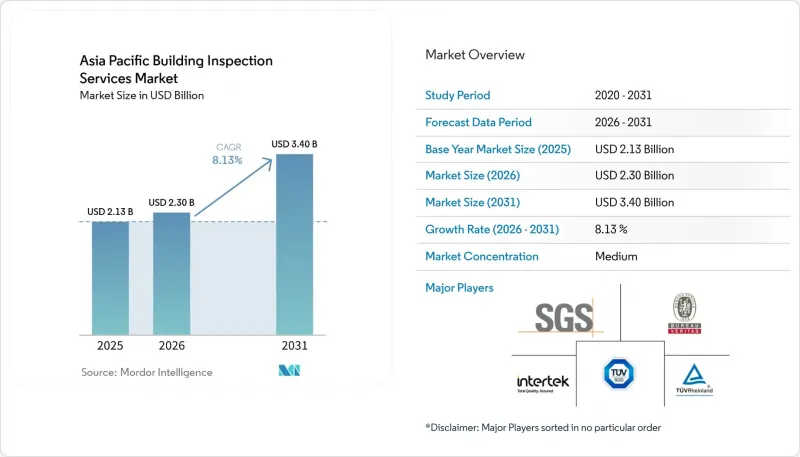
根據 Mordor Intelligence 預測,亞太地區建築檢查服務市場規模預計將在 2025 年達到 21.3 億美元,2026 年達到 23 億美元,到 2031 年達到 34 億美元,2026 年至 2031 年的複合年成長率為 8.13%。
亞太地區建築檢驗服務市場趨勢及洞察。
都市化和新建工程
新建專案和城市改造專案導致需要進行交付前、保固期和入住後評估的資產數量不斷增加。因此,亞太地區的建築檢驗服務市場受益於現有物業(包括住宅、商業和公共建築)的擴張。根據聯合國亞洲及太平洋經濟社會委員會(亞太經社會)的預測,該地區目前已超過22億的城市人口預計到2050年將增加50%。農村地區建築密度的增加可能會導致合格檢驗員的供應與資產數量相比出現緊張。雖然遠端檢驗工具使企業能夠為偏遠地區和農村城市提供服務,但現場檢驗對於許多受監管的任務仍然至關重要。在此背景下,擁有遍佈多地認證團隊的外包專家發揮著至關重要的作用。
智慧城市與綠建築計劃
綠色認證和智慧城市投資正在擴大檢驗建築性能和合規性所需的檢查工作量。世界綠色建築委員會 (WGBC) 的一份報告顯示,亞太地區的綠色建築可獲得高達 11% 的租金溢價,並實現 20% 至 60% 的節能效果。這些經濟效益促使業主透過定期檢查來維持認證,而不是將其視為一次性措施。新加坡的綠建築標誌 (Green Mark)、澳洲的綠建築之星 v1.1 和印度的 GRIHA 框架都要求基於既定標準進行書面評估。聯合國開發計畫署 (UNDP) 預測,到 2025 年,亞太地區將佔全球智慧城市投資的 40%,這凸顯了製定適用於互聯建築系統的協議的必要性。在高層建築和大型專案中,數位化缺陷記錄有助於在涉及多個承包商和公共實體時明確責任。
熟練檢驗員供需不平衡
合格檢查員數量有限,即使在需求旺盛的地區,服務提供也會受到限制。澳洲就業與技能局在其2025年人才短缺清單中,將「建築檢查員」列為澳洲所有州和領地的短缺人員。新南威爾斯州政府已承諾在2025年前投入920萬澳元,以加快建築認證和許可流程。住宅和小規模商業建築項目尤其面臨嚴重的短缺問題,因為這些項目薪資水平較低,難以吸引高素質負責人。服務提供者正透過培訓、跨區域合作和無人機勘測等方式來解決這個問題,但僅靠技術無法完全取代現場判斷。因此,大城市和發展中地區之間的服務品質可能存在差異。
細分市場分析
至2025年,商業建築檢驗服務將佔亞太地區建築檢驗服務市場43.2%的佔有率。這主要得益於辦公大樓、物流設施、零售設施、工業用地和綜合用途物業複雜的合規性和責任要求。商業客戶通常需要消防安全、能源性能、外觀狀況和機械設備等方面的檢驗結果文件,而住宅檢驗服務和特定構件檢驗服務的需求仍然穩定。隨著人們對綠色認證和資訊揭露的期望日益提高,重點市場對更頻繁、更詳細的評估的需求也日益成長。此外,商業項目通常資產規模大、營運意義重大,因此每個項目的合約金額也更高。
其他專業服務預計將在2026年至2031年間以10.4%的複合年成長率成長,包括能源審計、室內空氣品質檢測、專業外牆檢測、石棉勘測、聲學評估和綠色認證檢驗。客戶越來越傾向於將這些任務外包給擁有特定認證或技術能力的供應商,而不是購買單一的綜合服務。日本ERI檢測中心於2025年7月由ERI Solution和台東建築設備檢測中心合併而成,根據日本建築規範提供無人機外牆檢測、石棉勘測和3D雷射掃描服務。這種轉變為專業服務商創造了機遇,同時也降低了與業務廣泛的綜合服務商簽訂合約的確定性。同時,資料中心和半導體設施也需要結構、機械、電氣、管道、試運行和熱成像等方面的檢測服務。
至2025年,外包服務將佔亞太地區建築檢測服務市場規模的58.1%。這一細分市場的領先地位源於業主在組織內部維持合格人員、專業設備以及掌握最新當地法規方面所面臨的挑戰。對綠色認證、抗震合規性、缺陷記錄和數位化文件等方面的更詳細要求,有利於能夠將有限技能分散到廣泛基本客群的外部供應商。大規模國有企業和公共機構在技術人才儲備充足的領域仍保留內部團隊。
此外,外包服務是成長最快的採購管道,預計到2031年複合年成長率將達到9.3%。綜上所述,這些因素表明,企業內部能力建構未能跟上檢驗工作範圍變化的步伐。中國的品質保證舉措將第三方檢驗與財產保險掛鉤,蘇州工業園區的一個試點項目表明,檢驗記錄的價值不僅限於合規性,還可以透過可交易的碳資產體現出來。在中國和韓國,企業內部團隊仍扮演著至關重要的角色。然而,日益成長的認證需求和技術投資為亞太地區的建築檢驗服務業建構符合當地法規的外包系統提供了強力的動力。
其他好處:
- Excel格式的市場預測(ME)表
- 3個月的分析師支持
目錄
第1章:引言
- 研究假設和市場定義
- 調查範圍
第2章:調查方法
第3章執行摘要
第4章 市場狀況
- 市場概覽
- 市場促進因素
- 都市化和新建工程
- 智慧城市與綠建築計劃
- 加強對交付和缺陷責任的要求。
- 基礎設施現代化和應對氣候變遷的能力
- 在偏遠地區和交通不便的地區進行遠端測試。
- 用於高層建築和大型企劃管治的數位化缺陷記錄
- 市場限制因素
- 熟練的檢驗人員數量不穩定。
- 法規的執行情況因國家和城市而異。
- 數位檢測系統互通性的局限性
- 小規模承包商在技術採用上所存在的差異
- 價值和供應鏈分析
- 監管情勢與政府應對措施
- 技術展望
- 經濟和市場展望
- 主要行業趨勢
- 波特五力分析
第5章:亞太地區建築檢測服務市場、市場規模及成長預測
- 按服務
- 住宅檢查服務
- 特定元素檢測服務
- 商業建築檢查服務
- 其他專業服務
- 透過採購方式
- 內部服務
- 外包服務
- 透過使用
- 住宅
- 商業的
- 其他用途
- 最終用戶
- 房地產公司和仲介業者
- 房地產所有者和投資者
- 政府和地方當局
- 保險和金融機構
- 設施管理公司
- 國家
- 中國
- 印度
- 日本
- 韓國
- 澳洲
- 印尼
- 其他亞太國家
第6章 競爭情勢
- 市場集中度
- 策略趨勢
- 公司簡介
- SGS Group
- Bureau Veritas
- Intertek Group plc
- TUV SUD AG
- TUV Rheinland AG
- DEKRA SE
- DNV Group AS
- UL Solutions Inc.
- Applus+
- Eurofins Scientific SE
- NV5 Global
- Kiwa Group
- Quality Built
- Criterium Engineers
- Houspect
- Resicert
- HomeTeam Inspection Service
- InterNACHI
- Pro Inspect Solution(M)Sdn Bhd
- Cornerstone Premier Building Inspection Services LLC
第7章 市場機會與未來展望
According to Mordor Intelligence, the Asia Pacific building inspection services market size is projected to be USD 2.13 billion in 2025, USD 2.30 billion in 2026, and reach USD 3.40 billion by 2031, growing at a CAGR of 8.13% from 2026 to 2031.
Asia Pacific Building Inspection Services Market Trends and Insights
Urbanization and New-Build Construction
New construction and urban renewal are increasing the number of assets that need assessment before handover, during defect-liability periods, and after occupancy. The Asia Pacific building inspection services market, therefore, benefits from a larger installed base of residential, commercial, and public buildings. The United Nations Economic and Social Commission for Asia and the Pacific projects that the region's urban population, already above 2.2 billion, will increase by 50% by 2050. Greater building density in secondary cities can tighten the availability of qualified inspectors relative to the number of assets. Remote inspection tools can help providers reach difficult terrain and lower-tier cities, although physical verification remains important for many regulated tasks. This setting supports outsourced specialists who can mobilize certified teams across multiple locations.
Smart-City and Green-Building Programs
Green certification and smart-city investment are expanding the inspection work needed to verify building performance and compliance. The World Green Building Council reported that green buildings in the Asia Pacific can command rental premiums of up to 11% and can deliver energy savings of 20% to 60%. These economic benefits give owners a reason to maintain certification through periodic checks rather than treat it as a one-time exercise. Singapore's Green Mark, Australia's Green Star Buildings v1.1, and India's GRIHA framework create a need for documented assessment against stated criteria. The United Nations Development Program noted that the Asia Pacific was expected to receive 40% of global smart-city investment by 2025, increasing the need for protocols suited to connected building systems. Digital defect records for high-rise and large projects can improve accountability where several contractors and public agencies are involved.
Uneven Availability of Skilled Inspectors
A limited supply of qualified inspectors can restrict service capacity even where demand is rising. Jobs and Skills Australia listed Building Inspector as a shortage occupation across every Australian state and territory in its 2025 list. The New South Wales Government committed AUD 9.2 million in 2025 to accelerate building certification and trades licensing approvals. Shortages are especially difficult in residential and small-commercial work, where fee levels may not attract highly credentialed personnel. Providers may respond through training, geographic partnerships, and drone-supported surveys, but technology cannot replace every on-site judgment. The result can be uneven service quality between large cities and less-developed locations.
Other drivers and restraints analyzed in the detailed report include:
- Stronger Handover and Defect-Liability Requirements
- Infrastructure Modernization and Climate Resilience
- Inconsistent Code Enforcement Across Countries and Cities
For complete list of drivers and restraints, kindly check the Table Of Contents.
Segment Analysis
Commercial Building Inspection Services held 43.2% of the Asia Pacific building inspection services market share in 2025, supported by complex compliance and liability requirements for offices, logistics facilities, retail properties, industrial sites, and mixed-use assets. Commercial clients often need documented fire safety, energy performance, facade condition, and mechanical-system checks, while Home Inspection Services and Specific Element Inspection Services continue to serve stable demand pools. Green certification and disclosure expectations reinforce the need for more frequent and detailed assessments in major markets. Commercial work also has high value per engagement because the assets are often large and operationally important.
Other Specialized Services are forecast to grow at a 10.4% CAGR from 2026 to 2031 and include energy audits, indoor air-quality testing, facade-specific inspections, asbestos surveys, acoustic assessment, and green-certification verification. Clients are increasingly awarding these assignments to providers with narrow certifications or technical capabilities rather than buying a single general service. Japan's ERI Inspection Center was formed in July 2025 through the integration of ERISolution and Taito Building and Equipment Inspection Center, offering drone-based exterior-wall surveys, asbestos surveys, and 3D laser scanning under Japan's building standards framework. This shift creates opportunities for specialists and reduces the certainty of broad generalist contracts. At the same time, data-center and semiconductor facilities also require structural, mechanical, electrical, plumbing, commissioning, and thermal-imaging checks.
Outsourced Services accounted for 58.1% of the Asia Pacific building inspection services market size in 2025. The segment's lead reflects the challenge of maintaining certified staff, specialized equipment, and current local-code expertise within a property owner's organization. More detailed requirements for green certification, seismic compliance, defect records, and digital documentation favor external providers that can spread scarce skills across a larger client base. Large state-owned enterprises and public agencies still retain internal teams where they have established technical workforces.
Outsourced Services is also the fastest-growing sourcing channel, with a forecast of 9.3% CAGR through 2031. This combination shows that internal capability building is not keeping pace with the changing scope of inspection work. China's quality-insurance initiatives link third-party inspection to property cover, while the Suzhou Industrial Park pilot indicates that inspection records may have value beyond compliance through tradable carbon assets. In-house teams remain relevant in China and South Korea. Still, rising accreditation and technology-investment needs give the Asia Pacific building inspection services industry a strong incentive to build locally compliant outsourced capacity.
Complete Report Scope:
- By Service
- Home Inspection Services
- Specific Element Inspection Services
- Commercial Building Inspection Services
- Other Specialised Services
- By Sourcing Type
- In-House Services
- Outsourced Services
- By Application
- Residential
- Commercial
- Other Applications
- By End User
- Real-Estate Agencies and Brokers
- Property Owners and Investors
- Government and Municipalities
- Insurance and Financial Institutions
- Facility-Management Firms
- By Countries
- China
- India
- Japan
- South Korea
- Australia
- Indonesia
- Rest of Asia-Pacific
List of Companies Covered in this Report:
- SGS Group
- Bureau Veritas
- Intertek Group plc
- TUV SUD AG
- TUV Rheinland AG
- DEKRA SE
- DNV Group AS
- UL Solutions Inc.
- Applus+
- Eurofins Scientific SE
- NV5 Global
- Kiwa Group
- Quality Built
- Criterium Engineers
- Houspect
- Resicert
- HomeTeam Inspection Service
- InterNACHI
- Pro Inspect Solution (M) Sdn Bhd
- Cornerstone Premier Building Inspection Services LLC
Additional Benefits:
- The market estimate (ME) sheet in Excel format
- 3 months of analyst support
TABLE OF CONTENTS
1 Introduction
- 1.1 Study Assumptions and Market Definition
- 1.2 Scope of the Study
2 Research Methodology
3 Executive Summary
4 Market Landscape
- 4.1 Market Overview
- 4.2 Market Drivers
- 4.2.1 Urbanisation and New-Build Construction
- 4.2.2 Smart-City and Green-Building Programmes
- 4.2.3 Stronger Handover and Defect-Liability Requirements
- 4.2.4 Infrastructure Modernisation and Climate Resilience
- 4.2.5 Remote Inspection for Secondary Cities and Difficult Terrain
- 4.2.6 Digital Defect Records for High-Rise and Megaproject Governance
- 4.3 Market Restraints
- 4.3.1 Uneven Availability of Skilled Inspectors
- 4.3.2 Inconsistent Code Enforcement Across Countries and Cities
- 4.3.3 Limited Interoperability of Digital Inspection Systems
- 4.3.4 Technology-Adoption Gaps Among Smaller Contractors
- 4.4 Value and Supply-Chain Analysis
- 4.5 Regulatory Landscape and Government Initiatives
- 4.6 Technological Outlook
- 4.7 Economic and Market Scenario
- 4.8 Key Industry Trends
- 4.9 Porter's Five Forces Analysis
- 4.9.1 Threat of New Entrants
- 4.9.2 Bargaining Power of Suppliers
- 4.9.3 Bargaining Power of Buyers
- 4.9.4 Threat of Substitutes
- 4.9.5 Competitive Rivalry
5 Asia Pacific Building Inspection Services Market, Market Size & Growth Forecasts (Value In USD)
- 5.1 By Service
- 5.1.1 Home Inspection Services
- 5.1.2 Specific Element Inspection Services
- 5.1.3 Commercial Building Inspection Services
- 5.1.4 Other Specialised Services
- 5.2 By Sourcing Type
- 5.2.1 In-House Services
- 5.2.2 Outsourced Services
- 5.3 By Application
- 5.3.1 Residential
- 5.3.2 Commercial
- 5.3.3 Other Applications
- 5.4 By End User
- 5.4.1 Real-Estate Agencies and Brokers
- 5.4.2 Property Owners and Investors
- 5.4.3 Government and Municipalities
- 5.4.4 Insurance and Financial Institutions
- 5.4.5 Facility-Management Firms
- 5.5 By Countries
- 5.5.1 China
- 5.5.2 India
- 5.5.3 Japan
- 5.5.4 South Korea
- 5.5.5 Australia
- 5.5.6 Indonesia
- 5.5.7 Rest of Asia-Pacific
6 Competitive Landscape
- 6.1 Market Concentration
- 6.2 Strategic Moves
- 6.3 Company Profiles (includes Global Level Overview, Market Level Overview, Core Segments, Financials as available, Strategic Information, Market Rank/Share, Products and Services, Recent Developments)
- 6.3.1 SGS Group
- 6.3.2 Bureau Veritas
- 6.3.3 Intertek Group plc
- 6.3.4 TUV SUD AG
- 6.3.5 TUV Rheinland AG
- 6.3.6 DEKRA SE
- 6.3.7 DNV Group AS
- 6.3.8 UL Solutions Inc.
- 6.3.9 Applus+
- 6.3.10 Eurofins Scientific SE
- 6.3.11 NV5 Global
- 6.3.12 Kiwa Group
- 6.3.13 Quality Built
- 6.3.14 Criterium Engineers
- 6.3.15 Houspect
- 6.3.16 Resicert
- 6.3.17 HomeTeam Inspection Service
- 6.3.18 InterNACHI
- 6.3.19 Pro Inspect Solution (M) Sdn Bhd
- 6.3.20 Cornerstone Premier Building Inspection Services LLC
7 Market Opportunities and Future Outlook
- 7.1 White-Space and Unmet-Need Assessment


