


 |
市場調查報告書
商品編碼
2116360
建築檢驗服務:市場佔有率分析、產業趨勢與統計、成長預測(2026-2031)Building Inspection Services - Market Share Analysis, Industry Trends & Statistics, Growth Forecasts (2026 - 2031) |
||||||

※ 本網頁內容可能與最新版本有所差異。詳細情況請與我們聯繫。
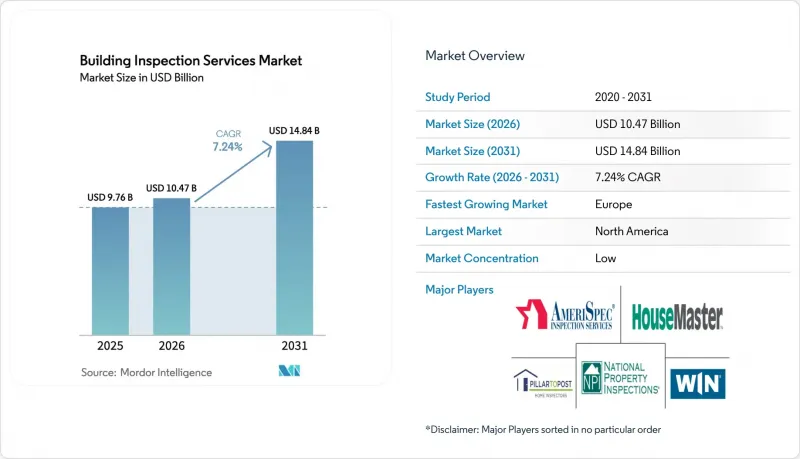
據 Mordor Intelligence 稱,建築檢查服務市場預計到 2026 年價值 104.7 億美元,高於 2025 年的 97.6 億美元,預計到 2031 年將達到 148.4 億美元。
預計從 2026 年到 2031 年,其複合年成長率將達到 7.24%。
本報告按服務類型(例如,住宅檢驗服務、特定構件檢驗服務)、採購方式(內部服務、外包服務)、應用領域(住宅、商業、其他)、最終用戶(例如,房地產公司/仲介業者、業主/投資者)和地區(例如,北美)進行分類。市場預測以美元計價。
全球建築檢驗服務市場趨勢及洞察
更嚴格的建築安全法規和標準
2024版《國際建築規範》引進了新的龍捲風荷載測量標準、更高的抗風基準值,並強制要求普遍採用一氧化碳偵測裝置,這從根本上增加了檢查的複雜性。 2024年,安大略省在其建築規範中取消了1730項差異,簡化了合規流程,同時保持了嚴格的安全檢查。加州SB-721法案強制要求多戶住宅的露台在2025年1月前進行檢查,這為專業人士創造了一個新的細分市場。這些政策提升了第三方檢查證書的價值,並鼓勵從業人員持續進行專業發展。
房地產交易量增加
房屋抵押貸款利率的穩定正在推動住宅市場復甦。美國房地產經紀人協會(NAR)預測,2025年美國住宅銷售額將成長9%。在加拿大,儘管放鬆了壓力測試規定並提高了抵押房屋抵押貸款上限等監管措施,2024年住宅銷售額仍增加了10%。各州立法,例如馬薩諸塞州目前正在審議的一項旨在取消房屋檢查豁免的法案,正在推動強制性檢查的監管進程。資料中心和可再生能源資產的商業房地產交易進一步推高了對房屋檢查的需求。這種需求的激增給房屋檢查系統帶來了壓力,因為合格的檢查員數量仍然不足,而且在競爭激烈的區域市場中,服務價格呈上漲趨勢。
極度分散的商業環境與價格壓力
成千上萬的自由工作者和當地小型企業競相提供住宅檢查服務,但美國許多主要大都會圈的平均價格卻停滯不前。私募股權基金持續整合細分領域的服務商,旨在透過利用數據驅動的日程安排和交叉銷售協同效應,實現全國範圍的企業發展。儘管收購活動層出不窮,但排名前五的公司在全球整體中所佔佔有率仍遠低於三分之一,常規服務的價格競爭依然激烈。服務商正透過投資高價的專業服務來凸顯自身優勢,例如能源審計、外部安全認證和無人機外部掃描。客戶重視能夠整合現場數據採集、雲端分析和數位化報告交付的端到端平台。
細分市場分析
預計到2025年,住宅檢驗服務將佔建築檢驗服務市場佔有率的44.12%,主要得益於交易量成長帶動的需求復甦。隨著美國許多州取消豁免條款,所有住宅交易現在都必須提供認證報告,這推動了交易量的成長。商業建築檢驗服務也穩定成長,主要得益於資料中心、物流和可再生能源專案將檢驗里程碑與資金籌措計劃掛鉤。 「其他專業服務」建築檢驗服務市場預計將以8.74%的複合年成長率成長,這主要得益於能源審計、無人機勘測和人工智慧驅動的外觀分析。
服務供應商提供熱成像、鼓風機測試和碳排放強度計算等一攬子服務,以符合歐洲零排放法規。加州的甲板安全檢查以及丹佛強制性的 ANSI/ASHRAE/ACCA 211-2018 二級能源審計表明,一些小眾法規也能帶來高利潤的業務。將結構工程師和軟體開發人員結合的公司已經建立了強大的競爭優勢。
到2025年,內部檢驗團隊的收入佔比將達到56.21%,因為大型業主和設施管理人員更傾向於直接監督。然而,隨著建築規範日益複雜和技術的快速發展,預計到2031年,外包建築檢驗服務的市場規模將以8.25%的複合年成長率成長。外部專家將技術成本分攤到不同的基本客群中,使得高解析度雷射雷達和人工智慧平台即使對於中型業主來說也更加經濟實惠。
保險公司和貸款機構越來越傾向於尋求第三方認證,以降低利益衝突的風險。 2024年,合作保險公司(The Co-Operators)收購卡森鄧洛普公司(Carson Dunlop),顯示保險集團正在透過垂直整合來獲取專業技術,以應對每年超過20萬次的檢驗工作。外包也有助於緩解產能失衡和人手不足,使全國各地的服務商能夠將員工重新部署到需求量大的地區。
區域分析
即使到了2025年,北美仍將是最大的區域貢獻者,這得益於嚴格的建築規範、老舊建築的高翻新率以及積極採用新技術的監管機構。除了2024年修訂的國際建築標準(IBC)之外,各州強制要求在新建築中安裝太陽能和電池儲能系統的法令,例如加州的第24號修正案,正在擴大檢查範圍。美國能源局對零排放建築的正式定義制定了統一的指南,檢查公司必須在頒發入住許可證之前檢驗。檢查能力的限制,例如奧勒岡州州檢查員短缺的情況,使得運轉率居高不下,從而支撐了價格。
歐洲是成長最快的市場。這主要歸功於《建築能源性能指令 (EPBD)》,該指令要求所有新建築在 2030 年前實現零排放,公共建築則在 2028 年前實現零排放。最低能源性能標準要求對能源性能最差的 16% 的建築維修,從而形成穩定的維修檢查業務。 「增強型能源性能證書」和「建築維修護照」在建築的整個生命週期中設置了檢查查核點,並提供多年收益預測。擁有熱成像無人機和生命週期碳排放計算工具的企業在這個跨境框架下具有競爭優勢。
在基礎設施投資和智慧城市計畫的推動下,亞太地區持續保持強勁成長勢頭。預計日本的建築業產值將在2024年達到6,092.7億美元,到2029年將達到7,166.6億美元,對合規性檢驗和品管的需求也將持續旺盛。必維集團(Bureau Veritas)於2024年收購澳洲APP集團,進一步鞏固了其在大規模交通運輸項目領域的業務基礎,凸顯了該地區產業整合的趨勢。儘管各國標準不一仍阻礙跨境標準化,但跨區域客戶往往更傾向於選擇能夠部署統一數位化平台並滿足在地化需求的公司。
其他好處:
- Excel格式的市場預測(ME)表
- 3個月的分析師支持
目錄
第1章:引言
- 研究假設和市場定義
- 調查範圍
第2章:調查方法
第3章執行摘要
第4章 市場狀況
- 市場概覽
- 市場促進因素
- 房地產交易數量增加
- 更嚴格的建築安全法規和標準
- 經合組織國家的老化建築存量
- 無人機空中巡檢技術的迅速普及
- 智慧建築中基於人工智慧的缺陷分析
- 強制性淨零排放目標正在推動能源審計的需求。
- 市場限制因素
- 供應商市場高度分散,價格壓力大
- 持證檢驗員短缺
- 產物保險上漲
- 無人機/遠端巡檢相關的隱私問題
- 價值供應鏈分析
- 監管情勢與政府應對措施
- 技術展望
- 經濟和市場展望
- 主要行業趨勢
- 產業吸引力—五力分析
- 新進入者的威脅
- 供應商的議價能力
- 買方的議價能力
- 替代品的威脅
- 競爭公司之間的競爭
第5章 市場規模與成長預測
- 按服務
- 住宅檢查服務
- 特定部件檢測服務
- 商業建築檢查服務
- 其他專業服務
- 透過採購方式
- 內部服務
- 外包服務
- 透過使用
- 住宅
- 商業
- 其他
- 最終用戶
- 房地產公司和仲介業者
- 房地產所有者和投資者
- 政府/市政當局
- 保險和金融機構
- 設施管理公司
- 按地區
- 北美洲
- 美國
- 加拿大
- 墨西哥
- 南美洲
- 巴西
- 阿根廷
- 智利
- 其他南美國家
- 歐洲
- 英國
- 德國
- 法國
- 義大利
- 西班牙
- 荷蘭
- 其他歐洲國家
- 中東和非洲
- 沙烏地阿拉伯
- 阿拉伯聯合大公國
- 其他中東和非洲國家
- 亞太地區
- 中國
- 印度
- 日本
- 韓國
- 澳洲
- 印尼
- 其他亞太國家
- 北美洲
第6章 競爭情勢
- 市場集中度
- 策略趨勢
- 市佔率分析
- 公司簡介
- SGS Group
- Bureau Veritas
- Intertek Group plc
- DEKRA SE
- NV5 Global
- AmeriSpec Inspection Services
- HouseMaster
- National Property Inspections
- Pillar To Post
- WIN Home Inspection
- SAFEbuilt
- Quality Built
- Criterium Engineers
- Houspect
- Resicert
- HomeTeam Inspection Service
- InterNACHI(International Association of Certified Home Inspectors)
- DEKRA Drone Inspection Services
- AeroSpect NY
- Drone Fly Inspect
第7章 市場機會與未來展望
According to Mordor Intelligence, building inspection services market size in 2026 is estimated at USD 10.47 billion, growing from 2025 value of USD 9.76 billion with 2031 projections showing USD 14.84 billion, growing at 7.24% CAGR over 2026-2031.
This report is Segmented by Service (Home Inspection Services, Specific Element Inspection Services, and More), Sourcing Type (In-House Services, Outsourced Services), Application (Residential, Commercial, Others), End User (Real-Estate Agencies & Brokers, Property Owners & Investors, and More), and Geography (North America, and More). The Market Forecasts are Provided in Terms of Value (USD).
Global Building Inspection Services Market Trends and Insights
Stricter Building-Safety Regulations & Codes
The 2024 International Building Code introduces tornado load metrics, higher wind-resistance thresholds, and universal carbon-monoxide detection, raising baseline inspection complexity. Ontario eliminated 1,730 provincial code variations in 2024, streamlining compliance while keeping rigorous safety checks. California's SB-721 requires deck inspections for multifamily properties by January 2025, generating a new niche for specialists. These policies increase the value of third-party inspection certificates and encourage continual professional development among providers.
Growing Volume of Real-Estate Transactions
Stabilizing mortgage rates are reviving housing turnover; the National Association of REALTORS projects a 9% increase in U.S. home sales during 2025. Canadian home sales advanced 10% in 2024 despite regulatory shifts that eased stress-test rules and raised insured mortgage caps. State legislation, such as the pending Massachusetts bill that disallows inspection waivers, underscores regulatory momentum for mandatory assessments. Commercial real-estate deals in data-center and renewable-energy assets add incremental inspection demand. The surge tightens capacity because certified inspectors remain in short supply, nudging service prices upward in tight local markets.
Highly Fragmented Provider Landscape & Price Pressure
Thousands of sole proprietors and small regional firms compete on commodity home inspection work, keeping average ticket prices flat in many U.S. metros. Private equity funds continue to consolidate niche providers, aiming to build national footprints with data-driven scheduling and cross-selling synergies. Despite ongoing deals, the top five firms still account for well under one-third of global revenue, so price competition remains intense for routine assignments. Operators differentiate by investing in specialized services such as energy auditing, facade safety certifications, and drone-enabled facade scans that command premium rates. Customers reward end-to-end platforms that blend on-site data capture with cloud-based analytics and digital report delivery.
Other drivers and restraints analyzed in the detailed report include:
- Ageing Building Stock in OECD Economies
- Rapid Uptake of Drone-Based Aerial Inspection
- Shortage of Certified Inspectors
For complete list of drivers and restraints, kindly check the Table Of Contents.
Segment Analysis
Home Inspection Services captured 44.12% of the building inspection services market share in 2025 as transaction-driven demand rebounded. Many U.S. states are revoking waiver clauses, so every residential deal now requires a certified report, lifting unit volumes. Commercial Building Inspection Services grew steadily because data center, logistics, and renewable-energy projects incorporate inspection milestones tied to financing schedules. The building inspection services market size for Other Specialised Services is projected to widen at an 8.74% CAGR, fueled by energy audits, drone surveys, and AI-enabled facade analytics.
Providers are bundling thermal imaging, blower-door testing, and carbon-intensity calculations to meet Europe's zero-emission mandates. California's deck safety checks and Denver's mandatory ANSI/ASHRAE/ACCA 211-2018 Level 2 energy audits illustrate how niche regulations spark high-margin assignments. Firms that combine structural engineers with software developers create defensible competitive moats.
In-house inspection teams retained 56.21% of revenue in 2025 because large real-estate owners and facility managers prefer direct oversight. Yet the building inspection services market size for Outsourced Services is projected to climb at an 8.25% CAGR through 2031 as codes grow more complex and technologies evolve rapidly. External specialists spread tech costs across a diverse client base, making high-resolution lidar or AI platforms affordable for mid-sized owners.
Insurers and lenders increasingly require third-party certifications to reduce conflict-of-interest exposure. The Co-operators' 2024 acquisition of Carson Dunlop illustrates how insurance groups are vertically integrating to secure inspection expertise that handles more than 200,000 assignments annually. Outsourcing also mitigates labor shortages because national providers redeploy staff to hotspots, smoothing capacity imbalances.
Complete Report Scope:
- By Service
- Home Inspection Services
- Specific Element Inspection Services
- Commercial Building Inspection Services
- Other Specialised Services
- By Sourcing Type
- In-House Services
- Outsourced Services
- By Application
- Residential
- Commercial
- Others
- By End User
- Real-Estate Agencies & Brokers
- Property Owners & Investors
- Government & Municipalities
- Insurance & Financial Institutions
- Facility-Management Firms
- By Geography
- North America
- United States
- Canada
- Mexico
- South America
- Brazil
- Argentina
- Chile
- Rest of South America
- Europe
- United Kingdom
- Germany
- France
- Italy
- Spain
- Netherlands
- Rest of Europe
- Middle East and Africa
- Saudi Arabia
- United Arab Emirates
- Rest of Middle East and Africa
- Asia-Pacific
- China
- India
- Japan
- South Korea
- Australia
- Indonesia
- Rest of Asia-Pacific
- North America
Geography Analysis
North America remained the largest regional contributor in 2025, underpinned by stringent codes, a high replacement rate for aging stock, and technology-friendly regulators. The 2024 International Building Code update, plus state ordinances such as California's Title 24 revisions requiring solar and battery systems in new construction, expand inspection scope. The U.S. Department of Energy's formal definition of a zero-emissions building sets uniform guidance that inspection firms must validate before occupancy permits are issued. Capacity constraints, exemplified by the Oregon inspector shortfall, keep utilization rates high and support pricing.
Europe is the fastest-growing market because the Energy Performance of Buildings Directive mandates zero-emission status for all new structures by 2030 and for public buildings by 2028. Minimum energy-performance standards force upgrades on the worst-performing 16% of the stock, unlocking steady retrofit inspection work. Enhanced Energy Performance Certificates and building-renovation passports embed inspection checkpoints through the asset lifecycle, creating multi-year revenue visibility. Providers with thermal-imaging drones and lifecycle-carbon calculators are winning cross-border frameworks.
Asia-Pacific is experiencing robust expansion led by infrastructure spending and smart-city initiatives. Japan's construction output reached USD 609.27 billion in 2024 and is projected at USD 716.66 billion by 2029, sustaining demand for compliance verification and quality control. Bureau Veritas' acquisition of Australia-based APP Group in 2024 strengthened its footprint across large-scale transport projects, illustrating the region's consolidation trend. Disparate national codes still hamper cross-border standardization, but pan-regional clients favor firms that can navigate local requirements while deploying uniform digital platforms.
- SGS Group
- Bureau Veritas
- Intertek Group plc
- DEKRA SE
- NV5 Global
- AmeriSpec Inspection Services
- HouseMaster
- National Property Inspections
- Pillar To Post
- WIN Home Inspection
- SAFEbuilt
- Quality Built
- Criterium Engineers
- Houspect
- Resicert
- HomeTeam Inspection Service
- InterNACHI (International Association of Certified Home Inspectors)
- DEKRA Drone Inspection Services
- AeroSpect NY
- Drone Fly Inspect
Additional Benefits:
- The market estimate (ME) sheet in Excel format
- 3 months of analyst support
TABLE OF CONTENTS
1 Introduction
- 1.1 Study Assumptions & Market Definition
- 1.2 Scope of the Study
2 Research Methodology
3 Executive Summary
4 Market Landscape
- 4.1 Market Overview
- 4.2 Market Drivers
- 4.2.1 Growing volume of real-estate transactions
- 4.2.2 Stricter building-safety regulations & codes
- 4.2.3 Ageing building stock in OECD economies
- 4.2.4 Rapid uptake of drone-based aerial inspection
- 4.2.5 AI-enabled defect analytics in smart buildings
- 4.2.6 Net-zero mandates driving energy-audit demand
- 4.3 Market Restraints
- 4.3.1 Highly fragmented provider landscape & price pressure
- 4.3.2 Shortage of certified inspectors
- 4.3.3 Rising liability-insurance premiums
- 4.3.4 Privacy concerns around drone/remote inspections
- 4.4 Value / Supply-Chain Analysis
- 4.5 Regulatory Landscape & Government Initiatives
- 4.6 Technological Outlook
- 4.7 Economic & Market Scenario
- 4.8 Key Industry Trends
- 4.9 Industry Attractiveness - Porter's Five Forces Analysis
- 4.9.1 Threat of New Entrants
- 4.9.2 Bargaining Power of Suppliers
- 4.9.3 Bargaining Power of Buyers
- 4.9.4 Threat of Substitutes
- 4.9.5 Degree of Competitive Rivalry
5 Market Size & Growth Forecasts (Value, In USD Billion)
- 5.1 By Service
- 5.1.1 Home Inspection Services
- 5.1.2 Specific Element Inspection Services
- 5.1.3 Commercial Building Inspection Services
- 5.1.4 Other Specialised Services
- 5.2 By Sourcing Type
- 5.2.1 In-House Services
- 5.2.2 Outsourced Services
- 5.3 By Application
- 5.3.1 Residential
- 5.3.2 Commercial
- 5.3.3 Others
- 5.4 By End User
- 5.4.1 Real-Estate Agencies & Brokers
- 5.4.2 Property Owners & Investors
- 5.4.3 Government & Municipalities
- 5.4.4 Insurance & Financial Institutions
- 5.4.5 Facility-Management Firms
- 5.5 By Geography
- 5.5.1 North America
- 5.5.1.1 United States
- 5.5.1.2 Canada
- 5.5.1.3 Mexico
- 5.5.2 South America
- 5.5.2.1 Brazil
- 5.5.2.2 Argentina
- 5.5.2.3 Chile
- 5.5.2.4 Rest of South America
- 5.5.3 Europe
- 5.5.3.1 United Kingdom
- 5.5.3.2 Germany
- 5.5.3.3 France
- 5.5.3.4 Italy
- 5.5.3.5 Spain
- 5.5.3.6 Netherlands
- 5.5.3.7 Rest of Europe
- 5.5.4 Middle East and Africa
- 5.5.4.1 Saudi Arabia
- 5.5.4.2 United Arab Emirates
- 5.5.4.3 Rest of Middle East and Africa
- 5.5.5 Asia-Pacific
- 5.5.5.1 China
- 5.5.5.2 India
- 5.5.5.3 Japan
- 5.5.5.4 South Korea
- 5.5.5.5 Australia
- 5.5.5.6 Indonesia
- 5.5.5.7 Rest of Asia-Pacific
- 5.5.1 North America
6 Competitive Landscape
- 6.1 Market Concentration
- 6.2 Strategic Moves
- 6.3 Market Share Analysis
- 6.4 Company Profiles (includes Global level Overview, Market level overview, Core Segments, Financials as available, Strategic Information, Products & Services, and Recent Developments)
- 6.4.1 SGS Group
- 6.4.2 Bureau Veritas
- 6.4.3 Intertek Group plc
- 6.4.4 DEKRA SE
- 6.4.5 NV5 Global
- 6.4.6 AmeriSpec Inspection Services
- 6.4.7 HouseMaster
- 6.4.8 National Property Inspections
- 6.4.9 Pillar To Post
- 6.4.10 WIN Home Inspection
- 6.4.11 SAFEbuilt
- 6.4.12 Quality Built
- 6.4.13 Criterium Engineers
- 6.4.14 Houspect
- 6.4.15 Resicert
- 6.4.16 HomeTeam Inspection Service
- 6.4.17 InterNACHI (International Association of Certified Home Inspectors)
- 6.4.18 DEKRA Drone Inspection Services
- 6.4.19 AeroSpect NY
- 6.4.20 Drone Fly Inspect


