


 |
市場調查報告書
商品編碼
2163334
北美5G服務:市場佔有率分析、產業趨勢與統計及成長預測(2026-2031年)North America 5G Services - Market Share Analysis, Industry Trends & Statistics, Growth Forecasts (2026 - 2031) |
||||||

※ 本網頁內容可能與最新版本有所差異。詳細情況請與我們聯繫。
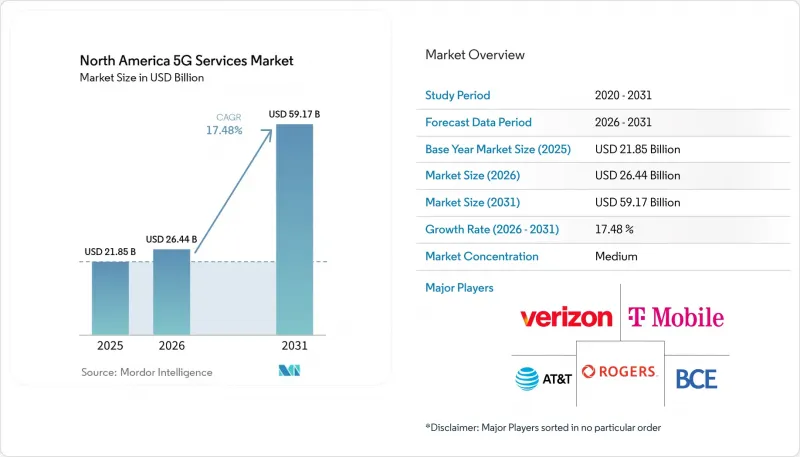
根據 Mordor Intelligence 預測,北美 5G 服務市場規模將從 2025 年的 218.5 億美元成長到 2026 年的 264.4 億美元,然後在 2031 年達到 591.7 億美元,2026 年至 2031 年的複合年成長率為 17.48%。
北美5G服務市場趨勢與洞察
向 5G 過渡和數據消耗增加
2024年,美國無線數據使用量達到132兆兆位元組,連續第三年維持35%的成長率。 2026年第一季,北美行動數據流量較去年同期成長22%。到2025年第三季度,北美5G連接數達到3.63億,覆蓋近95%的當地人口。預計到2031年,每用戶月數據使用量將從2025年的25GB成長到52GB,即使在涵蓋區域發展成熟後,仍需持續投資。北美5G服務市場的發展不僅將依賴用戶數量的成長,還將越來越依賴差異化的資料方案和企業級服務水準。
工業4.0和企業關鍵任務連接
私有5G的部署正從孤立的先導計畫轉向涵蓋多個商業場所的大規模部署。在現代汽車位於喬治亞、投資75.9億美元的Metaplant America工廠,諾基亞提供的私人5G網路正被用來支援200多台自主移動機器人。到2025年,超過一半的美國製造商將在其營運中使用人工智慧,61%的製造商預計到2027年將增加對人工智慧的投資。企業5G轉型可能需要5到7年,這為電信業者提前簽訂長期管理服務合約奠定了基礎。 2026年7月,AT&T和初期應變人員網路管理局(FRNA)共同運作了一個支援應用特定切片的全國性獨立核心網,用於公共安全領域。
高資本密集度及長投資回收期
由於高級企業服務的收入會隨時間推移而成長,網路投資仍然是北美5G服務市場的主要阻礙因素。 2026年3月,AT&T宣布將在未來五年內投資超過2,500億美元用於美國互聯基礎建設。 Verizon預計2026年的資本支出為160億至165億美元,T-Mobile預計為100億美元。小型基地台和毫米波的部署需要較長的投資回收期,尤其是在營運商為高密度都市區服務建造容量的情況下。獨立核心網、切片平台和原生AI無線接取網軟體除了增加頻段和無線基礎設施的成本外,還會延長整合升級的投資回收期。
細分市場分析
2025年,在智慧型手機普及率和影片流量的推動下,增強型行動寬頻將佔據北美5G服務市場55.43%的佔有率。影片佔全球行動數據流量的75%,推動了對高容量行動服務的需求。由於中頻段5G能夠與有線和DSL寬頻競爭,預計到2031年,固定無線存取將以21.23%的複合年成長率成長。超高可靠性、低延遲通訊(URLC)正在為公共安全和工業自動化提供支援。大規模機器類型通訊(MMC)正在為智慧城市系統和物流資產追蹤提供支援。
預計到2031年底,全球5G用戶數將達到64億,其中65%預計將使用獨立網路(SA)5G。在北美,5G普及率預計將接近或超過90%,商業性重心將轉向服務差異化。到2026年,57%的固定無線接取套餐提供基於速度的收費系統,低於2024年的40%。 T-Mobile在其託管式企業固定無線服務中將5G與衛星通訊捆綁在一起。這種模式強調北美5G服務市場的服務品質、容錯能力以及接取硬體。
2025年,非獨立組網(NSA)5G佔據了北美5G服務市場65.27%的佔有率。這是因為許多業者最初是在4G LTE核心網路的基礎上推出5G服務。預計到2031年,獨立組網(SA)5G將以23.47%的複合年成長率成長。 AT&T於2025年10月推出了其覆蓋全國的獨立網路核心網,Verizon於2025年6月開始提供獨立網路5G服務。 T-Mobile於2020年8月推出了其覆蓋全國的獨立組網5G服務,並持續擴展其網路切片產品組合。
這種獨立架構支援網路切片、可強制執行的服務品質 (QoS) 以及分散式邊緣運算,且無需回退到 LTE 網路。這些功能對於效能可預測性至關重要的高價值企業應用而言至關重要。 AT&T 正在利用 AWS 和 Microsoft Azure 在美國營運分散式邊緣運算區域,以應對對延遲敏感的工作負載。在加拿大,貝爾公司已在大多倫多-漢密爾頓地區運作了使用 n77 頻段的獨立核心網路。 TELUS 正在透過加拿大西部城市走廊擴展獨立 5G 服務覆蓋範圍。這種架構擴展了營運商在北美 5G 服務市場中可提供給企業客戶的服務類別。
其他好處:
- Excel格式的市場預測(ME)表
- 3個月的分析師支持
目錄
第1章:引言
- 研究假設和市場定義
- 調查範圍
第2章:調查方法
第3章執行摘要
第4章 市場狀況
- 市場概覽
- 市場促進因素
- 向 5G 過渡和數據消耗增加
- 企業工業4.0和關鍵任務連接
- 5G固定無線存取的擴展
- CBRS和中波頻率的自由化
- 獨立組網 5G、網路切片和邊緣貨幣化
- AI原生無線存取網與雲端網路的融合
- 市場限制因素
- 資本密集度高,投資回收期長
- 授權程序延誤和跨多個司法管轄區的部署延誤。
- 消費者價格溢價下降和每用戶平均收入(ARPU)降低
- 網路安全風險和供應商供應限制
- 宏觀經濟因素對市場的影響
- 產業價值鏈分析
- 監理情勢
- 技術展望
- 波特五力分析
第5章 市場規模與成長預測
- 按服務類型
- 高級行動寬頻
- 超高可靠性、低延遲通訊
- 大規模機器類型通訊
- 固定無線存取
- 透過網路架構
- 非獨立組網 5G
- 獨立組網 5G
- 按頻段
- 低頻段
- 中頻
- 毫米波
- 按最終用戶行業分類
- 資訊科技/通訊
- 汽車、旅行和交通
- 製造業、能源和公共產業
- 醫療保健和生命科學
- 銀行、金融服務、保險和監理科技
- 零售、媒體、電子商務
- 政府、國防、教育、公共部門
- 其他終端用戶產業
- 透過使用
- 資訊科技/通訊
- 溝通與協作
- 資產追蹤
- 智慧城市
- 智慧建築
- 自動駕駛汽車和V2X
- 智慧醫療
- 工業4.0
- 智慧公用事業
- 身臨其境型媒體與遊戲
- 公共安全和關鍵任務通訊
- 按地區
- 美國
- 加拿大
- 墨西哥
第6章 競爭情勢
- 市場集中度
- 策略趨勢
- 市佔率分析
- 公司簡介
- Verizon Communications Inc.
- T-Mobile US, Inc.
- AT&T Inc.
- Rogers Communications Inc.
- BCE Inc.
- TELUS Corporation
- America Movil, SAB de CV
- Telefonaktiebolaget LM Ericsson
- Nokia Corporation
- Samsung Electronics Co., Ltd.
- CommScope Holdings
- Fujitsu Network Communications
- Cisco Systems, Inc.
- Qualcomm Incorporated
- Dell Technologies Inc.
- Hewlett Packard Enterprise Company
- Amazon Web Services, Inc.
- Microsoft Corporation
- Mavenir Systems, Inc.
- DISH Wireless LLC
- Celona, Inc.
第7章 市場機會與未來展望
According to Mordor Intelligence, the North America 5G services market size is expected to grow from USD 21.85 billion in 2025 to USD 26.44 billion in 2026 and is forecast to reach USD 59.17 billion by 2031 at 17.48% CAGR over 2026-2031.
North America 5G Services Market Trends and Insights
5G Migration and Rising Data Consumption
Americans used 132 trillion megabytes of wireless data in 2024, marking the third consecutive year of 35% growth. Mobile data traffic in North America increased 22% year over year in the first quarter of 2026. North America recorded 363 million 5G connections by the third quarter of 2025, covering close to 95% of the regional population. Per-user monthly consumption is projected to increase from 25 GB in 2025 to 52 GB by 2031, requiring continued investment even after coverage reaches mature levels. The North America 5G services market can increasingly rely on differentiated data plans and enterprise service levels rather than subscriber additions alone.
Enterprise Industry 4.0 and Mission-Critical Connectivity
Private 5G adoption is moving from isolated pilots toward deployments across multiple operating sites. Hyundai's USD 7.59 billion Metaplant America in Georgia uses a Nokia-supplied private 5G network for more than 200 autonomous mobile robots. More than half of U.S. manufacturers used AI in operations in 2025, and 61% expected AI investment to increase by 2027. Enterprise 5G transformation can span 5-7 years, which supports long-term managed-service relationships for operators that secure early contracts. In July 2026, AT&T and the First Responder Network Authority activated a nationwide standalone core for public safety that supports application-specific slicing.
High Capital Intensity and Extended Payback Periods
Network investment remains a major constraint for the North America 5G services market because revenue from advanced enterprise services develops over time. AT&T committed more than USD 250 billion over 5 years to U.S. connectivity infrastructure in March 2026. Verizon guided USD 16-16.5 billion of 2026 capital spending, while T-Mobile guided USD 10 billion. Small-cell and millimeter-wave deployments need long amortization periods, especially where operators are building capacity for dense urban services. Standalone cores, slicing platforms, and AI-native RAN software add costs beyond spectrum and radio infrastructure, extending payback periods for integrated upgrades.
Other drivers and restraints analyzed in the detailed report include:
- 5G Fixed Wireless Access Expansion
- CBRS and Mid-Band Spectrum Liberalization
- Permitting Friction and Multi-Jurisdiction Deployment Delays
For complete list of drivers and restraints, kindly check the Table Of Contents.
Segment Analysis
Enhanced mobile broadband held 55.43% of the North America 5G services market share in 2025, supported by smartphone adoption and video traffic. Video represented 75% of global mobile data traffic, which sustained demand for high-capacity mobile services. Fixed wireless access is projected to expand at a 21.23% CAGR through 2031 because mid-band 5G can compete with cable and DSL broadband. Ultra-reliable low-latency communications supports public safety and industrial automation. Massive machine-type communications supports smart-city systems and logistics asset tracking.
Global 5G subscriptions are projected to reach 6.4 billion by the end of 2031, with 65% using standalone 5G. North American 5G subscription penetration is expected to approach or exceed 90%, which shifts commercial attention toward service differentiation. Speed-based tariffs appeared in 57% of fixed wireless access offers in 2026, compared with 40% in 2024. T-Mobile has bundled 5G and satellite connectivity in a managed business fixed wireless offer. This approach places service quality and resilience alongside access hardware in the North America 5G services market.
Non-standalone 5G held 65.27% of the North America 5G services market size in 2025 because many carriers initially launched 5G on 4G LTE cores. Standalone 5G is expected to expand at a 23.47% CAGR through 2031. AT&T launched a nationwide standalone core in October 2025, and Verizon activated standalone 5G in June 2025. T-Mobile launched standalone 5G nationally in August 2020 and continued to expand its slicing portfolio.
Standalone architecture enables network slicing, enforceable quality of service, and distributed edge computing without LTE fallback. These capabilities are relevant to the highest-value enterprise uses where predictable performance is required. AT&T operates distributed edge computing zones across the United States with AWS and Microsoft Azure for latency-sensitive workloads. In Canada, Bell activated a standalone core using n77 spectrum in the Greater Toronto and Hamilton Area. TELUS is extending standalone coverage through western Canadian urban corridors. This architecture broadens the service categories that operators can offer enterprise customers in the North America 5G services market.
Complete Report Scope:
- By Service Type
- Enhanced Mobile Broadband
- Ultra-Reliable Low-Latency Communications
- Massive Machine-Type Communications
- Fixed Wireless Access
- By Network Architecture
- Non-Standalone 5G
- Standalone 5G
- By Frequency Band
- Low Band
- Mid Band
- Millimeter-Wave
- By End-User Industry
- IT and Telecom
- Automotive, Mobility and Transportation
- Manufacturing, Energy and Utilities
- Healthcare and Life Sciences
- Banking, Financial Services, Insurance and RegTech
- Retail, Media and E-Commerce
- Government, Defense, Education and Public Sector
- Other End-User Industries
- By Application
- IT and Telecommunications
- Communication and Collaboration
- Asset Tracking
- Smart Cities
- Smart Buildings
- Autonomous Vehicles and Vehicle-to-Everything
- Smart Healthcare
- Industry 4.0
- Smart Utilities
- Immersive Media and Gaming
- Public Safety and Mission-Critical Communications
- By Geography
- United States
- Canada
- Mexico
List of Companies Covered in this Report:
- Verizon Communications Inc.
- T-Mobile US, Inc.
- AT&T Inc.
- Rogers Communications Inc.
- BCE Inc.
- TELUS Corporation
- America Movil, S.A.B. de C.V.
- Telefonaktiebolaget LM Ericsson
- Nokia Corporation
- Samsung Electronics Co., Ltd.
- CommScope Holdings
- Fujitsu Network Communications
- Cisco Systems, Inc.
- Qualcomm Incorporated
- Dell Technologies Inc.
- Hewlett Packard Enterprise Company
- Amazon Web Services, Inc.
- Microsoft Corporation
- Mavenir Systems, Inc.
- DISH Wireless L.L.C.
- Celona, Inc.
Additional Benefits:
- The market estimate (ME) sheet in Excel format
- 3 months of analyst support
TABLE OF CONTENTS
1 INTRODUCTION
- 1.1 Study Assumptions and Market Definition
- 1.2 Scope of the Study
2 RESEARCH METHODOLOGY
3 EXECUTIVE SUMMARY
4 MARKET LANDSCAPE
- 4.1 Market Overview
- 4.2 Market Drivers
- 4.2.1 5G Migration and Rising Data Consumption
- 4.2.2 Enterprise Industry 4.0 and Mission-Critical Connectivity
- 4.2.3 5G Fixed Wireless Access Expansion
- 4.2.4 CBRS and Mid-Band Spectrum Liberalization
- 4.2.5 Standalone 5G, Network Slicing and Edge Monetization
- 4.2.6 AI-Native RAN and Cloud-Network Convergence
- 4.3 Market Restraints
- 4.3.1 High Capital Intensity and Extended Payback Periods
- 4.3.2 Permitting Friction and Multi-Jurisdiction Deployment Delays
- 4.3.3 Weak Consumer Price Premium and ARPU Compression
- 4.3.4 Cybersecurity Exposure and Vendor-Supply Restrictions
- 4.4 Impact of Macroeconomic Factors on the Market
- 4.5 Industry Value Chain Analysis
- 4.6 Regulatory Landscape
- 4.7 Technological Outlook
- 4.8 Porter's Five Forces Analysis
- 4.8.1 Threat of New Entrants
- 4.8.2 Bargaining Power of Buyers
- 4.8.3 Bargaining Power of Suppliers
- 4.8.4 Threat of Substitutes
- 4.8.5 Intensity of Competitive Rivalry
5 MARKET SIZE AND GROWTH FORECASTS (VALUE)
- 5.1 By Service Type
- 5.1.1 Enhanced Mobile Broadband
- 5.1.2 Ultra-Reliable Low-Latency Communications
- 5.1.3 Massive Machine-Type Communications
- 5.1.4 Fixed Wireless Access
- 5.2 By Network Architecture
- 5.2.1 Non-Standalone 5G
- 5.2.2 Standalone 5G
- 5.3 By Frequency Band
- 5.3.1 Low Band
- 5.3.2 Mid Band
- 5.3.3 Millimeter-Wave
- 5.4 By End-User Industry
- 5.4.1 IT and Telecom
- 5.4.2 Automotive, Mobility and Transportation
- 5.4.3 Manufacturing, Energy and Utilities
- 5.4.4 Healthcare and Life Sciences
- 5.4.5 Banking, Financial Services, Insurance and RegTech
- 5.4.6 Retail, Media and E-Commerce
- 5.4.7 Government, Defense, Education and Public Sector
- 5.4.8 Other End-User Industries
- 5.5 By Application
- 5.5.1 IT and Telecommunications
- 5.5.2 Communication and Collaboration
- 5.5.3 Asset Tracking
- 5.5.4 Smart Cities
- 5.5.5 Smart Buildings
- 5.5.6 Autonomous Vehicles and Vehicle-to-Everything
- 5.5.7 Smart Healthcare
- 5.5.8 Industry 4.0
- 5.5.9 Smart Utilities
- 5.5.10 Immersive Media and Gaming
- 5.5.11 Public Safety and Mission-Critical Communications
- 5.6 By Geography
- 5.6.1 United States
- 5.6.2 Canada
- 5.6.3 Mexico
6 COMPETITIVE LANDSCAPE
- 6.1 Market Concentration
- 6.2 Strategic Moves
- 6.3 Market Share Analysis
- 6.4 Company Profiles (includes Global Level Overview, Market Level Overview, Core Segments, Financials as available, Strategic Information, Market Rank/Share, Products and Services, Recent Developments)
- 6.4.1 Verizon Communications Inc.
- 6.4.2 T-Mobile US, Inc.
- 6.4.3 AT&T Inc.
- 6.4.4 Rogers Communications Inc.
- 6.4.5 BCE Inc.
- 6.4.6 TELUS Corporation
- 6.4.7 America Movil, S.A.B. de C.V.
- 6.4.8 Telefonaktiebolaget LM Ericsson
- 6.4.9 Nokia Corporation
- 6.4.10 Samsung Electronics Co., Ltd.
- 6.4.11 CommScope Holdings
- 6.4.12 Fujitsu Network Communications
- 6.4.13 Cisco Systems, Inc.
- 6.4.14 Qualcomm Incorporated
- 6.4.15 Dell Technologies Inc.
- 6.4.16 Hewlett Packard Enterprise Company
- 6.4.17 Amazon Web Services, Inc.
- 6.4.18 Microsoft Corporation
- 6.4.19 Mavenir Systems, Inc.
- 6.4.20 DISH Wireless L.L.C.
- 6.4.21 Celona, Inc.
7 MARKET OPPORTUNITIES AND FUTURE OUTLOOK
- 7.1 White-Space and Unmet-Need Assessment

 中東地區 5G 服務:市場佔有率分析、產業趨勢與統計及成長預測(2026-2031 年)亞太地區5G服務:市佔率分析、產業趨勢與統計及成長預測(2026-2031年)5G服務:市場佔有率分析、產業趨勢與統計、成長預測(2026-2031年)
 5G服務市場規模、佔有率和趨勢分析報告:按通訊類型、行業和細分市場分類的預測(2026-2033年)
 2026-2030年全球5G服務市場
 2026年全球5G服務市場報告
 5G服務市場分析及預測(至2035年):依類型、產品類型、服務、技術、組件、應用、部署類型、最終用戶及功能分類
 2026-2034年全球5G服務市場規模、佔有率、趨勢和成長分析報告
 5G服務市場-全球產業規模、佔有率、趨勢、機會及預測(依通訊類型、產業垂直領域、最終用途、地區及競爭格局分類,2021-2031年)
 5G服務市場:產業趨勢·全球預測 (~2035年):服務類型·通訊類型·技術·用途·終端用戶·企業規模·各地區