


 |
市場調查報告書
商品編碼
2155281
中東地區 5G 服務:市場佔有率分析、產業趨勢與統計及成長預測(2026-2031 年)Middle East 5G Services - Market Share Analysis, Industry Trends & Statistics, Growth Forecasts (2026 - 2031) |
||||||

※ 本網頁內容可能與最新版本有所差異。詳細情況請與我們聯繫。
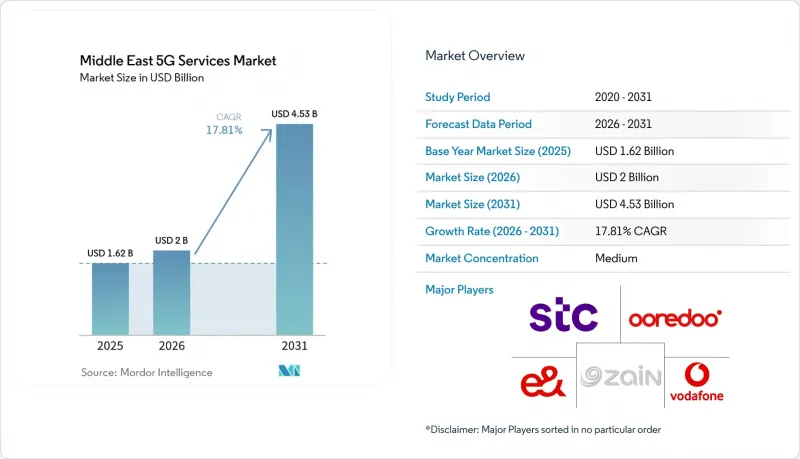
根據 Mordor Intelligence 預測,中東 5G 服務市場規模預計將在 2025 年達到 16.2 億美元,2026 年達到 20 億美元,到 2031 年達到 45.3 億美元,2026 年至 2031 年的複合年成長率為 17.81%。
中東5G服務市場趨勢與洞察
5G用戶和行動數據需求增加
在中東5G服務市場,用戶成長速度遠超過該地區目前的普及率。預計到2025年底,海灣合作理事會(GCC)國家的5G普及率將達到53%,到2031年將佔行動連線的88%,即8,400萬用戶。中東和北非(MENA)地區的5G用戶預計將從2025年的6000萬增至2026年的8000萬,愛立信預測到2031年將超過3.7億。隨著智慧型手機月均使用量接近47GB,MENA地區的行動數據流量預計將從每月Exabyte增加到Exabyte。在科威特,3G服務將於2025年終止,這將釋放出更多頻段,加速從傳統網路向5G服務的過渡。在土耳其,8,500萬行動用戶中,5G相容設備的擁有率有限,因此獲利能力可能會延遲,直到裝置更換加速。
企業數位轉型的應用案例
在中東5G服務市場,企業支出正逐漸成為比單純的消費者連結服務更重要的業務收益來源。 GSMA對中東和北非地區851家企業的調查預測,2025年至2030年間,數位轉型支出將平均佔營收的9.8%。在調查對象國家中,沙烏地阿拉伯的投資回收期最短,僅3.3年。到2030年,人工智慧、行動連線及相關設備預計將佔該地區技術投資的近45%。汽車、公共產業和物流業的受訪者預計,5G物聯網應用將帶來最大的效益。電信業者可以透過提供託管連線和基於績效的服務,而非僅僅提供基本頻寬,來提高單一連線收入。
對公司而言,實施成本高且投資回收期長。
在中東的5G服務市場,工業專用網路通常需要大量的現場特定投資,投資回收期長達數年。在油田和港口部署網路可能需要耐環境腐蝕的無線設備、分散式天線系統和強大的核心基礎設施。這些要求使得中小企業難以資金籌措專案資金。此外,電信業者在企業收入完全建立之前,也必須對頻段和站點進行大量投資。基礎設施共用和中立託管協議可以降低客戶的總擁有成本(TCO)。這些方案能否得到更廣泛的應用,取決於支援共用和回程傳輸共用的監管框架。
細分市場分析
到2025年,增強型行動寬頻將佔全部區域5G業務收益的41.89%。這反映了自2019年該地區開始部署5G以來已建立的消費者寬頻基礎。隨著智慧型手機的普及,對可靠、高容量連線的需求日益成長,而這一領域仍是中東5G服務市場的核心。超高可靠性、低延遲(URLC)支援工業自動化、港口物流和自動駕駛路線,這些應用對反應時間和可靠連接的要求極高。大規模機器類型通訊(MMC)支援智慧電錶、資產追蹤和農業監測,尤其適用於網路基礎設施不足的地區。總而言之,這些服務表明,中東的5G服務市場正在從消費者寬頻服務轉向滿足多樣化連接需求的平台。
預計到2031年,固定無線接入將以18.47%的複合年成長率成長,成為中東5G服務市場成長最快的服務類型。沙烏地阿拉伯和阿拉伯聯合大公國的電信業者正在利用獨立組網(SA)為光纖鋪設仍然困難或經濟上不可行(例如住宅和工業區)提供服務。現有的獨立網路容量使營運商無需等待傳統的固網建設即可連接家庭和企業。隨著其應用範圍的擴大以及企業和家庭採用更多客製化服務套餐,增強型行動寬頻(eMBB)在收入中的相對佔有率可能會逐漸下降。網路切片使服務提供者能夠根據所需的效能、客戶類型和位置來最佳化連接,而不是簡單地銷售標準的資料通訊套餐。
預計2025年,非獨立組網(NSA)5G將佔總營收的66.45%,繼續主導中東5G服務市場。營運商繼續利用4G網路進行訊號傳輸和移動性管理,因為這種方法可以在不立即完全取代核心網路的情況下擴展覆蓋範圍。這項策略在行動寬頻已被證明是行之有效的,因為在行動寬頻領域,廣泛的可用性最初優先於特定的效能。它還降低了部署獨立組網核心網帶來的短期成本和營運中斷。然而,非獨立組網限制了營運商日益尋求提供的差異化企業服務的選擇。
隨著客戶對更低延遲、網路切片和網路應用程式介面 (API) 的需求不斷成長,獨立組網 5G 預計到 2031 年將以 19.88% 的複合年成長率 (CAGR) 成長。獨立組網方案的收入前景得益於其能夠銷售明確的服務質量,包括延遲、抖動和吞吐量的保證。 2025 年 11 月,沃達豐卡達與諾基亞合作,針對港口、天然氣營運和資料中心等企業推出商用獨立組網。這項轉變將改變中東 5G 服務市場的商業性模式,使其能夠採用基於效能而非資料通訊量的定價方式。同時,這也要求業者加強其企業銷售、服務保障和網路營運能力。
其他好處:
- Excel格式的市場預測(ME)表
- 3個月的分析師支持
目錄
第1章:引言
- 研究假設和市場定義
- 調查範圍
第2章:調查方法
第3章執行摘要
第4章 市場狀況
- 市場概覽
- 宏觀經濟因素對市場的影響
- 市場促進因素
- 5G用戶和行動數據需求增加
- 企業數位轉型的應用案例
- 政府主導的數位經濟和智慧城市計劃
- 為尚未開通服務的地區提供固定無線網路存取。
- 能源、港口和千兆項目中的工業專用5G
- 5G-Advanced 和網路切片的商業化
- 市場限制因素
- 公司實施成本高,投資回收期長。
- 碎片化頻率政策與不平衡覆蓋的經濟原理
- 海灣合作理事會地區以外地區5G設備價格昂貴且缺乏部署準備。
- 站點訪問、光纖回程傳輸和專業技能瓶頸
- 產業價值鏈分析
- 監理情勢
- 技術展望
- 波特五力分析
第5章 市場規模與成長預測
- 按服務類型
- 高級行動寬頻
- 超高可靠性、低延遲通訊
- 大規模機器類型通訊
- 固定無線存取
- 透過網路架構
- 非獨立組網 5G
- 獨立組網 5G
- 按頻段
- 低頻段
- 中頻
- 毫米波
- 按最終用戶行業分類
- IT/通訊
- 汽車、旅行和交通
- 製造業、能源和公共產業
- 醫療保健和生命科學
- 銀行、金融服務、保險和監理科技
- 零售、媒體、電子商務
- 政府、國防、教育、公共部門
- 其他終端用戶產業
- 透過使用
- 溝通與協作
- 資產追蹤
- 智慧城市
- 智慧建築
- 自動駕駛汽車和V2X
- 智慧醫療
- 工業4.0
- 智慧公用事業
- 身臨其境型媒體與遊戲
- 公共安全和關鍵任務通訊
- 按地區
- 沙烏地阿拉伯
- 阿拉伯聯合大公國
- 科威特
- 卡達
- 土耳其
- 其他中東國家
第6章 競爭情勢
- 市場集中度
- 策略趨勢
- 市佔率分析
- 公司簡介
- stc Group
- e&
- Emirates Integrated Telecommunications Company PJSC
- Mobily
- Mobile Telecommunications Company Saudi Arabia
- Ooredoo QPSC
- Vodafone Qatar PQSC
- Zain Group
- Zain Kuwait
- Omantel
- Vodafone Oman
- Batelco
- Orange Jordan
- Turkcell Iletisim Hizmetleri Anonim Sirketi
- Turk Telekomunikasyon Anonim Sirketi
- Huawei Technologies Co., Ltd.
- Telefonaktiebolaget LM Ericsson(publ)
- Nokia Corporation
- ZTE Corporation
- Samsung Electronics Co., Ltd.
- Qualcomm Technologies, Inc.
- Cisco Systems, Inc.
- Mavenir Systems, Inc.
- Rakuten Symphony, Inc.
- Amdocs Limited
第7章 市場機會與未來展望
According to Mordor Intelligence, the Middle East 5G services market size is projected to be USD 1.62 billion in 2025, USD 2 billion in 2026, and reach USD 4.53 billion by 2031, growing at a CAGR of 17.81% from 2026 to 2031.
Middle East 5G Services Market Trends and Insights
Rising 5G Subscriber and Mobile-Data Demand
Subscriber momentum remains stronger than the region's current penetration level suggests in the Middle East 5G services market. GCC 5G penetration reached 53% at the end of 2025 and is forecast to represent 88% of mobile connections, or 84 million subscriptions, by 2031. MENA 5G subscriptions reached 80 million in 2026, compared with 60 million in 2025, and Ericsson expects them to exceed 370 million by 2031. MENA mobile data traffic is expected to rise from 11 exabytes per month to 30 exabytes per month as smartphone use approaches 47 GB per month. Kuwait's 3G retirement in 2025 released spectrum and reinforced the migration from older networks to 5G services. In Turkey, limited 5G handset ownership among the country's 85 million mobile subscribers could delay revenue conversion until device replacement accelerates.
Enterprise Digital Transformation Use Cases
Enterprise spending is becoming a more important source of service revenue than consumer connectivity alone in the Middle East 5G services market. A GSMA survey of 851 MENA enterprises found that digital transformation spending is expected to average 9.8% of revenue during 2025-2030 Saudi Arabia recorded the fastest return-on-investment period in the survey at 3.3 years. AI, mobile connectivity, and related devices are expected to represent nearly 45% of regional technology investment through 2030. Automotive, utilities, and logistics respondents reported the strongest expected effect from 5G IoT applications. Operators can improve revenue per connection when they provide managed connectivity and performance-based services instead of basic bandwidth.
High Deployment Cost and Long Enterprise Payback
Industrial private networks require substantial site-specific investment and often have multi-year payback periods in the Middle East 5G services market. Oilfield and port deployments can need ruggedized radio equipment, distributed antenna systems, and hardened core infrastructure. These requirements make projects harder to fund for small and medium-sized enterprises. Operators also face major spectrum and site investment needs before enterprise revenue is fully established. Infrastructure sharing and neutral-host arrangements can lower the total cost of ownership for customers. Their wider use depends on regulatory rules that support shared spectrum and shared backhaul.
Other drivers and restraints analyzed in the detailed report include:
- Government Digital Economy and Smart City Programs
- Fixed Wireless Access for Underserved Premises
- Fragmented Spectrum Policy and Uneven Coverage Economics
For complete list of drivers and restraints, kindly check the Table Of Contents.
Segment Analysis
Enhanced mobile broadband held 41.89% of regional 5G service revenue in 2025, reflecting the consumer broadband foundation established after regional rollouts began in 2019. It remains central to the Middle East 5G services market because rising smartphone use is increasing demand for reliable high-capacity connections. Ultra-reliable low-latency communications support industrial automation, port logistics, and autonomous vehicle corridors where response times and dependable connectivity are important. Massive machine-type communications support smart metering, asset tracking, and agricultural monitoring in areas that are less densely served. Together, these services show that the Middle East 5G services market is developing from a consumer broadband offering into a platform for several connectivity needs.
Fixed wireless access is projected to expand at an 18.47% CAGR through 2031, making it the fastest-moving service type in the Middle East 5G services market. Operators in Saudi Arabia and the UAE use standalone networks to serve residential districts and industrial parks where extending fiber remains difficult or economically unattractive. Available standalone capacity allows operators to connect homes and businesses without waiting for conventional fixed-line construction. Its wider use could gradually reduce the relative revenue weight of eMBB as enterprises and households adopt more tailored service packages. Network slicing gives providers a way to organize connectivity around required performance, customer type, and location, rather than selling only standard data allowances.
Non-standalone 5G held 66.45% of revenue in 2025 and remained the prevailing architecture across the Middle East 5G services market. Operators have continued to use 4G anchors for signaling and mobility management because the approach supports coverage expansion without an immediate full core-network replacement. This strategy has been practical for mobile broadband, where broad availability was initially more important than specialized performance. It also reduces the near-term cost and operational disruption associated with a standalone core deployment. However, non-standalone networks provide fewer options for the differentiated enterprise services that operators increasingly seek to provide.
Standalone 5G is expected to expand at a 19.88% CAGR through 2031 as customers seek lower latency, network slicing, and network application programming interfaces. The standalone revenue outlook is supported by its ability to sell defined service quality, including latency, jitter, and throughput commitments. Vodafone Qatar launched a commercial standalone network with Nokia in November 2025 for enterprise uses in ports, natural gas operations, and data centers. This transition changes the commercial logic of the Middle East 5G services market because it permits performance-based pricing instead of pricing centered only on data volume. It also requires operators to strengthen their enterprise sales, service assurance, and network operations capabilities.
Complete Report Scope:
- By Service Type
- Enhanced Mobile Broadband
- Ultra-Reliable Low-Latency Communications
- Massive Machine-Type Communications
- Fixed Wireless Access
- By Network Architecture
- Non-Standalone 5G
- Standalone 5G
- By Frequency Band
- Low Band
- Mid Band
- Millimeter-Wave
- By End-User Industry
- IT and Telecom
- Automotive, Mobility and Transportation
- Manufacturing, Energy and Utilities
- Healthcare and Life Sciences
- Banking, Financial Services, Insurance and RegTech
- Retail, Media and E-Commerce
- Government, Defense, Education and Public Sector
- Other End-User Industries
- By Application
- Communication and Collaboration
- Asset Tracking
- Smart Cities
- Smart Buildings
- Autonomous Vehicles and Vehicle-to-Everything
- Smart Healthcare
- Industry 4.0
- Smart Utilities
- Immersive Media and Gaming
- Public Safety and Mission-Critical Communications
- By Geography
- Saudi Arabia
- United Arab Emirates
- Kuwait
- Qatar
- Turkey
- Rest of Middle East
List of Companies Covered in this Report:
- stc Group
- e&
- Emirates Integrated Telecommunications Company PJSC
- Mobily
- Mobile Telecommunications Company Saudi Arabia
- Ooredoo Q.P.S.C.
- Vodafone Qatar P.Q.S.C.
- Zain Group
- Zain Kuwait
- Omantel
- Vodafone Oman
- Batelco
- Orange Jordan
- Turkcell Iletisim Hizmetleri Anonim Sirketi
- Turk Telekomunikasyon Anonim Sirketi
- Huawei Technologies Co., Ltd.
- Telefonaktiebolaget LM Ericsson (publ)
- Nokia Corporation
- ZTE Corporation
- Samsung Electronics Co., Ltd.
- Qualcomm Technologies, Inc.
- Cisco Systems, Inc.
- Mavenir Systems, Inc.
- Rakuten Symphony, Inc.
- Amdocs Limited
Additional Benefits:
- The market estimate (ME) sheet in Excel format
- 3 months of analyst support
TABLE OF CONTENTS
1 INTRODUCTION
- 1.1 Study Assumptions and Market Definition
- 1.2 Scope of the Study
2 RESEARCH METHODOLOGY
3 EXECUTIVE SUMMARY
4 MARKET LANDSCAPE
- 4.1 Market Overview
- 4.2 Impact of Macroeconomic Factors on the Market
- 4.3 Market Drivers
- 4.3.1 Rising 5G Subscriber and Mobile-Data Demand
- 4.3.2 Enterprise Digital-Transformation Use Cases
- 4.3.3 Government-Led Digital-Economy and Smart-City Programs
- 4.3.4 Fixed Wireless Access for Underserved Premises
- 4.3.5 Industrial Private 5G in Energy, Ports, and Giga-Projects
- 4.3.6 5G-Advanced and Network-Slicing Monetization
- 4.4 Market Restraints
- 4.4.1 High Deployment Cost and Long Enterprise Payback
- 4.4.2 Fragmented Spectrum Policy and Uneven Coverage Economics
- 4.4.3 Limited 5G Device Affordability and Readiness Outside GCC
- 4.4.4 Site Access, Fiber Backhaul, and Specialized Skills Bottlenecks
- 4.5 Industry Value Chain Analysis
- 4.6 Regulatory Landscape
- 4.7 Technological Outlook
- 4.8 Porter's Five Forces Analysis
- 4.8.1 Threat of New Entrants
- 4.8.2 Bargaining Power of Buyers
- 4.8.3 Bargaining Power of Suppliers
- 4.8.4 Threat of Substitutes
- 4.8.5 Intensity of Competitive Rivalry
5 MARKET SIZE AND GROWTH FORECASTS (VALUE)
- 5.1 By Service Type
- 5.1.1 Enhanced Mobile Broadband
- 5.1.2 Ultra-Reliable Low-Latency Communications
- 5.1.3 Massive Machine-Type Communications
- 5.1.4 Fixed Wireless Access
- 5.2 By Network Architecture
- 5.2.1 Non-Standalone 5G
- 5.2.2 Standalone 5G
- 5.3 By Frequency Band
- 5.3.1 Low Band
- 5.3.2 Mid Band
- 5.3.3 Millimeter-Wave
- 5.4 By End-User Industry
- 5.4.1 IT and Telecom
- 5.4.2 Automotive, Mobility and Transportation
- 5.4.3 Manufacturing, Energy and Utilities
- 5.4.4 Healthcare and Life Sciences
- 5.4.5 Banking, Financial Services, Insurance and RegTech
- 5.4.6 Retail, Media and E-Commerce
- 5.4.7 Government, Defense, Education and Public Sector
- 5.4.8 Other End-User Industries
- 5.5 By Application
- 5.5.1 Communication and Collaboration
- 5.5.2 Asset Tracking
- 5.5.3 Smart Cities
- 5.5.4 Smart Buildings
- 5.5.5 Autonomous Vehicles and Vehicle-to-Everything
- 5.5.6 Smart Healthcare
- 5.5.7 Industry 4.0
- 5.5.8 Smart Utilities
- 5.5.9 Immersive Media and Gaming
- 5.5.10 Public Safety and Mission-Critical Communications
- 5.6 By Geography
- 5.6.1 Saudi Arabia
- 5.6.2 United Arab Emirates
- 5.6.3 Kuwait
- 5.6.4 Qatar
- 5.6.5 Turkey
- 5.6.6 Rest of Middle East
6 COMPETITIVE LANDSCAPE
- 6.1 Market Concentration
- 6.2 Strategic Moves
- 6.3 Market Share Analysis
- 6.4 Company Profiles (includes Global Level Overview, Market Level Overview, Core Segments, Financials as available, Strategic Information, Market Rank/Share, Products and Services, Recent Developments)
- 6.4.1 stc Group
- 6.4.2 e&
- 6.4.3 Emirates Integrated Telecommunications Company PJSC
- 6.4.4 Mobily
- 6.4.5 Mobile Telecommunications Company Saudi Arabia
- 6.4.6 Ooredoo Q.P.S.C.
- 6.4.7 Vodafone Qatar P.Q.S.C.
- 6.4.8 Zain Group
- 6.4.9 Zain Kuwait
- 6.4.10 Omantel
- 6.4.11 Vodafone Oman
- 6.4.12 Batelco
- 6.4.13 Orange Jordan
- 6.4.14 Turkcell Iletisim Hizmetleri Anonim Sirketi
- 6.4.15 Turk Telekomunikasyon Anonim Sirketi
- 6.4.16 Huawei Technologies Co., Ltd.
- 6.4.17 Telefonaktiebolaget LM Ericsson (publ)
- 6.4.18 Nokia Corporation
- 6.4.19 ZTE Corporation
- 6.4.20 Samsung Electronics Co., Ltd.
- 6.4.21 Qualcomm Technologies, Inc.
- 6.4.22 Cisco Systems, Inc.
- 6.4.23 Mavenir Systems, Inc.
- 6.4.24 Rakuten Symphony, Inc.
- 6.4.25 Amdocs Limited
7 MARKET OPPORTUNITIES AND FUTURE OUTLOOK
- 7.1 White-Space and Unmet-Need Assessment

 亞太地區5G服務:市佔率分析、產業趨勢與統計及成長預測(2026-2031年)5G服務:市場佔有率分析、產業趨勢與統計、成長預測(2026-2031年)
 5G服務市場規模、佔有率和趨勢分析報告:按通訊類型、行業和細分市場分類的預測(2026-2033年)
 2026-2030年全球5G服務市場
 2026年全球5G服務市場報告
 5G服務市場分析及預測(至2035年):依類型、產品類型、服務、技術、組件、應用、部署類型、最終用戶及功能分類
 2026-2034年全球5G服務市場規模、佔有率、趨勢和成長分析報告
 5G服務市場-全球產業規模、佔有率、趨勢、機會及預測(依通訊類型、產業垂直領域、最終用途、地區及競爭格局分類,2021-2031年)
 5G服務市場:產業趨勢·全球預測 (~2035年):服務類型·通訊類型·技術·用途·終端用戶·企業規模·各地區
 5G 服務市場規模、佔有率及成長分析(按通訊類型、企業、應用、最終用戶和地區)- 產業預測(2025 年至 2032 年)