


 |
市場調查報告書
商品編碼
2157126
風力發電機煞車:市場佔有率分析、行業趨勢和統計數據、成長預測(2026-2031 年)Wind Turbine Brakes - Market Share Analysis, Industry Trends & Statistics, Growth Forecasts (2026 - 2031) |
||||||

※ 本網頁內容可能與最新版本有所差異。詳細情況請與我們聯繫。
據 Mordor Intelligence 稱,2025 年風力發電機煞車市值為 16.4 億美元,預計到 2031 年將達到 31.1 億美元,而 2026 年為 18.2 億美元,預測期(2026-2031 年)的複合年成長率為 11.31%。
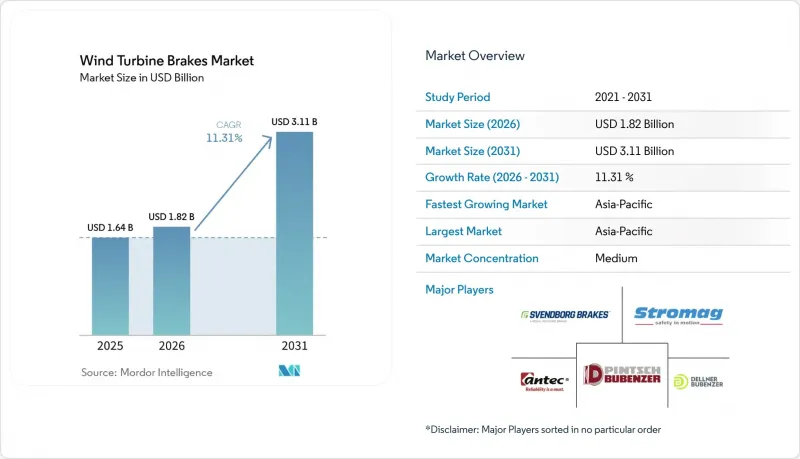
全球風力發電機機煞車市場趨勢及洞察
擴大全球風力發電廠的裝置容量
預計到2025年,新增風電裝置容量將達到159吉瓦,創歷史新高,屆時全球風電總裝置容量將超過2,500吉瓦。同年,全球新增可再生能源裝置容量為800吉瓦,其中風電將佔20%。風力發電機制動器市場正受益於此成長,因為每台新渦輪機都需要主偏航煞車迴路和轉子煞車迴路。離岸風力發電電場也正在為各個變槳驅動裝置增加煞車組件。到2025年,全球57個國家的風力發電機量將達到28395台,這將擴大對現有風電市場之外的服務和備件的需求。風力發電機機制動器市場受益於新安裝設備供應以及運作後所需的現場維護。
海上風力發電機尺寸的不斷增大以及由此導致的煞車負荷的增加。
離岸風力發電機的容量正超越早期專案設計中常見的10MW-15MW範圍。明陽馬達將於2025年安裝其「MySE 18.X-20MW」風力發電機組,同年東方電氣也測試了一台26MW的樣機。隨著轉子直徑超過250米,累積動能增加,煞車零件的負載也隨之增加。為了應對這一變化,需要一種能夠滿足更高負載、熱循環和緊急停止要求的煞車系統。由於海上作業成本的增加,離岸風力發電機煞車市場面臨更高的技術挑戰,包括維護、更換和故障維修成本。離岸風力發電專案儲備也在推動這一趨勢,預計到2026年將有24.5GW的離岸風力發電裝置容量投入運作,最終投資決策(FID)預計將達到22.3GW。
預先設計的煞車系統初始成本高昂
公用事業規模的風力渦輪機制組件需要產品設計、測試、文件編制和原始設備製造商 (OEM) 認證。這些要求構成了採購壁壘,開發商往往優先考慮初始成本而非生命週期價值。 IEC 61400-1 標準規定了煞車系統的設計要求,包括電網故障時的緊急停止操作以及海上應用中機械煞車的冗餘設計。對於南亞、東南亞、中東和撒哈拉以南非洲以外地區供應的先進系統,在地採購規則和進口關稅可能會增加成本。由於安全標準強制要求,操作員不能省略煞車系統。因此,在風力發電機機動系統市場,需求可能會轉向成本較低的產品,即使這些產品有長期可靠性和運作風險。
細分市場分析
到2025年,液壓煞車將佔總銷售額的42.5%,成為煞車類型中佔有率最大的。這一佔有率反映了液壓煞車在全球已安裝風力渦輪機的偏航控制和轉子應用中的廣泛應用。液壓裝置能夠提供高負載配置所需的煞車扭矩,包括大型海上轉子系統。此外,液壓煞車的使用也與許多機艙設計中已有的液壓基礎設施相容。現有渦輪機的更換需求持續支撐著對液壓系統的需求。機械式煞車繼續為維護工作提供轉子鎖定功能。氣動煞車利用變速變槳控制渦輪機的槳距-槳距調整為主要煞車功能。液壓或機械系統根據適用的IEC設計要求提供獨立的備用功能。其他類型的煞車器,包括中國GB/T 47557-2026標準中定義的氣動系統,則適用於更專業的應用。
預計2026年至2031年,電動煞車市場規模將以12.7%的複合年成長率成長。這一成長主要得益於新型風力發電機組從液壓變槳缸向永磁變槳馬達的轉變。彈簧驅動電磁煞車在斷電時啟動,並與數位監控系統協同工作。在風力發電機產業,由於電動驅動能夠簡化變槳驅動裝置的設計,因此這些系統正被擴大採用。中國的GB/T 47557-2026標準規定了氣動和電動煞車控制,使國家標準與IEC標準保持一致。這項框架正在推動電氣致動在中國的應用。 KTR同時提供電子機械EMB-STOP系列及液壓式KTR-STOP系列產品。該公司同時提供這兩種類型的產品表明,在當前的技術轉型時期,液壓煞車系統和電動煞車系統可以並行運作。
區域分析
預計到2025年,亞太地區將佔全球銷售額的31.2%,並在2031年之前以13.8%的複合年成長率成長。這將使該地區成為風力發電機機制動器市場規模最大、成長速度最快的地區。在中國,2025年新增風電裝置容量120.5吉瓦(其中超過110吉瓦為陸上風電),累積設備容量達640.5吉瓦。在印度,2025年新增裝置容量6.3吉瓦,較去年成長86%,累計裝置容量超過50吉瓦。預計到2026年,印度的裝置容量將超過60吉瓦。中國的GB/T 47557-2026標準於2026年8月生效,提高了渦輪機機動系統的合規標準。到2025年,中國風力發電煞車在地採購將超過65%。越南預計2025年累積風電裝置容量將達到7.4吉瓦,韓國、印尼和澳洲的市場規模也僅次於中國和印度。
歐洲憑藉其大規模運作中的風電場、先進的離岸風電產業以及不斷擴大的風電改造週期,在收入方面佔有舉足輕重的地位。預計到2025年,德國的陸上和海上發電裝置容量將增加5.7吉瓦,而歐盟在陸上和離岸風電領域的運作將達到14吉瓦。在英國,到2025年將有超過2500台離岸風力發電機運作,從而滿足了對適用於海洋環境的系統的需求。預計到2030年,歐盟風電在電力供應中的比例將從2025年的17%上升至25%。 IEC 61400-1:2019+AMD1:2025和DIN EN 81-44標準正在影響歐洲採購中的溫度等級、材料認證和監測要求。在北美,美國聯邦政府的獎勵和加拿大的可再生能源目標也支撐了市場需求。在美國,大規模風電場正在採用狀態監測平台,這推動了數位化連接煞車系統的使用。
南美洲及中東及非洲地區在風力發電機機制動器市場仍處於發展階段。巴西憑藉其豐富的風能資源和政府競標項目,為南美洲的需求提供支援。阿根廷和智利則透過可再生能源部署義務,進一步刺激了市場需求。沙烏地阿拉伯和阿拉伯聯合大公國正在根據其國家能源多元化計劃,將公用事業規模的風發電工程運作。摩洛哥擁有超過1.4吉瓦的風電裝置容量,是該地區供應鏈發展的標竿。在中東及非洲地區,由於大型專案和具競爭力的能源成本,預計2025年該地區的風電裝置容量將再次創下新紀錄。在這些地區,具有成本競爭力且擁有本地服務網路的產品更受歡迎。在地化需求可能會促使專業供應商在預測期內與該地區建立製造和服務合作夥伴關係。
其他好處:
- Excel格式的市場預測(ME)表
- 3個月的分析師支持
目錄
第1章:引言
- 研究假設和市場定義
- 調查範圍
第2章:調查方法
第3章執行摘要
第4章 市場狀況
- 市場概覽
- 市場促進因素
- 擴大全球風力發電廠的裝置容量
- 更大的海上風力發電機和更大的煞車負荷
- 老舊渦輪機設備的更換和維修需求
- 用於預測性維護的智慧煞車監測
- 惡劣海洋環境下對耐腐蝕煞車的要求
- 新興風電市場本地生產的售後零件的供應情況
- 市場限制因素
- 預先設計的煞車系統初始成本高昂
- 鋼材、摩擦材料和液壓元件的成本波動
- 海上通道和維修物流
- OEM平台間現場資料互通性的局限性
- 供應鏈分析
- 波特五力分析
- 科技趨勢
- 監理情勢
- 投資分析
第5章 市場規模與成長預測
- 按煞車類型
- 機械煞車
- 液壓煞車
- 電動煞車
- 空氣動力煞車
- 其他類型的煞車
- 透過使用
- 陸上風力發電機
- 離岸風力發電機
- 按地區
- 北美洲
- 美國
- 加拿大
- 墨西哥
- 歐洲
- 德國
- 法國
- 義大利
- 西班牙
- 英國
- 波蘭
- 俄羅斯
- 其他歐洲國家
- 亞太地區
- 中國
- 印度
- 日本
- 韓國
- 澳洲
- 印尼
- 越南
- 泰國
- 其他亞太國家
- 南美洲
- 巴西
- 阿根廷
- 智利
- 其他南美國家
- 中東和非洲
- 沙烏地阿拉伯
- 阿拉伯聯合大公國
- 埃及
- 南非
- 摩洛哥
- 其他中東和非洲國家
- 北美洲
第6章 競爭情勢
- 市場集中度
- 策略趨勢
- 市佔率分析
- 公司簡介
- Altra Industrial Motion Corp.
- Brembo SpA
- Chr. Mayr GmbH+Co. KG
- Coremo Ocmea SpA
- Dellner Brakes AB
- Friction Technology Limited
- Industrial Clutch Parts Ltd.
- Jiangxi Huawu Brake Co., Ltd.
- KTR Systems GmbH
- SIBRE-Siegerland Bremsen GmbH
- SIME Brakes Srl
- Stromag GmbH
- Svendborg Brakes ApS
- Trebu Technology BV
- Twiflex Limited
第7章 市場機會與未來展望
According to Mordor Intelligence, the wind turbine brakes market size was valued at USD 1.64 billion in 2025 and estimated to grow from USD 1.82 billion in 2026 to reach USD 3.11 billion by 2031, at a CAGR of 11.31% during the forecast period (2026-2031).
Global Wind Turbine Brakes Market Trends and Insights
Global Wind-Farm Capacity Expansion
Wind additions reached 159 GW in 2025, a record level that lifted global installed wind capacity past 2,500 GW. Wind accounted for 20% of the 800 GW of renewable capacity added worldwide during that year. The wind turbine brakes market benefits from this buildout because each new turbine needs primary yaw and rotor brake circuits. Offshore platforms also add braking assemblies for individual pitch drives. The number of turbines installed in 2025 reached 28,395 across 57 countries, which broadened the service and spare-parts requirements beyond established wind markets. The wind turbine brakes market gains from both the equipment supplied with new installations and the local maintenance capacity needed after commissioning.
Offshore Turbine Scale-Up and Higher Braking Loads
Offshore turbines have moved beyond the 10 MW to 15 MW range that shaped earlier project designs. MingYang installed its MySE 18.X-20 MW turbine in 2025, while Dongfang Electric tested a 26 MW prototype during the same year. Rotor diameters above 250 meters increase stored kinetic energy and place heavier demands on braking components. This change requires brake systems that can meet higher loads, thermal cycles, and emergency-stop requirements. The wind turbine brakes market has a higher technical threshold in offshore projects because access, replacement, and failure costs are more demanding at sea. The offshore pipeline also supports this direction, with 24.5 GW of offshore capacity expected to enter operation in 2026 and final investment decisions forecast for 22.3 GW.
High Upfront Cost of Engineered Brake Systems
Utility-scale turbine brake assemblies require product design, testing, documentation, and original-equipment qualification. These requirements create a purchasing barrier where developers place greater weight on initial cost than lifecycle value. IEC 61400-1 requires braking-system design provisions that include emergency-stop operation during grid-loss events and mechanical braking redundancy for offshore applications. Local-content rules and import duties can increase the cost of advanced systems supplied from outside South and Southeast Asia, the Middle East, and Sub-Saharan Africa. Operators cannot omit braking systems because safety codes require them. The wind turbine brakes market may therefore see demand shift toward lower-cost products, even when those products create longer-term reliability and operating risks.
Other drivers and restraints analyzed in the detailed report include:
- Aging Turbine Fleet Replacement and Retrofit Demand
- Smart Brake Monitoring for Predictive Maintenance
- Volatile Steel, Friction-Material and Hydraulic-Component Costs
For complete list of drivers and restraints, kindly check the Table Of Contents.
Segment Analysis
Hydraulic brakes accounted for 42.5% of revenue in 2025, giving them the largest position among brake types. This share reflects established use in yaw and rotor applications across the global installed fleet. Hydraulic units can deliver the braking torque required for high-load configurations, including large offshore rotor systems. Their use also fits the hydraulic infrastructure already present in many nacelle designs. Hydraulic-system demand remains supported by replacement needs from existing turbines. Mechanical brakes continue to provide rotor-lock capability for maintenance access. Aerodynamic brakes use pitch-to-feather operation as a primary stopping function in variable-speed, pitch-controlled turbines. Hydraulic or mechanical systems provide independent backup under applicable IEC design requirements. Other brake types, including pneumatic systems addressed by China's GB/T 47557-2026 standard, serve more specialized applications.
Electric brakes are forecast to expand at 12.7% CAGR during 2026-2031. Their growth follows the shift from hydraulic pitch cylinders to permanent-magnet pitch motors in newer turbines. Spring-applied electromagnetic brakes activate when power is lost and work with digital monitoring systems. The wind turbine brakes industry is adopting these systems where electrical actuation can simplify pitch-drive design. China's GB/T 47557-2026 covers pneumatic and electrical braking control and aligns domestic requirements with IEC standards. This framework supports the use of electrically actuated braking equipment in China. KTR offers both the EMB-STOP electromechanical line and the hydraulic KTR-STOP line. Its position across both types shows that hydraulic and electric braking systems can operate alongside one another during the technology transition.
Complete Report Scope:
- By Brake Type
- Mechanical Brakes
- Hydraulic Brakes
- Electric Brakes
- Aerodynamic Brakes
- Other Brake Types
- By Application
- Onshore Wind Turbines
- Offshore Wind Turbines
- By Geography
- North America
- United States
- Canada
- Mexico
- Europe
- Germany
- France
- Italy
- Spain
- United Kingdom
- Poland
- Russia
- Rest of Europe
- Asia-Pacific
- China
- India
- Japan
- South Korea
- Australia
- Indonesia
- Vietnam
- Thailand
- Rest of Asia-Pacific
- South America
- Brazil
- Argentina
- Chile
- Rest of South America
- Middle East and Africa
- Saudi Arabia
- United Arab Emirates
- Egypt
- South Africa
- Morocco
- Rest of Middle East and Africa
- North America
Geography Analysis
Asia-Pacific held 31.2% of revenue in 2025 and is forecast to grow at 13.8% CAGR through 2031. This gives the region the largest wind turbine brakes market size and the fastest geographic growth rate in the draft forecast. China installed 120.5 GW of wind capacity in 2025, including more than 110 GW onshore, and reached 640.5 GW of cumulative capacity. India added 6.3 GW during 2025, an 86% increase from the prior year, while installed capacity exceeded 50 GW. India's capacity is expected to exceed 60 GW in 2026. China's GB/T 47557-2026 standard took effect in August 2026 and raises the compliance baseline for turbine braking systems. Domestic manufacturers had achieved localization above 65% in the Chinese wind-brake supply by 2025. Vietnam reached 7.4 GW of cumulative wind capacity in 2025, while South Korea, Indonesia, and Australia added depth beyond China and India.
Europe has a significant revenue position because it combines a large operational fleet with an advanced offshore sector and a growing repowering cycle. Germany added 5.7 GW of onshore and offshore capacity in 2025, while the European Union commissioned 14 GW across both applications. The United Kingdom operated more than 2,500 offshore turbines in 2025, supporting demand for systems suited to marine conditions. EU wind generation is projected to rise from 17% of electricity in 2025 to 25% in 2030. IEC 61400-1:2019+AMD1:2025 and DIN EN 81-44 influence temperature ratings, material certification, and monitoring requirements in European procurement. North America also supports demand through United States federal incentives and Canadian renewable targets. Larger wind farms in the United States have adopted condition-monitoring platforms, which supports the use of digitally connected brake systems.
South America, the Middle East, and Africa are earlier-stage areas within the wind turbine brakes market. Brazil anchors South American demand through its wind resources and government auction programs. Argentina and Chile contribute additional volume through renewable-energy mandates. Saudi Arabia and the United Arab Emirates are commissioning utility-scale wind projects under national diversification programs. Morocco had more than 1.4 GW of installed wind capacity and serves as a regional reference point for supply-chain development. Africa and the Middle East recorded another installation record in 2025, supported by large projects and competitive energy costs. These areas favor cost-competitive products backed by local service networks. Localization requirements may lead specialist suppliers to develop regional manufacturing or service partnerships during the forecast period.
- Altra Industrial Motion Corp.
- Brembo S.p.A.
- Chr. Mayr GmbH + Co. KG
- Coremo Ocmea S.p.A.
- Dellner Brakes AB
- Friction Technology Limited
- Industrial Clutch Parts Ltd.
- Jiangxi Huawu Brake Co., Ltd.
- KTR Systems GmbH
- SIBRE - Siegerland Bremsen GmbH
- SIME Brakes S.r.l.
- Stromag GmbH
- Svendborg Brakes ApS
- Trebu Technology B.V.
- Twiflex Limited
Additional Benefits:
- The market estimate (ME) sheet in Excel format
- 3 months of analyst support
TABLE OF CONTENTS
1 INTRODUCTION
- 1.1 Study Assumptions and Market Definition
- 1.2 Scope of the Study
2 RESEARCH METHODOLOGY
3 EXECUTIVE SUMMARY
4 MARKET LANDSCAPE
- 4.1 Market Overview
- 4.2 Market Drivers
- 4.2.1 Global Wind-Farm Capacity Expansion
- 4.2.2 Offshore Turbine Scale-Up and Higher Braking Loads
- 4.2.3 Aging Turbine Fleet Replacement and Retrofit Demand
- 4.2.4 Smart Brake Monitoring for Predictive Maintenance
- 4.2.5 Corrosion-Resistant Braking Requirements in Harsh Marine Environments
- 4.2.6 Localized Aftermarket Parts Availability in Emerging Wind Markets
- 4.3 Market Restraints
- 4.3.1 High Upfront Cost of Engineered Brake Systems
- 4.3.2 Volatile Steel, Friction-Material and Hydraulic-Component Costs
- 4.3.3 Offshore Access and Maintenance Logistics
- 4.3.4 Limited Field Data Interoperability Across OEM Platforms
- 4.4 Supply-Chain Analysis
- 4.5 Porter's Five Forces Analysis
- 4.5.1 Bargaining Power of Suppliers
- 4.5.2 Bargaining Power of Buyers
- 4.5.3 Threat of New Entrants
- 4.5.4 Threat of Substitutes
- 4.5.5 Competitive Rivalry
- 4.6 Technology Outlook
- 4.7 Regulatory Landscape
- 4.8 Investment Analysis
5 MARKET SIZE AND GROWTH FORECASTS
- 5.1 By Brake Type
- 5.1.1 Mechanical Brakes
- 5.1.2 Hydraulic Brakes
- 5.1.3 Electric Brakes
- 5.1.4 Aerodynamic Brakes
- 5.1.5 Other Brake Types
- 5.2 By Application
- 5.2.1 Onshore Wind Turbines
- 5.2.2 Offshore Wind Turbines
- 5.3 By Geography
- 5.3.1 North America
- 5.3.1.1 United States
- 5.3.1.2 Canada
- 5.3.1.3 Mexico
- 5.3.2 Europe
- 5.3.2.1 Germany
- 5.3.2.2 France
- 5.3.2.3 Italy
- 5.3.2.4 Spain
- 5.3.2.5 United Kingdom
- 5.3.2.6 Poland
- 5.3.2.7 Russia
- 5.3.2.8 Rest of Europe
- 5.3.3 Asia-Pacific
- 5.3.3.1 China
- 5.3.3.2 India
- 5.3.3.3 Japan
- 5.3.3.4 South Korea
- 5.3.3.5 Australia
- 5.3.3.6 Indonesia
- 5.3.3.7 Vietnam
- 5.3.3.8 Thailand
- 5.3.3.9 Rest of Asia-Pacific
- 5.3.4 South America
- 5.3.4.1 Brazil
- 5.3.4.2 Argentina
- 5.3.4.3 Chile
- 5.3.4.4 Rest of South America
- 5.3.5 Middle East and Africa
- 5.3.5.1 Saudi Arabia
- 5.3.5.2 United Arab Emirates
- 5.3.5.3 Egypt
- 5.3.5.4 South Africa
- 5.3.5.5 Morocco
- 5.3.5.6 Rest of Middle East and Africa
- 5.3.1 North America
6 COMPETITIVE LANDSCAPE
- 6.1 Market Concentration
- 6.2 Strategic Moves
- 6.3 Market Share Analysis
- 6.4 Company Profiles (includes Global Level Overview, Market Level Overview, Core Segments, Financials as available, Strategic Information, Market Rank/Share, Products and Services, Recent Developments)
- 6.4.1 Altra Industrial Motion Corp.
- 6.4.2 Brembo S.p.A.
- 6.4.3 Chr. Mayr GmbH + Co. KG
- 6.4.4 Coremo Ocmea S.p.A.
- 6.4.5 Dellner Brakes AB
- 6.4.6 Friction Technology Limited
- 6.4.7 Industrial Clutch Parts Ltd.
- 6.4.8 Jiangxi Huawu Brake Co., Ltd.
- 6.4.9 KTR Systems GmbH
- 6.4.10 SIBRE - Siegerland Bremsen GmbH
- 6.4.11 SIME Brakes S.r.l.
- 6.4.12 Stromag GmbH
- 6.4.13 Svendborg Brakes ApS
- 6.4.14 Trebu Technology B.V.
- 6.4.15 Twiflex Limited
7 MARKET OPPORTUNITIES AND FUTURE OUTLOOK
- 7.1 White-Space and Unmet-Need Assessment

 2034年風力發電改造市場預測-全球分析(依改造類型、組件、渦輪機輸出功率、專案運作年限和地區分類)
 螺旋式風力發電機市場-2026年至2032年全球市場預測風力發電機機組市場:全球市場預測,2026-2032年風力發電機葉片陶瓷塗層市場-2026-2032年全球市場預測
 自適應優化風力發電機市場分析及預測(至2035年):按類型、產品、服務、技術、組件、應用、最終用戶、功能、安裝類型和解決方案分類
 陸域風力發電機市場機會、成長要素、產業趨勢分析及2026-2035年預測
 風力發電機:市場佔有率分析、行業趨勢和統計數據、成長預測(2026-2031 年)風力發電機市場機會、成長要素、產業趨勢分析及2026-2035年預測風力發電機市場:按類型、組件、容量、安裝類型、應用和最終用戶分類-2026-2032年全球市場預測風力發電機:市場佔有率分析、產業趨勢與統計、成長預測(2026-2031)