


 |
市場調查報告書
商品編碼
2109153
風力發電機市場機會、成長要素、產業趨勢分析及2026-2035年預測Wind Turbine Generator Market Opportunity, Growth Drivers, Industry Trend Analysis, and Forecast 2026 - 2035 |
||||||

全球風力發電機市場預計到 2025 年將達到 217 億美元,年複合成長率為 6.8%,預計到 2035 年將達到 402 億美元。
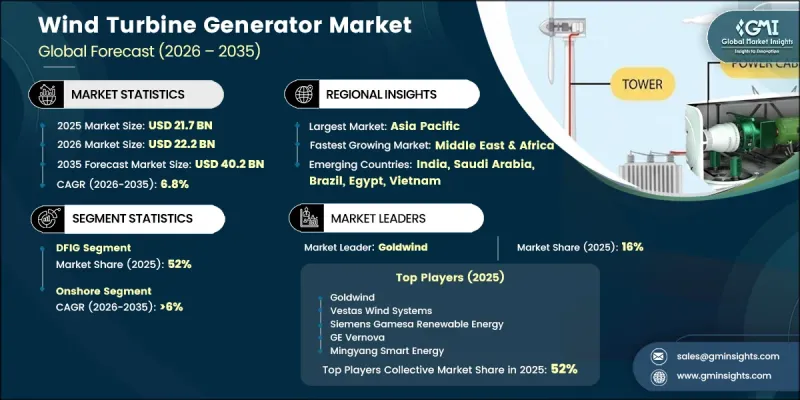
隨著各國擴大可再生能源發電裝置容量並優先發展更清潔的發電技術,市場持續成長。對電網現代化改造的持續投資、渦輪機系統的技術進步以及不斷成長的電力需求,都為產業擴張創造了有利條件。製造商正致力於提高發電機的效率、可靠性和運作性能,以滿足不斷變化的能源需求。對風力發電基礎設施投資的增加,以及相關政策的支持和現有風電設施的現代化改造,進一步推動了市場成長。先進數位監控技術的引進、零件耐久性的提升以及大容量渦輪機平台的出現,也增強了產業前景。對能源安全、脫碳目標以及經濟高效的可再生能源發電的日益重視,將繼續增強多個地區對風力發電機組的長期需求,從而在整個預測期內支持市場的永續發展。
| 市場範圍 | |
|---|---|
| 開始年份 | 2025 |
| 預測期 | 2026-2035 |
| 上市時的市場規模 | 217億美元 |
| 預測金額 | 402億美元 |
| 複合年成長率 | 6.8% |
雙饋感應發電機(DFIG)預計在2025年將佔據52%的市場佔有率,並在2035年之前以4%的複合年成長率成長。該細分市場憑藉其完善的供應鏈、成熟的服務網路以及相對較低的變流器需求,保持主導地位。 DFIG能夠在僅使用部分額定功率變流器的情況下實現變速運行,這有助於降低系統整體成本並提高電網相容性,從而支持市場的持續擴張。
預計到2025年,陸域風電市佔率將達到81.1%,並在2035年之前以6%的複合年成長率成長。陸域風電憑藉其低廉的安裝成本、完善的基礎設施以及在主要風電市場龐大的年度裝機量,持續引領產業發展。在老舊風機被高容量機型取代以及先進風機平台持續普及的推動下,預計整個預測期內產品需求將保持強勁。
預計到2025年,美國風力發電機發電機市佔率將達到65%。市場成長的驅動力包括對公用事業規模風發電工程的持續投資、現有風電場的不斷現代化改造,以及旨在提高發電效率和運行可靠性的先進渦輪機技術的日益普及。從老舊風力發電機向高容量系統的轉變,以及對經濟高效的再生能源日益成長的需求,為設備製造商和服務供應商創造了機會。此外,隨著風電場裝置容量的增加,營運和維護活動的增加預計將在整個預測期內保持美國對風力發電機發電機及相關服務的穩定需求。
全球風力發電機市場的主要參與者包括ABB、Bergey Windpower、中車風能、中船海莊、東方電氣、斗山、Eocycle Technologies、遠景能源、Enercon、GE Vernova、金風科技、日立能源、Inox Wind、Lagerwey、明陽智慧能源、Nordex集團、西門科技、日立能源、Inox Wind、Lagerwey、明陽智慧能源、Nordex集團、西門經法、Windo門子 Energy、Suzons Energy.Windo門子 Energy、Sungaway Energy、Subway Energy、Subway Energy、Subway Energy。進入全球風力發電機市場的企業正透過優先考慮產品創新、擴大產能和提高營運效率來增強自身競爭力。許多製造商正在投資先進的發電機技術,以實現更高的效率、更強的可靠性和更低的維護需求。各公司也正在增加研發投入,以推出滿足不斷變化的客戶需求的高容量解決方案。與專案開發商、電力公司和技術供應商建立策略合作夥伴關係,有助於企業拓展市場覆蓋範圍並確保長期業務發展。為了提高客戶維繫率,各公司都在透過預測性維護解決方案、數位化監控平台和綜合服務合約來加強售後服務。此外,為了滿足不斷成長的需求,他們正在擴大區域企業發展,最佳化供應鏈,提高生產能力,加強長期市場基礎,並增強整體競爭力。
目錄
第1章:調查方法和範圍
第2章執行摘要
第3章 行業洞察
- 產業生態系統
- 監理情勢
- 影響產業的因素
- 促進因素
- 產業潛在風險與挑戰
- 成長潛力分析
- 價格趨勢分析
- 波特的分析
- PESTLE分析
第4章 競爭情勢
- 介紹
- 企業市佔率分析:按地區分類
- 北美洲
- 歐洲
- 亞太地區
- 中東和非洲
- 拉丁美洲
- 戰略儀錶板
- 策略舉措
- 企業標竿管理
- 創新與科技趨勢
第5章 市場規模及預測:依發電機類型分類,2022-2035年
- PMSG
- DFIG
- EESG
- SCIG
第6章 市場規模與預測:依產能分類,2022-2035年
- 小於2兆瓦
- 2~5 MW
- 5~10 MW
- 10兆瓦或以上
第7章 市場規模及預測:依應用領域分類,2022-2035年
- 陸上
- 離岸
第8章 市場規模與預測:依最終用戶分類,2022-2035年
- 公共產業及獨立發電商(IPP)
- 工業專屬式
- 商業和微電網
- 住宅和地方區域的風力發電
第9章 市場規模及預測:依實施方案分類,2022-2035年
- 新的
- 更新
第10章 市場規模及預測:依驅動系統分類,2022-2035年
- 齒輪傳動
- 直驅
- 混合
第11章 市場規模及預測:依地區分類,2021-2034年
- 北美洲
- 美國
- 加拿大
- 墨西哥
- 歐洲
- 德國
- 法國
- 瑞典
- 英國
- 西班牙
- 義大利
- 亞太地區
- 中國
- 印度
- 日本
- 韓國
- 澳洲
- 中東和非洲
- 沙烏地阿拉伯
- UAE
- 埃及
- 南非
- 拉丁美洲
- 巴西
- 智利
- 阿根廷
第12章:公司簡介
- ABB
- Bergey Windpower
- CRRC Wind
- CSIC Haizhuang
- Dongfang Electric
- Doosan
- Eocycle Technologies
- Envision Energy
- Enercon
- GE Vernova
- Goldwind
- Hitachi Energy
- Inox Wind
- Lagerwey
- Mingyang Smart Energy
- Nordex Group
- Siemens Gamesa Renewable Energy
- Suzlon Energy
- Vestas Wind Systems
- Windey Energy
The Global Wind Turbine Generator Market was valued at USD 21.7 billion in 2025 and is estimated to grow at a CAGR of 6.8% to reach USD 40.2 billion by 2035.
The market continues to gain momentum as countries expand renewable energy capacity and prioritize cleaner power generation technologies. Continuous investments in grid modernization, technological advancements in turbine systems, and increasing electricity demand are creating favorable conditions for industry expansion. Manufacturers are focusing on improving generator efficiency, reliability, and operational performance to meet evolving energy requirements. Rising investments in wind energy infrastructure, combined with supportive policy initiatives and the modernization of existing wind assets, are further contributing to market growth. The integration of advanced digital monitoring technologies, improved component durability, and higher-capacity turbine platforms is also strengthening the industry's outlook. Growing emphasis on energy security, decarbonization targets, and cost-effective renewable electricity generation continues to reinforce long-term demand for wind turbine generators across multiple regions, supporting sustained market development throughout the forecast period.
| Market Scope | |
|---|---|
| Start Year | 2025 |
| Forecast Year | 2026-2035 |
| Start Value | $21.7 Billion |
| Forecast Value | $40.2 Billion |
| CAGR | 6.8% |
The DFIG segment captured a 52% share in 2025 and is forecast to grow at a 4% CAGR through 2035. The segment maintains its leading position because it benefits from a well-developed supply chain, a mature servicing network, and comparatively lower converter requirements. Its capability to enable variable-speed operation while relying on a partially rated power converter helps reduce overall system costs and improves grid compatibility, supporting continued market expansion.
The onshore segment accounted for 81.1% share in 2025 and is forecast to grow at a 6% CAGR through 2035. The segment continues to lead the industry due to its lower installation expenses, established deployment infrastructure, and significant annual deployment volumes across major wind energy markets. The replacement of aging turbines with higher-capacity models and the continued deployment of advanced turbine platforms are expected to support ongoing product demand throughout the forecast period.
U.S. Wind Turbine Generator Market held a 65% share in 2025. Market growth is supported by ongoing investments in utility-scale wind energy projects, continued modernization of existing wind farms, and increasing adoption of advanced turbine technologies designed to improve power generation efficiency and operational reliability. The replacement of aging wind turbines with higher-capacity systems, coupled with growing demand for cost-effective renewable electricity, is creating favorable opportunities for equipment manufacturers and service providers. In addition, the expansion of operation and maintenance activities, driven by a growing installed wind power base, is expected to support consistent demand for wind turbine generators and related services across the U.S. throughout the forecast period.
The leading companies operating in the global wind turbine generator market include ABB, Bergey Windpower, CRRC Wind, CSIC Haizhuang, Dongfang Electric, Doosan, Eocycle Technologies, Envision Energy, Enercon, GE Vernova, Goldwind, Hitachi Energy, Inox Wind, Lagerwey, Mingyang Smart Energy, Nordex Group, Siemens Gamesa Renewable Energy, Suzlon Energy, Vestas Wind Systems, and Windey Energy. Companies participating in the global wind turbine generator market are strengthening their competitive position by prioritizing product innovation, expanding manufacturing capabilities, and improving operational efficiency. Many manufacturers are investing in advanced generator technologies that deliver higher efficiency, enhanced reliability, and lower maintenance requirements. Businesses are also increasing research and development spending to introduce higher-capacity solutions that address evolving customer requirements. Strategic collaborations with project developers, utilities, and technology providers are helping companies broaden their market reach and secure long-term business opportunities. Organizations are enhancing their after-sales services through predictive maintenance solutions, digital monitoring platforms, and comprehensive service agreements to improve customer retention. In addition, firms are expanding their regional presence, optimizing supply chains, and increasing production capacity to meet rising demand while reinforcing their long-term market foothold and improving their overall competitive position.
Table of Contents
Chapter 1 Methodology & Scope
- 1.1 Research design
- 1.1.1 Research approach
- 1.1.2 Data collection methods
- 1.1.3 Base estimates and calculations
- 1.1.4 Base year calculation
- 1.1.5 Key trends for market estimates
- 1.2 Forecast model
- 1.3 Primary research & validation
- 1.3.1 Primary sources
- 1.4 Data mining sources
- 1.5 Market definitions
Chapter 2 Executive Summary
- 2.1 Industry 360-degree synopsis, 2022 – 2035
- 2.2 Business trends
- 2.3 Generator type trends
- 2.4 Capacity trends
- 2.5 Application trends
- 2.6 End User trends
- 2.7 Installation trends
- 2.8 Drive train trends
- 2.9 Regional trends
Chapter 3 Industry Insights
- 3.1 Industry ecosystem
- 3.2 Regulatory landscape
- 3.3 Industry impact forces
- 3.3.1 Growth drivers
- 3.3.2 Industry pitfalls & challenges
- 3.4 Growth potential analysis
- 3.5 Price trend analysis
- 3.6 Porter's analysis
- 3.6.1 Bargaining power of suppliers
- 3.6.2 Bargaining power of buyers
- 3.6.3 Threat of new entrants
- 3.6.4 Threat of substitutes
- 3.7 PESTEL analysis
Chapter 4 Competitive landscape, 2026
- 4.1 Introduction
- 4.2 Company market share analysis, by region, 2025
- 4.2.1 North America
- 4.2.2 Europe
- 4.2.3 Asia Pacific
- 4.2.4 Middle East & Africa
- 4.2.5 Latin America
- 4.3 Strategic dashboard
- 4.4 Strategic initiatives
- 4.5 Company benchmarking
- 4.6 Innovation & technology landscape
Chapter 5 Market Size and Forecast, By Generator Type, 2022 – 2035 (USD Million)
- 5.1 Key trends
- 5.2 PMSG
- 5.3 DFIG
- 5.4 EESG
- 5.5 SCIG
Chapter 6 Market Size and Forecast, By Capacity, 2022 – 2035 (USD Million)
- 6.1 Key trends
- 6.2 Below 2 MW
- 6.3 2-5 MW
- 6.4 5-10 MW
- 6.5 Above 10 MW
Chapter 7 Market Size and Forecast, By Application, 2022 – 2035 (USD Million)
- 7.1 Key trends
- 7.2 Onshore
- 7.3 Offshore
Chapter 8 Market Size and Forecast, By End User, 2022 – 2035 (USD Million)
- 8.1 Key trends
- 8.2 Utilities & IPPs
- 8.3 Industrial Captive
- 8.4 Commercial & Micro Grid
- 8.5 Residential & Community wind
Chapter 9 Market Size and Forecast, By Installation, 2022 – 2035 (USD Million)
- 9.1 Key trends
- 9.2 New
- 9.3 Replacement
Chapter 10 Market Size and Forecast, By Drivetrain, 2022 – 2035 (USD Million)
- 10.1 Key trends
- 10.2 Geared drive
- 10.3 Direct drive
- 10.4 Hybrid
Chapter 11 Market Size and Forecast, By Region, 2021 – 2034 (USD Billion)
- 11.1 Key trends
- 11.2 North America
- 11.2.1 U.S.
- 11.2.2 Canada
- 11.2.3 Mexico
- 11.3 Europe
- 11.3.1 Germany
- 11.3.2 France
- 11.3.3 Sweden
- 11.3.4 UK
- 11.3.5 Spain
- 11.3.6 Italy
- 11.4 Asia Pacific
- 11.4.1 China
- 11.4.2 India
- 11.4.3 Japan
- 11.4.4 South Korea
- 11.4.5 Australia
- 11.5 Middle East & Africa
- 11.5.1 Saudi Arabia
- 11.5.2 UAE
- 11.5.3 Egypt
- 11.5.4 South Africa
- 11.6 Latin America
- 11.6.1 Brazil
- 11.6.2 Chile
- 11.6.3 Argentina
Chapter 12 Company Profiles
- 12.1 ABB
- 12.2 Bergey Windpower
- 12.3 CRRC Wind
- 12.4 CSIC Haizhuang
- 12.5 Dongfang Electric
- 12.6 Doosan
- 12.7 Eocycle Technologies
- 12.8 Envision Energy
- 12.9 Enercon
- 12.10 GE Vernova
- 12.11 Goldwind
- 12.12 Hitachi Energy
- 12.13 Inox Wind
- 12.14 Lagerwey
- 12.15 Mingyang Smart Energy
- 12.16 Nordex Group
- 12.17 Siemens Gamesa Renewable Energy
- 12.18 Suzlon Energy
- 12.19 Vestas Wind Systems
- 12.20 Windey Energy

 螺旋式風力發電機市場-2026年至2032年全球市場預測風力發電機機組市場:全球市場預測,2026-2032年風力發電機葉片陶瓷塗層市場-2026-2032年全球市場預測
 自適應優化風力發電機市場分析及預測(至2035年):按類型、產品、服務、技術、組件、應用、最終用戶、功能、安裝類型和解決方案分類
 風力發電機:市場佔有率分析、行業趨勢和統計數據、成長預測(2026-2031 年)風力發電機市場:按類型、組件、容量、安裝類型、應用和最終用戶分類-2026-2032年全球市場預測風力發電機:市場佔有率分析、產業趨勢與統計、成長預測(2026-2031)
 無翼風力渦輪機市場-全球產業規模、佔有率、趨勢、機會、預測:按應用、最終用戶、地區和競爭格局分類,2021-2031年陸域風力發電機葉輪市場-全球產業規模、佔有率、趨勢、機會、預測:依葉片材料、區域和競爭格局分類,2021-2031年風力發電機制動器市場-全球產業規模、佔有率、趨勢、機會、預測:按應用、類型、運作模式、最終用戶、地區和競爭格局分類,2021-2031年