


 |
市場調查報告書
商品編碼
2156976
持續認證:市場佔有率分析、產業趨勢與統計、成長預測(2026-2031)Continuous Authentication - Market Share Analysis, Industry Trends & Statistics, Growth Forecasts (2026 - 2031) |
||||||

※ 本網頁內容可能與最新版本有所差異。詳細情況請與我們聯繫。
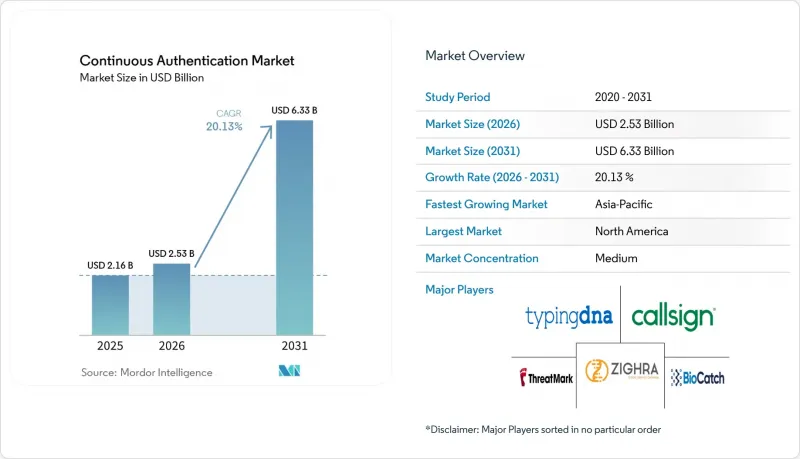
據 Mordor Intelligence 稱,2025 年持續認證市場價值為 21.6 億美元,預計到 2031 年將達到 63.3 億美元,而 2026 年為 25.3 億美元,2026 年至 2031 年預測期內的複合年成長率為 20.13%。
全球持續認證市場趨勢與洞察
帳戶劫持和會話劫持事件加劇
自動化憑證攻擊使得帳戶盜用更容易大規模發生。根據 LexisNexis Risk Solutions 預測,到 2025 年,帳戶盜用攻擊的總體發生率預計將達到 1.2%,比上一年成長 89%。該公司的數據還顯示,電子商務領域的登入攻擊發生率將從 3.4% 上升到 10.8%。 Proofpoint 的一項研究發現,在被成功盜用的帳戶中,59% 的帳戶在被攻擊時啟用了多因素身份驗證。這一差距促使安全投資轉向評估活動會話期間行為的控制措施。因此,當僅靠登入檢查無法識別使用者行為變化時,持續身份驗證市場將發揮重要作用。這個問題同樣適用於令牌重用和遠端會話盜用,因為即使憑證已洩露,會話也可能看起來仍然有效。企業可以利用交易行為的偏差、滑鼠移動的變化、異常的打字節奏或裝置上下文的變化來判斷會話是否應該繼續。這擴大了控制措施的實際價值,從防止未經授權的入侵擴展到在入侵後偵測濫用。
擴展零信任安全架構
在零信任架構中,組織必須在使用者和裝置的整個存取過程中檢驗。 NIST SP 1800-35 強制要求將持續使用者檢驗作為零信任實施方法的一部分。這種方法將持續身份驗證的地位從一項可選功能提升為身份架構的組成部分。它還為安全團隊提供了一個框架,將行為模式的檢查與網路分段和存取策略相結合。對於聯邦承包商和關鍵基礎設施營運商而言,這進一步證明了將其安全計畫與政府批准的指南保持一致的必要性。隨著越來越多的組織從早期的多因素身份驗證部署轉向成熟的零信任環境,持續身份驗證市場有望從中受益。持續身份驗證可以整合到存取請求、網路分段和策略決策中,而不是作為單獨的安全流程執行。這對於需要在不對所有使用者施加繁瑣身份驗證程序的情況下保護敏感應用程式的組織至關重要。它還支援在遠端員工、承包商和第三方用戶之間建立更一致的安全模型。
生物識別資料的隱私、同意與管治
在實施行為生物辨識技術時,必須考慮各司法管轄區的隱私和同意義務。歐盟委員會根據《一般資料保護規則》(GDPR) 第 9 條,將用於唯一識別個人的生物辨識資料定義為「特殊類型的個人資料」。最小化資料量並限制其使用可能會影響平台收集的訊號類型及其處理地點。歐洲和美國不同的法規使得在跨國部署中建立統一的同意流程變得困難。發表在 2025 年《科學報告》(Scientific Reports) 上的一篇論文描述了一種使用差分隱私和同構密碼學的聯邦生物識別方法。在持續身份驗證市場中,必須在更強大的檢測模型和減少敏感行為資訊外洩的設計之間取得平衡。當行為資訊跨境處理或在機構間聚合時,基於雲端的服務可能會面臨更嚴格的審查。設備端處理和聯邦方法可以限制原始資料的流動,但也可能限制對支撐模型性能的廣泛訊號池的存取。服務提供者還必須解釋如何獲得同意、資訊將保留多長時間以及使用者如何行使適用的隱私權。
細分市場分析
到2025年,軟體將佔總收入的69.73%,成為持續身分驗證市場中最大的組成部分。軟體平台可以透過雲端服務交付,無需安裝專用硬體。金融機構正在利用這些工具來評估日益增加的客戶會話中的行為訊號。擴大註冊範圍可以提昇平台所保存的歷史行為模式的價值。當模型整合到多個應用程式和業務流程中時,這將產生轉換成本。該領域還允許根據欺詐手段和數位管道的變化頻繁更新模型,共用的營運數據有助於提供者在各種銀行和商業環境中改進檢測方法。買家也重視集中管理,因為他們無需更換實體身份驗證系統即可更改策略、報告規則和風險閾值值。
預計到2031年,該服務的市場規模將以26.38%的複合年成長率成長。服務內容包括整合支援、模型校準、營運管理和安全文件編寫。對於大規模部署,通常需要在簽訂多年軟體合約之前對客戶特定應用程式進行測試。 2025年,BioCatch發布了Connect 2.0,其中包含Align SDK和整合工具BioCatch Link。同年,該公司報告稱,其中端市場合作夥伴管道的年度經常性收入成長了60%,並透過單一平台獲得了70多家區域性銀行和信用社的合作。客製化企業營運和自動化入駐之間的差異將決定組件提供者如何服務小規模買家。
到 2025 年,雲端將佔據持續身分驗證市場 61.74% 的佔有率。雲端能夠處理跨多個客戶管道的大量會話遙測資料。雲端採用也與零信任計畫中使用的身份編配模式相契合。預計到 2031 年,雲端採用的持續身分驗證市場規模將以 25.89% 的複合年成長率成長。如此高的市場佔有率和最快的成長速度反映了企業基礎架構(即使尚未部署)也持續採用雲端技術。雲端系統還可以簡化對集中式更新和威脅情報的存取。
在政府和關鍵基礎設施環境中,本地部署仍然發揮著至關重要的作用。資料主權要求和隔離網路可能會限制外部託管的行為分析的使用。 NIST SP 1800-35 包含了支援混合式身分識別環境中本地分析的架構。混合部署允許銀行在本地處理對延遲敏感的訊號,同時利用雲端系統進行更廣泛的詐欺分析。 2025 年感測器研究表明,生物識別和環境訊號的融合能夠在資源受限的設備上實現持續身份驗證。這些方法表明,部署選項將繼續與隱私、連接性和營運要求密切相關。當客戶需要快速做出決策或敏感資料無法發送到中央環境時,基於邊緣和設備的處理非常有用。此外,由於安全團隊必須跨更廣泛的端點管理策略,因此它也可能增加管治任務。
區域分析
到2025年,北美將佔據持續身份驗證市場36.43%的佔有率。該地區擁有早期採用者、大規模的數位銀行基礎設施以及對企業網路安全的強勁需求。聯邦金融機構檢查委員會(FFIEC)的指導意見推動了網路銀行多層身份驗證方法的發展。美國機構處理大量的數位交易,佔據了該地區需求的很大一部分。此外,加拿大銀行在零售、商業和財富管理業務中多年來對設備智慧和即時風險評分的採用,反映了加拿大銀行對這些功能的日益濃厚的興趣。在墨西哥,行動銀行和金融科技服務的擴張正在創造新的商機。
歐洲仍然是該地區第二大市場。該地區的金融機構遵循一套詳盡的強客戶認證和營運彈性框架。歐洲銀行管理局 (EBA) 關於強客戶認證中行為資料的立場為這些實施提供了監管基礎。將於 2025 年 1 月生效的《資料保護條例》(DORA) 強制要求將強認證機制納入資訊與通訊科技 (ICT) 風險管理。在英國、德國、法國和荷蘭,許多歐洲企業都已實施了相關措施。 「隱私設計」方法在該地區也至關重要,因為資料最小化正在重塑行為資料架構。
在亞太地區,持續身分驗證市場預計到2031年將以26.71%的複合年成長率成長。數位金融服務和智慧型手機的日益普及推動了高頻身份驗證互動的增加。印度、韓國和新加坡政府主導的數位身分計畫進一步鞏固了安全線上服務的基礎。 2025年2月,NEC開發出一種生物識別數位簽章技術,無需儲存或傳輸臉部資訊即可實現臉部認證。在南美洲,巴西處於領先地位,即時支付的活性化推動了對即時詐欺防範的需求。 2025年,BioCatch推出了“BioCatch Trust Argentina”,這是一個基於銀行間行為和設備的詐欺資訊共用網路。在中東和非洲地區,阿拉伯聯合大公國和沙烏地阿拉伯已出現早期需求,而在波灣合作理事會(GCC)國家,透過電信營運商進行分銷是主要的切入點。
其他好處:
- Excel格式的市場預測(ME)表
- 3個月的分析師支持
目錄
第1章:引言
- 研究假設和市場定義
- 調查範圍
第2章:調查方法
第3章執行摘要
第4章 市場狀況
- 市場概覽
- 市場促進因素
- 帳戶劫持和會話劫持事件加劇
- 擴展零信任安全架構
- 數位銀行和高風險線上交易的成長
- 基於風險的認證的監管要求
- 登入後檢測遠端存取和會話切換
- 保護隱私的設備內行為模型
- 市場限制因素
- 生物識別資料的隱私、同意與管治
- 跨傳統身份驗證協定堆疊整合的複雜性
- 行為偏差和假陽性導致的暴露
- 利用生成式人工智慧和深度造假技術來檢測行為欺騙的能力有限。
- 宏觀經濟因素的影響
- 價值和供應鏈分析
- 監理情勢
- 技術展望
- 波特五力分析
第5章 市場規模與成長預測
- 按組件
- 軟體
- 服務
- 部署模式
- 雲
- 現場
- 混合
- 身份驗證方法
- 行為生物特徵學
- 生理生物生物識別
- 設備、會話和環境智慧
- 多訊號連續認證
- 按組織規模
- 大公司
- 小型企業
- 按行業分類
- 政府和公共行政
- 零售與電子商務
- 運輸/物流
- 能源公用事業
- 資訊科技/通訊
- 媒體與娛樂
- 銀行、金融服務和保險(BFSI)
- 醫療保健和生命科學
- 其他工業部門
- 按地區
- 北美洲
- 美國
- 加拿大
- 墨西哥
- 南美洲
- 巴西
- 阿根廷
- 其他南美國家
- 歐洲
- 德國
- 英國
- 法國
- 義大利
- 比荷盧經濟聯盟
- 其他歐洲國家
- 亞太地區
- 中國
- 日本
- 印度
- 韓國
- 澳洲
- 其他亞太國家
- 中東和非洲
- 中東
- 阿拉伯聯合大公國
- 沙烏地阿拉伯
- 其他中東國家
- 非洲
- 南非
- 奈及利亞
- 埃及
- 其他非洲國家
- 中東
- 北美洲
第6章 競爭情勢
- 市場集中度
- 策略趨勢
- 市佔率分析
- 公司簡介
- BioCatch Ltd.
- ThreatMark sro
- Callsign Inc.
- TypingDNA Inc.
- Zighra Inc.
- BehavioSec AB
- SecuredTouch Ltd.
- Plurilock Security Inc.
- Neuro-ID, Inc.
- AimBrain Solutions Ltd.
- FST Biometrics Ltd.
- ID R&D Inc.
- LoginID Inc.
- XTN Cognitive Security
- Unbotify Ltd.
- Nethone Sp. z oo
- DataVisor, Inc.
- Featurespace Limited
- SardineAI Corp.
- Celebrus Technologies plc
- InnaIT Ltd.
- Neomia SAS
- Hummingbirds AI, Inc.
- Realeyes Data Services Ltd.
- Smart Eye AB
- Shufti Pro Limited
第7章 市場機會與未來展望
According to Mordor Intelligence, the continuous authentication market size was valued at USD 2.16 billion in 2025 and estimated to grow from USD 2.53 billion in 2026 to reach USD 6.33 billion by 2031, at a CAGR of 20.13% during the forecast period 2026-2031.
Global Continuous Authentication Market Trends and Insights
Escalation of Account Takeover and Session Hijacking
Account takeover has become easier to scale through automated credential attacks. LexisNexis Risk Solutions recorded a 1.2% overall account takeover attack rate in 2025, up 89% from the prior year. Its data also showed that e-commerce login attack rates rose from 3.4% to 10.8% in 2025. Proofpoint found that 59% of accounts affected by successful takeover had multifactor authentication enabled at the time of compromise. This gap directs security spending toward controls that assess behavior during an active session. The continuous authentication market, therefore, has a clear role where a login check alone cannot identify a change in user behavior. The same issue applies to token replay and remote session handoffs, because the session may appear valid even after credentials are compromised. Enterprises can use behavioral deviations during transactions, changes in mouse movement, unusual typing cadence, or shifts in device context to determine whether a session should continue. This expands the practical value of a control from preventing unauthorized entry to detecting misuse after entry.
Expansion of Zero-Trust Security Architectures
Zero-trust architecture requires organizations to verify users and devices throughout access activity. NIST SP 1800-35 identifies continuous verification of user identity as part of a zero-trust implementation approach. This approach moves continuous authentication from an optional feature to a component of identity architecture. It also provides security teams with a framework for connecting behavior-based checks to network segmentation and access policies. Federal contractors and critical infrastructure operators have a further reason to align their security programs with recognized government guidance. The continuous authentication market can benefit as more organizations move from initial multifactor authentication deployments toward mature zero-trust environments. Continuous identity checks can be integrated into access requests, network segments, and policy decisions rather than running as a separate security process. This matters to organizations that need to protect sensitive applications without requiring every user to complete a disruptive challenge. It also supports a more consistent security model across remote employees, contractors, and third-party users.
Privacy, Consent, and Biometric Data Governance
Behavioral biometric deployments must account for privacy and consent obligations across jurisdictions. The European Commission describes biometric data processed to uniquely identify a person as a special category of personal data under Article 9 of the General Data Protection Regulation. Data minimization and purpose limitation can affect what signals a platform collects and where it processes them. Different rules in Europe and the United States make a single consent process difficult for multinational deployments. A 2025 Scientific Reports paper described a federated biometric authentication approach using differential privacy and homomorphic encryption. The continuous authentication market must balance stronger detection models with designs that reduce exposure of sensitive behavioral information. Cloud-based services can face added scrutiny when behavioral information is processed across borders or combined across institutions. On-device and federated approaches can limit raw data movement, although they may reduce access to the broad signal pools that support model performance. Providers must also explain how consent is obtained, how long information is kept, and how a user can exercise applicable privacy rights.
Other drivers and restraints analyzed in the detailed report include:
- Growth of Digital Banking and High-Risk Online Transactions
- Regulatory Demand for Risk-Based Authentication
- Integration Complexity Across Legacy Authentication Stacks
For complete list of drivers and restraints, kindly check the Table Of Contents.
Segment Analysis
Software held 69.73% of revenue in 2025, making it the largest component of the continuous authentication market. Software platforms can be delivered through cloud services without a dedicated hardware installation. Financial institutions use these tools to assess behavioral signals across a growing number of customer sessions. Broader enrollment can improve the value of a platform's historical behavior patterns. This creates switching costs where models are connected to several applications and operational workflows. The segment also supports frequent model updates as fraud tactics and digital channels change, while shared operating data can help providers refine detection methods across different banking and commerce environments. Buyers also value centralized administration because policies, reporting rules, and risk thresholds can be changed without replacing a physical authentication system.
Services are projected to grow at a CAGR of 26.38% through 2031. Service work includes integration, model calibration, managed operations, and support for security documentation. Larger deployments often need testing against the customer's specific applications before a multiyear software agreement is signed. BioCatch introduced Connect 2.0 in 2025 with the Align SDK and BioCatch Link integration tool. The company reported 60% annual recurring revenue growth in its midmarket partner channel during 2025 and added more than 70 community banks and credit unions through a single platform. The difference between tailored enterprise work and automated onboarding will shape how component providers serve smaller buyers.
Cloud held 61.74% of the continuous authentication market share in 2025. It provides the capacity to process large volumes of session telemetry across multiple customer channels. Cloud deployment also fits identity orchestration models used in zero-trust programs. The continuous authentication market size for cloud deployments is projected to grow at a CAGR of 25.89% through 2031. This combination of the largest share and fastest growth reflects continued adoption across an undeployed enterprise base. Cloud systems can also simplify access to centralized updates and threat intelligence.
On-premises installations remain relevant in government and critical infrastructure settings. Data sovereignty requirements and isolated networks can limit the use of externally hosted behavioral processing. NIST SP 1800-35 includes architectures that accommodate on-premises analytics within hybrid identity environments. Hybrid deployments can allow banks to process latency-sensitive signals locally and use cloud systems for broader fraud analysis. A 2025 Sensors study demonstrated continuous authentication on resource-constrained devices through biometric and environmental signal fusion. These approaches show why deployment choices will remain linked to privacy, connectivity, and operational requirements. Edge and device-based processing can be useful where a customer needs rapid decisions or cannot send sensitive data to a central environment. They may also add governance work because security teams must manage policies across a wider set of endpoints.
Complete Report Scope:
- By Component
- Software
- Services
- By Deployment Mode
- Cloud
- On-Premises
- Hybrid
- By Authentication Method
- Behavioral Biometrics
- Physiological Biometrics
- Device, Session, and Environmental Intelligence
- Multisignal Continuous Authentication
- By Organization Size
- Large Enterprises
- Small and Medium-Sized Enterprises
- By Industry Vertical
- Government and Public Administration
- Retail and E-Commerce
- Transportation and Logistics
- Energy and Utilities
- IT and Telecommunication
- Media and Entertainment
- Banking, Financial Services, and Insurance (BFSI)
- Healthcare and Life Sciences
- Other Industry Verticals
- By Geography
- North America
- United States
- Canada
- Mexico
- South America
- Brazil
- Argentina
- Rest of South America
- Europe
- Germany
- United Kingdom
- France
- Italy
- BENELUX
- Rest of Europe
- Asia-Pacific
- China
- Japan
- India
- South Korea
- Australia
- Rest of Asia-Pacific
- Middle East and Africa
- Middle East
- United Arab Emirates
- Saudi Arabia
- Rest of Middle East
- Africa
- South Africa
- Nigeria
- Egypt
- Rest of Africa
- Middle East
- North America
Geography Analysis
North America held 36.43% of the continuous authentication market share in 2025. The region has early-adopter financial institutions, a large digital banking base, and strong demand for enterprise cybersecurity. Federal Financial Institutions Examination Council guidance has supported layered approaches to authentication in online banking. The United States accounts for much of the region's demand because its organizations process high volumes of digital transactions. A multiyear deployment of device intelligence and real-time risk scoring across retail, commercial, and wealth operations also reflected growing interest among Canadian banks in these capabilities. Mexico offers a developing opportunity as mobile banking and fintech services expand.
Europe remained the second-largest regional market. Its financial institutions operate within a detailed framework for strong customer authentication and operational resilience. The European Banking Authority's position on behavioral data for strong customer authentication provides a regulatory basis for these implementations. DORA has been applied since January 2025 and requires strong authentication mechanisms as part of information and communication technology risk management. The United Kingdom, Germany, France, and the Netherlands host many European enterprise deployments. Privacy-by-design approaches also matter in the region because data minimization shapes behavioral data architectures.
Asia-Pacific is projected to grow at a CAGR of 26.71% in the continuous authentication market through 2031. Expansion in digital financial services and smartphone use is increasing the number of high-frequency identity interactions. Government digital identity programs in India, South Korea, and Singapore provide a broader foundation for secure online services. NEC developed biometric digital signature technology in February 2025 that enabled facial authentication without storing or transmitting facial information. South America is led by Brazil, where instant payment activity has increased the need for real-time fraud controls. BioCatch launched BioCatch Trust Argentina in 2025 as an interbank behavior and device-based fraud intelligence-sharing network. The Middle East and Africa have early demand in the UAE and Saudi Arabia, while telecom distribution provides an entry route in the Gulf Cooperation Council countries.
- BioCatch Ltd.
- ThreatMark s.r.o.
- Callsign Inc.
- TypingDNA Inc.
- Zighra Inc.
- BehavioSec AB
- SecuredTouch Ltd.
- Plurilock Security Inc.
- Neuro-ID, Inc.
- AimBrain Solutions Ltd.
- FST Biometrics Ltd.
- ID R&D Inc.
- LoginID Inc.
- XTN Cognitive Security
- Unbotify Ltd.
- Nethone Sp. z o.o.
- DataVisor, Inc.
- Featurespace Limited
- SardineAI Corp.
- Celebrus Technologies plc
- InnaIT Ltd.
- Neomia SAS
- Hummingbirds AI, Inc.
- Realeyes Data Services Ltd.
- Smart Eye AB
- Shufti Pro Limited
Additional Benefits:
- The market estimate (ME) sheet in Excel format
- 3 months of analyst support
TABLE OF CONTENTS
1 INTRODUCTION
- 1.1 Study Assumptions and Market Definition
- 1.2 Scope of the Study
2 RESEARCH METHODOLOGY
3 EXECUTIVE SUMMARY
4 MARKET LANDSCAPE
- 4.1 Market Overview
- 4.2 Market Drivers
- 4.2.1 Escalation of Account Takeover and Session Hijacking
- 4.2.2 Expansion of Zero-Trust Security Architectures
- 4.2.3 Growth of Digital Banking and High-Risk Online Transactions
- 4.2.4 Regulatory Demand for Risk-Based Authentication
- 4.2.5 Post-Login Remote-Access and Session-Handoff Detection
- 4.2.6 Privacy-Preserving On-Device Behavioral Models
- 4.3 Market Restraints
- 4.3.1 Privacy, Consent, and Biometric Data Governance
- 4.3.2 Integration Complexity Across Legacy Authentication Stacks
- 4.3.3 Behavioral Drift and False-Positive Exposure
- 4.3.4 Limited Detection of Generative-AI and Deepfake Behavioral Spoofing
- 4.4 Impact of Macroeconomic Factors
- 4.5 Value and Supply-Chain Analysis
- 4.6 Regulatory Landscape
- 4.7 Technological Outlook
- 4.8 Porter's Five Forces Analysis
- 4.8.1 Threat of New Entrants
- 4.8.2 Bargaining Power of Suppliers
- 4.8.3 Bargaining Power of Buyers
- 4.8.4 Threat of Substitutes
- 4.8.5 Competitive Rivalry
5 MARKET SIZE AND GROWTH FORECASTS (VALUE)
- 5.1 By Component
- 5.1.1 Software
- 5.1.2 Services
- 5.2 By Deployment Mode
- 5.2.1 Cloud
- 5.2.2 On-Premises
- 5.2.3 Hybrid
- 5.3 By Authentication Method
- 5.3.1 Behavioral Biometrics
- 5.3.2 Physiological Biometrics
- 5.3.3 Device, Session, and Environmental Intelligence
- 5.3.4 Multisignal Continuous Authentication
- 5.4 By Organization Size
- 5.4.1 Large Enterprises
- 5.4.2 Small and Medium-Sized Enterprises
- 5.5 By Industry Vertical
- 5.5.1 Government and Public Administration
- 5.5.2 Retail and E-Commerce
- 5.5.3 Transportation and Logistics
- 5.5.4 Energy and Utilities
- 5.5.5 IT and Telecommunication
- 5.5.6 Media and Entertainment
- 5.5.7 Banking, Financial Services, and Insurance (BFSI)
- 5.5.8 Healthcare and Life Sciences
- 5.5.9 Other Industry Verticals
- 5.6 By Geography
- 5.6.1 North America
- 5.6.1.1 United States
- 5.6.1.2 Canada
- 5.6.1.3 Mexico
- 5.6.2 South America
- 5.6.2.1 Brazil
- 5.6.2.2 Argentina
- 5.6.2.3 Rest of South America
- 5.6.3 Europe
- 5.6.3.1 Germany
- 5.6.3.2 United Kingdom
- 5.6.3.3 France
- 5.6.3.4 Italy
- 5.6.3.5 BENELUX
- 5.6.3.6 Rest of Europe
- 5.6.4 Asia-Pacific
- 5.6.4.1 China
- 5.6.4.2 Japan
- 5.6.4.3 India
- 5.6.4.4 South Korea
- 5.6.4.5 Australia
- 5.6.4.6 Rest of Asia-Pacific
- 5.6.5 Middle East and Africa
- 5.6.5.1 Middle East
- 5.6.5.1.1 United Arab Emirates
- 5.6.5.1.2 Saudi Arabia
- 5.6.5.1.3 Rest of Middle East
- 5.6.5.2 Africa
- 5.6.5.2.1 South Africa
- 5.6.5.2.2 Nigeria
- 5.6.5.2.3 Egypt
- 5.6.5.2.4 Rest of Africa
- 5.6.5.1 Middle East
- 5.6.1 North America
6 COMPETITIVE LANDSCAPE
- 6.1 Market Concentration
- 6.2 Strategic Moves
- 6.3 Market Share Analysis
- 6.4 Company Profiles (includes Global Level Overview, Market Level Overview, Core Segments, Financials as available, Strategic Information, Market Rank/Share, Products and Services, Recent Developments)
- 6.4.1 BioCatch Ltd.
- 6.4.2 ThreatMark s.r.o.
- 6.4.3 Callsign Inc.
- 6.4.4 TypingDNA Inc.
- 6.4.5 Zighra Inc.
- 6.4.6 BehavioSec AB
- 6.4.7 SecuredTouch Ltd.
- 6.4.8 Plurilock Security Inc.
- 6.4.9 Neuro-ID, Inc.
- 6.4.10 AimBrain Solutions Ltd.
- 6.4.11 FST Biometrics Ltd.
- 6.4.12 ID R&D Inc.
- 6.4.13 LoginID Inc.
- 6.4.14 XTN Cognitive Security
- 6.4.15 Unbotify Ltd.
- 6.4.16 Nethone Sp. z o.o.
- 6.4.17 DataVisor, Inc.
- 6.4.18 Featurespace Limited
- 6.4.19 SardineAI Corp.
- 6.4.20 Celebrus Technologies plc
- 6.4.21 InnaIT Ltd.
- 6.4.22 Neomia SAS
- 6.4.23 Hummingbirds AI, Inc.
- 6.4.24 Realeyes Data Services Ltd.
- 6.4.25 Smart Eye AB
- 6.4.26 Shufti Pro Limited
7 MARKET OPPORTUNITIES AND FUTURE OUTLOOK
- 7.1 White-Space and Unmet-Need Assessment

 IT認證培訓市場預測至2034年-全球分析(按認證類型、培訓交付方式、認證等級、培訓提供者、應用、最終使用者和地區分類)
 OOB認證市場規模、佔有率和成長分析:按組件、認證方法、部署類型、企業規模、最終用戶和地區分類-2026-2033年產業預測
 號碼檢驗平台:市場佔有率分析、產業趨勢與統計、成長預測(2026-2031)身分驗證服務:市場佔有率分析、產業趨勢與統計資料、成長預測(2026-2031 年)專業認證和培訓市場預測至2034年—按認證類型、培訓形式、交付方式、提供者類型、最終用戶和地區分類的全球分析金融服務業高級認證:市場佔有率分析、產業趨勢與統計及成長預測(2026-2031 年)
 基於手機的身份驗證市場報告:按產品類型、應用程式和地區分類(2026-2034 年)
 2026年全球單因子身份驗證系統市場報告2026年全球密碼認證市場報告
 OOB認證市場:按認證類型、應用、部署模式、最終用戶產業和組織規模分類 - 全球預測(2026-2032年)