


 |
市場調查報告書
商品編碼
2114058
身分驗證服務:市場佔有率分析、產業趨勢與統計資料、成長預測(2026-2031 年)Authentication Services - Market Share Analysis, Industry Trends & Statistics, Growth Forecasts (2026 - 2031) |
||||||

※ 本網頁內容可能與最新版本有所差異。詳細情況請與我們聯繫。
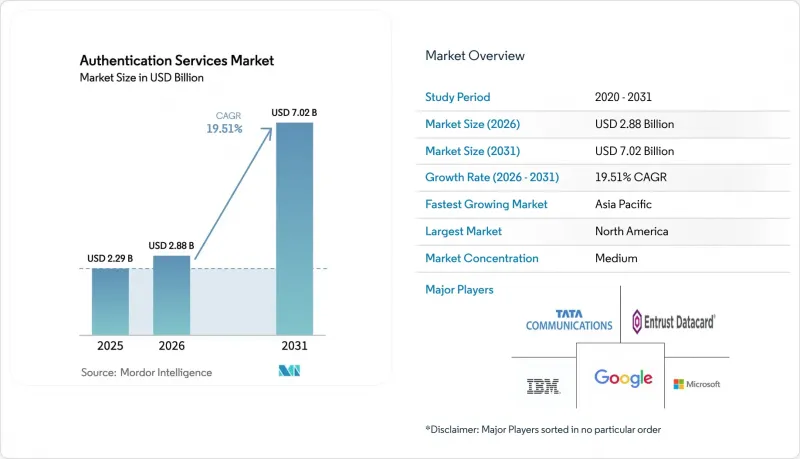
根據 Mordor Intelligence 預測,身分驗證服務市場規模將從 2025 年的 22.9 億美元成長到 2026 年的 28.8 億美元,到 2031 年將達到 70.2 億美元,2026 年至 2031 年的複合年成長率為 19.51%。
本報告依身分驗證類型(例如,無密碼身分驗證)、服務類型(例如,合規性管理)、部署模式(本地部署、公共雲端、私有雲端、混合部署)、最終用戶產業(例如,醫療保健、製造業)、組織規模(中小企業、大型企業)和地區進行細分。市場預測以美元(USD)為單位。
全球身分驗證服務市場趨勢與洞察
增加網路安全支出,以推進零信任舉措
美國聯邦政府指令要求所有私人企業在2027會計年度之前實施防釣魚的多因素身份驗證,以便即時採購FIDO2認證的令牌和風險管理引擎。歐洲銀行受《數位營運彈性法案》的監管,該法案將身分識別系統列為關鍵基礎設施,因此,歐洲銀行在2025會計年度預算中專注於自適應控制方面的投資。據報道,零信任架構的實施已將偵測到帳戶被盜用的平均時間縮短了三分之一,企業也能夠更清楚地了解憑證濫用。然而,由於傳統目錄缺乏即時策略整合能力,混合架構仍十分複雜。供應商正在透過提供雲端閘道器來解決這個問題,這些閘道器可以將安全性斷言標記語言(SAML)轉換為現代RESTful調用,從而降低遷移風險。這一因素使預計成長率提高了4.5個百分點,預計成長率將在2028年達到峰值,因為屆時多個監管截止日期將重疊。
Passkey 和 FIDO2 標準的興起降低了使用者體驗摩擦
到2025年,蘋果、谷歌和微軟將開始在21億台裝置上支援密碼金鑰,並將加密身分驗證整合到作業系統憑證管理員中,從而免去日常登入時輸入密碼的麻煩。 WebAuthn Level 3規範支援在雲端進行加密憑證備份,消除了裝置遺失這項先前阻礙普及的障礙。電子商務網站報告稱,在從簡訊驗證碼切換到密碼金鑰後,購物車放棄率降低了41%。日本和韓國的金融監管機構目前正將密碼金鑰定位為消費者應用程式的標準控制方法,並敦促銀行逐步淘汰傳統的憑證系統。隨著企業重組其服務台並遷移其憑證存儲,該標準帶來的便利性將使複合年成長率提高3.6個百分點。
成熟的身份驗證方法高成本
FIDO2硬體符記的成本在每位用戶25美元到55美元之間,這對價格敏感的中小型企業構成了一定的障礙。雖然筆記型電腦和智慧型手機中嵌入的生物識別感測器從長遠來看可以降低成本,但初始升級仍然需要資本投入,這與人事費用和行銷費用構成競爭。新興市場買家面臨安全模組的進口關稅,這使得總擁有成本增加了兩位數。供應商正在推出起價為每月3美元的按用戶訂閱模式來應對這項挑戰,但負責人往往會推遲續訂週期,直到受到保險公司和監管機構的壓力。這種成本阻力將使預期的複合年成長率下降1.9個百分點,直到規模經濟使單價低於大眾市場閾值。
細分市場分析
到2025年,多因素身分驗證 (MFA) 將佔據身分驗證服務市場57.24%的佔有率,凸顯其作為高價值工作流程中監管最低要求的地位。然而,預計到2031年,無密碼驗證方式的複合年成長率將達到20.29%,超過所有其他驗證方式,這反映了經營團隊為減少密碼重置次數和降低網路釣魚攻擊風險所做的努力。隨著GoogleWorkspace向1.8億用戶推出無密碼帳戶,預計到2025年,身分驗證服務市場將受益於3.4億個已註冊的金鑰。
無密碼技術的發展並非均衡。在美國一項醫療保健先導計畫中,每位臨床醫生的登入時間縮短了18秒,使他們每週能夠將大約2.3小時用於患者照護。歐洲銀行正在利用修訂後的支付服務指示中的一項例外條款,該條款允許對500歐元以下的交易僅使用生物識別技術,前提是設備與憑證關聯,並透過行為分析驗證身分。已實施Passkey的零售商發現,由於更流暢的支付體驗,顧客忠誠度提高,複購率也提高了29%。另一方面,製造業和能源公司仍然依賴硬體符記,因為空氣間隙隔離的營運技術(OT)無法跟上頻繁的韌體更新,這些行業在無密碼身份驗證的廣泛應用方面落後於其他行業。
預計到2025年,託管公鑰基礎設施 (MKI) 將佔總營收的39.16%,這表明企業希望將受WebTrust和ETSI審計的憑證生命週期營運外包。同時,受保險公司和銀行尋求基於上下文資訊的信任決策的需求驅動,基於風險的身份驗證編配預計將實現20.63%的複合年成長率。自適應引擎目前會評估設備健康狀況、地理位置異常和擊鍵節奏等細微的行為模式,僅在風險指標飆升時才加強身份驗證。
基於訂閱的金鑰管理減少了手動輪換儲存在微服務中的金鑰所需的時間,這項任務到 2025 年每月將耗費 14 個工程工時。報告和分析模組將證據數據整合到 SOC 2 和 ISO 27001 報告包中,從而減輕了 40% 的審計準備負擔。新加坡和香港的金融監管機構強制要求金融機構即時監控異常情況,這推動了身份驗證服務市場向 SaaS 儀表板發展,這些儀表板按用戶、設備和地區顯示風險指標。美國能源公司正在將自適應控制整合到其監控和資料收集 (SCADA) 層中,以滿足 CISA 的跨產業績效目標。
區域分析
預計到2025年,北美將佔全球銷售額的36.71%。這主要得益於一項總統令,該法令強制要求聯邦機構實施零信任,以及對具備反釣魚功能的身份驗證工具投入了4.2億美元。加拿大財政委員會秘書處將聯邦指南與泛加拿大信任框架相協調,並在各省之間建立了通用的身份驗證基礎設施。墨西哥的國家數位策略強調身分識別在普惠金融的應用,但由於後端現代化進程緩慢,其短期成效有限。
預計到2031年,亞太地區的複合年成長率將達到20.57%。這項成長主要得益於印度統一支付介面(UPI)的推動,該介面在2025年記錄了1,020億次身分驗證請求;以及中國強制要求在關鍵基礎設施的物聯網閘道中安裝硬體安全模組(HSM)的指令。日本和韓國目前正在強制要求行動銀行支援密碼金鑰,新加坡則正在將風險指南與即時評分結合。由新加坡、泰國和馬來西亞參與的東協互通性先導計畫旨在實現全部區域身份驗證資訊聯合,但屬性模式的完善仍然是一項挑戰。
在歐洲,eIDAS 2.0計畫正在穩步推進,目標是到2030年實現80%的公民使用數位錢包。德國聯邦資訊安全局(BSI)要求服務提供者將資料儲存在歐洲經濟區(EEA)內,並接受年度審計。英國退出互認框架迫使企業單獨管理客戶流量,導致成本上升。中東和非洲的普及情況不一。海灣國家在引入與銀行服務關聯的國民身分證方面取得了進展,而撒哈拉以南非洲國家則面臨著通訊基礎設施不穩定的困境。在拉丁美洲,普及速度緩慢,因為巴西強制要求對Pix支付進行嚴格的客戶身份驗證。然而,在其他地區,貨幣波動抑制了消費。
其他好處:
- Excel格式的市場預測(ME)表
- 3個月的分析師支持
目錄
第1章:引言
- 研究假設和市場定義
- 調查範圍
第2章:調查方法
第3章執行摘要
第4章 市場狀況
- 市場概覽
- 市場促進因素
- 數字身份數量的增加
- 獲得認證是確保安全合規和監管合規的必要條件。
- 自備設備辦公室(BYOD)的普及
- 企業增加網路安全支出,轉向零信任舉措
- Passkey 和 FIDO2 標準的引入減少了使用者體驗中的摩擦。
- 將身份驗證 API 整合到嵌入式物聯網模組中,可實現設備級收入來源。
- 市場限制因素
- 現有認證方法高成本
- 多因素身份驗證 (MFA) 的複雜性導致使用者疲勞和放棄登入。
- 從 2025 年起實施關稅後,硬體安全模組晶片的供應將受到限制。
- 各國數位身分系統的分散化阻礙了跨國身分驗證。
- 宏觀經濟因素對市場的影響
- 產業價值鏈分析
- 監理情勢
- 技術展望
- 波特五力分析
第5章 市場規模與成長預測
- 按身份驗證類型
- 單因素身份驗證
- 多因素身份驗證
- 無密碼身份驗證
- 按服務類型
- 合規管理
- 託管公鑰基礎設施
- 訂閱金鑰管理
- 報告與分析
- 基於風險的身份驗證編配
- 部署模式
- 現場
- 公共雲端
- 私有雲端
- 混合
- 按最終用戶行業分類
- 資訊科技/通訊
- BFSI
- 政府/國防
- 衛生保健
- 零售與電子商務
- 能源公用事業
- 製造業
- 教育
- 其他終端用戶產業
- 按組織規模
- 小型企業
- 大公司
- 按地區
- 北美洲
- 美國
- 加拿大
- 墨西哥
- 歐洲
- 德國
- 英國
- 法國
- 俄羅斯
- 其他歐洲國家
- 亞太地區
- 中國
- 日本
- 印度
- 韓國
- 澳洲
- 其他亞太國家
- 中東和非洲
- 中東
- 沙烏地阿拉伯
- 阿拉伯聯合大公國
- 其他中東國家
- 非洲
- 南非
- 埃及
- 其他非洲國家
- 中東
- 南美洲
- 巴西
- 阿根廷
- 其他南美國家
- 北美洲
第6章 競爭情勢
- 市場集中度
- 策略趨勢
- 市佔率分析
- 公司簡介
- Okta Inc.
- Microsoft Corporation
- IBM Corporation
- Thales Group
- Cisco Systems Inc.
- Entrust Datacard Corporation
- Broadcom Inc.
- Ping Identity Holding Corp.
- Google LLC
- OneLogin Inc.
- CyberArk Software Ltd.
- Yubico AB
- ForgeRock Inc.
- HID Global Corporation
- SailPoint Technologies Holdings Inc.
- Trustwave Holdings Inc.
- Wipro Limited
- Tata Communications Limited
- Verizon Communications Inc.
- Amazon Web Services Inc.
第7章 市場機會與未來展望
According to Mordor Intelligence, the authentication services market size is expected to grow from USD 2.29 billion in 2025 to USD 2.88 billion in 2026 and is forecast to reach USD 7.02 billion by 2031 at 19.51% CAGR over 2026-2031.
This report is Segmented by Authentication Type (Passwordless Authentication, and More), Service Type (Compliance Management, and More), Deployment Mode (On-Premises, Public Cloud, Private Cloud, Hybrid), End-User Industry (Healthcare, Manufacturing, and More), Organization Size (Small and Medium Enterprises, and Large Enterprises), and Geography. Market Forecasts are Provided in Terms of Value (USD).
Global Authentication Services Market Trends and Insights
Increasing Cybersecurity Spending for Zero-Trust Initiatives
Federal directives now require phishing-resistant multi-factor authentication for all United States civilian agencies by fiscal 2027, sparking immediate procurement of FIDO2-certified tokens and risk engines. European banks face oversight under the Digital Operational Resilience Act, which classifies identity systems as critical, driving 2025 budgets toward adaptive controls. Enterprises report sharper visibility into credential misuse as zero-trust rollouts cut mean-time-to-detect compromised accounts by one-third, yet hybrid architectures remain complex because legacy directories lack real-time policy hooks. Vendors respond with cloud gateways that translate Security Assertion Markup Language into modern RESTful calls, thereby lowering the migration risk. The driver adds 4.5 percentage points to forecast growth and peaks through 2028 as multiple regulatory deadlines converge.
Emergence of Passkeys and FIDO2 Standards Reducing UX Friction
Apple, Google, and Microsoft activated passkey support on 2.1 billion devices in 2025, embedding cryptographic authenticators inside operating-system credential managers and erasing password fatigue for everyday logins. The WebAuthn Level 3 specification enables cloud-encrypted credential backup, solving the device-loss hurdle that once slowed adoption. E-commerce sites report a 41% decline in cart abandonment after switching from SMS codes to passkeys. Financial regulators in Japan and South Korea now classify passkeys as baseline controls for consumer apps, nudging banks to sunset legacy credentials. The standard's usability boost translates into a 3.6-point lift in CAGR as enterprises retool help desks and migrate credential stores.
High Cost Involved with Matured Authentication Methods
FIDO2 hardware tokens run USD 25-55 per user, a hurdle for price-sensitive small businesses. Biometric sensors embedded in laptops or smartphones can lower costs over time, but early upgrades still require capital expenditure that competes with payroll and marketing expenses. Emerging-market buyers face import tariffs on security modules, which raise the total cost of ownership by double digits. Vendors respond with per-user subscription models starting at USD 3 monthly, yet budget holders often delay refresh cycles until insurance underwriters or regulators force the issue. The cost headwind reduces the anticipated CAGR by 1.9 points until economies of scale drive unit prices below mass-market thresholds.
Other drivers and restraints analyzed in the detailed report include:
- Growth in the Number of Digital Identities
- Integration of Authentication APIs into Embedded IoT Modules Enabling Device-Level Revenue Streams
- User Fatigue and Login Abandonment Due to MFA Complexity
For complete list of drivers and restraints, kindly check the Table Of Contents.
Segment Analysis
Multi-Factor Authentication retained 57.24% of the authentication services market share in 2025, underscoring its role as the regulatory minimum for high-value workflows. Passwordless approaches, however, are projected to outpace every other category at a 20.29% CAGR to 2031, signaling management's drive to cut reset tickets and phishing exposure. The authentication services market is expected to benefit from 340 million passkeys registered in 2025, following Google Workspace's introduction of passwordless accounts for 180 million users.
Passwordless growth is not uniform. Healthcare pilots in the United States shaved 18 seconds off each clinician's login time, freeing almost 2.3 hours weekly for patient care. European banks exploit exemptions in the revised Payment Services Directive that allow biometric-only flows below EUR 500, provided devices bind credentials and behavioral analytics confirm identity. Retailers that deploy passkeys have seen a 29% increase in repeat purchases, as smoother checkout experiences foster loyalty. Manufacturing and energy firms still rely on hardware tokens because air-gapped operational technology cannot support frequent firmware updates, thereby delaying widespread passwordless adoption in these verticals.
Managed Public Key Infrastructure generated 39.16% of 2025 revenue, indicating enterprises' desire to outsource certificate lifecycle tasks subject to WebTrust and ETSI audits. Yet Risk-Based Authentication Orchestration is forecast to deliver a 20.63% CAGR, riding insurer and bank appetite for context-aware trust decisions. Adaptive engines now score device health, geolocation anomalies, and micro-behavioral inputs such as keystroke cadence, stepping up verification only when risk indicators spike.
Subscription key management reduces manual rotation time for secrets stored in microservices, a task that consumed 14 engineering hours per month in 2025. Reporting and analytics modules integrate evidence into SOC 2 and ISO 27001 packages, reducing audit preparation by 40%. Financial regulators in Singapore and Hong Kong direct institutions to monitor anomalies in real time, pushing the authentication services market toward SaaS dashboards that expose risk metrics by user, device, and geography. U.S. energy utilities incorporate adaptive controls into their supervisory control and data acquisition (SCADA) layers to meet CISA's cross-sector performance goals.
Complete Report Scope:
- By Authentication Type
- Single Factor Authentication
- Multi Factor Authentication
- Passwordless Authentication
- By Service Type
- Compliance Management
- Managed Public Key Infrastructure
- Subscription Keys Management
- Reporting and Analytics
- Risk-Based Authentication Orchestration
- By Deployment Mode
- On-Premises
- Public Cloud
- Private Cloud
- Hybrid
- By End-User Industry
- IT and Telecommunications
- BFSI
- Government and Defense
- Healthcare
- Retail and E-Commerce
- Energy and Utilities
- Manufacturing
- Education
- Other End-User Industries
- By Organization Size
- Small and Medium Enterprises
- Large Enterprises
- By Geography
- North America
- United States
- Canada
- Mexico
- Europe
- Germany
- United Kingdom
- France
- Russia
- Rest of Europe
- Asia-Pacific
- China
- Japan
- India
- South Korea
- Australia
- Rest of Asia-Pacific
- Middle East and Africa
- Middle East
- Saudi Arabia
- United Arab Emirates
- Rest of Middle East
- Africa
- South Africa
- Egypt
- Rest of Africa
- Middle East
- South America
- Brazil
- Argentina
- Rest of South America
- North America
Geography Analysis
North America accounted for 36.71% of 2025 revenue, as an executive order mandated zero-trust adoption across federal agencies, unlocking USD 420 million for phishing-resistant authenticators. Canada's Treasury Board Secretariat synchronized federal guidance with the Pan-Canadian Trust Framework, creating a common credential backbone across provinces. Mexico's National Digital Strategy emphasized identity for financial inclusion, yet slow backend modernization capped quick wins.
The Asia-Pacific region is forecast to deliver a 20.57% CAGR through 2031, driven by India's Unified Payments Interface, which logged 102 billion authentication calls in 2025, and China's directive that IoT gateways in critical infrastructure be shipped with hardware security modules. Japan and South Korea now require passkey support in mobile banking, and Singapore aligns risk guidelines with real-time scoring. ASEAN's interoperability pilot, involving Singapore, Thailand, and Malaysia, aims for a region-wide credential federation but must still refine attribute schemas.
Europe advances on eIDAS 2.0, aiming to equip digital wallets for 80% of citizens by 2030. Germany's BSI requires providers to host data within the European Economic Area and undergo annual audits. The United Kingdom's exit from the mutual recognition framework forces companies to maintain separate customer flows, which increases costs. Adoption in the Middle East and Africa is mixed: Gulf states are rolling out national IDs linked to banking, while sub-Saharan countries struggle with patchy connectivity. Latin America experiences a moderate uptake as Brazil enforces strong customer authentication for Pix payments, although currency volatility elsewhere moderates spending.
- Okta Inc.
- Microsoft Corporation
- IBM Corporation
- Thales Group
- Cisco Systems Inc.
- Entrust Datacard Corporation
- Broadcom Inc.
- Ping Identity Holding Corp.
- Google LLC
- OneLogin Inc.
- CyberArk Software Ltd.
- Yubico AB
- ForgeRock Inc.
- HID Global Corporation
- SailPoint Technologies Holdings Inc.
- Trustwave Holdings Inc.
- Wipro Limited
- Tata Communications Limited
- Verizon Communications Inc.
- Amazon Web Services Inc.
Additional Benefits:
- The market estimate (ME) sheet in Excel format
- 3 months of analyst support
TABLE OF CONTENTS
1 INTRODUCTION
- 1.1 Study Assumptions and Market Definition
- 1.2 Scope of the Study
2 RESEARCH METHODOLOGY
3 EXECUTIVE SUMMARY
4 MARKET LANDSCAPE
- 4.1 Market Overview
- 4.2 Market Drivers
- 4.2.1 Growth in the Number of Digital Identities
- 4.2.2 Authentication Needed for Security Compliances and Regulations
- 4.2.3 Growing Adoption of Bring Your Own Device (BYOD)
- 4.2.4 Increasing Cybersecurity Spending by Enterprises for Zero-Trust Initiatives
- 4.2.5 Emergence of Passkeys and FIDO2 Standards Reducing UX Friction
- 4.2.6 Integration of Authentication APIs into Embedded IoT Modules Enabling Device-Level Revenue Streams
- 4.3 Market Restraints
- 4.3.1 High Cost Involved with Matured Authentication Methods
- 4.3.2 User Fatigue and Login Abandonment due to MFA Complexity
- 4.3.3 Chip Supply Constraints for Hardware Security Modules Post-2025 Tariffs
- 4.3.4 Fragmentation of National Digital Identity Schemes Hindering Cross-Border Authentication
- 4.4 Impact of Macroeconomic Factors on the Market
- 4.5 Industry Value Chain Analysis
- 4.6 Regulatory Landscape
- 4.7 Technological Outlook
- 4.8 Porter's Five Forces Analysis
- 4.8.1 Bargaining Power of Suppliers
- 4.8.2 Bargaining Power of Buyers
- 4.8.3 Threat of New Entrants
- 4.8.4 Threat of Substitute Products
- 4.8.5 Intensity of Competitive Rivalry
5 MARKET SIZE AND GROWTH FORECASTS (VALUE)
- 5.1 By Authentication Type
- 5.1.1 Single Factor Authentication
- 5.1.2 Multi Factor Authentication
- 5.1.3 Passwordless Authentication
- 5.2 By Service Type
- 5.2.1 Compliance Management
- 5.2.2 Managed Public Key Infrastructure
- 5.2.3 Subscription Keys Management
- 5.2.4 Reporting and Analytics
- 5.2.5 Risk-Based Authentication Orchestration
- 5.3 By Deployment Mode
- 5.3.1 On-Premises
- 5.3.2 Public Cloud
- 5.3.3 Private Cloud
- 5.3.4 Hybrid
- 5.4 By End-User Industry
- 5.4.1 IT and Telecommunications
- 5.4.2 BFSI
- 5.4.3 Government and Defense
- 5.4.4 Healthcare
- 5.4.5 Retail and E-Commerce
- 5.4.6 Energy and Utilities
- 5.4.7 Manufacturing
- 5.4.8 Education
- 5.4.9 Other End-User Industries
- 5.5 By Organization Size
- 5.5.1 Small and Medium Enterprises
- 5.5.2 Large Enterprises
- 5.6 By Geography
- 5.6.1 North America
- 5.6.1.1 United States
- 5.6.1.2 Canada
- 5.6.1.3 Mexico
- 5.6.2 Europe
- 5.6.2.1 Germany
- 5.6.2.2 United Kingdom
- 5.6.2.3 France
- 5.6.2.4 Russia
- 5.6.2.5 Rest of Europe
- 5.6.3 Asia-Pacific
- 5.6.3.1 China
- 5.6.3.2 Japan
- 5.6.3.3 India
- 5.6.3.4 South Korea
- 5.6.3.5 Australia
- 5.6.3.6 Rest of Asia-Pacific
- 5.6.4 Middle East and Africa
- 5.6.4.1 Middle East
- 5.6.4.1.1 Saudi Arabia
- 5.6.4.1.2 United Arab Emirates
- 5.6.4.1.3 Rest of Middle East
- 5.6.4.2 Africa
- 5.6.4.2.1 South Africa
- 5.6.4.2.2 Egypt
- 5.6.4.2.3 Rest of Africa
- 5.6.4.1 Middle East
- 5.6.5 South America
- 5.6.5.1 Brazil
- 5.6.5.2 Argentina
- 5.6.5.3 Rest of South America
- 5.6.1 North America
6 COMPETITIVE LANDSCAPE
- 6.1 Market Concentration
- 6.2 Strategic Moves
- 6.3 Market Share Analysis
- 6.4 Company Profiles (includes Global Level Overview, Market Level Overview, Core Segments, Financials as available, Strategic Information, Market Rank/Share for key companies, Products and Services, and Recent Developments)
- 6.4.1 Okta Inc.
- 6.4.2 Microsoft Corporation
- 6.4.3 IBM Corporation
- 6.4.4 Thales Group
- 6.4.5 Cisco Systems Inc.
- 6.4.6 Entrust Datacard Corporation
- 6.4.7 Broadcom Inc.
- 6.4.8 Ping Identity Holding Corp.
- 6.4.9 Google LLC
- 6.4.10 OneLogin Inc.
- 6.4.11 CyberArk Software Ltd.
- 6.4.12 Yubico AB
- 6.4.13 ForgeRock Inc.
- 6.4.14 HID Global Corporation
- 6.4.15 SailPoint Technologies Holdings Inc.
- 6.4.16 Trustwave Holdings Inc.
- 6.4.17 Wipro Limited
- 6.4.18 Tata Communications Limited
- 6.4.19 Verizon Communications Inc.
- 6.4.20 Amazon Web Services Inc.
7 MARKET OPPORTUNITIES AND FUTURE OUTLOOK
- 7.1 White-Space and Unmet-Need Assessment

 號碼檢驗平台:市場佔有率分析、產業趨勢與統計、成長預測(2026-2031)
 專業認證和培訓市場預測至2034年—按認證類型、培訓形式、交付方式、提供者類型、最終用戶和地區分類的全球分析金融服務業高級認證:市場佔有率分析、產業趨勢與統計及成長預測(2026-2031 年)
 基於手機的身份驗證市場報告:按產品類型、應用程式和地區分類(2026-2034 年)
 全球3D安全認證市場規模、佔有率、趨勢和成長分析報告(2026-2034年)
 2026年全球單因子身份驗證系統市場報告2026年全球密碼認證市場報告
 永續發展認證市場:按認證類型、應用和地區分類
 OOB認證市場:按認證類型、應用、部署模式、最終用戶產業和組織規模分類 - 全球預測(2026-2032年)身分驗證服務市場:按身分驗證方法、產業、部署模式和組織規模分類 - 2026-2032 年全球預測