


 |
市場調查報告書
商品編碼
2119283
號碼檢驗平台:市場佔有率分析、產業趨勢與統計、成長預測(2026-2031)Number Verification Platforms - Market Share Analysis, Industry Trends & Statistics, Growth Forecasts (2026 - 2031) |
||||||

※ 本網頁內容可能與最新版本有所差異。詳細情況請與我們聯繫。
根據 Mordor Intelligence 預測,號碼檢驗平台市場規模將從 2025 年的 18.4 億美元成長到 2026 年的 24.4 億美元,到 2031 年將進一步成長到 59.8 億美元,2026 年至 2031 年的年複合成長率(CAGR)為 19.64%。
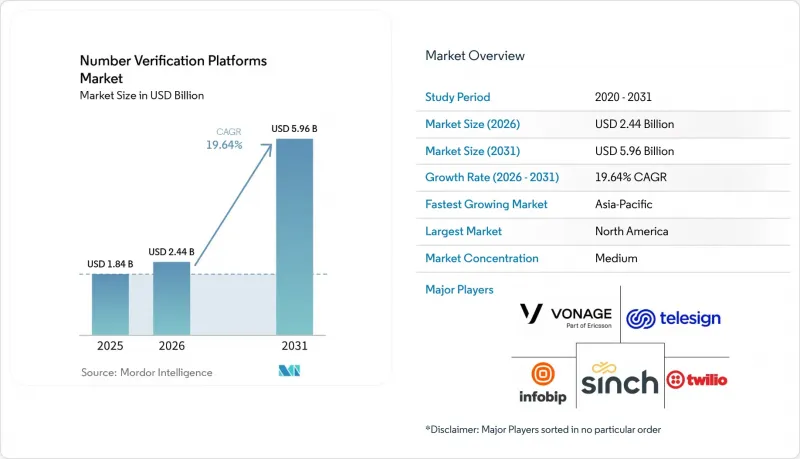
本報告按元件(軟體/平台和服務)、部署類型(雲端、本地部署和混合部署)、身分驗證方法(簡訊身分驗證及其他)、應用程式(使用者身分驗證及其他)、組織規模(大型企業及其他)、最終使用者產業(銀行業及其他)和地區進行細分。市場預測以美元計價。
全球電話號碼檢驗平台市場趨勢及洞察
帳戶劫持和SIM卡交換的風險日益增加。
帳戶劫持案件的增加使得手機號碼檢驗成為銀行和支付服務提供者更為迫切的安全需求。英國金融協會的報告顯示,到2025年,銀行共阻止了16.8億英鎊(約21億美元)的詐欺性詐騙。這意味著每發生1英鎊的詐欺性支付嘗試,就能減少0.7英鎊的損失,凸顯了防範工作的規模。 Cifas的記錄顯示,2026年上半年的詐欺性SIM卡交換案件數量比2025年同期增加了402%。這些事件表明,在授權密碼重設、付款或帳戶更改之前,即時驗證的重要性日益凸顯。由於網路訊號能夠識別攻擊者完成高風險操作之前最近的SIM卡變更,手機號碼驗證平台市場正從中受益。
監管措施從簡訊驗證碼過渡到更廣泛的領域
鑑於基於簡訊的動態密碼(OTP) 存在已知的安全漏洞,監管機構建議加強身份驗證。歐盟的數位身分錢包框架要求成員國在 2026 年 12 月前提供錢包。該框架還將身份驗證流程納入明確的技術和合規框架。在日本,修訂後的《防止未經授權使用行動電話法》於 2026 年 4 月生效,規定線上行動電話合約申請必須使用基於 IC 晶片的身份驗證。這些變化促使電信業者和平台提供者支援經過驗證的註冊流程。因此,「號碼檢驗平台市場」正受益於安全措施從選用功能轉變為正式營運要求的趨勢。
電信業者覆蓋範圍分散,網路數據不一致
在擁有眾多小規模行動電話電信商的市場中,營運商網路覆蓋範圍仍然不穩定。 GSMA Open Gateway計畫在2026年初之前在50個市場的85個網路中部署商用API。然而,其在撒哈拉以南非洲、中美洲以及南亞和東南亞部分地區的部署仍存在空白。當運營商無法提供足夠的網路訊號時,該平台必須依賴其他資料來源。這會降低結果的可靠性並增加誤報率。號碼檢驗平台市場受到此影響,因為全球銀行和數位平台需要在其營運的所有國家/地區保持一致的服務水準。
細分市場分析
到2025年,軟體/平台將佔據號碼檢驗平台市場76.42%的佔有率。企業更傾向於API主導的軟體,因為它可以與現有的身份驗證、支付和客戶服務系統整合。大部分的檢驗價值是透過API呼叫、資料查詢和自動決策規則產生。這些活動自然而然地融入軟體層。此外,使用軟體產品可以讓客戶透過集中式介面管理身分驗證流程。路由規則、回退路徑和風險閾值都可以設置,而無需單獨修改每個應用程式。這使得客戶註冊、登入、付款和帳戶恢復等環節的管理保持一致。軟體領域佔據如此大的佔有率反映了交易檢驗需求的持續性。
預計2026年至2031年,服務業將以21.22%的複合年成長率成長。銀行、保險公司和零售商通常需要協助協調營運商接入,並在多個市場上應用標準。託管服務提供者可以處理整合工作、與營運商談判以及增強詐欺訊號。 2026年7月,Sinch在其Engage平台中發布了電話號碼檢驗功能。此功能允許將電話號碼狀態檢查即時整合到宣傳活動工作流程中,而不再局限於開發者API。這使得更多業務用戶能夠獲取電話號碼資訊。對服務的需求還包括合規性報告和營運支援。因此,對於既擁有軟體存取權又具備實際實施經驗的服務供應商而言,電話號碼檢驗平台產業仍有很大的成長空間。
到2025年,基於雲端的採用將佔總收入的82.36%。雲端佔據主導地位的原因在於,在尖峰時段、促銷期或帳戶攻擊期間,身分驗證流量可能會出現快速波動。雲端基礎架構為企業提供可擴展的容量,無需永久過度配置。它還支援透過分散式端點即時交換營運商數據,這對於需要在多個地點處理大量檢驗事件的平台來說非常有利。此外,雲端服務允許在不修改本機軟體的情況下發布API功能更新。鑑於這些原因,在電話號碼身份驗證平台市場,基於雲端的交付模式仍然是處理大批量工作流程的首選。這種模式既支援大規模企業項目,也支援嵌入式身分驗證服務。
預計到2031年,基於雲端的採用率將以20.12%的複合年成長率成長。 2026年2月,Vonage在其Verify API上正式發布了「靜默認證」服務。該服務利用雲端連接端點獲取即時運營商數據,從而減少了對可見的動態密碼的需求。當雲端使用受到資料居住、系統隔離或主權等方面的要求限制時,本地部署仍然發揮著至關重要的作用。混合模式允許企業將某些國內事件保留在自身環境中,同時將國際事件或敏感度較低的事件傳送到雲端服務。雖然這些選項對於受監管的帳戶至關重要,但它們並不會改變雲端的主導地位。預計混合交付模式將在號碼檢驗平台市場中廣泛應用,尤其是在特定合規性要求的情況下。
區域分析
2025年,北美佔據了號碼檢驗平台市場33.12%的佔有率。該地區擁有龐大的金融服務、科技和數位商務公司群體,這些公司會產生大量的檢驗事件。這些機構需要強大的管理系統來處理付款、帳戶恢復和客戶註冊等事宜。 2025年11月,Vonage向所有美國主要電信業者正式推出了「靜默認證」和「SIM卡交換網路」API。此次發布標誌著該服務從試驗計畫轉向更廣泛的商業應用。加拿大和墨西哥則透過跨境數位商務和集團銀行業務需求為市場做出貢獻。此外,美國的合規環境有利於與營運商和法務部門建立牢固合作關係的供應商。
在號碼認證平台市場,歐洲是一個受監管驅動的地區。 EUDI錢包計劃為實現可互通的數位身分服務指明了方向。波蘭的T-Mobile、Orange、Plus和Play於2026年2月推出了號碼認證和SIM卡交換API。 Cosmote Telekom和Vodafone Greece隨後在2026年3月進行了類似的部署。德國、英國、法國、義大利和西班牙仍然是重要的收入來源。在南美洲,巴西已經建立了一個切實可行的營運商-企業模式,營運商支援了Itaúbank的大規模API部署。烏拉圭的Antel和Claro於2026年6月加入了開放式閘道器舉措。
預計到2031年,亞太地區將以23.12%的複合年成長率成長,引領區域成長前景。在日本,將於2026年4月實施的法規正在推動基於積體電路晶片的電子身分驗證(eKYC)技術應用於線上行動電話合約申請。印度領先的行動電話營運商在2025年印度行動通訊大會上宣布將開放聯合閘道器API。中國將於2025年啟動多個安全服務供應商試驗計畫。卡達的Ooredoo和沃達豐將於2025年開始提供號碼驗證和SIM卡交換API。由於電信業者的服務覆蓋範圍分散,撒哈拉以南非洲地區仍處於發展初期。因此,能夠跨業者提供可靠服務的平台仍有很大的成長空間。
其他好處:
- Excel格式的市場預測(ME)表
- 3個月的分析師支持
目錄
第1章:引言
- 研究假設和市場定義
- 調查範圍
第2章:調查方法
第3章執行摘要
第4章 市場狀況
- 市場概覽
- 市場促進因素
- 帳戶劫持和SIM卡交換的風險增加。
- 過渡到超越簡訊驗證碼的監管合規階段
- 拓展數位化註冊和帳戶恢復流程
- 利用網路ID API為電信業者創造收入
- 雲端原生檢驗編配的成長
- 對無縫行動身份驗證的需求日益成長
- 市場限制因素
- 電信業者服務區域分散化與網路數據不一致
- 隱私、同意和跨境資料處理的複雜性。
- 簡訊攔截和SIM卡交換漏洞
- 行動網路營運商和聚合商的複雜收入分成模式
- 宏觀經濟因素對市場的影響
- 產業價值鏈分析
- 科技趨勢
- 監理情勢
- 波特五力分析
第5章 市場規模與成長預測
- 按組件
- 軟體/平台
- 服務
- 部署模式
- 基於雲端的
- 現場
- 混合
- 檢驗方法
- 簡訊檢驗
- 透過語音通話進行身份驗證
- 多因素身份驗證
- 使用動態密碼進行身份驗證
- 其他檢驗方法
- 透過使用
- 使用者身份驗證
- 詐欺檢測與預防
- 客戶註冊和KYC
- 帳戶劫持預防
- 行銷與客戶關係檢驗
- 交易安全
- 按組織規模
- 大公司
- 小型企業
- 按最終用戶行業分類
- 銀行業、金融服務業及保險業
- 電子商務與零售
- 電訊
- 資訊科技和軟體
- 衛生保健
- 政府/公共部門
- 媒體與娛樂
- 旅遊與飯店
- 遊戲和線上賭博
- 按地區
- 北美洲
- 美國
- 加拿大
- 墨西哥
- 南美洲
- 巴西
- 阿根廷
- 智利
- 其他南美國家
- 歐洲
- 德國
- 英國
- 法國
- 義大利
- 西班牙
- 其他歐洲國家
- 亞太地區
- 中國
- 日本
- 印度
- 韓國
- 澳洲
- 其他亞太國家
- 中東
- 阿拉伯聯合大公國
- 沙烏地阿拉伯
- 卡達
- 其他中東國家
- 非洲
- 南非
- 埃及
- 奈及利亞
- 其他非洲國家
- 北美洲
第6章 競爭情勢
- 市場集中度
- 策略趨勢
- 市佔率分析
- 公司簡介
- Twilio Inc.
- Sinch AB
- Infobip Ltd.
- Telesign Corporation
- Vonage Holdings Corp.
- Bird BV
- Plivo Inc.
- Route Mobile Limited
- CM.com NV
- Mitto AG
- Kaleyra Inc.
- netnumber, Inc.
- TMT ID Limited
- Pangea Connectivity Technology Limited
- Acudo Group Limited
- Prove Identity, Inc.
- Trulioo Information Services Inc.
- ID.me, Inc.
- iDenfy UAB
- Sumsub Ltd.
- Onfido Limited
- Entersekt Technologies(Pty)Ltd
- XConnect Limited
- Socure, Inc.
第7章 市場機會與未來展望
According to Mordor Intelligence, the number verification platforms market size is projected to expand from USD 1.84 billion in 2025 to USD 2.44 billion in 2026, and to USD 5.98 billion by 2031, registering a CAGR of 19.64% between 2026 and 2031.
This report is Segmented by Component (Software / Platform, and Services), Deployment Mode (Cloud-Based, On-Premises, and Hybrid), Verification Method (SMS-Based Verification, and More), Application (User Authentication, and More), Organization Size (Large Enterprises, and More), End-User Industry (Banking, and More), and Geography. The Market Forecasts are Provided in Terms of Value (USD).
Global Number Verification Platforms Market Trends and Insights
Rising Account Takeover and SIM-Swap Exposure
Account takeover has made number verification a more immediate security requirement for banks and payment providers. UK Finance reported that banks prevented GBP 1.68 billion (USD 2.1 billion) in unauthorized payment fraud during 2025. That represented GBP 0.70 for every GBP 1.00 attempted, underscoring the scale of prevention activity. Cifas recorded a 402% increase in unauthorized SIM-swap cases during the first half of 2026 compared with the same period in 2025. These events create demand for real-time checks before a password reset, payment, or account change is accepted. The Number Verification Platforms Market benefits because network signals can identify a recent SIM change before an attacker completes a high-risk action.
Regulatory Migration Beyond SMS OTP
Regulators are encouraging stronger identity checks where SMS one-time passwords have known weaknesses. The EU framework for the European Digital Identity Wallet sets a December 2026 target for Member States to make wallets available. It also places identity processes within a defined technical and compliance framework. Japan's amended Mobile Phone Improper Use Prevention Act took effect in April 2026 and requires IC chip-based identity verification for online mobile contract applications. These changes encourage carriers and platform providers to support verified onboarding flows. The Number Verification Platforms Market, therefore, benefits from requirements that shift security controls from a voluntary feature to a formal operational requirement.
Fragmented Carrier Coverage and Inconsistent Network Data
Carrier coverage remains uneven in markets with several smaller mobile operators. GSMA Open Gateway had commercial API deployments across 85 networks in 50 markets by early 2026. That footprint still left gaps in Sub-Saharan Africa, Central America, and parts of South and Southeast Asia. Platforms must use other data sources when a carrier does not provide a suitable network signal. This can reduce confidence in the result and increase false positives. The Number Verification Platforms Market is affected because global banks and digital platforms need consistent service levels across every country in which they operate.
Other drivers and restraints analyzed in the detailed report include:
- Expansion of Digital Onboarding and Account Recovery
- Carrier Monetization of Network Identity APIs
- Privacy, Consent, and Cross-Border Data Complexity
For complete list of drivers and restraints, kindly check the Table Of Contents.
Segment Analysis
Software/Platform held 76.42% of the Number Verification Platforms Market share in 2025. Enterprises favor API-led software because it can connect with existing identity, payment, and customer service systems. Most verification value is created through API calls, data queries, and automated decision rules. These activities fit naturally within the software layer. Software products also allow customers to manage authentication journeys from a central interface. They can configure routing rules, fallback paths, and risk thresholds without changing every application separately. This supports consistent controls across customer onboarding, login, payment, and account recovery. The large software position reflects the recurring nature of demand for transaction-based verification.
Services are projected to expand at a 21.22% CAGR from 2026 to 2031. Banks, insurers, and retailers often need help coordinating carrier access and applying standards across several markets. Managed providers can handle integration work, carrier negotiations, and fraud-signal enrichment. Sinch launched number validation within its Engage platform in July 2026. The release brought real-time phone status checks into campaign workflows rather than limiting them to a developer API. This makes number intelligence available to a wider group of business users. Service demand can also include compliance reporting and operational support. The Number Verification Platforms industry, therefore, has room for providers that combine software access with practical implementation expertise.
Cloud-based deployment accounted for 82.36% of revenue in 2025. It held the largest share because authentication traffic can change sharply during payment peaks, promotions, or account attacks. Cloud infrastructure provides organizations with capacity that scales without permanent overprovisioning. It also supports the real-time exchange of carrier data through distributed endpoints. This is useful when a platform must process many verification events across several locations. Cloud services can also release updated API features without on-site software changes. For these reasons, the Number Verification Platforms Market continues to favor cloud delivery for high-volume workflows. The model supports both large enterprise programs and embedded verification services.
Cloud-based deployment is projected to grow at a 20.12% CAGR through 2031. Vonage made Silent Authentication generally available in its Verify API during February 2026. The service uses real-time carrier data through cloud-connected endpoints and can reduce the need for a visible one-time password. On-premises deployments remain relevant where data residency, system isolation, or sovereignty requirements limit cloud use. Hybrid models allow organizations to keep selected domestic events in their own environment. They can send international or lower-sensitivity events to cloud services. These choices are important in regulated accounts, but they do not change the cloud's leading role. The Number Verification Platforms Market is likely to use hybrid delivery, primarily where specific compliance requirements necessitate it.
Complete Report Scope:
- By Component
- Software / Platform
- Services
- By Deployment Mode
- Cloud-Based
- On-Premises
- Hybrid
- By Verification Method
- SMS-Based Verification
- Voice Call Verification
- Multi-Factor Authentication
- One-Time Password Verification
- Other Verification Methods
- By Application
- User Authentication
- Fraud Detection and Prevention
- Customer Onboarding and KYC
- Account Takeover Prevention
- Marketing and CRM Validation
- Transaction Security
- By Organization Size
- Large Enterprises
- Small and Medium-Sized Enterprises
- By End-User Industry
- Banking, Financial Services and Insurance
- E-Commerce and Retail
- Telecommunications
- Information Technology and Software
- Healthcare
- Government and Public Sector
- Media and Entertainment
- Travel and Hospitality
- Gaming and Online Betting
- By Geography
- North America
- United States
- Canada
- Mexico
- South America
- Brazil
- Argentina
- Chile
- Rest of South America
- Europe
- Germany
- United Kingdom
- France
- Italy
- Spain
- Rest of Europe
- Asia-Pacific
- China
- Japan
- India
- South Korea
- Australia
- Rest of Asia-Pacific
- Middle East
- United Arab Emirates
- Saudi Arabia
- Qatar
- Rest of Middle East
- Africa
- South Africa
- Egypt
- Nigeria
- Rest of Africa
- North America
Geography Analysis
North America held 33.12% of the Number Verification Platforms Market share in 2025. The region has a large base of financial services, technology, and digital commerce companies that generate many verification events. These organizations require strong controls for payments, account recovery, and customer onboarding. Vonage commercially launched Silent Authentication and SIM Swap Network APIs across major U.S. carriers in November 2025. The launch marked a move from pilot programs toward broader commercial use. Canada and Mexico contribute through cross-border digital commerce and group banking requirements. The U.S. compliance environment also favors suppliers with established carrier and legal operations.
Europe is a regulation-focused region for the Number Verification Platforms Market. The EUDI Wallet program sets a clear direction for interoperable digital identity services. Poland's T-Mobile, Orange, Plus, and Play launched Number Verification and SIM Swap APIs in February 2026. COSMOTE TELEKOM and Vodafone Greece followed with similar deployments in March 2026. Germany, the UK, France, Italy, and Spain remain important revenue centers. South America has a practical carrier-enterprise model in Brazil, where operators supported Itau's scaled adoption of APIs. Uruguay's Antel and Claro joined the Open Gateway initiative in June 2026.
Asia-Pacific is projected to grow at a 23.12% CAGR through 2031, leading the geographic growth outlook. Japan's April 2026 rules have encouraged IC chip-based eKYC for online mobile contract applications. India's largest mobile operators announced access to a federated Open Gateway API during the India Mobile Congress 2025. China launched several pilot programs for protection service businesses in 2025. Qatar's Ooredoo and Vodafone launched Number Verification and SIM Swap APIs in 2025. Sub-Saharan Africa remains at an earlier stage due to fragmented carrier coverage. This leaves room for platforms that can provide dependable service across operators.
- Twilio Inc.
- Sinch AB
- Infobip Ltd.
- Telesign Corporation
- Vonage Holdings Corp.
- Bird B.V.
- Plivo Inc.
- Route Mobile Limited
- CM.com N.V.
- Mitto AG
- Kaleyra Inc.
- netnumber, Inc.
- TMT ID Limited
- Pangea Connectivity Technology Limited
- Acudo Group Limited
- Prove Identity, Inc.
- Trulioo Information Services Inc.
- ID.me, Inc.
- iDenfy UAB
- Sumsub Ltd.
- Onfido Limited
- Entersekt Technologies (Pty) Ltd
- XConnect Limited
- Socure, Inc.
Additional Benefits:
- The market estimate (ME) sheet in Excel format
- 3 months of analyst support
TABLE OF CONTENTS
1 INTRODUCTION
- 1.1 Study Assumptions and Market Definition
- 1.2 Scope of the Study
2 RESEARCH METHODOLOGY
3 EXECUTIVE SUMMARY
4 MARKET LANDSCAPE
- 4.1 Market Overview
- 4.2 Market Drivers
- 4.2.1 Rising Account Takeover and SIM-Swap Exposure
- 4.2.2 Regulatory Migration Beyond SMS OTP
- 4.2.3 Expansion of Digital Onboarding and Account Recovery
- 4.2.4 Carrier Monetization of Network Identity APIs
- 4.2.5 Growth of Cloud-Native Verification Orchestration
- 4.2.6 Rising Demand for Frictionless Mobile Authentication
- 4.3 Market Restraints
- 4.3.1 Fragmented Carrier Coverage and Inconsistent Network Data
- 4.3.2 Privacy, Consent, and Cross-Border Data Complexity
- 4.3.3 SMS Interception and SIM-Swap Vulnerabilities
- 4.3.4 Complex MNO and Aggregator Revenue-Sharing Models
- 4.4 Impact of Macroeconomic Factors on the Market
- 4.5 Industry Value-Chain Analysis
- 4.6 Technology Outlook
- 4.7 Regulatory Landscape
- 4.8 Porter's Five Forces Analysis
- 4.8.1 Threat of New Entrants
- 4.8.2 Bargaining Power of Suppliers
- 4.8.3 Bargaining Power of Buyers
- 4.8.4 Threat of Substitutes
- 4.8.5 Intensity of Competitive Rivalry
5 MARKET SIZE AND GROWTH FORECASTS (VALUE)
- 5.1 By Component
- 5.1.1 Software / Platform
- 5.1.2 Services
- 5.2 By Deployment Mode
- 5.2.1 Cloud-Based
- 5.2.2 On-Premises
- 5.2.3 Hybrid
- 5.3 By Verification Method
- 5.3.1 SMS-Based Verification
- 5.3.2 Voice Call Verification
- 5.3.3 Multi-Factor Authentication
- 5.3.4 One-Time Password Verification
- 5.3.5 Other Verification Methods
- 5.4 By Application
- 5.4.1 User Authentication
- 5.4.2 Fraud Detection and Prevention
- 5.4.3 Customer Onboarding and KYC
- 5.4.4 Account Takeover Prevention
- 5.4.5 Marketing and CRM Validation
- 5.4.6 Transaction Security
- 5.5 By Organization Size
- 5.5.1 Large Enterprises
- 5.5.2 Small and Medium-Sized Enterprises
- 5.6 By End-User Industry
- 5.6.1 Banking, Financial Services and Insurance
- 5.6.2 E-Commerce and Retail
- 5.6.3 Telecommunications
- 5.6.4 Information Technology and Software
- 5.6.5 Healthcare
- 5.6.6 Government and Public Sector
- 5.6.7 Media and Entertainment
- 5.6.8 Travel and Hospitality
- 5.6.9 Gaming and Online Betting
- 5.7 By Geography
- 5.7.1 North America
- 5.7.1.1 United States
- 5.7.1.2 Canada
- 5.7.1.3 Mexico
- 5.7.2 South America
- 5.7.2.1 Brazil
- 5.7.2.2 Argentina
- 5.7.2.3 Chile
- 5.7.2.4 Rest of South America
- 5.7.3 Europe
- 5.7.3.1 Germany
- 5.7.3.2 United Kingdom
- 5.7.3.3 France
- 5.7.3.4 Italy
- 5.7.3.5 Spain
- 5.7.3.6 Rest of Europe
- 5.7.4 Asia-Pacific
- 5.7.4.1 China
- 5.7.4.2 Japan
- 5.7.4.3 India
- 5.7.4.4 South Korea
- 5.7.4.5 Australia
- 5.7.4.6 Rest of Asia-Pacific
- 5.7.5 Middle East
- 5.7.5.1 United Arab Emirates
- 5.7.5.2 Saudi Arabia
- 5.7.5.3 Qatar
- 5.7.5.4 Rest of Middle East
- 5.7.6 Africa
- 5.7.6.1 South Africa
- 5.7.6.2 Egypt
- 5.7.6.3 Nigeria
- 5.7.6.4 Rest of Africa
- 5.7.1 North America
6 COMPETITIVE LANDSCAPE
- 6.1 Market Concentration
- 6.2 Strategic Moves
- 6.3 Market Share Analysis
- 6.4 Company Profiles (includes Global Level Overview, Market Level Overview, Core Segments, Financials as available, Strategic Information, Market Rank/Share, Products and Services, Recent Developments)
- 6.4.1 Twilio Inc.
- 6.4.2 Sinch AB
- 6.4.3 Infobip Ltd.
- 6.4.4 Telesign Corporation
- 6.4.5 Vonage Holdings Corp.
- 6.4.6 Bird B.V.
- 6.4.7 Plivo Inc.
- 6.4.8 Route Mobile Limited
- 6.4.9 CM.com N.V.
- 6.4.10 Mitto AG
- 6.4.11 Kaleyra Inc.
- 6.4.12 netnumber, Inc.
- 6.4.13 TMT ID Limited
- 6.4.14 Pangea Connectivity Technology Limited
- 6.4.15 Acudo Group Limited
- 6.4.16 Prove Identity, Inc.
- 6.4.17 Trulioo Information Services Inc.
- 6.4.18 ID.me, Inc.
- 6.4.19 iDenfy UAB
- 6.4.20 Sumsub Ltd.
- 6.4.21 Onfido Limited
- 6.4.22 Entersekt Technologies (Pty) Ltd
- 6.4.23 XConnect Limited
- 6.4.24 Socure, Inc.
7 MARKET OPPORTUNITIES AND FUTURE OUTLOOK
- 7.1 White-Space and Unmet-Need Assessment

 身分驗證服務:市場佔有率分析、產業趨勢與統計資料、成長預測(2026-2031 年)
 專業認證和培訓市場預測至2034年—按認證類型、培訓形式、交付方式、提供者類型、最終用戶和地區分類的全球分析金融服務業高級認證:市場佔有率分析、產業趨勢與統計及成長預測(2026-2031 年)
 基於手機的身份驗證市場報告:按產品類型、應用程式和地區分類(2026-2034 年)
 全球3D安全認證市場規模、佔有率、趨勢和成長分析報告(2026-2034年)
 2026年全球單因子身份驗證系統市場報告2026年全球密碼認證市場報告
 永續發展認證市場:按認證類型、應用和地區分類
 OOB認證市場:按認證類型、應用、部署模式、最終用戶產業和組織規模分類 - 全球預測(2026-2032年)身分驗證服務市場:按身分驗證方法、產業、部署模式和組織規模分類 - 2026-2032 年全球預測