


 |
市場調查報告書
商品編碼
2097090
金融服務業高級認證:市場佔有率分析、產業趨勢與統計及成長預測(2026-2031 年)Advanced Authentication In Financial Services Industry - Market Share Analysis, Industry Trends & Statistics, Growth Forecasts (2026 - 2031) |
||||||

※ 本網頁內容可能與最新版本有所差異。詳細情況請與我們聯繫。
據 Mordor Intelligence 稱,2025 年金融服務業的高級身份驗證市場價值為 109.7 億美元,預計到 2031 年將從 2026 年的 119.2 億美元成長到 180.2 億美元,預測期(2026-2031 年)的複合成長率為 8.62%。
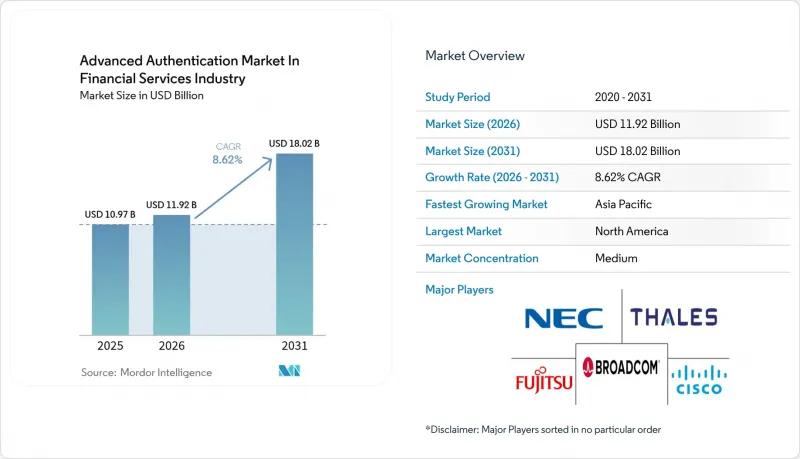
本報告依認證方式(智慧卡、生物識別、行動智慧憑證等)、元件(硬體、軟體、服務)、部署類型(本地部署和雲端部署)、最終用戶應用(零售銀行、企業及投資銀行等)和地區進行細分。市場預測以美元計價。
金融服務業高級身份驗證市場的洞察與趨勢
數位銀行和行動交易的普及
預計到2024年,成熟市場的行動滲透率將超過零售客戶的75%,在北美和歐洲,行動應用將佔所有非分店交易的60%以上。這一激增迫使銀行將決策時間縮短至200毫秒以內,並將投資轉向生物識別和行為認證方法,以實現無縫的後台認證。 2024年上半年,美國即時支付量年增47%,這需要在多步驟的轉帳過程中持續進行身分驗證。為了因應監管機構在2024年事件報告中指出的深度造假攻擊激增300%的問題,生物辨識偵測功能正被整合到行動軟體開發工具包(SDK)中。同時,支付卡產業資料安全標準(PCI DSS)4.0版強制要求所有超過30美元的無卡交易採用多因素認證,加速了從動態密碼向使用裝置內建感測器的生物識別的轉變。這些因素共同導致金融服務業高級身份驗證市場的交易量逐季成長,從而推動了供應商收入的成長。
對強客戶認證的監管要求激增
2024年,歐洲銀行管理局(EBA)將低風險交易的豁免限額提高至100歐元,並強制要求詐欺偵測引擎的準確率達到99.5%或更高。這促進了行為分析技術的應用,該技術可追蹤每次會話超過2000個參數。 2024年10月,印度儲備銀行強制要求所有超過5,000印度盧比的數位支付必須採用額外的身分驗證因素。這項規定將使該國78%的零售交易不再使用靜態密碼。 2024年3月,新加坡金融管理局修訂了其技術風險管理框架,為高價值轉帳引入了自適應風險措施,從而使能夠整合威脅情報資訊的雲端平台更具優勢。 PCI DSS v4.0現已將基於簡訊的動態密碼歸類為不適用於特權訪問,促使美國銀行採用FIDO2金鑰。這些相互重疊的監管要求加在一起,提高了身份驗證功能的最低監管標準,並增加了金融服務業對高級身份驗證的需求。
實施成本高,且與舊有系統相容性有挑戰
2015 年之前部署的核心系統缺乏原生生物識別API,因此必須使用中介軟體層,這可能導致成本增加高達 60%。一項針對 120 家區域性銀行的 2024 年調查發現,67% 的銀行認為整合複雜性是最大的障礙,預計每家銀行的成本在 200 萬美元到 800 萬美元之間。大型主機連接器會引入延遲,違反了聯邦金融監察委員會 (FFIEC) 要求 99.9% 可用性的運作規定。如果OTP權杖提前淘汰,則未使用的硬體資產成本將為每位使用者 12 美元。這些負擔使金融服務業高級身份驗證市場的短期成長預測下調了近一個百分點。
細分市場分析
到2025年,生物識別將在高階身分驗證市場佔據45.41%的市場。這反映了指紋和臉部認證在行動登入領域日益普及。相較之下,行為生物生物識別預計將在金融服務業的高級身分驗證市場中實現最高成長率,複合年成長率(CAGR)將達到11.12%,因為它可以識別靜態模板無法檢測到的會話異常。動態密碼(OTP)令牌在匯款核准流程中仍佔據重要地位,但隨著防釣魚金鑰的日益普及,其地位正受到威脅。嵌入安全元件中的行動智慧憑證正受益於Apple Pay等錢包的興起,後者在2024年處理了超過450億筆交易。
推動這一成長的關鍵在於多模態策略,該策略將登入時的指紋認證與整個會話期間的持續行為監控相結合。受市場對靈活認證方案需求不斷成長的驅動,泰雷茲公司2024年的生物識別感測器出貨量年增了34%。根據FIDO聯盟的數據,認證功能已整合到60億台設備中,銀行無需再郵寄硬體。這些因素共同推動了金融服務業高級認證市場在該細分領域的收入上限不斷提升。
預計到2025年,硬體(主要包括智慧卡讀卡機、感測器和一次性密碼產生器)將佔總收入的44.35%。然而,隨著雲端微服務使銀行能夠在滿足延遲要求的同時靈活擴展,軟體預計將以10.25%的複合年成長率成長,從而擴大其在金融服務業高級身份驗證市場中的收入佔有率。同時,由於供應商擴大將整合和諮詢服務納入訂閱模式以加速市場普及,這些服務正面臨價格壓力。
目前,68%的金融機構採用混合雲端,為「身分驗證即服務」(Authentication as a Service)的實作鋪平了道路。 Okta在2024會計年度處理了1.2兆次身分驗證事件,展現了其軟體強大的處理能力。硬體安全模組(HSM)在「信任根」(Root of Trust)功能中仍然發揮作用,但隨著策略引擎向軟體的轉變,其作用正在減弱。這種轉變正在推動金融服務業高級身份驗證市場的進一步擴張。
區域分析
北美地區預計在2025年佔總收入的36.85%,此前聯邦金融監察委員會(FFIEC)已將簡訊驗證碼列為高風險交易的不足之處。亞太地區預計將以11.09%的複合年成長率成長,這主要得益於印度儲備銀行要求對超過5000印度盧比的支付交易採用額外的身份驗證因素,以及新加坡推廣自適應身份驗證的法規。
亞太地區在2024年實現了最快的收入成長,這主要得益於「行動優先」的銀行架構,該地區68%的金融交易是透過智慧型手機完成的,而北美地區的這一比例為52%。光是印度儲備銀行的一項指令就預測,到2030年,印度的行動用戶將超過14億,隨著銀行將設備和行為訊號整合到其綜合風險引擎中,金融服務業對高階身分驗證的需求將進一步成長。 2024年,中國四大銀行在試點分店推出了掌紋認證解決方案,進一步豐富了該地區的演算法多樣性。
在歐洲,PSD2合規計畫的實施進展緩慢但穩定地推進。然而,歐洲銀行管理局(EBA)2024年的修訂案豁免了100歐元以下交易的風險分析,這正在加速行為生物辨識技術的應用,並減少電子商務支付流程中的摩擦。北歐國家的發卡機構目前正在試行將語音生物辨識技術應用於電話銀行,為其多通路策略增添了新的元素。
北美市場成長的重點在於即時支付和分店現代化。美國信用社正在採用FIDO2密鑰來支援無人分店,而加拿大銀行則將硬體認證功能整合到穿戴式裝置中。預計到2031年,北美地區高度認證市場規模將達到66.4億美元,佔全球需求的36.85%,凸顯了高度認證市場在金融服務業的戰略重要性。
其他好處:
- Excel格式的市場預測(ME)表
- 3個月的分析師支持
目錄
第1章:引言
- 研究假設和市場定義
- 調查範圍
第2章:調查方法
第3章執行摘要
第4章 市場狀況
- 市場概覽
- 市場促進因素
- 數位銀行和行動交易的普及
- 對強大的客戶身份驗證的監管要求激增。
- 網路安全威脅日益加劇,詐騙造成的損失也日益擴大
- 將行為生物特徵技術整合到基於風險的平台中正在取得進展。
- 去中心化身分框架與自主錢包的普及
- ATM和分店使用無密碼FIDO2的興起
- 市場限制因素
- 實施成本高昂,且面臨與舊有系統。
- 生物識別資料儲存和使用方面的資料隱私問題
- 對高頻交易中交易延遲的敏感性
- 由於專有認證生態系統,因此存在供應商鎖定風險。
- 產業價值鏈分析
- 監理情勢
- 技術展望
- 波特五力分析
- 宏觀經濟因素的影響
- 投資分析
第5章 市場規模與成長預測
- 身份驗證方法
- 智慧卡
- 生物識別(指紋、臉部、虹膜、語音)
- 行動智慧憑證
- 動態密碼令牌
- 行為生物特徵學
- 按組件
- 硬體
- 軟體
- 服務
- 部署模式
- 現場
- 雲
- 透過最終用戶應用程式
- 零售銀行
- 企業及投資銀行
- 支付卡和已提交的付款
- 保險
- 財富管理與金融科技平台
- 其他終端用戶應用程式
- 按地區
- 北美洲
- 美國
- 加拿大
- 墨西哥
- 南美洲
- 巴西
- 阿根廷
- 其他南美國家
- 歐洲
- 德國
- 英國
- 法國
- 義大利
- 西班牙
- 俄羅斯
- 其他歐洲國家
- 亞太地區
- 中國
- 日本
- 印度
- 韓國
- 澳洲
- 其他亞太國家
- 中東和非洲
- 中東
- 沙烏地阿拉伯
- 阿拉伯聯合大公國
- 土耳其
- 其他中東國家
- 非洲
- 南非
- 奈及利亞
- 埃及
- 其他非洲國家
- 中東
- 北美洲
第6章 競爭情勢
- 市場集中度
- 策略趨勢
- 市佔率分析
- 公司簡介
- Thales Group
- NEC Corporation
- Broadcom Inc.
- Fujitsu Limited
- Cisco Systems Inc.(Duo Security LLC)
- Okta Inc.
- HID Global Corporation(Assa Abloy AB)
- Ping Identity Holding Corp.
- RSA Security LLC
- Daon Inc.
- BioCatch Ltd.
- Validsoft Ltd.
- ForgeRock Inc.
- PistolStar Inc.
- SecurEnvoy Ltd.
- Micro Focus International plc(NetIQ)
- Yubico AB
- Lumidigm Inc.
第7章 市場機會與未來展望
According to Mordor Intelligence, the advanced authentication market size in the financial services industry was valued at USD 10.97 billion in 2025 and estimated to grow from USD 11.92 billion in 2026 to reach USD 18.02 billion by 2031, at a CAGR of 8.62% during the forecast period (2026-2031).
This report is Segmented by Authentication Type (Smartcards, Biometrics, Mobile Smart Credentials, and More), Component (Hardware, Software, and Services), Deployment Mode (On-Premise and Cloud), End-User Application (Retail Banking, Corporate and Investment Banking, and More), and Geography. The Market Forecasts are Provided in Value (USD).
Insights and Trends of Advanced Authentication Market In Financial Services Industry
Proliferation of Digital Banking and Mobile Transactions
Mobile penetration is expected to surpass 75% of retail clients in mature markets by 2024, and mobile apps now account for more than 60% of all non-branch transactions in North America and Europe. The surge compels banks to compress decision windows below 200 milliseconds, shifting investment toward biometric and behavioral methods that authenticate silently in the background. U.S. real-time payment volumes advanced 47% year over year in H1-2024, prompting demand for continuous identity assurance throughout multi-step transfers. Liveness detection is being embedded inside mobile software development kits to counter the 300% spike in deepfake attacks that regulators highlighted in 2024 incident reports. At the same time, the Payment Card Industry Data Security Standard version 4.0 requires multi-factor authentication for every card-not-present purchase exceeding USD 30, accelerating the replacement of one-time passwords with biometrics that utilize device-native sensors. Collectively, these factors add more than twenty percentage points of volume to the advanced authentication market in the financial services industry each quarter, fuelling vendor revenue expansion.
Surge in Regulatory Mandates for Strong Customer Authentication
The European Banking Authority expanded low-risk transaction exemptions to EUR 100 in 2024, while simultaneously requiring fraud-detection engines to achieve 99.5% accuracy, prompting the adoption of behavioral analytics that track over 2,000 parameters per session. In October 2024, the Reserve Bank of India mandated an additional factor for every digital payment above INR 5,000, a rule that eliminates static passwords for 78% of retail transactions in the country. Singapore's Monetary Authority revised its Technology Risk Management framework in March 2024, introducing risk-adaptive measures for high-value transfers, thereby favoring cloud platforms capable of ingesting threat intelligence feeds. PCI DSS v4.0 now classifies SMS one-time passwords as inadequate for privileged access, prompting U.S. banks to adopt FIDO2 keys. Collectively, these overlapping mandates lift demand for the advanced authentication market in the financial services industry by raising the regulatory floor for identity verification capabilities.
High Implementation Costs and Legacy Compatibility Challenges
Core systems deployed before 2015 lack native biometric application programming interfaces, which forces the use of middleware layers that can inflate costs by up to 60%. A 2024 survey of 120 community banks found that 67% cited integration complexity as the top barrier, with estimated spending ranging from USD 2 million to USD 8 million per institution. Mainframe connectors introduce latency that conflicts with Federal Financial Institutions Examination Council (FFIEC) uptime rules, which require 99.9% availability. Stranded hardware assets cost USD 12 per user when OTP tokens are decommissioned ahead of schedule. These burdens shave nearly one percentage point off the projected growth of the advanced authentication market in the financial services industry in the near term.
Other drivers and restraints analyzed in the detailed report include:
- Escalating Cybersecurity Threats and Fraud Losses
- Growing Integration of Behavioral Biometrics in Risk-Based Platforms
- Data-Privacy Concerns over Biometric Storage and Usage
For complete list of drivers and restraints, kindly check the Table Of Contents.
Segment Analysis
Biometrics commanded a 45.41% market share in the advanced authentication market in 2025, reflecting the widespread use of fingerprint and facial scans during mobile logins. In contrast, behavioral biometrics is projected to post an 11.12% CAGR, the fastest growth rate within the advanced authentication market in the financial services industry, as it uncovers session anomalies that static templates miss. One-time password tokens remain entrenched in wire-approval flows but are being supplanted as phishing-resistant passkeys proliferate. Mobile smart credentials, anchored in secure elements, are riding the rise of wallets like Apple Pay, which processed more than 45 billion transactions in 2024.
Growth dynamics hinge on multi-modal strategies that combine fingerprint verification at entry with continuous behavioral monitoring throughout the session. Thales shipped 34% more biometric sensors in 2024 amid demand for flexible modality choices. FIDO Alliance data show 6 billion devices already contain embedded authenticators, obviating the need for banks to mail hardware. Together, these factors raise the revenue ceiling for the advanced authentication market in the financial services industry across this segment.
Hardware supplied 44.35% of revenue in 2025, anchored by smartcard readers, sensors, and OTP generators. Yet, software will grow at a 10.25% CAGR, expanding its revenue share of the advanced authentication market in the financial services industry as cloud microservices enable banks to scale elastically while meeting latency requirements. Integration and consulting services face fee pressure as vendors fold them into subscription models for faster adoption.
Sixty-eight percent of financial institutions now operate hybrid clouds, clearing the path for authentication as a service. Okta processed 1.2 trillion authentication events in fiscal 2024, showing the software's volume capacity. Hardware security modules persist for root-of-trust functions but play a narrower role as policy engines migrate to software. This shift drives another phase of expansion in the advanced authentication market in the financial services industry.
Complete Report Scope:
- By Authentication Type
- Smartcards
- Biometrics (fingerprint, facial, iris, voice)
- Mobile Smart Credentials
- One-Time Password Tokens
- Behavioral Biometrics
- By Component
- Hardware
- Software
- Services
- By Deployment Mode
- On-Premise
- Cloud
- By End-User Application
- Retail Banking
- Corporate and Investment Banking
- Payment Cards and Digital Payments
- Insurance
- Wealth Management and FinTech Platforms
- Other End-User Applications
- By Geography
- North America
- United States
- Canada
- Mexico
- South America
- Brazil
- Argentina
- Rest of South America
- Europe
- Germany
- United Kingdom
- France
- Italy
- Spain
- Russia
- Rest of Europe
- Asia-Pacific
- China
- Japan
- India
- South Korea
- Australia
- Rest of Asia-Pacific
- Middle East and Africa
- Middle East
- Saudi Arabia
- United Arab Emirates
- Turkey
- Rest of Middle East
- Africa
- South Africa
- Nigeria
- Egypt
- Rest of Africa
- Middle East
- North America
Geography Analysis
North America captured 36.85% of 2025 revenue after the Federal Financial Institutions Examination Council classified SMS codes as insufficient for high-risk actions. The Asia-Pacific is poised for an 11.09% CAGR due to the Reserve Bank of India's rules, which apply an extra factor for payments above INR 5,000, and Singapore's regulations promoting adaptive authentication.
The Asia-Pacific region produced the fastest revenue growth during 2024, driven by mobile-first banking architectures that account for 68% of financial transactions on smartphones, compared with 52% in North America. Reserve Bank of India directives alone will govern more than 1.4 billion mobile subscribers by 2030, expanding the advanced authentication market in the financial services industry as banks integrate device and behavioral signals into unified risk engines. China's big four banks adopted palm-vein solutions in 2024 pilot branches, boosting regional algorithm diversity.
Europe recorded steady but slower gains as PSD2 compliance programs matured. Yet, the European Banking Authority's 2024 update, which allows transaction-risk analysis exemptions below EUR 100, encourages the broader use of behavioral biometrics and reduces friction in e-commerce checkouts. Nordic issuers are now testing voice biometrics for telephone banking, adding another inherent factor to their multi-channel strategies.
North America's growth centers on real-time payments and branch modernization. U.S. credit unions have adopted FIDO2 keys to support cashierless branches, while Canadian banks are embedding hardware attestation in wearable devices. The advanced authentication market size at the regional level is projected to reach USD 6.64 billion by 2031, accounting for 36.85% of global demand, underscoring its strategic significance within the advanced authentication market in the financial services industry.
- Thales Group
- NEC Corporation
- Broadcom Inc.
- Fujitsu Limited
- Cisco Systems Inc. (Duo Security LLC)
- Okta Inc.
- HID Global Corporation (Assa Abloy AB)
- Ping Identity Holding Corp.
- RSA Security LLC
- Daon Inc.
- BioCatch Ltd.
- Validsoft Ltd.
- ForgeRock Inc.
- PistolStar Inc.
- SecurEnvoy Ltd.
- Micro Focus International plc (NetIQ)
- Yubico AB
- Lumidigm Inc.
Additional Benefits:
- The market estimate (ME) sheet in Excel format
- 3 months of analyst support
TABLE OF CONTENTS
1 INTRODUCTION
- 1.1 Study Assumptions and Market Definition
- 1.2 Scope of the Study
2 RESEARCH METHODOLOGY
3 EXECUTIVE SUMMARY
4 MARKET LANDSCAPE
- 4.1 Market Overview
- 4.2 Market Drivers
- 4.2.1 Proliferation of digital banking and mobile transactions
- 4.2.2 Surge in regulatory mandates for strong customer authentication
- 4.2.3 Escalating cybersecurity threats and fraud losses
- 4.2.4 Growing integration of behavioral biometrics in risk-based platforms
- 4.2.5 Adoption of decentralized identity frameworks and self-sovereign wallets
- 4.2.6 Rise of passwordless FIDO2 in ATM and branch journeys
- 4.3 Market Restraints
- 4.3.1 High implementation costs and legacy compatibility challenges
- 4.3.2 Data-privacy concerns over biometric storage and usage
- 4.3.3 Transaction-latency sensitivity in high-frequency trading
- 4.3.4 Vendor lock-in risk from proprietary authentication ecosystems
- 4.4 Industry Value Chain Analysis
- 4.5 Regulatory Landscape
- 4.6 Technological Outlook
- 4.7 Porter's Five Forces Analysis
- 4.7.1 Threat of New Entrants
- 4.7.2 Bargaining Power of Buyers/Consumers
- 4.7.3 Bargaining Power of Suppliers
- 4.7.4 Threat of Substitute Products
- 4.7.5 Intensity of Competitive Rivalry
- 4.8 Impact of Macroeconomic Factors
- 4.9 Investment Analysis
5 MARKET SIZE AND GROWTH FORECASTS (VALUE)
- 5.1 By Authentication Type
- 5.1.1 Smartcards
- 5.1.2 Biometrics (fingerprint, facial, iris, voice)
- 5.1.3 Mobile Smart Credentials
- 5.1.4 One-Time Password Tokens
- 5.1.5 Behavioral Biometrics
- 5.2 By Component
- 5.2.1 Hardware
- 5.2.2 Software
- 5.2.3 Services
- 5.3 By Deployment Mode
- 5.3.1 On-Premise
- 5.3.2 Cloud
- 5.4 By End-User Application
- 5.4.1 Retail Banking
- 5.4.2 Corporate and Investment Banking
- 5.4.3 Payment Cards and Digital Payments
- 5.4.4 Insurance
- 5.4.5 Wealth Management and FinTech Platforms
- 5.4.6 Other End-User Applications
- 5.5 By Geography
- 5.5.1 North America
- 5.5.1.1 United States
- 5.5.1.2 Canada
- 5.5.1.3 Mexico
- 5.5.2 South America
- 5.5.2.1 Brazil
- 5.5.2.2 Argentina
- 5.5.2.3 Rest of South America
- 5.5.3 Europe
- 5.5.3.1 Germany
- 5.5.3.2 United Kingdom
- 5.5.3.3 France
- 5.5.3.4 Italy
- 5.5.3.5 Spain
- 5.5.3.6 Russia
- 5.5.3.7 Rest of Europe
- 5.5.4 Asia-Pacific
- 5.5.4.1 China
- 5.5.4.2 Japan
- 5.5.4.3 India
- 5.5.4.4 South Korea
- 5.5.4.5 Australia
- 5.5.4.6 Rest of Asia-Pacific
- 5.5.5 Middle East and Africa
- 5.5.5.1 Middle East
- 5.5.5.1.1 Saudi Arabia
- 5.5.5.1.2 United Arab Emirates
- 5.5.5.1.3 Turkey
- 5.5.5.1.4 Rest of Middle East
- 5.5.5.2 Africa
- 5.5.5.2.1 South Africa
- 5.5.5.2.2 Nigeria
- 5.5.5.2.3 Egypt
- 5.5.5.2.4 Rest of Africa
- 5.5.5.1 Middle East
- 5.5.1 North America
6 COMPETITIVE LANDSCAPE
- 6.1 Market Concentration
- 6.2 Strategic Moves
- 6.3 Market Share Analysis
- 6.4 Company Profiles (includes Global level Overview, Market level overview, Core Segments, Financials as available, Strategic Information, Market Rank/Share for key companies, Products and Services, and Recent Developments)
- 6.4.1 Thales Group
- 6.4.2 NEC Corporation
- 6.4.3 Broadcom Inc.
- 6.4.4 Fujitsu Limited
- 6.4.5 Cisco Systems Inc. (Duo Security LLC)
- 6.4.6 Okta Inc.
- 6.4.7 HID Global Corporation (Assa Abloy AB)
- 6.4.8 Ping Identity Holding Corp.
- 6.4.9 RSA Security LLC
- 6.4.10 Daon Inc.
- 6.4.11 BioCatch Ltd.
- 6.4.12 Validsoft Ltd.
- 6.4.13 ForgeRock Inc.
- 6.4.14 PistolStar Inc.
- 6.4.15 SecurEnvoy Ltd.
- 6.4.16 Micro Focus International plc (NetIQ)
- 6.4.17 Yubico AB
- 6.4.18 Lumidigm Inc.
7 MARKET OPPORTUNITIES AND FUTURE OUTLOOK
- 7.1 White-space and Unmet-need Assessment

 號碼檢驗平台:市場佔有率分析、產業趨勢與統計、成長預測(2026-2031)身分驗證服務:市場佔有率分析、產業趨勢與統計資料、成長預測(2026-2031 年)
 專業認證和培訓市場預測至2034年—按認證類型、培訓形式、交付方式、提供者類型、最終用戶和地區分類的全球分析
 基於手機的身份驗證市場報告:按產品類型、應用程式和地區分類(2026-2034 年)
 全球3D安全認證市場規模、佔有率、趨勢和成長分析報告(2026-2034年)
 2026年全球單因子身份驗證系統市場報告2026年全球密碼認證市場報告
 永續發展認證市場:按認證類型、應用和地區分類
 OOB認證市場:按認證類型、應用、部署模式、最終用戶產業和組織規模分類 - 全球預測(2026-2032年)身分驗證服務市場:按身分驗證方法、產業、部署模式和組織規模分類 - 2026-2032 年全球預測