


 |
市場調查報告書
商品編碼
2156965
石油液體:市場佔有率分析、行業趨勢和統計數據、成長預測(2026-2031)Petroleum Liquid Feedstock - Market Share Analysis, Industry Trends & Statistics, Growth Forecasts (2026 - 2031) |
||||||

※ 本網頁內容可能與最新版本有所差異。詳細情況請與我們聯繫。
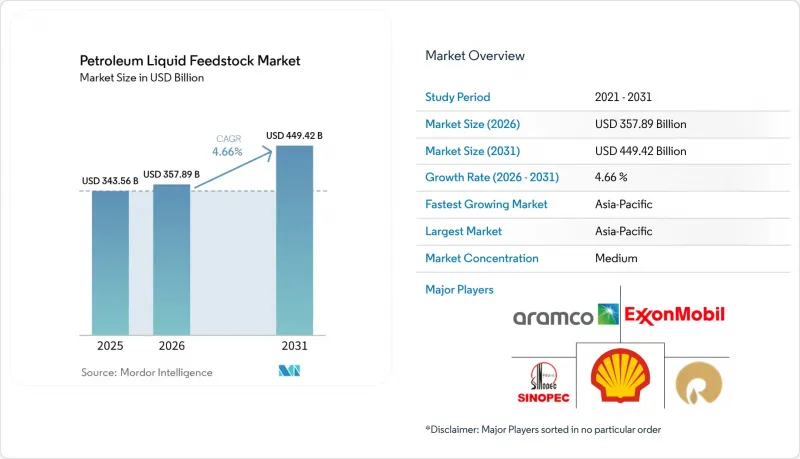
據 Mordor Intelligence 稱,2025 年石油基液體市場價值為 3435.6 億美元,預計將從 2026 年的 3578.9 億美元成長到 2031 年的 4494.2 億美元,預測期(2026-2031 年)的複合年成長率為 4.66%。
全球石油基液體原料市場趨勢與洞察
對烯烴和芳烴化合物的需求增加
石油液體市場仍依賴以石腦油為原料的蒸氣裂解裝置,仍是利用單一原料生產乙烯、丙烯、丁二烯和苯的成熟商業路線。這些產品使石油液體市場在基礎化學品供應中佔有穩固地位。埃克森美孚將於2025年第二季開始在廣東的煉油廠進行商業運營,該煉油廠年產能為160萬噸,其石腦油將從包括卡達拉斯拉凡煉油廠在內的中東供應商採購。到2025年,亞洲主要石化生產商的進口量將達到8,660萬噸,這清楚地表明了該地區對外部原料供應的依賴。儘管2026年初中東供應中斷將導致裂解裝置運作減少,但買家將被迫實現供應管道多元化,將美洲、印度和澳洲納入其供應基礎。
石油煉製和石化一體化
在一體化生產基地,生產商可以透過提煉原油並將中間體轉化為石化產品,在生產過程的更多階段保持增值。這種模式是石油液體市場的主要投資目標,因為它使營運商能夠對原料採購和產品銷售進行更精細的控制。 2025年4月,沙烏地阿美、中國石化和亞斯瑞福簽署了延佈計畫業務框架協議,該項目將包括一座年產180萬噸的混合原料裂解裝置和一座年產150萬噸的芳烴化合物聯合裝置。沙烏地阿美設定目標,2030年將每日處理量高達400萬桶原油轉化為化學產品。中國石油的大連計畫投資685億元人民幣(約93億美元),計畫興建一座年產1,000萬噸的煉油廠和一座年產120萬噸的乙烯裝置,預計於2026年動工。此類項目可望降低國內用戶對現貨石腦油價格的依賴,並進一步增加對非一體化買家的壓力。
原油和石腦油價格波動
石腦油價格與原油價格密切相關,原油市場供應趨緊可能導致裂解裝置成本迅速上漲。始於2026年2月底的供應中斷導致中東向亞洲的石腦油流入量急劇下降,東北亞裂解裝置的運轉率從2月的80%降至3月的60%。在供應中斷的情況下,2026年3月,2026年5月交貨的石腦油基準價格達到每噸1,300美元。到2026年5月,日本買家已透過替代管道(包括來自阿爾及利亞、秘魯、美國和中亞的供應)確保了其正常石腦油進口量的80%。因此,石油液體市場呈現兩極化:一是承受近期價格波動的現貨買家,二是擁有更強保障的綜合生產商和長期買家。根據東京商工研究所的一項調查,到 2026 年 6 月,85% 的日本製造企業將報告石腦油及相關溶劑的供應受限,這表明這種短缺可能會蔓延到石化工廠以外的領域。
細分市場分析
預計到2025年,石腦油將佔石油基液體原料市場(按類型分類)的65.67%,並預計到2031年將以5.13%的複合年成長率成長。與柴油和氣態原料相比,石腦油具有更廣泛的應用前景,因為它既可用於蒸汽裂解生產烯烴,也可用於催化重整生產芳烴。中國在2025年將其石腦油進口配額幾乎加倍,進口量將達到1,679萬噸。中國和沙烏地阿拉伯新建的綜合裝置旨在消耗重質石腦油,這將推動該領域的成長。即使乙烯的利潤率本身仍然較低,丙烯、丁二烯和芳烴的價值也將有助於提高石腦油裂解的經濟效益。
在石油基液體原料市場,柴油可作為重質裂解裝置的補充原料,並在石腦油短缺時作為替代原料。該市場採用靈活的原料供應系統,以最大限度地減少單一原料供應中斷或價格過高造成的損失。 2026年初的供應中斷凸顯了雙原料供應系統對於能夠切換原料的生產商的價值。沙烏地基礎工業公司(SABIC)的福建聯合裝置和S-Oil公司的沙欣專案均在其設計中融入了原料柔軟性。這種方法確保柴油仍然是煉油和石化聯合裝置風險管理的關鍵原料。
區域分析
到2025年,亞太地區將佔石油基液體燃料市場佔有率的42.69%,預計到2031年將以5.67%的複合年成長率成長。由於新裂解裝置的運作,預計2026年中國石腦油需求將增加8.6%。該地區的項目計劃包括埃克森美孚的廣東聯合裝置、HAPCO的盤錦裝置、BASF的FlexiCracker裝置以及新的對二甲苯生產能力。 2025年,中國進口了1,679萬噸石腦油,反映出裂解裝置需求的成長以及來自某些氣體替代品的競爭減少。 2025年8月,韓國生產商同意將裂解裝置產能削減270萬至370萬噸,以應對日益激烈的競爭壓力。同時,到2026年5月,日本80%的正常石腦油進口將來自替代供應商。面對 2026 年初可能出現的供應中斷,印度和東南亞仍然是重要的成長地區,煉油廠和裂解裝置正在探索原料多元化。
在乙烷儲量依然豐富的北美,石腦油的用途正從蒸汽裂解轉向芳香烴化合物、特殊中間體和混合油。埃克森美孚對貝城煉油廠的改造是在2025年8月做出最終投資決定之後進行的,這體現了該公司專注於高價值煉油和化學品生產的策略。歐洲面臨原料成本上漲、化學品產能過剩以及來自中國的出口所帶來的壓力。歐洲石腦油價格從供應中斷前的水平上漲了64%,並在2026年4月下旬達到峰值,但隨後到2026年6月又回落了80%的漲幅。英力士集團正在安特衛普投資40億歐元(43億美元)建造以乙烷為原料的「一號計畫」裂解裝置。該裝置將擁有每年145萬噸的乙烯產能。此計畫將降低歐洲未來對石腦油作為乙烯原料的需求,同時維持對芳烴原料的需求。
中東正從主要的石腦油出口地區轉型為更整合的化工生產中心。沙烏地阿美、中石化和亞斯列夫集團在延布的合資項目包括一套原料裂解裝置和芳烴化合物聯合裝置,可將原料加工成高附加價值化學品。沙烏地阿拉伯的原料分配機制使政府能夠影響大規模石化計畫的進度。在非洲,丹格特集團計畫在2028年將其雷基煉油廠的日產能擴大至140萬桶,使其丙烯年產能增加75萬噸。在南美洲,巴西是主要的消費驅動力,而阿根廷和安地斯山脈國家的市場在農業、建築和包裝價值鏈中的需求量相對較小。
其他好處:
- Excel格式的市場預測(ME)表
- 3個月的分析師支持
目錄
第1章:引言
- 研究假設和市場定義
- 調查範圍
第2章:調查方法
第3章執行摘要
第4章 市場狀況
- 市場概覽
- 市場促進因素
- 對烯烴和芳烴化合物的需求增加
- 石油煉製和石化一體化
- 包裝、建築和汽車應用領域對聚合物的需求
- 可再生燃料將促進生物石腦油的採用。
- 原料的柔軟性和數位化產量最佳化
- 市場限制因素
- 原油和石腦油價格波動
- 乙烷、液化石油氣和丙烷的替代品-脫氫途徑
- 石化產品供應過剩和利潤率承壓
- 價值鏈分析
- 波特五力分析
第5章 市場規模與成長預測
- 按類型
- 石腦油
- 柴油
- 最終產品
- 乙烯
- 苯
- 丙烯
- 己烷
- 萘
- 其他最終產品
- 透過使用
- 工業溶劑
- 清潔液
- 汽油混合物
- 汽油
- 其他用途
- 按地區
- 亞太地區
- 中國
- 印度
- 日本
- 韓國
- 東南亞國協
- 其他亞太國家
- 北美洲
- 美國
- 加拿大
- 墨西哥
- 歐洲
- 德國
- 英國
- 法國
- 義大利
- 北歐國家
- 俄羅斯
- 其他歐洲國家
- 南美洲
- 巴西
- 阿根廷
- 其他南美國家
- 中東和非洲
- 沙烏地阿拉伯
- 南非
- 其他中東和非洲國家
- 亞太地區
第6章 競爭情勢
- 市場集中度
- 策略趨勢
- 市佔率和排名分析
- 公司簡介
- BP plc
- Chevron Phillips Chemical Company LLC
- China Petrochemical Corporation
- CNPC
- Exxon Mobil Corporation
- Formosa Petrochemical Corporation
- Kuwait Petroleum Corporation
- LyondellBasell Industries NV
- PetroChina Company Limited
- PTT Global Chemical Public Company Limited
- Reliance Industries Limited
- SABIC
- Saudi Arabian Oil Co.
- Shell plc
- TotalEnergies
第7章 市場機會與未來展望
According to Mordor Intelligence, the petroleum liquid feedstock market size was valued at USD 343.56 billion in 2025 and is estimated to grow from USD 357.89 billion in 2026 to USD 449.42 billion by 2031, at a CAGR of 4.66% during the forecast period (2026-2031).
Global Petroleum Liquid Feedstock Market Trends and Insights
Rising Demand for Olefins and Aromatics
The petroleum liquid feedstock market continues to rely on naphtha-fed steam crackers, which remain the established commercial route for producing ethylene, propylene, butadiene, and benzene from a single feedstock stream. This product range gives the petroleum liquid feedstock market a durable role in base chemical supply. ExxonMobil began commercial operations at its 1.6 million tons per year Guangdong complex in Q2 2025 and procured naphtha from Middle Eastern suppliers, including Qatar's Ras Laffan refinery. Imports by major Asian petrochemical producers reached 86.6 million tons in 2025, reflecting the scale of the region's dependence on external feedstock supplies. The early-2026 disruption to Middle East flows reduced cracker activity, but also encouraged buyers to diversify supply routes to include the Americas, India, and Australia.
Refinery-Petrochemical Integration
Integrated sites refine crude oil and convert intermediate streams into petrochemicals, allowing producers to retain value across more stages of production. This model is a major investment focus in the petroleum liquid feedstock market because it gives operators greater control over feedstock availability and product placement. Aramco, Sinopec, and YASREF signed a Venture Framework Agreement in April 2025 for a Yanbu project with a 1.8 million tons per year mixed-feed cracker and a 1.5 million tons per year aromatics complex. Aramco has stated an ambition to convert up to 4 million barrels per day of crude oil into chemicals by 2030. PetroChina's Dalian project, with an investment of CNY 68.5 billion (USD 9.3 billion), is planned to include a 10 million tons-per-year refinery and a 1.2 million metric tons-per-year ethylene unit, with construction scheduled to start in 2026. Such projects reduce internal users' exposure to spot naphtha prices and can put more pressure on non-integrated buyers.
Crude Oil and Naphtha Price Volatility
Naphtha pricing remains closely tied to crude oil, which can rapidly increase costs for crackers when oil markets tighten. A supply disruption that began in late February 2026 sharply reduced Middle East naphtha flows to Asia and lowered Northeast Asian cracker utilization to 60% in March from 80% in February. Benchmark naphtha for May 2026 delivery reached USD 1,300 per ton in March 2026 during the disruption. By May 2026, Japanese buyers had secured 80% of their normal naphtha import volumes through alternative sources, including supplies from Algeria, Peru, the United States, and Central Asia. The petroleum liquid feedstock market, therefore, divides into spot buyers that absorb immediate volatility and integrated producers or long-term buyers that have greater protection. A Tokyo Shoko Research survey found that 85% of Japanese manufacturing companies reported constraints on naphtha and related solvent supplies in June 2026, indicating that shortages can extend beyond petrochemical plants.
Other drivers and restraints analyzed in the detailed report include:
- Polymer Demand from Packaging, Construction, and Automotive Applications
- Bio-Naphtha Adoption Driven by Renewable-Fuel Mandates
- Substitution by Ethane, LPG, and Propane-Dehydrogenation Routes
For complete list of drivers and restraints, kindly check the Table Of Contents.
Segment Analysis
Naphtha held 65.67% of the petroleum liquid feedstock market share by type in 2025 and is projected to grow at a 5.13% CAGR through 2031. It serves both steam cracking for olefins and catalytic reforming for aromatics, giving it a broader yield profile than gas oil or gas-based feeds. China nearly doubled its 2025 naphtha import quotas, and imports reached 16.79 million tons. New integrated facilities in China and Saudi Arabia are designed to consume heavy naphtha, supporting segment growth. The value of propylene, butadiene, and aromatics can strengthen the economics of naphtha cracking when ethylene margins alone are weak.
Within the petroleum liquid feedstock market, gas oil acts as a complementary feedstock for heavy-feed crackers and provides an alternative during naphtha shortages. The market uses flexible feed systems to minimize disruption when a single input becomes unavailable or costly. The early-2026 supply disruption underscored the value of dual-feed operations for producers able to switch inputs. SABIC's Fujian complex and S-Oil's Shaheen Project both incorporate feedstock flexibility into their designs. This approach keeps gas oil relevant as a risk-management input within refinery-petrochemical complexes.
Complete Report Scope:
- By Type
- Naphtha
- Gas Oil
- By End Product
- Ethylene
- Benzene
- Propylene
- Hexane
- Naphthalene
- Other End Products
- By Application
- Industrial Solvents
- Cleaning Fluids
- Adulterant to Petrol
- Gasoline
- Other Applications
- By Geography
- Asia-Pacific
- China
- India
- Japan
- South Korea
- ASEAN Countries
- Rest of Asia-Pacific
- North America
- United States
- Canada
- Mexico
- Europe
- Germany
- United Kingdom
- France
- Italy
- NORDIC Countries
- Russia
- Rest of Europe
- South America
- Brazil
- Argentina
- Rest of South America
- Middle East and Africa
- Saudi Arabia
- South Africa
- Rest of Middle East and Africa
- Asia-Pacific
Geography Analysis
Asia-Pacific held 42.69% of the petroleum liquid feedstock market share in 2025 and is projected to grow at a CAGR of 5.67% through 2031. China's naphtha demand is forecast to grow 8.6% in 2026 as new cracker capacity increases consumption. The regional project pipeline includes ExxonMobil's Guangdong complex, HAPCO's Panjin unit, BASF's flexi-cracker, and new paraxylene capacity. China imported 16.79 million tons of naphtha in 2025, reflecting increased demand from crackers and the reduced competitiveness of some gas-based alternatives. South Korean producers agreed in August 2025 to reduce cracker capacity by 2.7 to 3.7 million tons amid competitive pressure, while Japan sourced 80% of its normal naphtha import quantities by May 2026 from alternative suppliers. India and Southeast Asia remain important growth areas as refiners and crackers seek greater feedstock diversity following the early-2026 disruption.
In North America, naphtha use is shifting away from steam cracking and toward aromatics, specialty intermediates, and blending, as ethane remains plentiful. ExxonMobil's Baytown reconfiguration, following its August 2025 final investment decision, reflects a focus on higher-value refining and chemical outputs. Europe faces high feedstock costs, excess chemical capacity, and pressure from Chinese exports. European naphtha prices rose 64% from pre-disruption levels to a late-April 2026 peak, then lost 80% of that gain by June 2026. INEOS is building its EUR 4 billion (USD 4.3 billion) Project ONE ethane-fed cracker in Antwerp, with a capacity of 1.45 million tons per year of ethylene. The project reduces future European demand for naphtha as an ethylene feedstock while retaining demand for aromatics-grade material.
The Middle East is developing from a major naphtha exporter into a more integrated chemicals production base. The Yanbu venture between Aramco, Sinopec, and Yasref includes a mixed-feed cracker and aromatics complex that processes feedstock into higher-value chemical products. Saudi Arabia's feedstock allocation process gives the government influence over the pace of large petrochemical projects. In Africa, Dangote plans to expand the Lekki refinery to 1.4 million barrels per day by 2028 and add 750,000 tons per year of propylene capacity. Brazil leads South American consumption, while Argentina and Andean markets account for smaller quantities in the agrochemical, construction, and packaging value chains.
- BP p.l.c
- Chevron Phillips Chemical Company LLC
- China Petrochemical Corporation
- CNPC
- Exxon Mobil Corporation
- Formosa Petrochemical Corporation
- Kuwait Petroleum Corporation
- LyondellBasell Industries N.V.
- PetroChina Company Limited
- PTT Global Chemical Public Company Limited
- Reliance Industries Limited
- SABIC
- Saudi Arabian Oil Co.
- Shell plc
- TotalEnergies
Additional Benefits:
- The market estimate (ME) sheet in Excel format
- 3 months of analyst support
TABLE OF CONTENTS
1 Introduction
- 1.1 Study Assumptions and Market Definition
- 1.2 Scope of the Study
2 Research Methodology
3 Executive Summary
4 Market Landscape
- 4.1 Market Overview
- 4.2 Market Drivers
- 4.2.1 Rising Demand for Olefins and Aromatics
- 4.2.2 Refinery-Petrochemical Integration
- 4.2.3 Polymer Demand from Packaging, Construction and Automotive Applications
- 4.2.4 Bio-Naphtha Adoption Driven by Renewable-Fuel Mandates
- 4.2.5 Feedstock Flexibility and Digital Yield Optimization
- 4.3 Market Restraints
- 4.3.1 Crude Oil and Naphtha Price Volatility
- 4.3.2 Substitution by Ethane, LPG and Propane-Dehydrogenation Routes
- 4.3.3 Petrochemical Overcapacity and Margin Compression
- 4.4 Value Chain Analysis
- 4.5 Porter's Five Forces Analysis
- 4.5.1 Bargaining Power of Suppliers
- 4.5.2 Bargaining Power of Buyers
- 4.5.3 Threat of New Entrants
- 4.5.4 Threat of Substitutes
- 4.5.5 Competitive Rivalry
5 Market Size and Growth Forecasts (Value)
- 5.1 By Type
- 5.1.1 Naphtha
- 5.1.2 Gas Oil
- 5.2 By End Product
- 5.2.1 Ethylene
- 5.2.2 Benzene
- 5.2.3 Propylene
- 5.2.4 Hexane
- 5.2.5 Naphthalene
- 5.2.6 Other End Products
- 5.3 By Application
- 5.3.1 Industrial Solvents
- 5.3.2 Cleaning Fluids
- 5.3.3 Adulterant to Petrol
- 5.3.4 Gasoline
- 5.3.5 Other Applications
- 5.4 By Geography
- 5.4.1 Asia-Pacific
- 5.4.1.1 China
- 5.4.1.2 India
- 5.4.1.3 Japan
- 5.4.1.4 South Korea
- 5.4.1.5 ASEAN Countries
- 5.4.1.6 Rest of Asia-Pacific
- 5.4.2 North America
- 5.4.2.1 United States
- 5.4.2.2 Canada
- 5.4.2.3 Mexico
- 5.4.3 Europe
- 5.4.3.1 Germany
- 5.4.3.2 United Kingdom
- 5.4.3.3 France
- 5.4.3.4 Italy
- 5.4.3.5 NORDIC Countries
- 5.4.3.6 Russia
- 5.4.3.7 Rest of Europe
- 5.4.4 South America
- 5.4.4.1 Brazil
- 5.4.4.2 Argentina
- 5.4.4.3 Rest of South America
- 5.4.5 Middle East and Africa
- 5.4.5.1 Saudi Arabia
- 5.4.5.2 South Africa
- 5.4.5.3 Rest of Middle East and Africa
- 5.4.1 Asia-Pacific
6 Competitive Landscape
- 6.1 Market Concentration
- 6.2 Strategic Moves
- 6.3 Market Share (%)/Ranking Analysis
- 6.4 Company Profiles (includes Global Overview, Market Overview, Core Segments, Financials as available, Strategic Information, Products and Services, and Recent Developments)
- 6.4.1 BP p.l.c
- 6.4.2 Chevron Phillips Chemical Company LLC
- 6.4.3 China Petrochemical Corporation
- 6.4.4 CNPC
- 6.4.5 Exxon Mobil Corporation
- 6.4.6 Formosa Petrochemical Corporation
- 6.4.7 Kuwait Petroleum Corporation
- 6.4.8 LyondellBasell Industries N.V.
- 6.4.9 PetroChina Company Limited
- 6.4.10 PTT Global Chemical Public Company Limited
- 6.4.11 Reliance Industries Limited
- 6.4.12 SABIC
- 6.4.13 Saudi Arabian Oil Co.
- 6.4.14 Shell plc
- 6.4.15 TotalEnergies
7 Market Opportunities and Future Outlook
- 7.1 White-Space and Unmet-Need Assessment

 馬來西亞成品油市場:市場佔有率分析、產業趨勢與統計及成長預測(2026-2031年)北非精煉石油產品:市場佔有率分析、產業趨勢與統計及成長預測(2026-2031 年)西非精煉石油產品:市場佔有率分析、產業趨勢與統計及成長預測(2026-2031 年)
 2026年全球產品平臺運輸市場報告
 2026-2034年全球石油基液體原料市場規模、佔有率、趨勢和成長分析報告全球精製藍氫市場規模、佔有率、趨勢和成長分析報告:2026-2034年2026年全球成品油市場報告
 成品油市場-全球產業規模、佔有率、趨勢、機會、預測(按產品類型、應用、餾分、地區和競爭格局分類),2021-2031年
 成品油市場規模、佔有率及成長分析(依產品類型、應用、終端用戶產業、通路及地區分類)-2026-2033年產業預測
 石油基液體市場規模、佔有率和成長分析(按類型、最終產品和地區分類)—產業預測(2026-2033 年)