


 |
市場調查報告書
商品編碼
2125536
馬來西亞成品油市場:市場佔有率分析、產業趨勢與統計及成長預測(2026-2031年)Malaysia Refined Petroleum Products - Market Share Analysis, Industry Trends & Statistics, Growth Forecasts (2026 - 2031) |
||||||

※ 本網頁內容可能與最新版本有所差異。詳細情況請與我們聯繫。
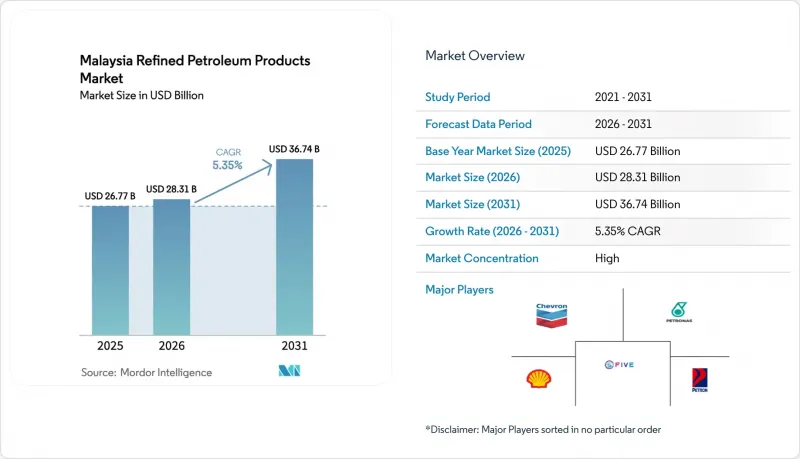
根據 Mordor Intelligence 預測,馬來西亞成品油市場規模預計將從 2025 年的 267.7 億美元成長到 2026 年的 283.1 億美元,然後從 2026 年到 2031 年以 5.35% 的複合年成長率成長,到 2031 年達到 367.4 億美元。
本報告按產品類型(汽油、柴油、液化石油氣、航空燃料、燃料油等)、硫含量(低硫和高硫)、來源(國內煉油廠和進口)、分銷管道(零售加油站、線上/自動燃料配送等)和最終用途部門(運輸、工業製造、航運和燃料庫、農業和採礦等)進行分類。
馬來西亞成品油市場趨勢與洞察
國內對運輸燃料的需求正在激增。
2023年,馬來西亞共註冊了799,731輛新車,其中乘用車佔絕大多數。儘管預計到2024年電動車的累積數量仍將低於2萬輛,但汽油和柴油的需求仍然強勁。馬幣的RON95汽油補貼價格減輕了家庭負擔,但預計2025年中期對該補貼的審查將鼓勵高所得駕駛者改用RON97汽油,從而維持整體銷售量。燃油零售商正透過與Setel的「DuitNow QR」和「Touch 'n Go」電子錢包整合,簡化900萬用戶的加油站支付流程,以彌補利潤微薄的局面。連接馬來半島主要城市和東馬各州的長途貨車運輸依賴柴油,導致需求集中在巴生谷的都市區,這些地區受區域電動車普及的影響較小。
擴大石化下游一體化
邊佳蘭綜合煉油廠日煉油能力達30萬桶,年石化產能達330萬噸,使馬來西亞國家石油公司(Petronas)能夠靈活地在燃料油和高利潤烯烴之間切換生產。恆源集團(Heng Yuan)正在考慮在波德申港實施類似的石腦油製烯烴轉化計劃,但該計劃的實施需要確保原料供應並最終落實資金籌措。這些綜合資產使馬來西亞能夠向越南和印尼出口聚合物前體,這兩個國家在2024年從馬來西亞進口的化學品超過150萬噸。對話集團(Dialogue Group)在邊佳蘭的倉儲設施為調配和轉運提供了柔軟性,最大限度地減少了船舶停工時間。
加速推廣電動車並提高燃油效率
充電站數量從2023年的1500個增加到2024年10月的3354個,目標在2025年底達到10,000個。然而,在雪蘭莪州和吉隆坡以外地區,人們對電動車續航里程的擔憂阻礙了其廣泛普及。德勤的一項調查顯示,58%的消費者仍然偏好內燃機汽車,因為入門級電動車的價格在42000至60000馬幣之間,而燃油車的價格則超過124000馬幣。預計未來十年,鼓勵汽車製造商推出混合動力汽車的燃油效率標準將使每輛車的油耗降低20%至30%。
細分市場分析
2025年,汽油在馬來西亞成品油市場中仍佔46.7%的佔有率,這主要得益於前一年新增乘用車註冊量達到719,160輛。航空燃料預計將以7.5%的複合年成長率成長,客運量將回升至1.129億人次,且自2028年起,國內永續航空燃料(SAF)供應量將有所增加。柴油仍是商用車輛的必需燃料,預計2025年商用車輛的道路柴油消耗量將達到79億公升。液化石油氣(LPG)是家庭烹飪的主要燃料,而由於近乎全面電氣化的推進,煤油的需求正在下降。燃油需求主要來自配備脫硫裝置的船舶和工業鍋爐,其中高硫等級的燃油在船用燃料油領域仍佔據主導地位。石腦油為馬來西亞國家石油公司快速裂解裝置(PETRONAS RAPID)每年330萬噸的供應量提供支持,其下游利潤率高於汽油混合燃料。
隨著航空旅行和航運的擴張,這個細分市場將繼續向噴射機燃料和船用燃油傾斜,而汽油增速將因燃油效率標準的日益嚴格而放緩。因此,儘管汽油的絕對銷售佔有率將保持不變,但到2031年,航空燃油在馬來西亞成品油市場中的佔有率將會增加。
隨著歐盟5柴油標準於2021年生效,歐5汽油標準於2025年生效,預計2025年,低硫燃料將佔馬來西亞成品油市場佔有率的55.1%。這一類別主要得益於基本符合超低硫標準的永續航空燃料(SAF)混合燃料,預計其複合年成長率將達到5.9%。高硫燃料主要得益於配備脫硫裝置的發電廠和船舶,將佔據剩餘的44.9%市場佔有率,但由於合規成本不斷上升,其複合年成長率預計將被限制在4.6%。
馬來西亞國內煉油企業正投資加氫設備以滿足10ppm的氫氣含量限制。其中,馬來西亞國家石油公司(PETRONAS)馬六甲分公司在2020年投資了12億馬幣,恆源煉油廠運作的加氫裂解裝置若原料供應允許,即可滿足歐5排放標準。由於新加坡和泰國的煉油企業已開始供應歐5混合燃料,這項轉變為區域間套利創造了機會,但也導致氫氣需求和營運成本的增加。
其他好處:
- Excel格式的市場預測(ME)表
- 3個月的分析師支持
目錄
第1章:引言
- 研究假設和市場定義
- 調查範圍
第2章:調查方法
第3章執行摘要
第4章 市場狀況
- 市場概覽
- 市場促進因素
- 國內對運輸燃料的需求正在激增。
- 下游石化領域一體化的擴大
- 政府鼓勵發展船用燃料樞紐
- 投資生物煉製廠生產永續航空燃料(SAF)
- 戰略儲備政策以提高煉油廠運轉率
- 航運路線重組導致區域供應鏈變化
- 市場限制因素
- 電動車加速普及和燃油效率提高
- 取消碳排放稅和燃油補貼
- 原油進口價格差異的波動會影響煉油廠的利潤率。
- 對船用燃料中硫含量的更嚴格規定正在降低對重質燃料油(HSFO)的需求。
- 供應鏈分析
- 監理情勢
- 技術展望
- 波特五力模型
- PESTLE分析
第5章 市場規模與成長預測
- 依產品類型
- 汽油
- 柴油引擎
- LPG
- 煤油
- 航空燃料
- 燃料油(高硫燃料油、超低硫燃料油)
- 其他(瀝青、石腦油)
- 按硫含量
- 低硫(10 ppm 或更低)
- 高硫含量(10 ppm 或更高)
- 來源
- 國內煉油廠
- 進口
- 透過分銷管道
- 零售加油站
- 大量銷售,商用
- 直接供貨合約
- 線上/自動化燃油配送
- 按最終用途類別
- 運輸
- 發電
- 工業製造
- 石油化學產品
- 住宅/商業
- 航運和燃料庫
- 農業和採礦業
第6章 競爭情勢
- 市場集中度
- 策略趨勢(併購、聯盟、購電協議)
- 市場佔有率分析(主要公司的市場排名和佔有率)
- 公司簡介
- Petronas(Petroliam Nasional Berhad)
- Shell PLC
- Chevron Corporation(Caltex Malaysia)
- Petron Malaysia Refining & Marketing Bhd
- Hengyuan Refining Company Berhad
- Gas Malaysia Berhad
- Petroleum Sarawak Berhad(PETROS)
- FIVE Petroleum Malaysia Sdn Bhd
- EcoCeres
- Dialog Group Berhad
- PETMAL Oil Holdings Sdn Bhd
- Rongsheng Petrochemical Co. Ltd
- Sinopec International(Trading)Pte Ltd
- Vitol Asia Pte Ltd
- Trafigura Group Pte Ltd
- Malaysia Marine & Heavy Engineering Holdings Bhd
- YTL Power International Berhad
- BHPetrol(Boustead Petroleum Marketing Sdn Bhd)
- Caltex(Malaysia)Marketing Sdn Bhd
第7章 市場機會與未來展望
According to Mordor Intelligence, the Malaysia refined petroleum products market size is expected to grow from USD 26.77 billion in 2025 to USD 28.31 billion in 2026 and is forecast to reach USD 36.74 billion by 2031 at 5.35% CAGR over 2026-2031.
This report is Segmented by Product Type (Petrol, Diesel, LPG, Aviation Fuel, Fuel Oil, and Others), Sulfur Content (Low-Sulfur and High-Sulfur), Source (Domestic Refineries and Imports), Distribution Channel (Retail Fuel Stations, Online/Automated Fuel Delivery, and More), and End-Use Sector (Transportation, Industrial Manufacturing, Marine and Bunkering, Agriculture and Mining, and More).
Malaysia Refined Petroleum Products Market Trends and Insights
Surge in Domestic Transportation Fuel Demand
Malaysia added 799,731 vehicles in 2023, with passenger cars dominating registrations and cementing a robust gasoline and diesel requirement despite fewer than 20,000 cumulative electric vehicles by 2024. Subsidized RON95 pricing at MYR 1.99 per liter shields household budgets, yet mid-2025 subsidy retargeting moves higher-income drivers toward RON97, sustaining overall throughput. Fuel retailers are cushioning thin margins through Setel's DuitNow QR and Touch 'n Go e-wallet integration, which streamlines forecourt payments for nine million users. Long-haul trucking between Peninsular hubs and East Malaysian states depends on diesel, insulating demand from localized EV adoption concentrated in Klang Valley urban centers.
Expansion of Petrochemical Downstream Integration
The Pengerang Integrated Complex couples 300,000 bpd of refining with 3.3 million tpy of petrochemical capacity, allowing PETRONAS to swing output between fuels and higher-margin olefins. Hengyuan is studying a similar naphtha-to-olefins retrofit at Port Dickson but must lock in feedstock and financing before proceeding. Integrated assets position Malaysia to ship polymer precursors to Vietnam and Indonesia, which imported more than 1.5 million t of Malaysian chemicals in 2024. Dialog Group's storage farms at Pengerang provide blending and staging flexibility that minimizes vessel waiting time.
Accelerating EV Adoption and Fuel Efficiency Improvements
Charging points increased from 1,500 in 2023 to 3,354 by October 2024, and the target is 10,000 by the end of 2025. Even so, range anxiety outside Selangor and Kuala Lumpur slows uptake. Deloitte finds that 58% of consumers still prefer internal combustion vehicles, given the MYR 42,000-60,000 entry price versus MYR 124,000-plus for EVs. Fuel-efficiency standards that push automakers toward hybrids will trim per-vehicle consumption by 20-30% over a decade.
Other drivers and restraints analyzed in the detailed report include:
- Government Incentives for Bunker Fuel Hub Development
- Bio-Refinery Investments for Sustainable Aviation Fuel
- Carbon Taxation and Removal of Fuel Subsidies
For complete list of drivers and restraints, kindly check the Table Of Contents.
Segment Analysis
Petrol retained 46.7% of the Malaysia refined petroleum products market share in 2025, powered by 719,160 passenger-vehicle additions in the prior year. Aviation fuel is poised for a 7.5% CAGR as passenger traffic rebounds toward 112.9 million journeys and as local SAF supply ramps from 2028. Diesel remains essential for a commercial fleet that burned 7.9 billion liters on roads in 2025. LPG dominates household cooking, while kerosene shrinks with near-universal electrification. Fuel oil demand hinges on scrubber-equipped ships and industrial boilers; high-sulfur grades persist in the bunker segment. Naphtha supports PETRONAS RAPID's 3.3 million tpy cracker, generating a higher downstream margin than gasoline blending.
This segment will continue to pivot toward jet and marine grades as air travel and shipping expand, whereas gasoline growth moderates under efficiency norms. Aviation fuel will therefore raise its slice of Malaysia's refined petroleum products market by 2031, even as petrol maintains absolute volume dominance.
Low-sulfur fuels captured 55.1% of Malaysia's refined petroleum products market share in 2025 after Euro 5 diesel took effect in 2021 and Euro 5 petrol followed in 2025. The category should post a 5.9% CAGR, aided by SAF blending that inherently meets ultra-low-sulfur thresholds. High-sulfur fuels hold the remaining 44.9% share, buoyed by power plants and scrubber-equipped vessels yet capped at 4.6% CAGR as compliance costs rise.
Domestic refiners have invested in hydrotreaters to meet the 10 ppm ceiling, with PETRONAS Melaka spending MYR 1.2 billion in 2020 and Hengyuan operating a hydrocracker that can hit Euro 5 specs when feedstock availability allows. The shift secures regional arbitrage opportunities, since Singaporean and Thai refiners already supply Euro 5 blends, but it also raises hydrogen demand and operating costs.
Complete Report Scope:
- By Product Type
- Petrol (Gasoline)
- Diesel
- LPG
- Kerosene
- Aviation Fuel
- Fuel Oil (HSFO, VLSFO)
- Others (Bitumen, Naphtha)
- By Sulfur Content
- Low-Sulfur (Up to 10 ppm)
- High-Sulfur (Above 10 ppm)
- By Source
- Domestic Refineries
- Imports
- By Distribution Channel
- Retail Fuel Stations
- Commercial Bulk Sales
- Direct Supply Contracts
- Online/Automated Fuel Delivery
- By End-Use Sector
- Transportation
- Power Generation
- Industrial Manufacturing
- Petrochemicals
- Residential and Commercial
- Marine and Bunkering
- Agriculture and Mining
List of Companies Covered in this Report:
- Petronas (Petroliam Nasional Berhad)
- Shell PLC
- Chevron Corporation (Caltex Malaysia)
- Petron Malaysia Refining & Marketing Bhd
- Hengyuan Refining Company Berhad
- Gas Malaysia Berhad
- Petroleum Sarawak Berhad (PETROS)
- FIVE Petroleum Malaysia Sdn Bhd
- EcoCeres
- Dialog Group Berhad
- PETMAL Oil Holdings Sdn Bhd
- Rongsheng Petrochemical Co. Ltd
- Sinopec International (Trading) Pte Ltd
- Vitol Asia Pte Ltd
- Trafigura Group Pte Ltd
- Malaysia Marine & Heavy Engineering Holdings Bhd
- YTL Power International Berhad
- BHPetrol (Boustead Petroleum Marketing Sdn Bhd)
- Caltex (Malaysia) Marketing Sdn Bhd
Additional Benefits:
- The market estimate (ME) sheet in Excel format
- 3 months of analyst support
TABLE OF CONTENTS
1 Introduction
- 1.1 Study Assumptions & Market Definition
- 1.2 Scope of the Study
2 Research Methodology
3 Executive Summary
4 Market Landscape
- 4.1 Market Overview
- 4.2 Market Drivers
- 4.2.1 Surge in domestic transportation fuel demand
- 4.2.2 Expansion of petrochemical downstream integration
- 4.2.3 Government incentives for bunker fuel hub development
- 4.2.4 Bio-refinery investments for Sustainable Aviation Fuel
- 4.2.5 Strategic stockpiling policies enhancing refinery utilization
- 4.2.6 Regional supply-chain shifts due to shipping lane realignments
- 4.3 Market Restraints
- 4.3.1 Accelerating EV adoption & fuel efficiency improvements
- 4.3.2 Carbon taxation & removal of fuel subsidies
- 4.3.3 Volatility in crude import differentials affecting refinery margins
- 4.3.4 Tightening marine fuel sulfur regulations compressing HSFO demand
- 4.4 Supply-Chain Analysis
- 4.5 Regulatory Landscape
- 4.6 Technological Outlook
- 4.7 Porter's Five Forces
- 4.7.1 Threat of New Entrants
- 4.7.2 Bargaining Power of Suppliers
- 4.7.3 Bargaining Power of Buyers
- 4.7.4 Threat of Substitutes
- 4.7.5 Competitive Rivalry
- 4.8 PESTLE Analysis
5 Market Size & Growth Forecasts
- 5.1 By Product Type
- 5.1.1 Petrol (Gasoline)
- 5.1.2 Diesel
- 5.1.3 LPG
- 5.1.4 Kerosene
- 5.1.5 Aviation Fuel
- 5.1.6 Fuel Oil (HSFO, VLSFO)
- 5.1.7 Others (Bitumen, Naphtha)
- 5.2 By Sulfur Content
- 5.2.1 Low-Sulfur (Up to 10 ppm)
- 5.2.2 High-Sulfur (Above 10 ppm)
- 5.3 By Source
- 5.3.1 Domestic Refineries
- 5.3.2 Imports
- 5.4 By Distribution Channel
- 5.4.1 Retail Fuel Stations
- 5.4.2 Commercial Bulk Sales
- 5.4.3 Direct Supply Contracts
- 5.4.4 Online/Automated Fuel Delivery
- 5.5 By End-Use Sector
- 5.5.1 Transportation
- 5.5.2 Power Generation
- 5.5.3 Industrial Manufacturing
- 5.5.4 Petrochemicals
- 5.5.5 Residential and Commercial
- 5.5.6 Marine and Bunkering
- 5.5.7 Agriculture and Mining
6 Competitive Landscape
- 6.1 Market Concentration
- 6.2 Strategic Moves (M&A, Partnerships, PPAs)
- 6.3 Market Share Analysis (Market Rank/Share for key companies)
- 6.4 Company Profiles (includes Global level Overview, Market level overview, Core Segments, Financials as available, Strategic Information, Products & Services, and Recent Developments)
- 6.4.1 Petronas (Petroliam Nasional Berhad)
- 6.4.2 Shell PLC
- 6.4.3 Chevron Corporation (Caltex Malaysia)
- 6.4.4 Petron Malaysia Refining & Marketing Bhd
- 6.4.5 Hengyuan Refining Company Berhad
- 6.4.6 Gas Malaysia Berhad
- 6.4.7 Petroleum Sarawak Berhad (PETROS)
- 6.4.8 FIVE Petroleum Malaysia Sdn Bhd
- 6.4.9 EcoCeres
- 6.4.10 Dialog Group Berhad
- 6.4.11 PETMAL Oil Holdings Sdn Bhd
- 6.4.12 Rongsheng Petrochemical Co. Ltd
- 6.4.13 Sinopec International (Trading) Pte Ltd
- 6.4.14 Vitol Asia Pte Ltd
- 6.4.15 Trafigura Group Pte Ltd
- 6.4.16 Malaysia Marine & Heavy Engineering Holdings Bhd
- 6.4.17 YTL Power International Berhad
- 6.4.18 BHPetrol (Boustead Petroleum Marketing Sdn Bhd)
- 6.4.19 Caltex (Malaysia) Marketing Sdn Bhd
7 Market Opportunities & Future Outlook
- 7.1 White-space & unmet-need assessment
- 7.2 Emerging Biofuel Integration
- 7.3 Digital Supply Chain Optimization
- 7.4 Carbon Capture & Low-Carbon Refinery Projects
- 7.5 Hydrogen Co-processing Opportunities

 北非精煉石油產品:市場佔有率分析、產業趨勢與統計及成長預測(2026-2031 年)西非精煉石油產品:市場佔有率分析、產業趨勢與統計及成長預測(2026-2031 年)
 石油煉廠氫氣市場機會、成長促進因素、產業趨勢分析及2026-2035年預測
 石油液體市場-全球產業規模、佔有率、趨勢、機會、預測:按類型、產品類型、應用、地區和競爭格局分類,2021-2031年
 2026年全球產品平臺運輸市場報告
 2026-2034年全球石油基液體原料市場規模、佔有率、趨勢和成長分析報告全球精製藍氫市場規模、佔有率、趨勢和成長分析報告:2026-2034年2026年全球成品油市場報告成品油市場-全球產業規模、佔有率、趨勢、機會、預測(按產品類型、應用、餾分、地區和競爭格局分類),2021-2031年
 成品油市場規模、佔有率及成長分析(依產品類型、應用、終端用戶產業、通路及地區分類)-2026-2033年產業預測