

 |
市場調查報告書
商品編碼
2115229
北非精煉石油產品:市場佔有率分析、產業趨勢與統計及成長預測(2026-2031 年)North Africa Refined Petroleum Products - Market Share Analysis, Industry Trends & Statistics, Growth Forecasts (2026 - 2031) |
||||||

※ 本網頁內容可能與最新版本有所差異。詳細情況請與我們聯繫。
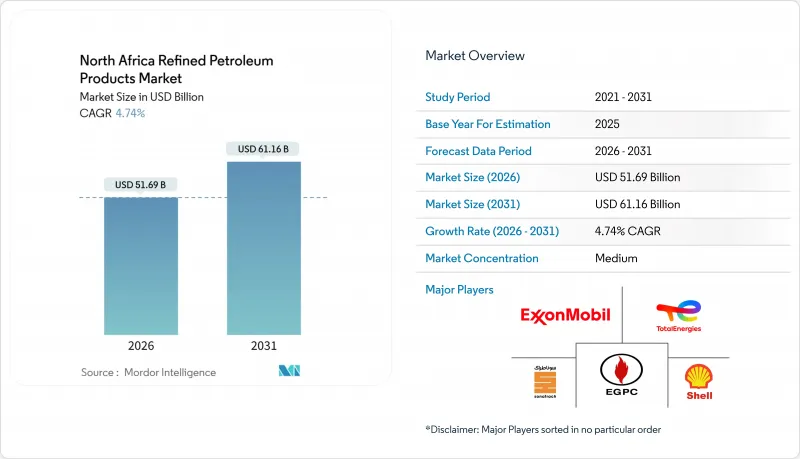
根據 Mordor Intelligence 估計,2026 年北非精煉石油產品市場規模為 516.9 億美元,預計在預測期(2026-2031 年)內將以 4.74% 的複合年成長率成長,到 2031 年達到 611.6 億美元。
本報告涵蓋產品類型(汽油、柴油、液化石油氣、煤油、航空燃料、重油、其他)、硫含量(低硫和高硫)、配銷通路(零售加油站、線上/自動燃料配送等)、最終用途行業(運輸、石化、船舶和燃料庫等)以及地區(阿爾及利亞、埃及、摩洛哥、利比亞、突尼斯等)。
北非成品油市場趨勢與洞察
車輛數量的增加推高了對運輸燃料的需求。
都市化、旅遊需求成長以及跨境貨運路線的增加正在推動汽油、柴油和噴射機燃料消費量的成長。埃及的目標是到2028年吸引3000萬遊客,促使租車服務和城際長途巴士服務不斷擴張;摩洛哥的航空樞紐在2024年實現了兩位數的客運量成長。阿爾及利亞的納夫塔爾公司在2024年分銷了1330萬噸燃料,隨著其產品和通路的重組,預計銷量將穩步成長。利比亞的燃料補貼仍佔GDP的35%,這助長了走私活動,人為地提高了區域需求數據,並維持了煉油廠的高加工量。儘管電力生產正在逐步轉向使用燃料,但交通運輸業仍保持強勁,支撐了北非成品油市場需求的良好前景。
煉油廠現代化改造與產能擴張
過去十年,埃及已在下游產業投資約80億美元。其中包括投資27億美元擴建MIDOR煉油廠、在阿斯尤特投資15億至30億美元建造加氫裂解裝置,以及對亞歷山大石油公司進行瓶頸改造。預計到2027年,這些項目將使埃及的煉油能力達到每日90萬桶。阿爾及利亞的哈希梅薩烏德煉油廠日產能為11萬桶,將於2025年開工建設,與索納特拉夫公司重新運作的斯基克達和阿爾澤煉油廠形成互補。製程升級將提高成品油收率,並有助於達到歐盟5排放標準。這將減少對進口的依賴,並為北非成品油市場的出口套利奠定基礎。
政治和安全動盪正在限制利比亞原油的供應。
扎維亞煉油廠的儲存槽於2024年12月停止營運。這與2024年8月的一次停產類似,那次停產導致國內煉油產量減少了63%。這些反覆發生的不可抗力事件擾亂了原料供應,迫使進口增加,並迫使鄰國煉油商採購昂貴的原油,阻礙了北非成品油市場的成長。
細分市場分析
隨著開羅、卡薩布蘭卡和馬拉喀什機場的登機口容量和航空公司數量的增加,預計2026年至2031年航空燃油銷量將以6.5%的複合年成長率成長。儘管柴油在2025年仍將佔據北非成品油市場35.5%的最大佔有率,但其成長率僅4.5%,落後於航空噴射機燃料,因為發電替代燃料抵消了貨運量的成長。汽油銷售與整體需求保持同步,液化石油氣在烹飪和農村地區發揮重要作用,而燃料油則因排放法規而萎縮。瀝青和石腦油的需求因道路建設和石化原料需求的成長而增加。這些策略權衡促使煉油商最大限度地提高中間餾分油的產量,從而支撐了北非成品油市場的整體盈利。
埃及的目標是到2028年吸引3000萬遊客,為此,MIDOR和阿斯尤特需要滿足約150萬噸噴射機燃料日益成長的需求,這也推動了對加氫技術的進一步投資。優質噴射機燃料的高利潤率以及與航空公司簽訂的穩定契約,使得煤油最佳化成為北非成品油行業的首要任務。
預計到2025年,低硫原油將佔市場佔有率的58.1%,並將在2031年之前以5.3%的複合年成長率成長,屆時埃及和摩洛哥將實施歐5標準。阿爾及利亞正在逐步過渡,計劃從2027年起全面達標,而突尼斯和利比亞則相對落後。受船用燃料含硫量法規和電力產業用量下降的影響,高硫原油的市佔率僅成長3.8%。配備加氫處理系統的聯合煉油廠利潤豐厚,而老舊的精煉廠若不進行現代化改造,則面臨閒置風險。這些差異正在推動北非成品油市場的技術革新和資本流入。
其他好處:
- Excel格式的市場預測(ME)表
- 3個月的分析師支持
目錄
第1章:引言
- 研究假設和市場定義
- 調查範圍
第2章:調查方法
第3章執行摘要
第4章 市場狀況
- 市場概覽
- 市場促進因素
- 車輛數量的增加推高了對運輸燃料的需求。
- 煉油廠維修及產能擴建(埃及、阿爾及利亞)
- 分階段的補貼改革正在提高下游產業的盈利。
- 在地中海排放控制區實施0.1%的硫含量上限後,以港口主導的燃料庫樞紐策略正在興起。
- 新建石化聯合企業增加石腦油和液化石油氣的提取量
- 市場限制因素
- 政治和安全動盪限制了利比亞原油的供應。
- 由於歐盟和中東產能過剩,進口競爭加劇。
- 電力產業向天然氣和可再生能源的轉型正在降低對燃料油和柴油的需求。
- 供應鏈分析
- 監理情勢
- 技術展望
- 波特五力模型
第5章 市場規模與成長預測
- 依產品類型
- 汽油
- 柴油引擎
- LPG
- 煤油
- 航空燃料
- 燃料油(高硫燃料油、超低硫燃料油)
- 其他(瀝青、石腦油)
- 按硫含量
- 低硫(10 ppm 或更低)
- 高硫含量(10 ppm 或更高)
- 透過分銷管道
- 零售加油站
- 大量銷售,商用
- 直接供貨合約
- 線上/自動化燃油配送
- 按最終用途類別
- 運輸
- 發電
- 工業製造
- 石油化學產品
- 住宅/商業
- 航運和燃料庫
- 農業和採礦業
- 按地區
- 阿爾及利亞
- 埃及
- 利比亞
- 摩洛哥
- 突尼西亞
- 北非其他地區
第6章 競爭情勢
- 市場集中度
- 策略趨勢(併購、聯盟、購電協議)
- 市場佔有率分析(主要公司的市場排名和佔有率)
- 公司簡介
- Sonatrach
- Egyptian General Petroleum Corporation(EGPC)
- TotalEnergies SE
- Shell plc
- Exxon Mobil Corp.
- Qalaa Holdings/Egyptian Refining Co.
- Libya National Oil Corporation
- Naftal(Algeria)
- Vivo Energy
- Puma Energy
- MIDOR
- Alexandria Petroleum Co.
- Assiut Oil Refining Co.
- Suez Oil Processing Co.
- Skikda Refinery(Sonatrach)
- Libya Oil Holding(Oilibya)
- Red Sea National Refining & Petrochemicals
- ENNPI(Engineering for Petroleum)
- Axens Group
- Honeywell UOP
- Litasco(Swiss-Libyan Trading)
第7章 市場機會與未來展望
According to Mordor Intelligence, the North Africa refined petroleum products market size is estimated at USD 51.69 billion in 2026, and is expected to reach USD 61.16 billion by 2031, at a CAGR of 4.74% during the forecast period (2026-2031).
This report is Segmented by Product Type (Petrol, Diesel, LPG, Kerosene, Aviation Fuel, Fuel Oil, and Others), Sulfur Content (Low-Sulfur and High-Sulfur), Distribution Channel (Retail Fuel Stations, Online/Automated Fuel Delivery, and More), End-Use Sector (Transportation, Petrochemicals, Marine and Bunkering, and More), and Geography (Algeria, Egypt, Morocco, Libya, Tunisia, and More)
North Africa Refined Petroleum Products Market Trends and Insights
Vehicle-Fleet Growth Boosts Transport Fuel Demand
Continued urbanization, stronger tourism flows, and expanding cross-border freight routes are lifting gasoline, diesel, and jet-fuel consumption. Egypt's target of 30 million tourists by 2028 widens rental-car fleets and inter-city coach services, while Morocco's aviation hubs posted double-digit traffic gains in 2024. Algeria's Naftal distributed 13.3 million tonnes of fuels in 2024 and expects steady growth as it reorganizes products and channels. Fuel subsidies in Libya still absorb 35% of GDP, encouraging smuggling that artificially inflates regional demand statistics and keeps refinery throughputs elevated. Despite ongoing power fuel switching, transport remains resilient, reinforcing a positive volume outlook for the North Africa refined petroleum products market.
Refinery Upgrades and Capacity Expansions
Egypt invested roughly USD 8 billion in its downstream over the past decade, including MIDOR's USD 2.7 billion expansion, Assiut's USD 1.5-3 billion hydrocracker, and Alexandria Petroleum debottlenecking. Combined projects lift national capacity toward 900,000 barrels per day by 2027. Algeria's 110,000-barrel-per-day Hassi Messaoud refinery broke ground in 2025 and complements Sonatrach's revitalized Skikda and Arzew plants. Raised complexity boosts white-product yields and Euro 5 compliance, shrinking import dependence and setting the stage for export arbitrage within the North Africa refined petroleum products market.
Political-Security Disruptions Curbing Libyan Crude Feedstock
Zawiya refinery halted operations in December 2024 after armed clashes destroyed storage tanks, mirroring previous outages that slashed national output by 63% in August 2024. Repeated force majeure erodes feedstock supply, forces higher imports, and pushes refiners in neighboring states to source costlier barrels, hindering the growth of the North Africa refined petroleum products market.
Other drivers and restraints analyzed in the detailed report include:
- Gradual Subsidy Reform Improving Downstream Economics
- Port-Led Bunkering Hub Strategy After Mediterranean 0.1% Sulfur Cap
- Import Competition from Surplus EU and Middle-East Products
For complete list of drivers and restraints, kindly check the Table Of Contents.
Segment Analysis
Aviation fuel volume expands at a 6.5% CAGR between 2026 and 2031 as Cairo, Casablanca, and Marrakech airports add gates and carriers. Diesel retained the largest slice at 35.5% of the North Africa refined petroleum products market size in 2025, but its 4.5% growth trails jet fuel because power-generation displacement offsets freight gains. Petrol follows overall demand, LPG holds niche cooking and rural roles, and fuel oil contracts under emission curbs. Bitumen and naphtha rise with road building and petrochemical feedstock pull. The strategic trade-off pushes refiners to maximize middle distillates, underpinning profitability across the North Africa refined petroleum products market.
Egypt's aim for 30 million tourists by 2028 implies roughly 1.5 million tonnes of incremental jet fuel that MIDOR and Assiut must meet, encouraging further hydrotreating investments. Premium jet margins and stable airline contracts make kerosene optimization a top priority within the North Africa refined petroleum products industry.
Low-sulfur grades captured 58.1% share in 2025 and are projected to expand at a 5.3% CAGR through 2031 as Egypt and Morocco enforce Euro 5 standards. Algeria moves gradually yet plans full alignment post-2027, while Tunisia and Libya lag. High-sulfur fuels rise just 3.8% amid marine sulfur caps and shrinking power-sector usage. Complex refineries with hydrotreaters seize premium margins, whereas older topping plants risk stranded status unless modernized. This divergence drives technology uptake and capital flows across the North Africa refined petroleum products market.
Complete Report Scope:
- By Product Type
- Petrol (Gasoline)
- Diesel
- LPG
- Kerosene
- Aviation Fuel
- Fuel Oil (HSFO, VLSFO)
- Others (Bitumen, Naphtha)
- By Sulfur Content
- Low-Sulfur (Up to 10 ppm)
- High-Sulfur (Above 10 ppm)
- By Distribution Channel
- Retail Fuel Stations
- Commercial Bulk Sales
- Direct Supply Contracts
- Online/Automated Fuel Delivery
- By End-Use Sector
- Transportation
- Power Generation
- Industrial Manufacturing
- Petrochemicals
- Residential and Commercial
- Marine and Bunkering
- Agriculture and Mining
- By Geography
- Algeria
- Egypt
- Libya
- Morocco
- Tunisia
- Rest of North Africa
List of Companies Covered in this Report:
- Sonatrach
- Egyptian General Petroleum Corporation (EGPC)
- TotalEnergies SE
- Shell plc
- Exxon Mobil Corp.
- Qalaa Holdings / Egyptian Refining Co.
- Libya National Oil Corporation
- Naftal (Algeria)
- Vivo Energy
- Puma Energy
- MIDOR
- Alexandria Petroleum Co.
- Assiut Oil Refining Co.
- Suez Oil Processing Co.
- Skikda Refinery (Sonatrach)
- Libya Oil Holding (Oilibya)
- Red Sea National Refining & Petrochemicals
- ENNPI (Engineering for Petroleum)
- Axens Group
- Honeywell UOP
- Litasco (Swiss-Libyan Trading)
Additional Benefits:
- The market estimate (ME) sheet in Excel format
- 3 months of analyst support
TABLE OF CONTENTS
1 Introduction
- 1.1 Study Assumptions & Market Definition
- 1.2 Scope of the Study
2 Research Methodology
3 Executive Summary
4 Market Landscape
- 4.1 Market Overview
- 4.2 Market Drivers
- 4.2.1 Vehicle-fleet growth boosts transport fuel demand
- 4.2.2 Refinery upgrades & capacity expansions (Egypt, Algeria)
- 4.2.3 Gradual subsidy reform improving downstream economics
- 4.2.4 Port-led bunkering hub strategy post-Mediterranean ECA 0.1 % S cap
- 4.2.5 New petrochemical complexes raising naphtha/LPG offtake
- 4.3 Market Restraints
- 4.3.1 Political-security disruptions curbing Libyan crude feedstock
- 4.3.2 Import competition from surplus EU & Middle-East products
- 4.3.3 Power-sector fuel-switching to gas & renewables cuts FO/diesel demand
- 4.4 Supply-Chain Analysis
- 4.5 Regulatory Landscape
- 4.6 Technological Outlook
- 4.7 Porter's Five Forces
- 4.7.1 Bargaining Power of Suppliers
- 4.7.2 Bargaining Power of Consumers
- 4.7.3 Threat of New Entrants
- 4.7.4 Threat of Substitutes
- 4.7.5 Intensity of Rivalry
5 Market Size & Growth Forecasts
- 5.1 By Product Type
- 5.1.1 Petrol (Gasoline)
- 5.1.2 Diesel
- 5.1.3 LPG
- 5.1.4 Kerosene
- 5.1.5 Aviation Fuel
- 5.1.6 Fuel Oil (HSFO, VLSFO)
- 5.1.7 Others (Bitumen, Naphtha)
- 5.2 By Sulfur Content
- 5.2.1 Low-Sulfur (Up to 10 ppm)
- 5.2.2 High-Sulfur (Above 10 ppm)
- 5.3 By Distribution Channel
- 5.3.1 Retail Fuel Stations
- 5.3.2 Commercial Bulk Sales
- 5.3.3 Direct Supply Contracts
- 5.3.4 Online/Automated Fuel Delivery
- 5.4 By End-Use Sector
- 5.4.1 Transportation
- 5.4.2 Power Generation
- 5.4.3 Industrial Manufacturing
- 5.4.4 Petrochemicals
- 5.4.5 Residential and Commercial
- 5.4.6 Marine and Bunkering
- 5.4.7 Agriculture and Mining
- 5.5 By Geography
- 5.5.1 Algeria
- 5.5.2 Egypt
- 5.5.3 Libya
- 5.5.4 Morocco
- 5.5.5 Tunisia
- 5.5.6 Rest of North Africa
6 Competitive Landscape
- 6.1 Market Concentration
- 6.2 Strategic Moves (M&A, Partnerships, PPAs)
- 6.3 Market Share Analysis (Market Rank/Share for key companies)
- 6.4 Company Profiles (includes Global level Overview, Market level overview, Core Segments, Financials as available, Strategic Information, Products & Services, and Recent Developments)
- 6.4.1 Sonatrach
- 6.4.2 Egyptian General Petroleum Corporation (EGPC)
- 6.4.3 TotalEnergies SE
- 6.4.4 Shell plc
- 6.4.5 Exxon Mobil Corp.
- 6.4.6 Qalaa Holdings / Egyptian Refining Co.
- 6.4.7 Libya National Oil Corporation
- 6.4.8 Naftal (Algeria)
- 6.4.9 Vivo Energy
- 6.4.10 Puma Energy
- 6.4.11 MIDOR
- 6.4.12 Alexandria Petroleum Co.
- 6.4.13 Assiut Oil Refining Co.
- 6.4.14 Suez Oil Processing Co.
- 6.4.15 Skikda Refinery (Sonatrach)
- 6.4.16 Libya Oil Holding (Oilibya)
- 6.4.17 Red Sea National Refining & Petrochemicals
- 6.4.18 ENNPI (Engineering for Petroleum)
- 6.4.19 Axens Group
- 6.4.20 Honeywell UOP
- 6.4.21 Litasco (Swiss-Libyan Trading)
7 Market Opportunities & Future Outlook
- 7.1 White-space & Unmet-Need Assessment

 西非精煉石油產品:市場佔有率分析、產業趨勢與統計及成長預測(2026-2031 年)
 石油煉廠氫氣市場機會、成長促進因素、產業趨勢分析及2026-2035年預測
 石油液體市場-全球產業規模、佔有率、趨勢、機會、預測:按類型、產品類型、應用、地區和競爭格局分類,2021-2031年
 2026年全球產品平臺運輸市場報告
 2026-2034年全球石油基液體原料市場規模、佔有率、趨勢和成長分析報告全球精製藍氫市場規模、佔有率、趨勢和成長分析報告:2026-2034年2026年全球成品油市場報告成品油市場-全球產業規模、佔有率、趨勢、機會、預測(按產品類型、應用、餾分、地區和競爭格局分類),2021-2031年
 成品油市場規模、佔有率及成長分析(依產品類型、應用、終端用戶產業、通路及地區分類)-2026-2033年產業預測
 石油基液體市場規模、佔有率和成長分析(按類型、最終產品和地區分類)—產業預測(2026-2033 年)