

 |
市場調查報告書
商品編碼
2114398
西非精煉石油產品:市場佔有率分析、產業趨勢與統計及成長預測(2026-2031 年)West Africa Refined Petroleum Products - Market Share Analysis, Industry Trends & Statistics, Growth Forecasts (2026 - 2031) |
||||||

※ 本網頁內容可能與最新版本有所差異。詳細情況請與我們聯繫。
根據 Mordor Intelligence 估計,西非精煉石油產品市場在 2026 年的價值為 619.6 億美元,預計在預測期(2026-2031 年)內將以 4.88% 的複合年成長率成長,到 2031 年達到 786.2 億美元。
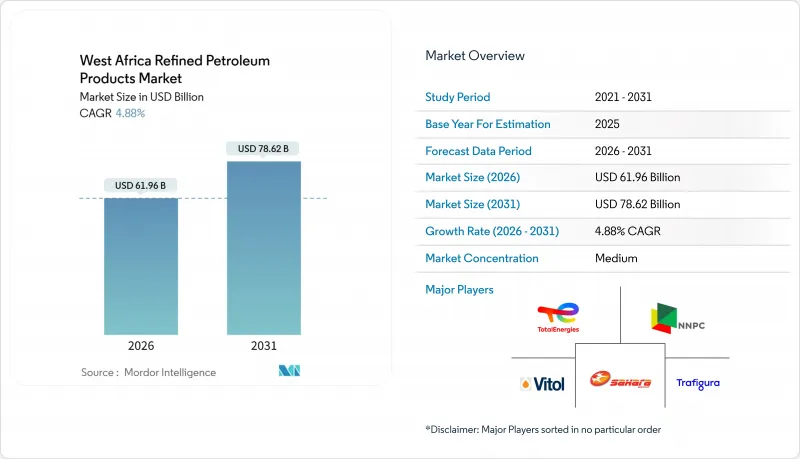
本報告按產品類型(汽油、柴油、液化石油氣、煤油、航空燃料、重油等)、硫含量(低硫和高硫)、配銷通路(零售加油站、線上/自動燃料配送等)、最終用途行業(運輸、石化、航運和燃料庫等)以及地區(奈及利亞、加納、貝南、尼日爾、馬利共和國等)進行分類。
西非成品油市場趨勢與洞察
由於車輛數量增加,燃料需求也隨之增加。
隨著拉各斯、阿克拉和阿比讓的都市化和共享出行服務的擴張,車輛登記數量穩步成長。儘管2023年至2026年間柴油和汽油價格飆升超過400%,但商用車輛車隊仍透過將燃油成本轉嫁給終端用戶來維持行駛里程。相較之下,對價格敏感的家庭正在轉向液化石油氣(LPG)和壓縮天然氣(CNG),這得益於拉各斯一項燃料轉型計劃,該計劃將每公里成本降低了約70%。因此,即使汽油成長放緩,西非成品油市場在物流方面仍依賴柴油。加納2024年3.85億公升的成品油出口量凸顯了其在向內陸薩赫勒地區轉口貿易中的重要角色。這種差異表明,商業需求將在整個預測期內保持穩定,而消費者汽油需求可能會放緩。
放鬆管制和取消補貼將吸引投資。
奈及利亞在2023年取消燃油補貼後,每年節省的50多億美元資金被重新分配,用於投資下游私人企業。丹格特煉油廠確保了以奈拉計價的原油供應,使其營運免受美元短缺的影響,此前美元短缺曾嚴重阻礙了這家國有煉油廠的營運。至2024年,道達爾能源等國際經銷商將其分銷網路擴展至約540個地點,而美孚石油奈及利亞公司則投資1000億奈拉用於加油站自動化和數位化支付。貝南和尼日的區域貿易商已開始與丹格特簽署直接承購協議,從而將供應鏈成本降低了高達20%。然而,缺乏透明的定價機制加劇了現貨市場的波動,迫使經銷商需要獲得更多的營運資金。
價格波動與貨幣貶值
奈及利亞奈拉兌美元匯率從2023年的460奈拉兌1美元跌至2026年1月的1675奈拉兌1美元,導致汽油價格飆升至每公升近1030奈拉,嚴重影響了家庭購買力。截至2024年9月,奈及利亞國家石油公司(NNPC)的未償債務已累計約60億美元,並轉向「原油與成品油互換」政策,雖然固定了外匯,但限制了價格柔軟性。 2024年,丹格特集團的汽油價格一度跌破每公升899.50奈拉的零售基準價,但極低的利潤率使其無力維修或擴建加油站。類似的貨幣下行壓力也影響了加納塞地,而在貝南,由於實行西非法郎掛鉤,歐元與奈拉之間的外匯進一步擴大,使得進口商的避險策略更加複雜。這種波動性阻礙了西非成品油市場長期合約的簽訂。
細分市場分析
預計到2025年,柴油市佔率將達到35.5%。這主要得益於物流車輛的需求以及電網可靠性低於60%地區的緊急發電需求。這一強勁表現將確保柴油在整個預測期內繼續保持西非成品油市場的主要地位。同時,丹格特石油公司受益於歐洲冬季需求高峰,其出口產品中柴油和燃料油佔超過60%。然而,由於丹格特石油公司滿足了奈及利亞60%的需求,奈及利亞石油公司在2025年前九個月的汽油進口量為零,減緩了國內汽油需求的成長。
液化石油氣預計將以7.3%的複合年成長率成為所有產品類型中成長最快的,奈及利亞的目標是到2030年實現年產量1500萬噸,加納的目標是家庭普及率達到50%。補貼鋼瓶供應計畫和新建灌裝廠,例如Puma Energy位於特馬的工廠(每小時可處理1200個鋼瓶),正在推動住宅普及。雖然煤油的使用量正在下降,但由於拉各斯、阿克拉和阿比讓等地新航線的開通,航空燃料的需求量呈現穩定成長。隨著基礎設施和石化項目的擴張,瀝青和石腦油的產量也在增加,這表明西非成品油市場下游產業將進一步多元化。
即使到了2025年,高硫燃料仍將維持54.9%的市場佔有率,這反映出老舊發電機組和簡易煉油廠的持續存在。然而,隨著國際海事組織(IMO)2020和西非國家經濟共同體(ECOWAS)法規對排放限制的日益嚴格,預計到2031年,低硫產品的市場佔有率將以6.2%的複合年成長率成長。到2025年,全球船用燃料需求將發生轉變,超低硫燃料油(VLSFO)將佔市場佔有率的75%,這將促使塔科拉迪和阿比讓的儲罐進行維修,以適應更清潔的燃料等級。丹格特集團的加氫裂解裝置目前生產符合歐盟V標準的汽油和10ppm的柴油,符合國內品質標準,同時透過出口獲得溢價。
配備脫硫裝置的船舶仍運載高硫燃油,主要目的地奈及利亞和加納的發電廠,因為這兩個國家的環保關稅仍然很低。缺乏二次精煉設施的模組化煉油廠生產的高硫產品被分銷到監管較少的內陸地區。隨著時間的推移,政策壓力和低硫燃料供應的增加可能會促使西非成品油市場轉向低硫混合燃料。然而,鑑於現有的基礎設施,全面淘汰高硫燃料預計仍需要數年時間。
其他好處:
- Excel格式的市場預測(ME)表
- 3個月的分析師支持
目錄
第1章:引言
- 研究假設和市場定義
- 調查範圍
第2章:調查方法
第3章執行摘要
第4章 市場狀況
- 市場概覽
- 市場促進因素
- 由於車輛數量增加,燃料需求也隨之增加。
- 放鬆管制和逐步取消補貼正在吸引投資。
- 由於煉油廠供不應求,對進口的依賴程度很高
- 模組化煉油廠建設的擴張將促進區域貿易。
- 海上燃料庫中心的發展(加納、象牙海岸共和國)
- 在零售加油站引入數位燃油支付方式
- 市場限制因素
- 價格波動與貨幣貶值
- 港口、管道和倉儲設施的基礎設施瓶頸
- 東京都市圈早期向替代燃料和電動出行轉型
- 碳強度法規(國際海事組織 2020 年,西非國家經濟共同體草案)
- 供應鏈分析
- 監理情勢
- 技術展望
- 波特五力模型
第5章 市場規模與成長預測
- 依產品類型
- 汽油
- 柴油引擎
- LPG
- 煤油
- 航空燃料
- 燃料油(高硫燃料油、超低硫燃料油)
- 其他(瀝青、石腦油)
- 按硫含量
- 低硫(10 ppm 或更低)
- 高硫含量(10 ppm 或更高)
- 透過分銷管道
- 零售加油站
- 大量銷售,商用
- 直接供貨合約
- 線上/自動化燃油配送
- 按最終用途類別
- 運輸
- 發電
- 工業製造
- 石油化學產品
- 住宅/商業
- 航運和燃料庫
- 農業和採礦業
- 按地區
- 奈及利亞
- 迦納
- 貝南
- 布吉納法索
- 尼日
- 馬利共和國
- 西非其他地區
第6章 競爭情勢
- 市場集中度
- 策略趨勢(併購、聯盟、購電協議)
- 市場佔有率分析(主要公司的市場排名和佔有率)
- 公司簡介
- NNPC Trading Ltd(Duke Oil)
- Trafigura Group Pte Ltd
- Vitol SA
- Sahara Group Ltd
- TotalEnergies Marketing Nigeria PLC
- Dangote Oil Refinery Co.
- Puma Energy Holdings Pte Ltd
- Oando PLC
- Mercuria Energy Trading SA
- Monjasa Holding AS
- Oryx Energies SA
- Gunvor Group Ltd
- Conoil PLC
- 11 PLC(Mobil Oil Nigeria)
- Aiteo Group
- Addax Petroleum Marketing
- Octogone International Gas & Oil Ltd
- FuelSupply Co.
- Zen Petroleum Ltd
- Star Oil & Gas Ltd
第7章 市場機會與未來展望
According to Mordor Intelligence, the West Africa refined petroleum products market size is estimated at USD 61.96 billion in 2026, and is expected to reach USD 78.62 billion by 2031, at a CAGR of 4.88% during the forecast period (2026-2031).
This report is Segmented by Product Type (Petrol, Diesel, LPG, Kerosene, Aviation Fuel, Fuel Oil, and Others), Sulfur Content (Low-Sulfur and High-Sulfur), Distribution Channel (Retail Fuel Stations, Online/Automated Fuel Delivery, and More), End-Use Sector (Transportation, Petrochemicals, Marine and Bunkering, and More), and Geography (Nigeria, Ghana, Benin, Niger, Mali, and More).
West Africa Refined Petroleum Products Market Trends and Insights
Rising Vehicle-Fleet Fuel Demand
Vehicle registrations keep climbing as urbanization and ride-hailing services spread across Lagos, Accra, and Abidjan. Commercial fleets endured diesel and petrol price jumps exceeding 400% between 2023 and 2026, yet maintained mileage by passing fuel costs to end users. By contrast, price-sensitive households are switching to LPG and CNG, helped by Lagos-based conversion schemes that cut per-kilometer costs by roughly 70% compared with petrol. As a result, the West Africa refined petroleum products market continues to depend on diesel for logistics even as gasoline growth moderates. Ghana's 385 million-liter product exports in 2024 underscored its re-export role to landlocked Sahel states. This divergence suggests sustained commercial demand but softer consumer gasoline throughput over the forecast horizon.
Deregulation & Subsidy Phase-Out Attracting Investment
Nigeria redirected more than USD 5 billion in yearly fiscal savings after scrapping fuel subsidies in 2023, clearing headroom for private downstream projects. Dangote Refinery secured naira-denominated crude supply, shielding operations from dollar scarcity that stalled state refineries. International marketers such as TotalEnergies lifted their network count to about 540 outlets by 2024, while Mobil Oil Nigeria committed NGN 100 billion to station automation and digital payments. Regional traders in Benin and Niger have begun signing direct Dangote off-take deals, trimming supply-chain costs up to 20%. Nonetheless, the absence of a transparent pricing formula fuels spot-market volatility, obliging distributors to carry larger working-capital buffers.
Price Volatility & Currency Depreciation
The naira weakened from NGN 460 per USD in 2023 to NGN 1,675 per USD by January 2026, pushing petrol prices near NGN 1,030 per liter and compressing household purchasing power. NNPC accrued roughly USD 6 billion in arrears by September 2024, pivoting to crude-for-product swaps that fix exchange rates but curtail price flexibility. Dangote temporarily undercut retail benchmarks at NGN 899.50 per liter in 2024, yet the razor-thin margin discouraged station upgrades and expansions. Similar depreciation pressures shook the Ghanaian cedi and widened euro-naira mismatches under Benin's CFA peg, complicating hedging strategies for importers. Such volatility deters long-term contracting in the West Africa refined petroleum products market.
Other drivers and restraints analyzed in the detailed report include:
- High Import Reliance Due to Refinery Deficits
- Modular Refinery Build-Out Enabling Intra-Regional Trade
- Port, Pipeline & Storage Infrastructure Bottlenecks
For complete list of drivers and restraints, kindly check the Table Of Contents.
Segment Analysis
Diesel accounted for 35.5% of the 2025 market, underpinned by logistics fleets and back-up power generation where grid reliability stands below 60%. Such resilience ensures diesel remains the commercial backbone of the West Africa refined petroleum products market over the forecast horizon. At the same time, Dangote dedicates more than 60% of export barrels to diesel and fuel oil, benefiting from European winter demand peaks. However, domestic gasoline growth is moderating as Oando's petrol imports fell to zero cargoes in the first nine months of 2025 after Dangote met 60% of Nigeria's needs.
LPG is set to expand at a 7.3% CAGR, the fastest among product types, as Nigeria targets 15 million metric tonnes annually by 2030 and Ghana eyes 50% household penetration. Subsidized cylinder programs and new bottling plants, such as Puma Energy's Tema facility processing 1,200 cylinders per hour, are unlocking residential adoption. Kerosene usage is retreating, while aviation fuel enjoys steady uplift from new routes at Lagos, Accra, and Abidjan. Bitumen and naphtha volumes rise in tandem with infrastructure and petrochemical projects, hinting at a broader downstream diversification within the West Africa refined petroleum products market.
High-sulfur fuels retained a 54.9% share in 2025, reflecting legacy generators and simple topping refineries. Yet low-sulfur products are on a 6.2% CAGR trajectory to 2031 as IMO 2020 and ECOWAS rules tighten emission limits. Global marine demand moved to a 75% VLSFO-dominant mix by 2025, stimulating tank upgrades in Takoradi and Abidjan to accommodate cleaner grades. Dangote's hydrocrackers now output Euro-V gasoline and 10-ppm diesel, capturing premium export differentials while meeting domestic quality mandates.
Scrubber-equipped vessels still lift high-sulfur fuel oil, mainly destined for Nigerian and Ghanaian power plants where environmental tariffs remain low. Modular refineries lacking secondary conversion generate higher-sulfur outputs that circulate inland, where enforcement is softer. Over time, policy pressure and rising access to cleaner barrels will tilt the West Africa refined petroleum products market toward lower-sulfur blends, although a complete phase-out remains years away, given installed asset profiles.
Complete Report Scope:
- By Product Type
- Petrol (Gasoline)
- Diesel
- LPG
- Kerosene
- Aviation Fuel
- Fuel Oil (HSFO, VLSFO)
- Others (Bitumen, Naphtha)
- By Sulfur Content
- Low-Sulfur (Up to 10 ppm)
- High-Sulfur (Above 10 ppm)
- By Distribution Channel
- Retail Fuel Stations
- Commercial Bulk Sales
- Direct Supply Contracts
- Online/Automated Fuel Delivery
- By End-Use Sector
- Transportation
- Power Generation
- Industrial Manufacturing
- Petrochemicals
- Residential and Commercial
- Marine and Bunkering
- Agriculture and Mining
- By Geography
- Nigeria
- Ghana
- Benin
- Burkina Faso
- Niger
- Mali
- Rest of West Africa
List of Companies Covered in this Report:
- NNPC Trading Ltd (Duke Oil)
- Trafigura Group Pte Ltd
- Vitol SA
- Sahara Group Ltd
- TotalEnergies Marketing Nigeria PLC
- Dangote Oil Refinery Co.
- Puma Energy Holdings Pte Ltd
- Oando PLC
- Mercuria Energy Trading SA
- Monjasa Holding AS
- Oryx Energies SA
- Gunvor Group Ltd
- Conoil PLC
- 11 PLC (Mobil Oil Nigeria)
- Aiteo Group
- Addax Petroleum Marketing
- Octogone International Gas & Oil Ltd
- FuelSupply Co.
- Zen Petroleum Ltd
- Star Oil & Gas Ltd
Additional Benefits:
- The market estimate (ME) sheet in Excel format
- 3 months of analyst support
TABLE OF CONTENTS
1 Introduction
- 1.1 Study Assumptions & Market Definition
- 1.2 Scope of the Study
2 Research Methodology
3 Executive Summary
4 Market Landscape
- 4.1 Market Overview
- 4.2 Market Drivers
- 4.2.1 Rising vehicle-fleet fuel demand
- 4.2.2 Deregulation & subsidy phase-out attracting investment
- 4.2.3 High import reliance due to refinery deficits
- 4.2.4 Modular refinery build-out enabling intra-regional trade
- 4.2.5 Offshore bunkering hubs growth (Ghana, Cote d'Ivoire)
- 4.2.6 Digital fuel-payment adoption at retail forecourts
- 4.3 Market Restraints
- 4.3.1 Price volatility & currency depreciation
- 4.3.2 Port, pipeline & storage infrastructure bottlenecks
- 4.3.3 Early shift to alternative fuels & e-mobility in capitals
- 4.3.4 Carbon-intensity rules (IMO 2020, ECOWAS drafts)
- 4.4 Supply-Chain Analysis
- 4.5 Regulatory Landscape
- 4.6 Technological Outlook
- 4.7 Porter's Five Forces
- 4.7.1 Threat of New Entrants
- 4.7.2 Bargaining Power of Buyers
- 4.7.3 Bargaining Power of Suppliers
- 4.7.4 Threat of Substitutes
- 4.7.5 Competitive Rivalry
5 Market Size & Growth Forecasts
- 5.1 By Product Type
- 5.1.1 Petrol (Gasoline)
- 5.1.2 Diesel
- 5.1.3 LPG
- 5.1.4 Kerosene
- 5.1.5 Aviation Fuel
- 5.1.6 Fuel Oil (HSFO, VLSFO)
- 5.1.7 Others (Bitumen, Naphtha)
- 5.2 By Sulfur Content
- 5.2.1 Low-Sulfur (Up to 10 ppm)
- 5.2.2 High-Sulfur (Above 10 ppm)
- 5.3 By Distribution Channel
- 5.3.1 Retail Fuel Stations
- 5.3.2 Commercial Bulk Sales
- 5.3.3 Direct Supply Contracts
- 5.3.4 Online/Automated Fuel Delivery
- 5.4 By End-Use Sector
- 5.4.1 Transportation
- 5.4.2 Power Generation
- 5.4.3 Industrial Manufacturing
- 5.4.4 Petrochemicals
- 5.4.5 Residential and Commercial
- 5.4.6 Marine and Bunkering
- 5.4.7 Agriculture and Mining
- 5.5 By Geography
- 5.5.1 Nigeria
- 5.5.2 Ghana
- 5.5.3 Benin
- 5.5.4 Burkina Faso
- 5.5.5 Niger
- 5.5.6 Mali
- 5.5.7 Rest of West Africa
6 Competitive Landscape
- 6.1 Market Concentration
- 6.2 Strategic Moves (M&A, Partnerships, PPAs)
- 6.3 Market Share Analysis (Market Rank/Share for key companies)
- 6.4 Company Profiles (includes Global level Overview, Market level overview, Core Segments, Financials as available, Strategic Information, Products & Services, and Recent Developments)
- 6.4.1 NNPC Trading Ltd (Duke Oil)
- 6.4.2 Trafigura Group Pte Ltd
- 6.4.3 Vitol SA
- 6.4.4 Sahara Group Ltd
- 6.4.5 TotalEnergies Marketing Nigeria PLC
- 6.4.6 Dangote Oil Refinery Co.
- 6.4.7 Puma Energy Holdings Pte Ltd
- 6.4.8 Oando PLC
- 6.4.9 Mercuria Energy Trading SA
- 6.4.10 Monjasa Holding AS
- 6.4.11 Oryx Energies SA
- 6.4.12 Gunvor Group Ltd
- 6.4.13 Conoil PLC
- 6.4.14 11 PLC (Mobil Oil Nigeria)
- 6.4.15 Aiteo Group
- 6.4.16 Addax Petroleum Marketing
- 6.4.17 Octogone International Gas & Oil Ltd
- 6.4.18 FuelSupply Co.
- 6.4.19 Zen Petroleum Ltd
- 6.4.20 Star Oil & Gas Ltd
7 Market Opportunities & Future Outlook
- 7.1 White-space & Unmet-Need Assessment

 北非精煉石油產品:市場佔有率分析、產業趨勢與統計及成長預測(2026-2031 年)
 石油煉廠氫氣市場機會、成長促進因素、產業趨勢分析及2026-2035年預測
 石油液體市場-全球產業規模、佔有率、趨勢、機會、預測:按類型、產品類型、應用、地區和競爭格局分類,2021-2031年
 2026年全球產品平臺運輸市場報告
 2026-2034年全球石油基液體原料市場規模、佔有率、趨勢和成長分析報告全球精製藍氫市場規模、佔有率、趨勢和成長分析報告:2026-2034年2026年全球成品油市場報告成品油市場-全球產業規模、佔有率、趨勢、機會、預測(按產品類型、應用、餾分、地區和競爭格局分類),2021-2031年
 成品油市場規模、佔有率及成長分析(依產品類型、應用、終端用戶產業、通路及地區分類)-2026-2033年產業預測
 石油基液體市場規模、佔有率和成長分析(按類型、最終產品和地區分類)—產業預測(2026-2033 年)