


 |
市場調查報告書
商品編碼
2156920
法國種子加工機械:市場佔有率分析、產業趨勢與統計及成長預測(2026-2031)France Seed Processing Machinery - Market Share Analysis, Industry Trends & Statistics, Growth Forecasts (2026 - 2031) |
||||||

※ 本網頁內容可能與最新版本有所差異。詳細情況請與我們聯繫。
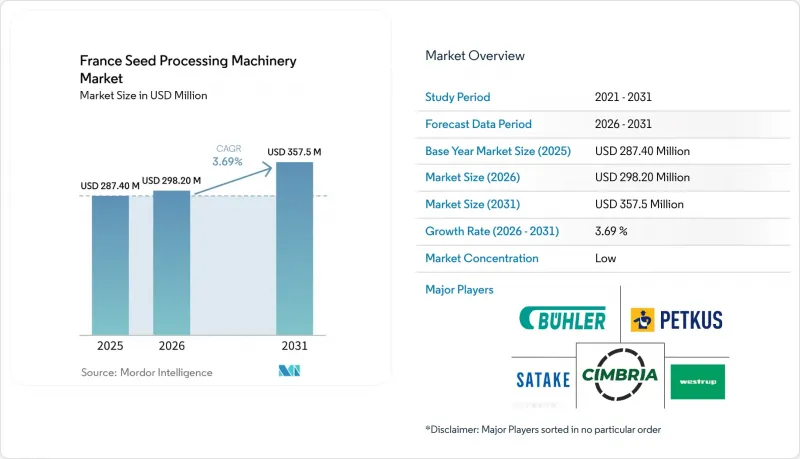
根據 Mordor Intelligence 預測,法國種子加工機械市場規模將從 2025 年的 2.874 億美元成長到 2026 年的 2.982 億美元,到 2031 年將達到 3.575 億美元。
預計 2026 年至 2031 年的預測期內複合年成長率為 3.69%。
法國種子加工機械市場趨勢與洞察
關於品種純度和發芽率的法律合規義務
法國官方種子認證系統制定了嚴格的品質標準,直接影響種子加工設備的需求。認證工作由法國國家種子和植物協會(Societe Nationale des Agriculteurs Multiplicateurs de Semences,簡稱SEMAE)透過官方品質管制局(Direction de la Qualite et du Controle Officiel,簡稱DQCO)進行。 DQCO會對種子批次進行品種純度、發芽率、水分含量和病蟲害檢測等方面的評估,然後頒發認證。玉米種子必須達到至少90%的發芽率才能獲得「SOC France」標籤。因此,在整個製作流程中,精確的清洗、分級、分類和批次一致性至關重要。正因如此,法國種子加工機械市場對高精度加工技術的需求持續強勁。這是因為能夠持續滿足認證要求的設備有助於加工商最大限度地減少批次間的差異,並確保符合國家品質標準。
擴大認證種子和出口導向生產
法國在認證種子生產中扮演著至關重要的角色,其大規模的繁殖基地支撐著對可靠種子處理能力的需求。 SEMAE 將法國定位為大型作物認證種子的主要供應國,因此,出口級加工在設備投資中仍佔據重要地位。出口導引型買家要求批次可追溯、包裝受控以及純度檢驗可靠。經濟合作暨發展組織(OECD) 種子體系為品種認證和國際貿易提供了一個通用框架。因此,加工廠必須配備能夠實現結果可重複性和清晰批次識別的設備。這項營運要求確保了法國種子加工機械市場在符合認證和出口通路要求的工廠中擁有穩定的基礎。
前期成本高,投資回收期長
先進種子加工設施所需的巨額資本投資仍然是法國種子加工機械市場的主要阻礙因素。整合光學分類機、重力分類機、自動化種子加工系統和數位檢測技術的現代化加工生產線需要大量的初期投入,而財務回報通常需要透過提高加工能力和減少加工損耗,在幾個生產週期內才能實現。鑑於這些投資挑戰,法國農業和市場管理局(FranceAgriMer)已在其「法國2030」計畫下撥款2,000萬歐元(約2,320萬美元),用於支持對創新農業機械的投資,以公共資金覆蓋符合條件的設備成本的20%至40%。這種持續的資本補貼需求凸顯了採用先進加工技術所帶來的巨大財務負擔。因此,由於投資能力有限且投資回收期長,中小種子加工企業往往推遲設備現代化改造,減緩了下一代種子加工系統的應用。
細分市場分析
以機器類型細分來看,光學分類機在2025年將佔法國種子加工機械市場規模的24.0%。這一佔有率反映了機器視覺在識別認證批次中缺陷方面發揮的重要作用,這些缺陷即使在製作流程中也必須能夠被識別,並且機器視覺也有助於純度檢測。清選機和預清選機用於去除異物並進行初步粒度分選,而平土機、分離機、去石機和種子包裝機則為需要大批量加工的穀物和玉米項目提供支援。隨著有機種子生產商準備過渡到經批准的包衣材料,包覆和種子加工設備的重要性日益凸顯。拋光機和其他專用機械在蔬菜和特殊種子加工中繼續發揮至關重要的作用,因為在這些加工過程中,表面品質和批次處理的精細化尤其重要。
預計從2026年到2031年,光學分類機的年複合成長率將達到7.5%,這主要得益於其能夠處理小規模、可追溯且對規格要求嚴格的批次。這些機器是對篩檢和重力分選的補充,使工廠能夠在不改變核心機器流程的情況下增加偵測能力。供應商持續投資於測試能力和先進的分選平台,使操作人員能夠評估機器,從而找到與其作物和批次特性相符的產品。
其他好處:
- Excel格式的市場預測(ME)表
- 3個月的分析師支持
目錄
第1章:引言
- 研究假設和市場定義
- 調查範圍
第2章:調查方法
第3章執行摘要
第4章 市場狀況
- 市場概覽
- 市場促進因素
- 符合品種純度和發芽率的基本標準。
- 擴大認證種子和出口導向生產
- 老舊洗滌和分類生產線的改造
- 利用自動化來彌補農村地區工程師短缺的問題
- 由於轉向多品種、小批量生產,對產品維修。
- 對有機和特種批次進行光學分選,同時保留原產地資訊。
- 市場限制因素
- 前期成本高,專案投資回收期長
- 嚴格的合規要求,包括CE認證、ATEX認證和文件編制。
- 小批量生產中換型和清潔驗證的負擔。
- 它的使用僅限於需要空調的季節之外。
- 監理情勢
- 技術展望
- 波特五力分析
第5章 市場規模與成長預測
- 按機器類型
- 預清潔劑
- 清潔工
- 烘乾機
- 平土機
- 塗佈機和加工機
- 分類機和除石機
- 磨床
- 光學分類機
- 種子包裝機
- 其他專用設備
- 按操作模式
- 自動的
- 半自動
- 最終用戶
- 商業種子加工廠
- 種子生產商
- 研究機構
- 農場設施
- 糧食處理設施
第6章 競爭情勢
- 市場集中度
- 策略趨勢
- 市佔率分析
- 公司簡介
- Buhler AG
- Cimbria A/S(Grain & Protein Technologies)
- PETKUS Technologie GmbH
- Satake Corporation
- Ag Growth International Inc.
- Westrup ApS
- Skiold A/S(Solix Group)
- Oliver Manufacturing Co., Inc.
- Carter Day International, Inc.
- DOREZ SAS
- ETABL SCHNEIDER JAQUET CIE
- MERIS Services Industries SAS
- FAO SAS
- Atrissem SAS
- Meyer Corp
第7章 市場機會與未來展望
According to Mordor Intelligence, the France seed processing machinery market size is forecast to increase from USD 287.40 million in 2025 to USD 298.20 million in 2026, and reach USD 357.50 million by 2031, at a CAGR of 3.69% during the forecast period 2026-2031.
France Seed Processing Machinery Market Trends and Insights
Mandatory Varietal Purity and Germination Compliance
France's official seed certification system establishes stringent quality standards that directly influence demand for seed processing equipment. Certification is administered by the French National Seed and Plant Association (Societe Nationale des Agriculteurs Multiplicateurs de Semences, SEMAE) through the Official Quality and Control Directorate (Direction de la Qualite et du Controle Officiel, DQCO), which evaluates seed lots for varietal purity, germination capacity, moisture content, and freedom from harmful organisms before granting certification. Maize seed must achieve a minimum germination rate of 90% to qualify for the SOC France label, making precise cleaning, grading, sorting, and lot uniformity essential throughout the processing chain. As a result, the France seed processing machinery market sees sustained demand for high-precision processing technologies, as equipment that consistently meets certification requirements helps processors minimize lot rejection and maintain compliance with national quality standards.
Expansion of Certified Seed and Export-Oriented Production
France plays a significant role in certified seed production, and its large multiplication base supports demand for reliable conditioning capacity. SEMAE identifies the country as a major supplier of large-crop certified seed, which sustains the relevance of export-quality processing for plant investment. Export-oriented buyers require traceable lots, controlled packaging, and reliable purity verification. The Organization for Economic Co-operation and Development (OECD) Seed Schemes provide the common framework used for varietal certification and international trade. Processing plants, therefore, require equipment that supports repeatable results and clear lot identification. This operational requirement provides the France seed processing machinery market with a stable base among facilities serving certified and export channels.
High Upfront Cost and Long Project Payback
The high capital investment required for advanced seed processing facilities remains a key restraint in the France seed processing machinery market. Modern processing lines integrating optical sorters, gravity separators, automated seed treatment systems, and digital inspection technologies require substantial upfront expenditure, while financial returns are typically realized over several production cycles through improved throughput and lower processing losses. Recognizing these investment challenges, FranceAgriMer allocated a EUR 20 million (USD 23.2 million) budget under the France 2030 program to support investments in innovative agricultural equipment, with public funding covering 20-40% of eligible equipment costs. This ongoing need for capital subsidies underscores the financial burden of adopting advanced processing technologies. As a result, small and medium-sized seed processors often defer equipment modernization due to limited investment capacity and extended payback periods, thereby slowing the adoption of next-generation seed processing systems.
Other drivers and restraints analyzed in the detailed report include:
- Replacement of Aging Cleaning and Grading Lines
- Automation to Offset Rural Technician Scarcity
- Limited Utilization Outside Seasonal Conditioning Windows
For complete list of drivers and restraints, kindly check the Table Of Contents.
Segment Analysis
By machinery type, optical sorters accounted for 24.0% of the France seed processing machinery market size in 2025. This position reflects the role of machine vision in identifying defects and supporting purity checks for certified lots that must remain distinguishable during processing. Cleaners and pre-cleaners remove foreign material and perform primary size separation, while graders, separators, destoners, and seed packagers support higher-volume cereal and maize programs. Coating and seed treatment equipment are gaining importance as organic seed producers prepare for the transition to approved coating substances. Polishers and other specialized machines remain relevant for vegetable and specialty seed work, where surface quality and careful lot handling are particularly important.
Optical sorters are forecast to expand at a 7.5% CAGR between 2026 and 2031, supported by their ability to manage small, traceable, and specification-sensitive lots. The equipment complements screening and gravity separation, enabling plants to add inspection capability without altering the role of core mechanical stages. Suppliers continue to invest in test capability and advanced sorting platforms, helping operators evaluate a machine against the characteristics of their own crop and lot mix.
Complete Report Scope:
- By Machinery Type
- Pre-Cleaners
- Cleaners
- Dryers
- Graders
- Coaters and Treaters
- Separators and Destoners
- Polishers
- Optical Sorters
- Seed Packagers
- Other Specialized Equipment
- By Operation Mode
- Automatic
- Semi-Automatic
- By End User
- Commercial Seed Processing Plants
- Seed Producers
- Research Institutions
- On-Farm Facilities
- Grain Handling Facilities
List of Companies Covered in this Report:
- Buhler AG
- Cimbria A/S ( Grain & Protein Technologies)
- PETKUS Technologie GmbH
- Satake Corporation
- Ag Growth International Inc.
- Westrup ApS
- Skiold A/S (Solix Group)
- Oliver Manufacturing Co., Inc.
- Carter Day International, Inc.
- DOREZ SAS
- ETABL SCHNEIDER JAQUET CIE
- MERIS Services Industries SAS
- FAO SAS
- Atrissem SAS
- Meyer Corp
Additional Benefits:
- The market estimate (ME) sheet in Excel format
- 3 months of analyst support
TABLE OF CONTENTS
1 INTRODUCTION
- 1.1 Study Assumptions and Market Definition
- 1.2 Scope of the Study
2 RESEARCH METHODOLOGY
3 EXECUTIVE SUMMARY
4 MARKET LANDSCAPE
- 4.1 Market Overview
- 4.2 Market Drivers
- 4.2.1 Mandatory Varietal Purity and Germination Compliance
- 4.2.2 Expansion of Certified Seed and Export-Oriented Production
- 4.2.3 Replacement of Aging Cleaning and Grading Lines
- 4.2.4 Automation to Offset Rural Technician Scarcity
- 4.2.5 Retrofit Demand from Multi-Crop, Small-Lot Changeovers
- 4.2.6 Optical Sorting for Identity-Preserved Organic and Specialty Lots
- 4.3 Market Restraints
- 4.3.1 High Upfront Cost and Long Project Payback
- 4.3.2 Stringent CE, ATEX, and Documentation Compliance
- 4.3.3 Small-Lot Changeover and Cleaning Validation Burden
- 4.3.4 Limited Utilization Outside Seasonal Conditioning Windows
- 4.4 Regulatory Landscape
- 4.5 Technological Outlook
- 4.6 Porter's Five Forces Analysis
- 4.6.1 Bargaining Power of Suppliers
- 4.6.2 Bargaining Power of Buyers
- 4.6.3 Threat of New Entrants
- 4.6.4 Threat of Substitutes
- 4.6.5 Intensity of Competitive Rivalry
5 MARKET SIZE AND GROWTH FORECASTS (VALUE)
- 5.1 By Machinery Type
- 5.1.1 Pre-Cleaners
- 5.1.2 Cleaners
- 5.1.3 Dryers
- 5.1.4 Graders
- 5.1.5 Coaters and Treaters
- 5.1.6 Separators and Destoners
- 5.1.7 Polishers
- 5.1.8 Optical Sorters
- 5.1.9 Seed Packagers
- 5.1.10 Other Specialized Equipment
- 5.2 By Operation Mode
- 5.2.1 Automatic
- 5.2.2 Semi-Automatic
- 5.3 By End User
- 5.3.1 Commercial Seed Processing Plants
- 5.3.2 Seed Producers
- 5.3.3 Research Institutions
- 5.3.4 On-Farm Facilities
- 5.3.5 Grain Handling Facilities
6 COMPETITIVE LANDSCAPE
- 6.1 Market Concentration
- 6.2 Strategic Moves
- 6.3 Market Share Analysis
- 6.4 Company Profiles (Includes Global Level Overview, Market Level Overview, Core Segments, Financials as Available, Strategic Information, Market Rank/Share, Products and Services, Recent Developments)
- 6.4.1 Buhler AG
- 6.4.2 Cimbria A/S ( Grain & Protein Technologies)
- 6.4.3 PETKUS Technologie GmbH
- 6.4.4 Satake Corporation
- 6.4.5 Ag Growth International Inc.
- 6.4.6 Westrup ApS
- 6.4.7 Skiold A/S (Solix Group)
- 6.4.8 Oliver Manufacturing Co., Inc.
- 6.4.9 Carter Day International, Inc.
- 6.4.10 DOREZ SAS
- 6.4.11 ETABL SCHNEIDER JAQUET CIE
- 6.4.12 MERIS Services Industries SAS
- 6.4.13 FAO SAS
- 6.4.14 Atrissem SAS
- 6.4.15 Meyer Corp
7 MARKET OPPORTUNITIES AND FUTURE OUTLOOK

 日本種子加工機械:市場佔有率分析、產業趨勢及統計、成長預測(2026-2031)
 精密模具及加工市場預測至2034年-全球模具類型、加工製程、材料、應用、最終使用者及區域分析中國種子加工機械:市場佔有率分析、產業趨勢與統計、成長預測(2026-2031)
 粉末加工設備市場-全球產業規模、佔有率、趨勢、機會、預測:按技術、最終用戶、地區和競爭格局分類,2021-2031年種子加工機械:市場佔有率分析、產業趨勢與統計、成長預測(2026-2031)
 鑽石單晶加工設備市場:依製程、設備類型、自動化程度和終端用戶產業分類-2026-2032年全球預測
 全球石材加工機械市場規模、佔有率、趨勢和成長分析報告:2026-2034年
 精密加工市場規模、佔有率和趨勢分析報告:按營運方式、類型、最終用途、地區和細分市場預測,2026-2033年
 石材加工機械市場規模、佔有率及成長分析(按機器類型、加工材料、應用、最終用戶、機器自動化程度及地區分類)-2026-2033年產業預測
 全球精密加工市場