


 |
市場調查報告書
商品編碼
2119021
中國種子加工機械:市場佔有率分析、產業趨勢與統計、成長預測(2026-2031)China Seed Processing Machinery - Market Share Analysis, Industry Trends & Statistics, Growth Forecasts (2026 - 2031) |
||||||

※ 本網頁內容可能與最新版本有所差異。詳細情況請與我們聯繫。
根據 Mordor Intelligence 估計,中國種子加工機械市場在 2025 年的價值為 11.7 億美元,預計到 2031 年將從 2026 年的 12.5 億美元成長到 17.5 億美元,在預測期(2026-2031 年)內的複合年成長率為 7%。
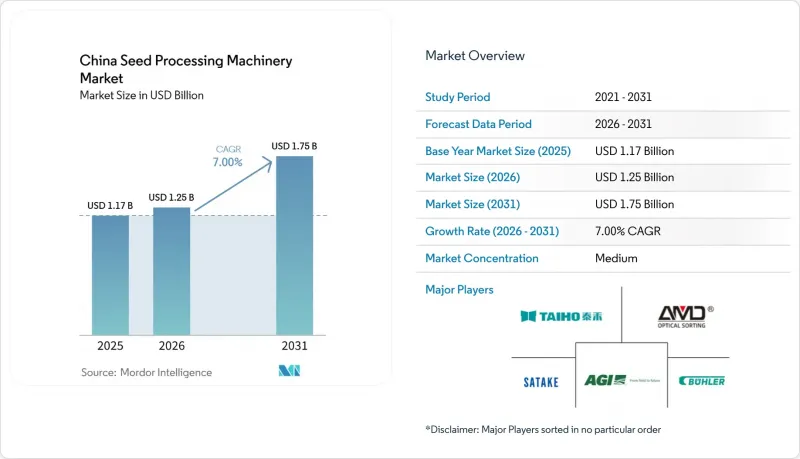
本報告按機器類型(預清理機、清洗機、烘乾機、分類機、磨床、光學分類機、種子包裝機等)、運作模式(全自動、半自動)和最終用戶(商業種子加工廠、種子生產商、農場設施等)進行細分。市場預測以貨幣價值(美元)表示。
中國種子加工機械市場趨勢及洞察。
擴大認證種子的生產
繼2024年兩家認證機構獲得認可,首批認證檢驗員註冊後,中國首批認證種子於2025年初進入商業市場。新體系對種子的物理純度和發芽率提出了比以往體系更嚴格的要求。因此,加工商現在需要在同一條生產線上分類機、去石機、包衣機和清洗機,僅靠基礎清洗機已無法滿足認證生產的需求。農業農村部於2025年實施的作物品種均質化措施,進一步鼓勵使用高純度、可追溯的品種。這導致收穫後種子加工設備的投資進一步增加。這種影響在中國東北地區最為顯著,該地區的大豆和玉米種子認證正在迅速擴展。隨著品管在認證體系下從可選環節轉變為生產要求,預計中國的種子加工機械市場將從中受益。
政府對種子加工設備的補貼
中央政府2025年補貼清單將初級種子加工設備納入農業機械購置補貼範圍。此補助與2024-2026年國家機械購置及申請補助指引一致。省級計畫可以補充中央政府的補貼,提高大型計畫的經濟可行性。甘肅省的種子產區縣正在獲得設施和設備的補貼,補貼額度最高可達安裝成本的40%。在國家框架下,高性能智慧設備,例如光學分類機和自動分級系統,受到優先考慮。這使得加工商更換老舊機械生產線變得更加現實。該政策也使得多級整套系統比單一設備更具吸引力。明確的補貼設備類別將支撐中國主要產區種子加工機械市場的需求。
光學分選系統的初始成本很高
國產光學分類機每通道造價10.5萬美元,而進口系統每通道造價23.5萬美元。這兩個價格都遠高於國產小型氣篩分分類機的最低價格(1.15萬美元)。據估計,中國已安裝的2.5萬條加工生產線中,大多數每季種子處理量不到500噸。這些企業往往無法在五年內收迴光學分選設備的成本。將光學分類機改造到老舊的機械生產線上會增加22.5%的整合成本,即使買家不更換整條生產線,這也是一筆不小的財務負擔。雖然設備租賃和服務模式可以減輕初始的財務壓力,但補貼資格要求仍然優先考慮設備購買。在資金籌措通路拓展或設備價格下降之前,成本仍將是小規模加工企業採用光學分選設備的阻礙因素。
細分市場分析
到2025年,洗衣機將佔銷售額的27.5%,成為最大的機械類別。光學分類機預計將成為所有機械類型中成長最快的,到2031年複合年成長率將達到11.5%。光學分類機的國內售價約為每通道10.5萬美元,其單台收入是標準分類機的7到9倍。隨著商業工廠擴大採用多通道分類機系統,分類收入的成長速度可能會超過機器銷售的成長速度。
在中國,人工智慧驅動的種子分選並非只是分階段的升級,而是結構性的改變。中國科學院發表的一項研究表明,利用非破壞性雷射光譜技術檢測種子活力的系統非常有效,分選後的種子發芽率接近100%。這表明,中國下一代光學分類機將能夠檢測種子內部的缺陷,而目前的設備僅限於表面評估。目前分選技術與下一代分選技術之間的功能差距正在加速光學設備的更換,合肥泰和、安徽中科等國內供應商正試圖在國際競爭對手提價之前抓住這一機會。
其他好處:
- Excel格式的市場預測(ME)表
- 3個月的分析師支持
目錄
第1章:引言
- 市場分析與定義的前提條件
- 分析範圍
第2章 分析方法
第3章執行摘要
第4章 市場狀況
- 市場概覽
- 市場促進因素
- 擴大認證種子的生產
- 政府對種子加工設備的補貼
- 種子品質檢測自動化
- 出口種子純度需求不斷成長
- 種子加工合約的成長
- 種子加工數位化追溯的要求
- 市場限制因素
- 光學分選系統的初始成本很高
- 中小加工企業的需求分佈
- 熟練的試運行和維護技術人員短缺
- 各州的數據和合規要求不一致。
- 監理情勢
- 技術展望
- 波特五力分析
第5章:預測市場規模與成長率
- 按機器類型
- 預清潔劑
- 洗衣機
- 烘乾機
- 平土機
- 塗佈機和加工機
- 分離器/除石機
- 磨床
- 光學分類機
- 種子包裝機
- 其他專用設備
- 透過運作模式
- 自動的
- 半自動
- 最終用戶
- 商業種子加工廠
- 種子生產商
- 研究機構
- 農場設施
- 糧食處理設施
第6章 競爭情勢
- 市場集中度
- 策略趨勢
- 市佔率分析
- 公司簡介
- Buhler AG
- Satake Corporation
- AGI
- Cimbria A/S
- Hefei Taihe Optoelectronic Technology Co., Ltd.
- Anhui Zhongke Optic-electronic Color Sorter Machinery Co., Ltd.
- Shijiazhuang Synmec International Trading, Ltd.
- Hebei Ruixue Grain Selecting Machinery Co., Ltd.
- Shijiazhuang Sanli Grain Sorting Machinery Co., Ltd.
- Shijiazhuang Dingliang Machinery Equipment Co., Ltd.
- Kaifeng Lecheng Machinery Co., Ltd.
- Hebei Beibu Machinery Technology Co., Ltd.
- Shijiazhuang Xinlu Technology Co., Ltd.
- Henan Zhongyuan Grain Machinery Co., Ltd.
- Shandong Sishui Sanyi Machinery Co., Ltd.
- Zhengzhou Aix Machinery Equipment Co., Ltd.
- Shijiazhuang Hongdefa Machinery Co., Ltd.
- Hefei Meyer Optoelectronic Technology Inc.
第7章 市場機會與未來展望
According to Mordor Intelligence, the China seed processing machinery market was valued at USD 1.17 billion in 2025 and is estimated to grow from USD 1.25 billion in 2026 to reach USD 1.75 billion by 2031, at a CAGR of 7% during the forecast period (2026-2031).
This report is Segmented by Machinery Type (Pre-Cleaners, Cleaners, Dryers, Graders, Polishers, Optical Sorters, Seed Packagers, and More), by Operation Mode (Automatic and Semi-Automatic), and by End-User (Commercial Seed Processing Plants, Seed Producers, On-Farm Facilities, and More). The Market Forecasts are Provided in Terms of Value (USD).
China Seed Processing Machinery Market Trends and Insights
Expansion of Certified Seed Production
China's first certified seeds reached commercial markets in early 2025, following the accreditation of 2 certification bodies and the registration of the first certification inspectors in 2024. The new system imposes stricter requirements for physical purity and germination than the previous approach. As a result, processors require graders, destoners, coaters, and cleaners within the same production line, making a basic cleaner insufficient for certified production needs. MARA's 2025 action on crop variety homogenization further supports the use of traceable, high-purity varieties. This is directing more capital spending toward post-harvest seed handling. The impact is most pronounced in Northeast China, where soybean and corn seed certification is expanding. The China seed processing machinery market stands to benefit as certification converts quality control from a voluntary process into a production requirement.
Government Subsidies for Seed Processing Equipment
The central government's 2025 subsidy list includes seed initial-processing equipment within agricultural machinery purchase support. This support is in accordance with the 2024-2026 national machinery purchase and application subsidy guidelines. Provincial programs can supplement central support and improve the economics of larger projects. Gansu seed production counties have provided facility and equipment subsidies covering up to 40% of installation costs. The national framework prioritizes high-performance and intelligent equipment, including optical sorters and automated grading systems. This makes replacing older mechanical lines more feasible for processors. The policy also increases the appeal of complete, multi-stage systems over stand-alone machines. Demand in China's seed processing machinery market is supported across major growing provinces, as the eligible equipment category is clearly defined.
High Upfront Cost of Optical Sorting Systems
Domestic optical sorters cost USD 105,000 per channel, while imported systems cost USD 235,000 per channel. Both prices are significantly above the USD 11,500 entry price of a small domestic air-screen cleaner. Most of China's estimated 25,000 installed processing lines handle less than 500 tonnes of seed per season. These operators often cannot justify the cost of optical sorting equipment within a payback period of less than 5 years. Retrofitting an optical sorter into an older mechanical line can add a 22.5% integration cost premium, raising the financial hurdle even when buyers do not replace the entire line. Equipment leasing and service-based models could reduce the initial financial burden, but subsidy eligibility still favors equipment purchases. Until financing options expand or equipment prices decline, cost will remain a limiting factor for adoption in smaller processing operations.
Other drivers and restraints analyzed in the detailed report include:
- Automation of Seed Quality Inspection
- Rising Demand for Export-Grade Seed Purity
- Fragmented Demand among Small and Medium Processors
For complete list of drivers and restraints, kindly check the Table Of Contents.
Segment Analysis
Cleaners accounted for 27.5% of revenue in 2025, making it the largest machinery category. Optical sorters is forecast to grow at the fastest rate, with a 11.5% CAGR through 2031, the highest among machinery types. Optical sorters generated 7-9 times the revenue per unit of standard cleaners, reflecting their domestic price of USD 105,000 per channel. Commercial plants increasingly specify multi-channel installations, so sorting revenue can rise faster than machine volumes.
China's AI-powered seed sorting represents a structural shift rather than an incremental upgrade. Research published by the Chinese Academy of Sciences (CAS) has validated a nondestructive laser-spectroscopy seed vitality detection system, achieving near-100% post-sorting germination rates. This indicates that future generations of optical sorters in China will be capable of detecting internal seed defects, an area where current equipment is limited to surface-level assessment. This capability gap between current and next-generation sorting is driving a replacement cycle for optical equipment, which domestic suppliers, including Hefei Taihe and Anhui Zhongke, are positioning to capture before international competitors can reprice their products.
Complete Report Scope:
- By Machinery Type
- Pre-Cleaners
- Cleaners
- Dryers
- Graders
- Coaters and Treaters
- Separators and Destoners
- Polishers
- Optical Sorters
- Seed Packagers
- Other Specialized Equipment
- By Operation Mode
- Automatic
- Semi-Automatic
- By End User
- Commercial Seed Processing Plants
- Seed Producers
- Research Institutions
- On-Farm Facilities
- Grain Handling Facilities
List of Companies Covered in this Report:
- Buhler AG
- Satake Corporation
- AGI
- Cimbria A/S
- Hefei Taihe Optoelectronic Technology Co., Ltd.
- Anhui Zhongke Optic-electronic Color Sorter Machinery Co., Ltd.
- Shijiazhuang Synmec International Trading, Ltd.
- Hebei Ruixue Grain Selecting Machinery Co., Ltd.
- Shijiazhuang Sanli Grain Sorting Machinery Co., Ltd.
- Shijiazhuang Dingliang Machinery Equipment Co., Ltd.
- Kaifeng Lecheng Machinery Co., Ltd.
- Hebei Beibu Machinery Technology Co., Ltd.
- Shijiazhuang Xinlu Technology Co., Ltd.
- Henan Zhongyuan Grain Machinery Co., Ltd.
- Shandong Sishui Sanyi Machinery Co., Ltd.
- Zhengzhou Aix Machinery Equipment Co., Ltd.
- Shijiazhuang Hongdefa Machinery Co., Ltd.
- Hefei Meyer Optoelectronic Technology Inc.
Additional Benefits:
- The market estimate (ME) sheet in Excel format
- 3 months of analyst support
TABLE OF CONTENTS
1 Introduction
- 1.1 Study Assumptions and Market Definition
- 1.2 Scope of the Study
2 Research Methodology
3 Executive Summary
4 Market Landscape
- 4.1 Market Overview
- 4.2 Market Drivers
- 4.2.1 Expansion of certified seed production
- 4.2.2 Government subsidies for seed processing equipment
- 4.2.3 Automation of seed quality inspection
- 4.2.4 Rising demand for export-grade seed purity
- 4.2.5 Growth of contract seed processing
- 4.2.6 Digital traceability requirements in seed processing
- 4.3 Market Restraints
- 4.3.1 High upfront cost of optical sorting systems
- 4.3.2 Fragmented demand among small and medium processors
- 4.3.3 Shortage of skilled commissioning and maintenance technicians
- 4.3.4 Inconsistent data and compliance requirements across provinces
- 4.4 Regulatory Landscape
- 4.5 Technological Outlook
- 4.6 Porter's Five Forces Analysis
- 4.6.1 Bargaining Power of Suppliers
- 4.6.2 Bargaining Power of Buyers
- 4.6.3 Threat of New Entrants
- 4.6.4 Threat of Substitutes
- 4.6.5 Intensity of Competitive Rivalry
5 Market Size And Growth Forecasts (Value)
- 5.1 By Machinery Type
- 5.1.1 Pre-Cleaners
- 5.1.2 Cleaners
- 5.1.3 Dryers
- 5.1.4 Graders
- 5.1.5 Coaters and Treaters
- 5.1.6 Separators and Destoners
- 5.1.7 Polishers
- 5.1.8 Optical Sorters
- 5.1.9 Seed Packagers
- 5.1.10 Other Specialized Equipment
- 5.2 By Operation Mode
- 5.2.1 Automatic
- 5.2.2 Semi-Automatic
- 5.3 By End User
- 5.3.1 Commercial Seed Processing Plants
- 5.3.2 Seed Producers
- 5.3.3 Research Institutions
- 5.3.4 On-Farm Facilities
- 5.3.5 Grain Handling Facilities
6 Competitive Landscape
- 6.1 Market Concentration
- 6.2 Strategic Moves
- 6.3 Market Share Analysis
- 6.4 Company Profiles (includes Global Level Overview, Market Level Overview, Core Segments, Financials as available, Strategic Information, Market Rank/Share, Products and Services, Recent Developments)
- 6.4.1 Buhler AG
- 6.4.2 Satake Corporation
- 6.4.3 AGI
- 6.4.4 Cimbria A/S
- 6.4.5 Hefei Taihe Optoelectronic Technology Co., Ltd.
- 6.4.6 Anhui Zhongke Optic-electronic Color Sorter Machinery Co., Ltd.
- 6.4.7 Shijiazhuang Synmec International Trading, Ltd.
- 6.4.8 Hebei Ruixue Grain Selecting Machinery Co., Ltd.
- 6.4.9 Shijiazhuang Sanli Grain Sorting Machinery Co., Ltd.
- 6.4.10 Shijiazhuang Dingliang Machinery Equipment Co., Ltd.
- 6.4.11 Kaifeng Lecheng Machinery Co., Ltd.
- 6.4.12 Hebei Beibu Machinery Technology Co., Ltd.
- 6.4.13 Shijiazhuang Xinlu Technology Co., Ltd.
- 6.4.14 Henan Zhongyuan Grain Machinery Co., Ltd.
- 6.4.15 Shandong Sishui Sanyi Machinery Co., Ltd.
- 6.4.16 Zhengzhou Aix Machinery Equipment Co., Ltd.
- 6.4.17 Shijiazhuang Hongdefa Machinery Co., Ltd.
- 6.4.18 Hefei Meyer Optoelectronic Technology Inc.
7 Market Opportunities And Future Outlook

 日本種子加工機械:市場佔有率分析、產業趨勢及統計、成長預測(2026-2031)
 精密模具及加工市場預測至2034年-全球模具類型、加工製程、材料、應用、最終使用者及區域分析
 全球老虎機市場規模、佔有率、趨勢和成長分析報告(2026-2034年)
 粉末加工設備市場-全球產業規模、佔有率、趨勢、機會、預測:按技術、最終用戶、地區和競爭格局分類,2021-2031年
 2026年全球熔噴不織布機械市場報告種子加工機械:市場佔有率分析、產業趨勢與統計、成長預測(2026-2031)
 精密加工市場分析與預測(至2035年):依類型、產品、服務、技術、應用、材料類型、製程、最終用戶、設備及解決方案分類
 鑽石單晶加工設備市場:依製程、設備類型、自動化程度和終端用戶產業分類-2026-2032年全球預測全球石材加工機械市場規模、佔有率、趨勢和成長分析報告:2026-2034年
 精密加工市場規模、佔有率和趨勢分析報告:按營運方式、類型、最終用途、地區和細分市場預測,2026-2033年