

 |
市場調查報告書
商品編碼
2119070
日本種子加工機械:市場佔有率分析、產業趨勢及統計、成長預測(2026-2031)Japan Seed Processing Machinery - Market Share Analysis, Industry Trends & Statistics, Growth Forecasts (2026 - 2031) |
||||||

※ 本網頁內容可能與最新版本有所差異。詳細情況請與我們聯繫。
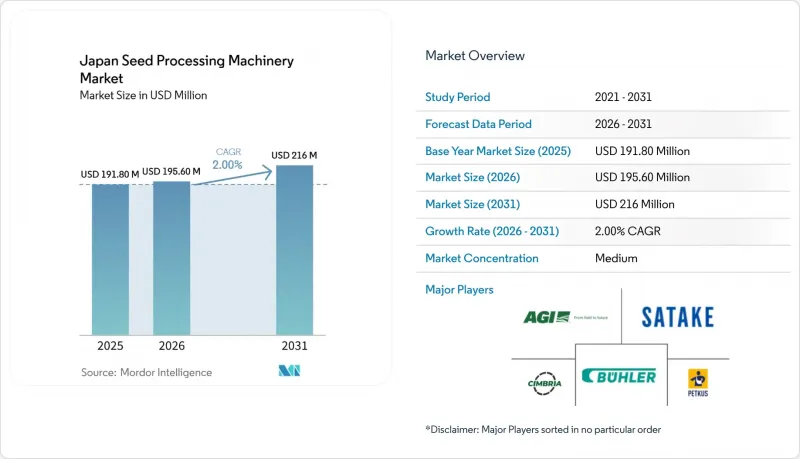
根據 Mordor Intelligence 預測,日本種子加工設備市場規模預計將在 2025 年達到 1.918 億美元,並在 2026 年從 1.956 億美元成長到 2031 年的 2.16 億美元,在預測期(2026-2031 年)內複合年成長率為 2%。
本報告按機器類型(預清理機、清洗機、烘乾機、分類機、磨床、光學分類機、種子包裝機等)、運作模式(全自動和半自動)以及最終用戶(商業種子加工廠、種子生產商等)進行細分。市場預測以貨幣價值(美元)表示。
日本種子加工機械市場趨勢與洞察
鼓勵智慧農業和自動化以節省勞力
日本《促進智慧農業技術應用法》於2024年10月1日生效,該法建立了一套針對提高農業生產力的機械設備的認證和補貼系統。符合條件的投資可以透過農業現代化基金獲得加速折舊和低利率貸款。農林水產省於2025年發布了首批「智慧農業技術計畫」認證,涵蓋自動化灌溉、機器人收割和無人機田間管理等領域。 2026會計年度的補充預算啟動了一項新的提案徵集,重點關注減少收穫後作業(包括種子清洗和分類)的勞動時間。這使得種子加工設備不再是可選項,而是鼓勵投資。經合組織預測,到2030年代中期,日本主要農業從業人員的數量將比2010年減少45%以上。自動化生產線的引入將使合作社和商業設施在人員減少的情況下維持加工量。這些政策結合起來,即使在農民收入困難的時期,也能為自動化投資提供更穩定的基礎,使日本種子加工機械市場即使在低收入時期也能維持對自動化的投入。
更換勞力密集、過時的生產線
日本安裝的大部分種子加工設備是在上世紀90年代和本世紀初引進的。這些生產線的設計初衷是服務大規模的工作團隊和人工檢驗。現代自動化系統能夠在減少30%至50%人員的同時,達到類似的加工能力。此外,它們還具備老式設備所缺乏的基於感測器的品管功能。根據經合組織的報告,隨著個體農戶的減少,企業在日本農業中扮演越來越重要的角色。北海道和東北地區的大規模企業可能會選擇整合式和半自動線,而不是小規模的機械升級。由於小規模農戶往往會推遲購買,因此設備的更新換代需求可能仍然不均衡。具備本地資金籌措、安裝和服務能力的供應商在贏得這些更新換代專案方面具有優勢。在日本種子加工機械市場,能夠從安裝到維護全程管理更新換代專案的公司將更受青睞。
光學分類機和整合生產線的初始成本較高
一台中型光學分類機,包括安裝、軟體設定和試運行,造價可能超過2,000萬日圓(約13萬美元)。如此高昂的支出超出了許多農民和小規模合作社的預算。農業現代化基金和日本農業協會(JA)附屬機構的貸款可以提供幫助,但申請者需要提供預計的加工能力和認證種子的銷售預測。小規模企業可能無法獲得準備這些申請所需的諮詢和支援。此外,區域合作社委員會在人工智慧分選項目上也面臨7至9年的漫長投資回收期。這可能會延誤核准,並減緩日本種子加工機械市場的整體成長。因此,採購模式呈現兩極化。大規模商業工廠能夠購買高性能系統,而小規模工廠則被迫推遲投資或選擇基礎設備。緊湊型模組化系統有望隨著時間的推移縮小這種差距。日本種子加工機械市場需要此類產品,以滿足那些無力投資整套工業生產線的合作社的需求。如果國內供應得到保障,區域加工中心的准入條件也將得到改善。
細分市場分析
到2025年,作為認證種子加工第一步的關鍵設備,清洗機將佔市場收入的35%。清洗機(例如氣篩式和重力式分類機)的銷售比高階設備的銷售更為穩定,因為它們能在下游設備有效運作前去除大量雜質。隨著加工設施逐漸淘汰人工目視檢查,光學分分類機市場預計將在2026年至2031年間以8.5%的複合年成長率成長。乾燥機在北海道和東北地區繼續發揮至關重要的作用,因為這些地區的種子含水量會因收穫條件而異,這也支撐了對低能耗系統的需求。
隨著精密加工逐漸成為田間化學噴塗的替代方案,塗層和加工機械的重要性日益凸顯。分類機、分離、除垢和磨床的應用已日趨成熟,主要受設備更新換代需求的驅動;而多功能清洗機則對獨立式預洗機構成越來越大的壓力。種子包裝機械受益於零售通路對批次追溯和麵向消費者的包裝的需求。佐竹株式會社推出的「TIARA」和「SLASH BPLUS」反映了市場正向更先進的光學分類系統轉型。布勒公司的「SORTEX AI700」則增加了基於人工智慧的選項。預計2031年,光學分類機在設備價值中的比例將進一步提升。
其他好處:
- Excel格式的市場預測(ME)表
- 3個月的分析師支持
目錄
第1章:引言
- 市場分析與定義的前提條件
- 分析範圍
第2章 分析方法
第3章執行摘要
第4章 市場狀況
- 市場概覽
- 市場促進因素
- 擴大認證種子的生產
- 自動化能夠獎勵智慧農業發展並節省勞力。
- 種子品質檢測自動化
- 出口種子純度需求
- 替換勞力密集、過時的生產線
- 日本緊湊型模組化系統的開發
- 市場限制因素
- 光學分選和整合生產線的初始成本較高
- 農業工人老化和接班人需求分散
- 本地試運行和維護專家短缺
- 傳統設備與農場數據之間的互通性差距
- 監理情勢
- 技術展望
- 波特五力分析
第5章:預測市場規模與成長率
- 按機器類型
- 預清潔劑
- 洗衣機
- 烘乾機
- 分類機
- 塗佈機和加工機
- 分離器/除石機
- 磨床
- 光學分類機
- 種子包裝機
- 其他專用設備
- 透過運作模式
- 自動的
- 半自動
- 最終用戶
- 商業種子加工廠
- 種子生產商
- 研究機構
- 農場設施
- 糧食處理設施
第6章 競爭情勢
- 市場集中度
- 策略趨勢
- 市佔率分析
- 公司簡介
- Satake Corporation
- Buhler AG
- Ag Growth International Inc.
- PETKUS Technologie GmbH
- Cimbria A/S(Grain and Protein Technologies)
- Yamamoto Co., Ltd.
- Kubota Corporation
- Yanmar Holdings Co., Ltd.
- Iseki and Co., Ltd.
- Nisshin Shokai Co., Ltd.
- Daisho Co., Ltd.
- Kett Co., Ltd.
- Shizuoka Seiki Co., Ltd.
第7章 市場機會與未來展望
According to Mordor Intelligence, the Japan seed processing machinery market was valued at USD 191.8 million in 2025 and is estimated to grow from USD 195.6 million in 2026 to reach USD 216 million by 2031, at a CAGR of 2% during the forecast period (2026-2031).
This report is Segmented by Machinery Type (Pre-Cleaners, Cleaners, Dryers, Graders, Polishers, Optical Sorters, Seed Packagers, and More), by Operation Mode (Automatic and Semi-Automatic), and by End-User (Commercial Seed Processing Plants, Seed Producers, and More). The Market Forecasts are Provided in Terms of Value (USD).
Japan Seed Processing Machinery Market Trends and Insights
Smart Agriculture Incentives and Labor-Saving Automation
Japan's Smart Agriculture Technology Utilization Promotion Act took effect on October 1, 2024, establishing a certification and subsidy route for machinery that improves farm productivity. Eligible investments can receive accelerated depreciation and low-interest lending through the Agricultural Modernization Fund. MAFF issued its first Smart Agriculture Technology Plan certifications in 2025, covering automated irrigation, robotic harvesting, and drone-supported field management. The 2026 supplementary budget opened a further solicitation focused on reducing labor time in post-harvest work, including seed cleaning and grading. This positions seed processing equipment as an incentivized investment rather than a discretionary purchase. The OECD expects Japan's core agricultural workforce to decline by more than 45% from its 2010 level by the mid-2030s. Automated lines can help cooperatives and commercial plants maintain processing volumes with fewer workers. Together, these policies provide a more stable basis for automation investment when farm income conditions are weak, allowing the Japan seed processing machinery market to sustain automation spending during weaker income cycles.
Replacement of Labor-Intensive Legacy Lines
A substantial portion of Japan's installed seed processing equipment dates from the 1990s and early 2000s. These lines were designed for larger operating teams and for manual inspection tasks. Modern automatic systems can deliver similar throughput with 30% to 50% fewer personnel. They can also include sensor-based quality control that older equipment cannot support. The OECD reports that corporate entities are taking a larger role in Japanese agriculture as individual farm households decline. Larger operators in Hokkaido and Tohoku will choose integrated and semi-autonomous lines instead of minor mechanical upgrades. Replacement demand can still be uneven because small farms often delay purchases. Suppliers with local financing, installation, and service capability are better positioned to capture these replacement projects. The Japan seed processing machinery market rewards companies that can manage replacement projects from installation through maintenance.
High Upfront Cost of Optical Sorting and Integrated Lines
A mid-capacity optical sorter can cost more than JPY 20 million (USD 130,000) when installation, software configuration, and commissioning are included. This level of spending exceeds the unassisted budget of many on-farm operators and smaller cooperatives. Agricultural Modernization Fund lending and JA-affiliated financing can help, but applicants need throughput projections and certified-seed revenue forecasts. Smaller operators may lack the advisory support needed to prepare these applications. Regional cooperative committees also face long payback periods of 7 to 9 years for AI-assisted sorting projects. This can delay approvals, slowing overall growth in the Japan seed processing machinery market. The result is a two-tier purchasing pattern. Large commercial plants can buy premium systems, while smaller facilities defer investment or choose basic mechanical equipment. Compact modular systems could narrow this gap over time. The Japan seed processing machinery market needs these products to serve cooperatives that cannot fund full industrial lines. Domestic availability can improve access in regional processing locations.
Other drivers and restraints analyzed in the detailed report include:
- Expansion of Certified Seed Production
- Automation of Seed Quality Inspection
- Aging Farm Workforce and Fragmented Replacement Demand
For complete list of drivers and restraints, kindly check the Table Of Contents.
Segment Analysis
Cleaners accounted for 35% of market revenue in 2025, as they represent the required first step in certified-seed processing. Air-screen cleaners and gravity separators remove bulk foreign matter before downstream equipment can operate effectively, making cleaner sales more stable than premium equipment sales. Optical sorters are forecast to grow at an 8.5% CAGR between 2026 and 2031 as facilities move away from manual visual inspection. Dryers remain important in Hokkaido and Tohoku, where harvest conditions create moisture variation and support demand for low-energy systems.
Coaters and treaters are gaining relevance as precision treatment offers an alternative to field-applied chemistry. Graders, separators, destoners, and polishers have mature applications with mainly replacement-led demand, while combined-function cleaners are pressuring standalone pre-cleaners. Seed packagers benefit from retail channels that require lot traceability and consumer packaging. Satake's TIARA and SLASH BPLUS launches reflect the move toward more capable optical sorting systems. Buhler AG's SORTEX AI700 adds an AI-based option, and optical sorters are estimated to account for a larger share of equipment value by 2031.
Complete Report Scope:
- By Machinery Type
- Pre-Cleaners
- Cleaners
- Dryers
- Graders
- Coaters and Treaters
- Separators and Destoners
- Polishers
- Optical Sorters
- Seed Packagers
- Other Specialized Equipment
- By Operation Mode
- Automatic
- Semi-Automatic
- By End User
- Commercial Seed Processing Plants
- Seed Producers
- Research Institutions
- On-Farm Facilities
- Grain Handling Facilities
List of Companies Covered in this Report:
- Satake Corporation
- Buhler AG
- Ag Growth International Inc.
- PETKUS Technologie GmbH
- Cimbria A/S (Grain and Protein Technologies)
- Yamamoto Co., Ltd.
- Kubota Corporation
- Yanmar Holdings Co., Ltd.
- Iseki and Co., Ltd.
- Nisshin Shokai Co., Ltd.
- Daisho Co., Ltd.
- Kett Co., Ltd.
- Shizuoka Seiki Co., Ltd.
Additional Benefits:
- The market estimate (ME) sheet in Excel format
- 3 months of analyst support
TABLE OF CONTENTS
1 Introduction
- 1.1 Study Assumptions and Market Definition
- 1.2 Scope of the Study
2 Research Methodology
3 Executive Summary
4 Market Landscape
- 4.1 Market Overview
- 4.2 Market Drivers
- 4.2.1 Expansion of certified seed production
- 4.2.2 Smart-agriculture incentives and labor-saving automation
- 4.2.3 Automation of seed quality inspection
- 4.2.4 Demand for export-grade seed purity
- 4.2.5 Replacement of labor-intensive legacy lines
- 4.2.6 Domestic development of compact modular systems
- 4.3 Market Restraints
- 4.3.1 High upfront cost of optical sorting and integrated lines
- 4.3.2 Aging farm workforce and fragmented replacement demand
- 4.3.3 Shortage of local commissioning and maintenance specialists
- 4.3.4 Interoperability gaps across legacy equipment and farm data
- 4.4 Regulatory Landscape
- 4.5 Technological Outlook
- 4.6 Porter's Five Forces Analysis
- 4.6.1 Bargaining Power of Suppliers
- 4.6.2 Bargaining Power of Buyers
- 4.6.3 Threat of New Entrants
- 4.6.4 Threat of Substitutes
- 4.6.5 Intensity of Competitive Rivalry
5 Market Size And Growth Forecasts (Value)
- 5.1 By Machinery Type
- 5.1.1 Pre-Cleaners
- 5.1.2 Cleaners
- 5.1.3 Dryers
- 5.1.4 Graders
- 5.1.5 Coaters and Treaters
- 5.1.6 Separators and Destoners
- 5.1.7 Polishers
- 5.1.8 Optical Sorters
- 5.1.9 Seed Packagers
- 5.1.10 Other Specialized Equipment
- 5.2 By Operation Mode
- 5.2.1 Automatic
- 5.2.2 Semi-Automatic
- 5.3 By End User
- 5.3.1 Commercial Seed Processing Plants
- 5.3.2 Seed Producers
- 5.3.3 Research Institutions
- 5.3.4 On-Farm Facilities
- 5.3.5 Grain Handling Facilities
6 Competitive Landscape
- 6.1 Market Concentration
- 6.2 Strategic Moves
- 6.3 Market Share Analysis
- 6.4 Company Profiles (includes Global Level Overview, Market Level Overview, Core Segments, Financials as available, Strategic Information, Market Rank/Share, Products and Services, Recent Developments)
- 6.4.1 Satake Corporation
- 6.4.2 Buhler AG
- 6.4.3 Ag Growth International Inc.
- 6.4.4 PETKUS Technologie GmbH
- 6.4.5 Cimbria A/S (Grain and Protein Technologies)
- 6.4.6 Yamamoto Co., Ltd.
- 6.4.7 Kubota Corporation
- 6.4.8 Yanmar Holdings Co., Ltd.
- 6.4.9 Iseki and Co., Ltd.
- 6.4.10 Nisshin Shokai Co., Ltd.
- 6.4.11 Daisho Co., Ltd.
- 6.4.12 Kett Co., Ltd.
- 6.4.13 Shizuoka Seiki Co., Ltd.
7 Market Opportunities And Future Outlook

 精密模具及加工市場預測至2034年-全球模具類型、加工製程、材料、應用、最終使用者及區域分析
 中國種子加工機械:市場佔有率分析、產業趨勢與統計、成長預測(2026-2031)
 全球老虎機市場規模、佔有率、趨勢和成長分析報告(2026-2034年)
 粉末加工設備市場-全球產業規模、佔有率、趨勢、機會、預測:按技術、最終用戶、地區和競爭格局分類,2021-2031年
 2026年全球熔噴不織布機械市場報告種子加工機械:市場佔有率分析、產業趨勢與統計、成長預測(2026-2031)
 精密加工市場分析與預測(至2035年):依類型、產品、服務、技術、應用、材料類型、製程、最終用戶、設備及解決方案分類
 鑽石單晶加工設備市場:依製程、設備類型、自動化程度和終端用戶產業分類-2026-2032年全球預測全球石材加工機械市場規模、佔有率、趨勢和成長分析報告:2026-2034年
 精密加工市場規模、佔有率和趨勢分析報告:按營運方式、類型、最終用途、地區和細分市場預測,2026-2033年