


 |
市場調查報告書
商品編碼
2155653
南美洲城域密集波分複用(DWDM):市場佔有率分析、產業趨勢與統計數據以及成長預測(2026-2031 年)South America Metro Dense Wave Division Multiplexing (DWDM) - Market Share Analysis, Industry Trends & Statistics, Growth Forecasts (2026 - 2031) |
||||||

※ 本網頁內容可能與最新版本有所差異。詳細情況請與我們聯繫。
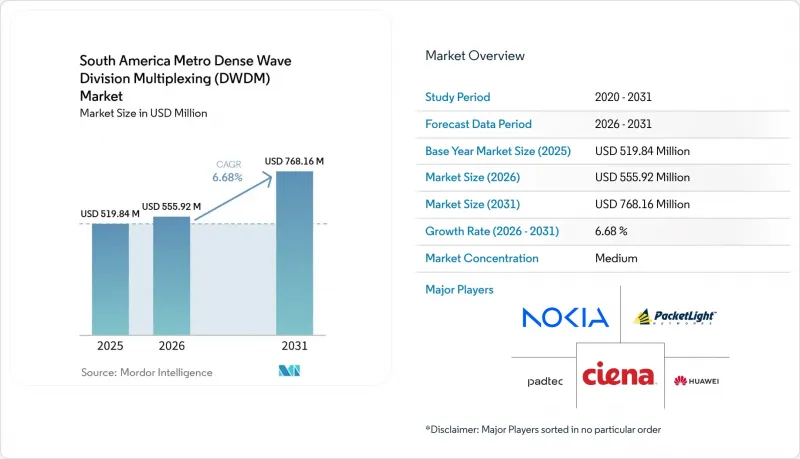
根據 Mordor Intelligence 預測,南美城域高密度分波多工(DWDM) 市場規模將從 2025 年的 5.1984 億美元成長到 2026 年的 5.5592 億美元,然後在 2031 年達到 7.6816 億美元,2026 年的複合年成長率為 203131.38%。
南美城域高密度分波多工(DWDM) 市場的趨勢與見解。
提升5G行動回程和去程傳輸。
在巴西,截至2024年底,獨立組網的5G網路已覆蓋464個城市。巴西國家電信管理局(Anatel)的頻率分配規定要求在2026年12月31日前,在530個城市完成光纖回程傳輸的建設。這一期限為電信業者投資傳輸基礎設施以滿足覆蓋需求提供了明確的時間框架。由於eCPRI流量可能超過傳統微波連接的容量,中頻段5G網路採用基於光纖的去程傳輸。 DWDM系統允許營運商在基地台區域已鋪設光纖的地方提升傳輸容量。在阿根廷,阿根廷電信在2025年新增了800多個5G基地台,使其5G基地台數量在當年年底達到1000個。他們的目標是在2026年底前達到2000多個。這些影響不僅集中在長途線路,也集中在大都會圈的聚合網路。每次新增無線叢集時,接取網路和城域核心網路之間都需要足夠的容量。此外,營運商需要在每個匯聚點實現低延遲,以支援獨立的5G業務。因此,隨著營運商增加光纖傳輸容量以實現覆蓋目標,南美城域高密度分波多工(DWDM)市場將從中受益。 Anatel的2025-2029年網路規劃指出,目前仍有1207個城市沒有光纖回程傳輸網路建設工作將在當前部署階段之後繼續推進。
擴展雲端和超大規模資料中心之間的互聯互通
聖保羅正逐漸成為人工智慧基礎設施和大型資料中心園區的重要區域中心。這些園區需要在可用區和相鄰設施之間建立低延遲的光環連接。這種需求不同於主要依賴城際骨幹鏈路的傳統流量模式。 Ascenty公司已獲得一份新的150兆瓦人工智慧相關合約,並宣布了一項價值12億美元的計劃,將在聖保羅大都會圈建設四個超大規模資料中心。該計劃包括專為大規模人工智慧工作負載設計的設施。這些項目將直接產生對高容量城域資料中心互連鏈路的需求。
對進口設備和資金籌措成本的依賴程度高
在巴西,DWDM硬體價值的75%至85%依賴進口設備。 2026年2月,巴西出口管制委員會(GECEX)通過第852/2026號決議,提高了部分IT和電信產品的關稅,使得這種依賴更加顯著。依產品分類的不同,關稅稅率分別為7.2%、12.6%或20%。光纖傳輸設備在加徵工業生產稅(IPI)和州增值稅(ICMS)之前,可能需繳納12%至16%的進口關稅。不符合「extalif」(關稅豁免)計畫條件的電信營運商,其總到岸成本可能增加40%至60%。 extalif流程平均需要180天,可能會延誤設備採購計畫。此外,巴西也對來自中國的光纖電纜徵收每公斤2.42美元的固定反傾銷稅,為期五年。這將為需要新建光纖或有源傳輸設備的工程項目增加另一項成本。在阿根廷,基準利率高企,外匯管制週期較長。這些因素可能會延長進口連貫光系統的資金籌措週期。因此,能否在本地組裝系統並獲得國內資金籌措可能會影響供應商的商業性地位。
細分市場分析
2025年,硬體在南美城域DWDM市場中佔85.73%。這一佔有率反映了400G連貫線路卡和Flexgrid ROADM底盤所需的資本投入。這些系統在全部區域的主要網路建設項目中繼續發揮核心作用。硬體支出也包括現有城域站點容量擴展所需的設備。服務則透過整合、部署和支援合約來滿足剩餘的組件需求。 NEC負責監督Electronet骨幹網路現代化改造的系統統籌,該專案涵蓋巴西23個州,新建光纖線路長達8000公里。
預計到2031年,軟體將以10.17%的複合年成長率成長,成為所有組件中成長最快的領域。電信業者正在利用軟體來管理多廠商網路、實現波長配置自動化以及分析各層效能。隨著網路站點的擴展和更高容量波長的部署,這些功能的價值將進一步提升。 2026年,Adtran發布了Terabit特級邊緣路由器,可與其FSP 3000 IP OLS以及ZR或ZR+連貫光學模組整合。該設計擴展了400G邊緣傳輸,並減少了對獨立轉發器設備的需求。因此,軟體管理將在每個網路元件的部署中發揮更大的作用。
至2025年,頻寬高達100 Gbps的頻寬市場將佔南美城域高密度分波多工(DWDM)市場的36.84%。這一佔有率反映出傳統城域系統的部署規模仍然相當龐大。許多營運商尚未達到完全替換這些系統的財務閾值。 200 Gbps和400 Gbps頻寬可作為營運商升級特定核心節點的遷移選項。這種方法允許營運商在保留匯聚環內傳統設備的同時,改善主幹路由。此外,它還允許營運商同時滿足多個速率頻段(而不僅僅是一個頻段)的頻寬。
預計到2031年,超過400 Gbps的細分市場將以10.22%的複合年成長率成長。此細分市場的發展得益於巴西超大規模資料中心園區和託管設施之間的互聯線路。 2025年11月,Scala資料中心、Lightera和諾基亞在Scala位於聖保羅的園區完成了南美洲首個AccuCore中空光纖展示。此次展示採用了諾基亞的「1830 PSI-M」平台和第六代「PSE-6」光子晶片組。該項目展示了未來提升單波長容量的潛力。其意義在於檢驗了能夠突破傳統單模光纖限制的容量提升方案。
其他好處:
- Excel格式的市場預測(ME)表
- 3個月的分析師支持
目錄
第1章:引言
- 研究假設和市場定義
- 調查範圍
第2章:調查方法
第3章執行摘要
第4章 市場狀況
- 市場概覽
- 市場促進因素
- 提升5G行動回程和去程傳輸。
- 擴展雲端和超大規模資料中心之間的互聯互通
- 光纖和FTTH整合
- 向 400G 和 800G連貫光纖通訊過渡
- 人工智慧工作負載集中在聖保羅都會區中心
- 資金籌措使得區域網路服務供應商的DWDM網路得以擴展到沿海走廊以外。
- 市場限制因素
- 對進口設備和資金籌措成本的依賴程度高
- 缺乏專業的光學工程和維修技能
- 地方政府道路使用權和許可證辦理程序延誤
- 高密度都市區走廊的電力和土地利用限制
- 產業價值鏈分析
- 監理情勢
- 技術展望
- 波特五力分析
- 宏觀經濟因素對市場的影響
第5章 市場規模與成長預測
- 按組件
- 硬體
- 軟體
- 服務
- 按輸電容量
- 最高可達 100 Gbps
- 200 Gbps
- 400 Gbps
- 400 Gbps 或更高
- 透過使用
- 資料中心之間的互連
- 行動回程傳輸和去程傳輸
- 寬頻和接取網路的聚合
- 其他用途
- 最終用戶
- 電信服務供應商
- 雲端和資料中心供應商
- 公司
- 政府/公共部門
- 國家
- 巴西
- 阿根廷
- 其他南美國家
第6章 競爭情勢
- 市場集中度
- 策略趨勢
- 市佔率分析
- 公司簡介
- Huawei Technologies Co., Ltd.
- Nokia Corporation
- Ciena Corporation
- Padtec SA
- ZTE Corporation
- Smartoptics AS
- Cisco Systems, Inc.
- ADTRAN, Inc.
- Ribbon Communications Inc.
- PacketLight Networks Ltd.
- NEC Corporation
- Silica Networks Argentina SA
- Tejas Networks Limited
- Raisecom Technology Co., Ltd.
- FiberHome Telecommunication Technologies Co., Ltd.
- Datacom SA
第7章 市場機會與未來展望
According to Mordor Intelligence, the South America metro dense wave division multiplexing (DWDM) market size is expected to grow from USD 519.84 million in 2025 to USD 555.92 million in 2026, and is forecast to reach USD 768.16 million by 2031, at a 6.68% CAGR over 2026-2031.
South America Metro Dense Wave Division Multiplexing (DWDM) Market Trends and Insights
5G Mobile Backhaul and Fronthaul Capacity Upgrades
Brazil's 5G standalone rollout reached 464 cities by the end of 2024. Anatel's spectrum commitments require fiber backhaul at 530 municipal seats by December 31, 2026. This deadline establishes a defined period for transport investment by operators that need to meet coverage obligations. Mid-band 5G networks use fiber-based fronthaul because eCPRI traffic can exceed the capacity of older microwave connections. DWDM systems allow operators to add transport capacity where fiber already reaches base station areas. In Argentina, Telecom Argentina ended 2025 with 1,000 5G sites after adding more than 800 locations that year, and it targeted more than 2,000 sites by the end of 2026. The effect is concentrated in metropolitan aggregation networks rather than only in long-distance routes. Each new radio cluster needs adequate capacity between the access network and the metro core. Operators also need low latency at each aggregation point to support standalone 5G services. The South America metro dense wave division multiplexing (DWDM) market, therefore, benefits when coverage targets lead operators to increase fiber-backed transport capacity. Anatel's 2025-2029 network plan identified 1,207 municipalities without optical backhaul, indicating continued work beyond the current rollout phase.
Cloud and Hyperscale Data Center Interconnect Expansion
Sao Paulo has become the region's main location for AI infrastructure and large data center campuses. These campuses require low-latency optical rings that connect availability zones and nearby facilities. This need differs from traditional traffic patterns that depended mainly on backbone links between cities. Ascenty secured 150 MW of new AI contracts and announced a USD 1.2 billion plan for 4 hyperscale data centers in the Sao Paulo metropolitan area. The plan includes a facility designed for large-scale AI workloads. These projects create direct demand for high-capacity metro data center interconnect links.
High Imported-Equipment Exposure and Financing Costs
Brazil depends on imported equipment for 75-85% of the value of DWDM hardware. This exposure became more significant after GECEX Resolution 852/2026 raised duties on selected IT and telecommunications products in February 2026. The listed rates were 7.2%, 12.6%, or 20%, depending on product classification. Optical transport apparatus can face headline import duties of 12-16% before IPI and ICMS are added. Operators that do not qualify for the ex-tariff program may face total landed-cost increases of 40-60%. The ex-tariff process averages 180 days, which can extend equipment planning. Brazil also applied a definitive anti-dumping duty of USD 2.42 per kilogram on optical fiber cables from China for 5 years. This adds a separate cost element for projects that require new fiber and active transport equipment. Argentina faces high benchmark interest rates and periodic foreign exchange restrictions. Those conditions can extend financing cycles for imported coherent optical systems. Locally assembled systems and access to domestic financing can therefore affect vendors' commercial position.
Other drivers and restraints analyzed in the detailed report include:
- Fiberization and FTTH Aggregation
- Migration to 400G and 800G Coherent Optics
- Shortage of Specialized Optical Engineering and Maintenance Skills
For complete list of drivers and restraints, kindly check the Table Of Contents.
Segment Analysis
Hardware held 85.73% of the South America Metro DWDM market share in 2025. The share reflected the capital required for 400G coherent line cards and flex-grid ROADM chassis. These systems remain central to major network construction projects across the region. Hardware spending also includes equipment needed to expand capacity at established metro sites. Services account for the remaining component demand through integration, deployment, and support contracts. NEC coordinated system integration for Eletronet's backbone modernization, spanning 8,000 km of new fiber routes across 23 Brazilian states.
Software is projected to expand at a 10.17% CAGR through 2031, the highest rate among components. Operators use software to manage multivendor networks, automate wavelength provisioning, and analyze performance across layers. These functions become more valuable as networks add more sites and higher-capacity wavelengths. Adtran introduced a terabit-scale edge router in 2026 that integrates with its FSP 3000 IP OLS and ZR or ZR+ coherent optics. The design extends 400G edge transport and reduces the need for separate transponder equipment. Software management can consequently become a larger part of each deployed network element.
The up-to-100 Gbps tier accounted for 36.84% of the South America metro dense wave division multiplexing (DWDM) market in 2025. Its position reflects a sizeable installed base of older metro systems. Many operators have not reached the financial threshold to fully replace these systems. The 200 Gbps and 400 Gbps tiers serve as transition options for operators upgrading selected core nodes. This approach allows operators to improve key routes while retaining older equipment in aggregation rings. It also supports equipment demand across more than 1 speed tier simultaneously.
The above-400 Gbps segment is projected to expand at a 10.22% CAGR through 2031. The segment is supported by data center interconnect routes between hyperscale campuses and colocation facilities in Brazil. Scala Data Centers, Lightera, and Nokia completed South America's first AccuCore hollow-core fiber proof of concept at Scala's Sao Paulo campus in November 2025. Nokia's 1830 PSI-M platform and sixth-generation PSE-6 photonic chipset were used in the demonstration. The project showed a possible path to higher wavelength capacity over time. Its relevance lies in testing capacity improvements that could reduce limitations of conventional single-mode fiber.
Complete Report Scope:
- By Component
- Hardware
- Software
- Services
- By Transmission Capacity
- Up to 100 Gbps
- 200 Gbps
- 400 Gbps
- Above 400 Gbps
- By Application
- Data Center Interconnect
- Mobile Backhaul and Fronthaul
- Broadband and Access Network Aggregation
- Other Applications
- By End-User
- Communication Service Providers
- Cloud and Data Center Providers
- Enterprises
- Government and Public Sector
- By Country
- Brazil
- Argentina
- Rest of South America
List of Companies Covered in this Report:
- Huawei Technologies Co., Ltd.
- Nokia Corporation
- Ciena Corporation
- Padtec S.A.
- ZTE Corporation
- Smartoptics AS
- Cisco Systems, Inc.
- ADTRAN, Inc.
- Ribbon Communications Inc.
- PacketLight Networks Ltd.
- NEC Corporation
- Silica Networks Argentina S.A.
- Tejas Networks Limited
- Raisecom Technology Co., Ltd.
- FiberHome Telecommunication Technologies Co., Ltd.
- Datacom S.A.
Additional Benefits:
- The market estimate (ME) sheet in Excel format
- 3 months of analyst support
TABLE OF CONTENTS
1 INTRODUCTION
- 1.1 Study Assumptions and Market Definition
- 1.2 Scope of the Study
2 RESEARCH METHODOLOGY
3 EXECUTIVE SUMMARY
4 MARKET LANDSCAPE
- 4.1 Market Overview
- 4.2 Market Drivers
- 4.2.1 5G Mobile Backhaul and Fronthaul Capacity Upgrades
- 4.2.2 Cloud and Hyperscale Data Center Interconnect Expansion
- 4.2.3 Fiberization and FTTH Aggregation
- 4.2.4 Migration to 400G and 800G Coherent Optics
- 4.2.5 AI Workload Concentration in Sao Paulo Metro Hubs
- 4.2.6 Funding-Enabled Regional ISP DWDM Buildout Beyond Coastal Corridors
- 4.3 Market Restraints
- 4.3.1 High Imported-Equipment Exposure and Financing Costs
- 4.3.2 Shortage of Specialized Optical Engineering and Maintenance Skills
- 4.3.3 Municipal Right-of-Way and Permitting Delays
- 4.3.4 Power and Site Constraints in Dense Metro Corridors
- 4.4 Industry Value Chain Analysis
- 4.5 Regulatory Landscape
- 4.6 Technological Outlook
- 4.7 Porter's Five Forces Analysis
- 4.7.1 Bargaining Power of Suppliers
- 4.7.2 Bargaining Power of Buyers
- 4.7.3 Threat of New Entrants
- 4.7.4 Threat of Substitutes
- 4.7.5 Competitive Rivalry
- 4.8 Impact of Macroeconomic Factors on the Market
5 MARKET SIZE AND GROWTH FORECASTS (VALUE)
- 5.1 By Component
- 5.1.1 Hardware
- 5.1.2 Software
- 5.1.3 Services
- 5.2 By Transmission Capacity
- 5.2.1 Up to 100 Gbps
- 5.2.2 200 Gbps
- 5.2.3 400 Gbps
- 5.2.4 Above 400 Gbps
- 5.3 By Application
- 5.3.1 Data Center Interconnect
- 5.3.2 Mobile Backhaul and Fronthaul
- 5.3.3 Broadband and Access Network Aggregation
- 5.3.4 Other Applications
- 5.4 By End-User
- 5.4.1 Communication Service Providers
- 5.4.2 Cloud and Data Center Providers
- 5.4.3 Enterprises
- 5.4.4 Government and Public Sector
- 5.5 By Country
- 5.5.1 Brazil
- 5.5.2 Argentina
- 5.5.3 Rest of South America
6 COMPETITIVE LANDSCAPE
- 6.1 Market Concentration
- 6.2 Strategic Moves
- 6.3 Market Share Analysis
- 6.4 Company Profiles (includes Global Level Overview, Market Level Overview, Core Segments, Financials as available, Strategic Information, Market Rank/Share, Products and Services, Recent Developments)
- 6.4.1 Huawei Technologies Co., Ltd.
- 6.4.2 Nokia Corporation
- 6.4.3 Ciena Corporation
- 6.4.4 Padtec S.A.
- 6.4.5 ZTE Corporation
- 6.4.6 Smartoptics AS
- 6.4.7 Cisco Systems, Inc.
- 6.4.8 ADTRAN, Inc.
- 6.4.9 Ribbon Communications Inc.
- 6.4.10 PacketLight Networks Ltd.
- 6.4.11 NEC Corporation
- 6.4.12 Silica Networks Argentina S.A.
- 6.4.13 Tejas Networks Limited
- 6.4.14 Raisecom Technology Co., Ltd.
- 6.4.15 FiberHome Telecommunication Technologies Co., Ltd.
- 6.4.16 Datacom S.A.
7 MARKET OPPORTUNITIES AND FUTURE OUTLOOK
- 7.1 White-Space and Unmet-Need Assessment

 城域緊密耦合分波多工(DWDM):市場佔有率分析、產業趨勢與統計數據以及成長預測(2026-2031 年)歐洲城域緊密耦合分波多工(DWDM):市場佔有率分析、產業趨勢與統計數據以及成長預測(2026-2031 年)
 DWDM收發器市場規模、佔有率和成長分析:按外形規格、資料速率、傳輸距離、應用、最終用戶、銷售管道和地區分類 - 產業預測,2026-2033年
 2026年超C分波多工(WDM)設備全球市場報告
 分波多工設備市場:按設備類型、技術、應用和最終用戶分類的全球預測,2026-2032年波長管理設備市場:依產品類型、技術、連接埠數量、波長範圍、應用和最終用戶分類,全球預測,2026-2032年粗分波多工模組市場(按產品類型、傳輸距離、通道數、外形規格、光纖類型、應用和最終用戶分類),全球預測,2026-2032年2026年全球高密度分波多工器(DWDM)收發器市場報告
 密集波分複用 (DWDM) 市場規模、佔有率、成長及全球產業分析:按類型、應用和地區劃分的洞察與預測 (2026-2034)
 多工器(WDM)全球市場規模、佔有率、趨勢分析報告:2024 年至 2031 年按類型、產業和地區分類的展望與預測