


 |
市場調查報告書
商品編碼
2155604
機器視覺系統租賃:市場佔有率分析、產業趨勢與統計、成長預測(2026-2031)Machine Vision System Leasing - Market Share Analysis, Industry Trends & Statistics, Growth Forecasts (2026 - 2031) |
||||||

※ 本網頁內容可能與最新版本有所差異。詳細情況請與我們聯繫。
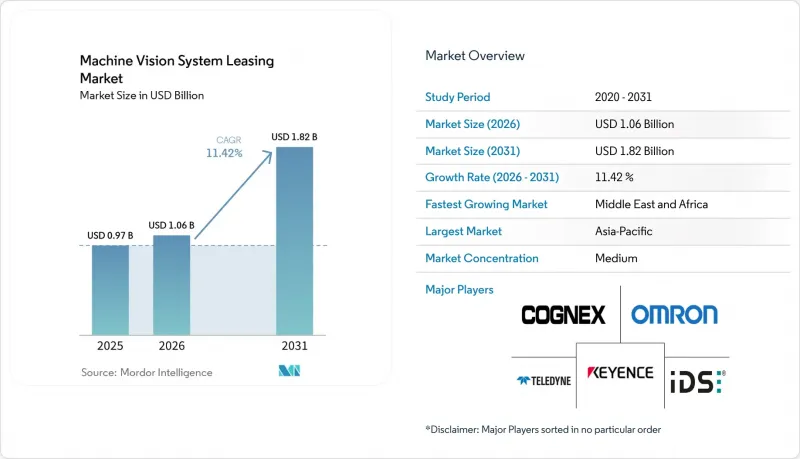
根據 Mordor Intelligence 預測,機器視覺系統租賃市場規模預計將在 2026 年達到 10.6 億美元,到 2031 年達到 18.2 億美元,2026 年至 2031 年的複合年成長率為 11.42%。
全球機器視覺系統租借市場趨勢及洞察
工業4.0、品質自動化和零缺陷製造
目前,零缺陷的要求已從航太和汽車產業擴展到半導體封裝和藥品片劑檢測等領域。機器視覺系統租賃市場正受惠於偵測密度的提高,隨著生產標準的日益嚴格,設備升級也變得勢在必行。 2026年5月,康耐視發布了採用高通龍翼技術的“In-Sight 3900視覺系統”,該系統無需外部PC即可實現嵌入式AI檢測。這項發布表明,透過嵌入式運算而非獨立的運算基礎設施,可以更有效地處理偵測深度和線速度。此外,康耐視的「OneVision」支援集中訓練的AI模型,這些模型可以部署在多個地點的系統中。因此,機器視覺系統租賃市場不僅可以作為設備資金籌措的手段,還可以作為持續品質改進的管道。
視覺引導機器人和彈性生產
視覺系統正逐漸成為機器人工作單元不可或缺的一部分,而不再是獨立的偵測站。根據國際機器人聯合會(IFR)預測,到2024年,全球機器人部署數量將超過54.2萬台,其中70%集中在亞洲。這種部署規模不斷擴大,對視覺引導、定位和偵測功能的需求也隨之持續成長。 2026年3月,Basler和Orbbec聯合發布了面向自主移動機器人(AMR)、自動導引車(AGV)和工業3D視覺應用的「Basler Stereo mini」相機。機器人租賃公司現在可以將相機及相關視覺組件整合到更廣泛的設備租賃合約中。因此,對機器視覺系統租賃市場的需求將來自那些需要尖端感測器和強大運算能力的彈性生產線。
高階視覺系統整體擁有成本高昂
即使以經營租賃的方式購置,高階3D和高光譜遙測成像系統仍價格不斐。高昂的系統成本意味著更高的每月租金,這對小規模客戶而言可能難以負擔。此外,如果合約終止時資產價值低於預期,租賃公司將面臨殘值風險。服務義務也會進一步增加每份合約所需的資金。根據德國租賃協會預測,由於汽車和化學工業的投資決策延遲,到2025年,生產機械租賃市場預計將下降5.5%,至49.6億歐元(53.8億美元)。在機器視覺系統租賃市場,北美和西歐以外地區需要更強大的二手設備分銷管道來應對此風險。
細分市場分析
到2025年,機器視覺相機將佔設備市場佔有率的31.23%。這一佔有率反映了它們在眾多生產現場的工業自動化、線上檢測和機器人引導中的應用。由於相機應用範圍廣泛,它們通常作為租賃系統部署的起點。客戶可以租賃相機機身,並單獨購買光學元件和照明設備。這種方式降低了基礎部署的初始合約負擔。機器視覺系統租賃市場受益於這種模組化結構,該結構允許根據各種技術要求客製化合約。在需要根據特定生產線調整影像品質和視野角的系統中,光學元件和鏡頭仍然發揮著至關重要的作用。照明系統仍然必不可少,因為光照條件決定了相機能否持續識別缺陷。視覺處理設備提供運行檢測模型並將結果傳輸到工廠控制系統所需的運算能力。
整合視覺系統將多種元素整合到單一解決方案中,深受那些優先考慮簡化採購流程的客戶的青睞。這些系統減輕了硬體供應商、整合商和金融服務提供者之間的協調負擔。預計到2031年,專用成像系統將以12.62%的複合年成長率成長。高光譜遙測、短波紅外線和頻譜平台正擴大應用於食品安全保障、藥品分類和回收等領域。 Teledyne DALSA設計的「Kaleido」配備了符合GigE Vision和GenICam標準的10GigE介面。標準化介面簡化了供應商和客戶的系統整合。機器視覺系統租賃市場幫助用戶部署專用設備,而無需擁有性能可能很快就會過時的資產。當新的成像功能能夠改變檢測和分類的經濟效益時,這一點尤其重要。
截至2025年,2D成像將佔視覺技術領域的65.54%。它仍然廣泛應用於條碼讀取、表面檢測、尺寸測量和標籤檢驗。其廣泛的應用範圍使其成為許多租賃組合的關鍵技術基礎。此外,2D系統可以在合約期間內透過軟體更新進行升級。這意味著客戶無需更換所有硬體組件即可利用改進的檢測邏輯。機器視覺系統租賃市場正是利用這種模式,為客戶提供最新的軟體和系統支援。一維成像在倉儲和物流運作中仍然發揮著較為有限的掃描和追溯作用。3D成像在汽車組裝檢驗和電子產品焊點檢測中正變得越來越重要。這些應用需要標準2D相機無法取得的深度資訊。
預計到2031年,高光譜遙測和頻譜成像技術將以12.19%的複合年成長率成長。這項技術可應用於食品污染檢測、藥片包衣檢測和回收材料分類等領域。與傳統相機相比,它能夠分析更寬波長範圍內的資訊。由此產生的數據可以提高材料辨識的準確性,但也增加了處理和整合方面的要求。 2026年,泰萊公司(Teledyne)發布了名為「Kaleido」的平台,旨在幫助系統建置商降低整合的複雜性。在機器視覺系統租賃市場,可以將光學硬體和人工智慧推理軟體打包用於這些應用。這樣就形成了一種將設備使用、資料處理和支援服務整合在一起的合約。這種機制縮小了設備租賃和「視覺即服務」(Vision-as-a-Service)之間的實際差異。
區域分析
2025年,亞太地區佔該區域市佔率的37.66%。該地區擁有眾多電子組裝、半導體製造、電動車電池生產和汽車製造中心。中國、日本、韓國、印度和東南亞國協憑藉著多元化的產業優勢,共同推動了市場需求。日本和韓國在精密製造和先進影像處理技術的應用方面擁有成熟的市場環境。中國本土供應商的規模支撐了租賃量的成長,但這可能會限制國際供應商的溢價。印度仍處於發展初期,電子組裝、汽車和製藥公司正在對其檢測流程進行現代化改造。 TKH集團在2026年上半年財報中指出,亞太地區在電池、工廠自動化、半導體和家用電子電器等產業的需求驅動下,為機器視覺領域做出了顯著貢獻。製造業投資的規模和速度也支撐著該地區機器視覺系統租賃市場的發展。
北美和歐洲是僅次於歐洲的第二大區域集團,擁有完善的租賃基礎設施。北美受惠於成熟的資產融資環境以及汽車、半導體和食品加工產業的先進自動化技術。較低的人事費用和生產回流計畫也推動了對機器視覺設備的投資。歐洲在工業自動化領域擁有深厚的基礎,德國一直是該領域的重要標竿。預計到2025年,德國的租賃支出將佔總資本支出的26.6%,新契約將成長3.2%,達到831.2億歐元(901.9億美元)。這鼓勵了企業採用經營租賃結構,即使在資本投資決策較為謹慎的情況下也是如此。南美洲的需求基礎相對小規模,主要集中在巴西的汽車和食品加工產業。在這種環境下,租賃可以成為應對資金籌措和外匯風險的手段。
預計到2031年,中東和非洲地區的複合年成長率將達到12.37%。沙烏地阿拉伯和阿拉伯聯合大公國(阿拉伯聯合大公國)的產業多元化計畫正在推動對先進製造能力的需求。租賃模式允許企業在設施建設期間使用檢測設備,而無需承擔永久所有權的負擔。南非憑藉其採礦和食品加工製造業,擁有成熟的產業基礎。非洲各地的商業機會仍處於起步階段,但發展勢頭良好。大規模區域專案通常由國際工程、採購和施工(EPC)承包商承建。這些承包商可能透過全球通路而非當地分銷商來獲取租賃設備。因此,國際供應商無需即時投資當地子公司即可進入機器視覺系統租賃市場。
其他好處:
- Excel格式的市場預測(ME)表
- 3個月的分析師支持
目錄
第1章:引言
- 研究假設和市場定義
- 調查範圍
第2章:調查方法
第3章執行摘要
第4章 市場狀況
- 市場概覽
- 市場促進因素
- 工業4.0、高品質自動化和零缺陷製造。
- 視覺引導機器人和彈性生產
- 利用人工智慧技術對電子設備、電動車電池、食品和藥品進行檢測。
- 人手不足和對持續檢測的需求
- 透過租賃和「願景即服務」降低初始資本支出 (Capex)
- 技術更新換代週期正在加快,人們越來越傾向於使用而非擁有。
- 市場限制因素
- 高階視覺系統的總擁有成本(TCO)很高。
- 熟練的整合商和應用工程師短缺
- 快速過時的視覺相關資產的不確定剩餘價值
- 對資料居住、網路安全和模型問責制的擔憂
- 宏觀經濟因素對市場的影響
- 產業價值鏈分析
- 監理情勢
- 技術展望
- 波特五力分析
第5章 市場規模與成長預測
- 依設備類型
- 機器視覺相機
- 光學儀器和透鏡
- 照明系統
- 視覺處理單元
- 整合視覺系統
- 特殊成像系統
- 視覺科技
- 一維成像
- 2D成像
- 3D成像
- 高光譜遙測和頻譜成像
- 透過使用
- 檢驗和品管
- 測量與計量
- 識別和可追溯性
- 引導和定位
- 缺陷檢測
- 機器人視覺
- 按租賃期限
- 短期
- 中期
- 長期
- 按最終用戶行業分類
- 汽車和電動車
- 電子和半導體
- 食品/飲料
- 藥品和醫療設備
- 包裝
- 物流和倉儲
- 其他終端用戶產業
- 按地區
- 北美洲
- 美國
- 加拿大
- 墨西哥
- 南美洲
- 巴西
- 阿根廷
- 其他南美國家
- 歐洲
- 德國
- 英國
- 法國
- 義大利
- 西班牙
- 其他歐洲國家
- 亞太地區
- 中國
- 日本
- 印度
- 韓國
- ASEAN
- 其他亞太國家
- 中東和非洲
- 中東
- 沙烏地阿拉伯
- 阿拉伯聯合大公國
- 其他中東國家
- 非洲
- 南非
- 其他非洲國家
- 中東
- 北美洲
第6章 競爭情勢
- 市場集中度
- 策略趨勢
- 市佔率分析
- 公司簡介
- Cognex Corporation
- KEYENCE CORPORATION
- OMRON Corporation
- Basler AG
- Teledyne Technologies Incorporated
- SICK AG
- Zebra Technologies Corporation
- Sony Group Corporation
- IDS Imaging Development Systems GmbH
- TKH Group NV
- MVTec Software GmbH
- Allied Vision Technologies GmbH
- Stemmer Imaging AG
- Datalogic SpA
- Baumer Holding AG
- National Instruments Corporation
- NVIDIA Corporation
- Qualcomm Incorporated
- Emerson Electric Co.
- Panasonic Holdings Corporation
第7章 市場機會與未來展望
According to Mordor Intelligence, the machine vision system leasing market size was USD 1.06 billion in 2026 and is forecast to reach USD 1.82 billion by 2031, accelerating at a CAGR of 11.42% over 2026-2031.
Global Machine Vision System Leasing Market Trends and Insights
Industry 4.0 Quality Automation and Zero-Defect Manufacturing
Zero-defect requirements now extend beyond aerospace and automotive into semiconductor packaging and pharmaceutical tablet inspection. The machine vision system leasing market benefits from higher inspection density, which requires equipment that can be refreshed as production thresholds become more demanding. Cognex introduced the In-Sight 3900 Vision System in May 2026, featuring Qualcomm DragonWing technology to enable embedded AI inspection without an external PC. The release showed that inspection depth and line speed are increasingly addressed through embedded computing rather than through separate computing infrastructure. Cognex OneVision also supports centrally trained AI models that can be deployed across systems at several sites. The machine vision system leasing market can therefore serve as a channel for continuous quality improvement, not only as a means of financing equipment.
Vision-Guided Robotics and Flexible Production
Vision systems are becoming integral parts of robot work cells rather than separate inspection stations. The International Federation of Robotics reported more than 542,000 global robot installations in 2024, with 70% in Asia. This installed base creates recurring demand for vision guidance, positioning, and inspection capability. Basler and Orbbec introduced the Basler Stereo mini camera in March 2026 for AMR, AGV, and industrial 3D vision uses. Robot lessors can bundle cameras and related vision components within broader equipment contracts. The machine vision system leasing market consequently gains demand from flexible production lines that need current sensor and compute capability.
High Total Cost of Ownership for Premium Vision Systems
Premium 3D and hyperspectral configurations can remain costly even when acquired through an operating lease. High system costs can translate into monthly payments that smaller customers find difficult to justify. Lessors also bear residual-value risk if an asset's value at the end of the contract is lower than originally expected. Service obligations further increase the capital required for each contract. The German leasing association reported that production-machinery leasing declined by 5.5% to EUR 4.96 billion (USD 5.38 billion) in 2025, amid delayed investment decisions in the automotive and chemical sectors. The machine vision system leasing market needs stronger secondary equipment channels to manage this risk outside North America and Western Europe.
Other drivers and restraints analyzed in the detailed report include:
- AI-Enabled Inspection Across Key Manufacturing Sectors
- Labor Shortages and Demand for Consistent Inspection
- Shortage of Skilled Integrators and Application Engineers
For complete list of drivers and restraints, kindly check the Table Of Contents.
Segment Analysis
Machine vision cameras held 31.23% of the equipment-type segment in 2025. This position reflects their use in industrial automation, inline inspection, and robotic guidance across many production settings. Cameras are often the starting point for a leased system because they can support a wide range of applications. Customers can lease camera bodies while purchasing optics and illumination separately. This approach can lower the initial contractual commitment for basic deployments. The machine vision system leasing market benefits from this modular structure because it supports contracts suited to different technical requirements. Optics and lenses remain important in packages where image quality or field of view must be tailored to a specific line. Illumination systems also remain necessary because lighting conditions can determine whether a camera can consistently identify a defect. Vision processing equipment provides the computing capability needed to run inspection models and communicate results to factory controls.
Integrated vision systems combine several elements in a single offering and appeal to customers who value simpler procurement. These systems can reduce coordination requirements between hardware suppliers, integrators, and finance providers. Specialized imaging systems are projected to expand at a 12.62% CAGR through 2031. Hyperspectral, SWIR, and multispectral platforms are being used more widely in food safety, pharmaceutical sorting, and recycling. Teledyne DALSA designed the Kaleido with a 10 GigE interface that complies with GigE Vision and GenICam standards. Standardized interfaces can simplify system integration for providers and customers. The machine vision system leasing market can help users adopt specialized equipment while avoiding ownership of an asset whose performance may be surpassed quickly. This matters where new imaging capability can change the economics of inspection or sorting.
2D imaging accounted for 65.54% of the vision-technology segment in 2025. It remains widely used for barcode reading, surface inspection, dimensional measurement, and label verification. Its broad role makes it the main technology base for many lease portfolios. 2D systems can also be updated through software releases during the contract period. This means a customer may receive improving inspection logic without replacing every hardware component. The machine vision system leasing market uses this model to offer access to current software and system support. 1D imaging continues to serve narrower scanning and traceability roles in warehouse and logistics operations. 3D imaging has gained relevance in automotive assembly verification and electronics solder-joint inspection. These uses require depth information that cannot be captured through standard 2D cameras.
Hyperspectral and multispectral imaging is projected to expand at a 12.19% CAGR through 2031. This technology can support food contamination detection, pharmaceutical tablet coating checks, and sorting of recycled materials. It analyzes information across a broader range of wavelengths than a conventional camera. The resulting data can improve material distinction, although it also adds processing and integration requirements. Teledyne introduced the Kaleido in 2026 as a platform to help system builders reduce integration complexity. The machine vision system leasing market can package optical hardware with AI inference software for these applications. This creates contracts that combine equipment access, data processing, and support. Such structures narrow the practical difference between equipment leasing and vision-as-a-service.
Complete Report Scope:
- By Equipment Type
- Machine Vision Cameras
- Optics and Lenses
- Illumination Systems
- Vision Processing Equipment
- Integrated Vision Systems
- Specialized Imaging Systems
- By Vision Technology
- 1D Imaging
- 2D Imaging
- 3D Imaging
- Hyperspectral and Multispectral Imaging
- By Application
- Inspection and Quality Control
- Measurement and Metrology
- Identification and Traceability
- Guidance and Positioning
- Defect Detection
- Robotic Vision
- By Lease Duration
- Short-Term
- Medium-Term
- Long-Term
- By End-User Industry
- Automotive and EV
- Electronics and Semiconductor
- Food and Beverage
- Pharmaceuticals and Medical Devices
- Packaging
- Logistics and Warehousing
- Other End-User Industries
- By Geography
- North America
- United States
- Canada
- Mexico
- South America
- Brazil
- Argentina
- Rest of South America
- Europe
- Germany
- United Kingdom
- France
- Italy
- Spain
- Rest of Europe
- Asia-Pacific
- China
- Japan
- India
- South Korea
- ASEAN
- Rest of Asia-Pacific
- Middle East and Africa
- Middle East
- Saudi Arabia
- United Arab Emirates
- Rest of the Middle East
- Africa
- South Africa
- Rest of Africa
- Middle East
- North America
Geography Analysis
Asia-Pacific held 37.66% of the geographic segment in 2025. The region combines major centers for electronics assembly, semiconductor fabrication, EV battery production, and automotive manufacturing. China, Japan, South Korea, India, and ASEAN countries each contribute to demand through different industrial strengths. Japan and South Korea have mature adoption environments for precision manufacturing and advanced imaging. China's local supplier base supports leasing volume but can limit premium pricing for international providers. India remains at an earlier stage, with electronics assembly, automotive, and pharmaceutical companies updating inspection workflows. TKH Group reported a strong Asia-Pacific contribution to machine vision in its H1 2026 results, driven by demand from battery, factory automation, semiconductor, and consumer electronics. The scale and pace of manufacturing investment support the machine vision system leasing market in the region.
North America and Europe are the next major geographic blocks and have established leasing infrastructure. North America benefits from a mature asset-finance environment and higher levels of automation in automotive, semiconductor, and food processing. Labor costs and reshoring plans also support investment in machine vision equipment. Europe has a deep industrial automation base, with Germany remaining an important reference point for the sector. The German leasing quota reached 26.6% of total equipment investment in 2025, while new business rose 3.2% to EUR 83.12 billion (USD 90.19 billion). This supports the use of operating lease structures even when capital investment decisions are cautious. South America represents a smaller demand base concentrated in Brazil's automotive and food-processing sectors. Leasing can address capital-access constraints and currency volatility risk in those settings.
The Middle East and Africa are projected to expand at a 12.37% CAGR through 2031. Industrial diversification programs in Saudi Arabia and the UAE support demand for advanced manufacturing capability. Leasing lets users access inspection equipment without committing to permanent ownership while facilities are being developed. South Africa provides an established base through mining-related and food-processing manufacturing. The broader African opportunity remains in its early stages but is moving in a positive direction. Large regional projects are often delivered by international engineering, procurement, and construction contractors. These contractors may obtain leased equipment through global channels rather than local distributors. The machine vision system leasing market can therefore be accessible to international providers without immediate investment in a local subsidiary.
- Cognex Corporation
- KEYENCE CORPORATION
- OMRON Corporation
- Basler AG
- Teledyne Technologies Incorporated
- SICK AG
- Zebra Technologies Corporation
- Sony Group Corporation
- IDS Imaging Development Systems GmbH
- TKH Group N.V.
- MVTec Software GmbH
- Allied Vision Technologies GmbH
- Stemmer Imaging AG
- Datalogic S.p.A.
- Baumer Holding AG
- National Instruments Corporation
- NVIDIA Corporation
- Qualcomm Incorporated
- Emerson Electric Co.
- Panasonic Holdings Corporation
Additional Benefits:
- The market estimate (ME) sheet in Excel format
- 3 months of analyst support
TABLE OF CONTENTS
1 INTRODUCTION
- 1.1 Study Assumptions and Market Definition
- 1.2 Scope of the Study
2 RESEARCH METHODOLOGY
3 EXECUTIVE SUMMARY
4 MARKET LANDSCAPE
- 4.1 Market Overview
- 4.2 Market Drivers
- 4.2.1 Industry 4.0 Quality Automation and Zero-Defect Manufacturing
- 4.2.2 Vision-Guided Robotics and Flexible Production
- 4.2.3 AI-Enabled Inspection for Electronics, EV Batteries, Food and Pharmaceuticals
- 4.2.4 Labor Shortages and Demand for Consistent Inspection
- 4.2.5 Leasing and Vision-as-a-Service Lowering Upfront Capex
- 4.2.6 Faster Technology Replacement Cycles Favoring Access Over Ownership
- 4.3 Market Restraints
- 4.3.1 High Total Cost of Ownership for Premium Vision Systems
- 4.3.2 Shortage of Skilled Integrators and Application Engineers
- 4.3.3 Uncertain Residual Value of Fast-Obsolescing Vision Assets
- 4.3.4 Data-Residency, Cybersecurity and Model-Liability Concerns
- 4.4 Impact of Macroeconomic Factors on the Market
- 4.5 Industry Value Chain Analysis
- 4.6 Regulatory Landscape
- 4.7 Technological Outlook
- 4.8 Porter's Five Forces Analysis
- 4.8.1 Threat of New Entrants
- 4.8.2 Bargaining Power of Suppliers
- 4.8.3 Bargaining Power of Buyers
- 4.8.4 Threat of Substitutes
- 4.8.5 Intensity of Competitive Rivalry
5 MARKET SIZE AND GROWTH FORECASTS (VALUE)
- 5.1 By Equipment Type
- 5.1.1 Machine Vision Cameras
- 5.1.2 Optics and Lenses
- 5.1.3 Illumination Systems
- 5.1.4 Vision Processing Equipment
- 5.1.5 Integrated Vision Systems
- 5.1.6 Specialized Imaging Systems
- 5.2 By Vision Technology
- 5.2.1 1D Imaging
- 5.2.2 2D Imaging
- 5.2.3 3D Imaging
- 5.2.4 Hyperspectral and Multispectral Imaging
- 5.3 By Application
- 5.3.1 Inspection and Quality Control
- 5.3.2 Measurement and Metrology
- 5.3.3 Identification and Traceability
- 5.3.4 Guidance and Positioning
- 5.3.5 Defect Detection
- 5.3.6 Robotic Vision
- 5.4 By Lease Duration
- 5.4.1 Short-Term
- 5.4.2 Medium-Term
- 5.4.3 Long-Term
- 5.5 By End-User Industry
- 5.5.1 Automotive and EV
- 5.5.2 Electronics and Semiconductor
- 5.5.3 Food and Beverage
- 5.5.4 Pharmaceuticals and Medical Devices
- 5.5.5 Packaging
- 5.5.6 Logistics and Warehousing
- 5.5.7 Other End-User Industries
- 5.6 By Geography
- 5.6.1 North America
- 5.6.1.1 United States
- 5.6.1.2 Canada
- 5.6.1.3 Mexico
- 5.6.2 South America
- 5.6.2.1 Brazil
- 5.6.2.2 Argentina
- 5.6.2.3 Rest of South America
- 5.6.3 Europe
- 5.6.3.1 Germany
- 5.6.3.2 United Kingdom
- 5.6.3.3 France
- 5.6.3.4 Italy
- 5.6.3.5 Spain
- 5.6.3.6 Rest of Europe
- 5.6.4 Asia-Pacific
- 5.6.4.1 China
- 5.6.4.2 Japan
- 5.6.4.3 India
- 5.6.4.4 South Korea
- 5.6.4.5 ASEAN
- 5.6.4.6 Rest of Asia-Pacific
- 5.6.5 Middle East and Africa
- 5.6.5.1 Middle East
- 5.6.5.1.1 Saudi Arabia
- 5.6.5.1.2 United Arab Emirates
- 5.6.5.1.3 Rest of the Middle East
- 5.6.5.2 Africa
- 5.6.5.2.1 South Africa
- 5.6.5.2.2 Rest of Africa
- 5.6.5.1 Middle East
- 5.6.1 North America
6 COMPETITIVE LANDSCAPE
- 6.1 Market Concentration
- 6.2 Strategic Moves
- 6.3 Market Share Analysis
- 6.4 Company Profiles (includes Global Level Overview, Market Level Overview, Core Segments, Financials as available, Strategic Information, Market Rank/Share, Products and Services, Recent Developments)
- 6.4.1 Cognex Corporation
- 6.4.2 KEYENCE CORPORATION
- 6.4.3 OMRON Corporation
- 6.4.4 Basler AG
- 6.4.5 Teledyne Technologies Incorporated
- 6.4.6 SICK AG
- 6.4.7 Zebra Technologies Corporation
- 6.4.8 Sony Group Corporation
- 6.4.9 IDS Imaging Development Systems GmbH
- 6.4.10 TKH Group N.V.
- 6.4.11 MVTec Software GmbH
- 6.4.12 Allied Vision Technologies GmbH
- 6.4.13 Stemmer Imaging AG
- 6.4.14 Datalogic S.p.A.
- 6.4.15 Baumer Holding AG
- 6.4.16 National Instruments Corporation
- 6.4.17 NVIDIA Corporation
- 6.4.18 Qualcomm Incorporated
- 6.4.19 Emerson Electric Co.
- 6.4.20 Panasonic Holdings Corporation
7 MARKET OPPORTUNITIES AND FUTURE OUTLOOK
- 7.1 White-Space and Unmet-Need Assessment

 2034年機器視覺半導體市場預測-全球半導體元件、感測器類型、半導體技術、應用、最終用戶和區域分析機器視覺和機器人市場預測至2034年——全球視覺技術、視覺能力、機器人類型、引導方法、最終用戶和地區分析
 橡膠分析設備市場規模、佔有率和成長分析:按儀器類型、測試類型、應用、最終用戶、操作方法和地區分類 - 產業預測,2026-2033 年
 固定式工業掃描
 機器視覺軟體:市場佔有率分析、產業趨勢與統計、成長預測(2026-2031)緊湊型機器視覺系統:市場佔有率分析、產業趨勢與統計、成長預測(2026-2031)
 全球機器視覺市場:機會與策略展望(至2035年)歐洲機器視覺系統:市場佔有率分析、產業趨勢與統計及成長預測(2026-2031 年)
 機器視覺市場-2026-2032年全球市場預測
 機器視覺市場報告:按產品、組件、應用、產業和地區分類(2026-2034 年)