


 |
市場調查報告書
商品編碼
2155271
機器視覺軟體:市場佔有率分析、產業趨勢與統計、成長預測(2026-2031)Machine Vision Software - Market Share Analysis, Industry Trends & Statistics, Growth Forecasts (2026 - 2031) |
||||||

※ 本網頁內容可能與最新版本有所差異。詳細情況請與我們聯繫。
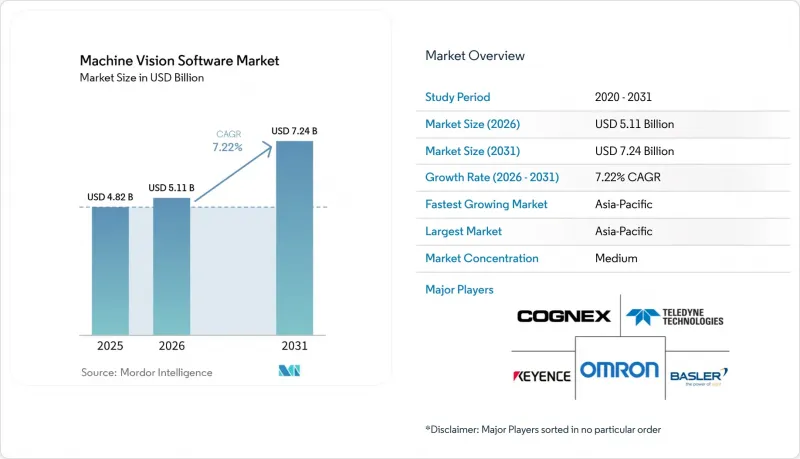
據 Mordor Intelligence 稱,2025 年機器視覺軟體市值為 48.2 億美元,預計到 2031 年將達到 72.4 億美元,而 2026 年為 51.1 億美元,預測期(2026-2031 年)的複合年成長率為 7.22%。
全球機器視覺軟體市場趨勢與洞察
零缺陷製造和自動化檢測
從抽樣檢測轉向全面的線上檢測,一直是機器視覺軟體市場需求的核心驅動力。 OEM 合約中日益成長的極低缺陷容差要求,是人工檢測無法一致實現的。雖然深度學習模型在受控環境下已實現了極高的檢測精度,但近期研究表明,許多已報告的應用仍處於原型或試點階段。這為能夠協助跨多個工廠部署的供應商提供了巨大的發展機會。汽車和醫療設備的品質要求也傾向於採用能夠提供可重複且檢驗記錄的檢測系統。如果檢測結果不僅作為獨立的品質記錄,還能透過製造執行系統觸發糾正措施,那麼軟體的價值將進一步提升。
將人工智慧和深度學習引入視覺工作流程
深度學習正在變革機器視覺軟體市場。傳統供應商被迫添加神經網路功能,而人工智慧原生供應商則正在進入現有的偵測應用市場。成長最快的行業是汽車、電子和物流,這些行業對公差要求嚴格且產品差異性大,限制了固定檢測規則的有效性。康耐視 (Cognex) 於 2026 年 3 月發布的一項調查顯示,57% 的受訪者已在其機器視覺操作中使用人工智慧,30% 的受訪者計劃在不久的將來實施。 2026 年 5 月,MVTec 發布了 HALCON 26.05,該版本包含用於提升人工智慧和基於規則的性能、多模態視覺提示以及降低訓練圖像需求的工具。該平台允許非專業人士建立和維護模型,從而解決了視覺和人工智慧整合人才短缺的難題。這種對易用性的重視將使部署範圍擴展到以前需要專業工程團隊才能應用的領域之外。
整合視覺單元的總擁有成本較高
整合視覺單元的總擁有成本是機器視覺軟體市場,尤其是中型製造商面臨的主要限制因素。即使不包括人工智慧模型訓練、操作員培訓和後續再培訓成本,多線部署的整合服務成本可能高達 15,000 美元至 45,000 美元。根據引用的基準數據,硬體折舊和整合工作佔初始部署成本的 52%。之後,成本將轉移到軟體、支援和持續營運費用上,這可能與以一次性設備採購為中心的採購計劃相衝突。康耐視 (Cognex) 於 2026 年 5 月正式發布了「OneVision」產品,並報告稱,隨著部署規模的擴大,成本可節省高達 50%。雖然集中式模型管理可以解決一些成本問題,但買家也需要評估長期訂閱和平台依賴性。
細分市場分析
到2025年,視覺偵測和品質保證軟體將佔據機器視覺軟體市場33.21%的佔有率。其強勁的市場地位反映了該軟體在汽車、家用電子電器和食品包裝生產線缺陷檢測領域的長期應用。人工智慧和深度學習視覺軟體市場預計到2031年將以8.63%的複合年成長率成長。這一成長與基於規則的工具在處理產品外觀變化、新型缺陷模式或複雜表面幾何時所面臨的挑戰密切相關。航太、特種化學品和醫療設備等行業的製造商,尤其是那些生產多品種、小批量產品的企業,擴大使用合成缺陷資料而非龐大的真實缺陷圖像庫來訓練模型。
視覺開發和編程軟體對於建立客製化應用的整合商和內部工程團隊而言,仍然發揮著至關重要的作用。影像處理和分析軟體也仍然是需要專業測量和分類的應用的核心基礎架構。 HALCON 26.05 版本提升了人工智慧和基於規則方法的處理速度,支援多模態語言模型,並增強了目標偵測功能。隨著部署的視覺系統數量的增加,校準、配置和系統管理工具的功能也隨之擴展。供應商擴大將這些功能整合到訂閱服務中,而不是作為單獨的許可證出售。這種方式提高了每位客戶的軟體收入,同時降低了硬體驅動型採購決策中的成本可見度。
到2025年,本地部署和邊緣軟體將佔總收入的72.34%。這反映了生產線每分鐘運作超過200台機器,需要在10毫秒內獲得推理結果的需求。預計到2031年,雲端軟體將以7.89%的複合年成長率成長。在機器視覺軟體市場,雲端系統主要用於集中式模型訓練、版本控制、跨站點管治和聚合分析。當偵測決策控制缺陷產品剔除裝置時,即使使用雲端技術,本地執行的需求仍然存在。因此,對於既需要在生產線上快速決策又需要協調模型管理的製造商而言,混合架構至關重要。
2026年5月,康耐視發布了“OneVision”,一個雲到邊緣的架構。此解決方案支援集中式訓練和管治,即使在生產過程中沒有雲端連接,也能確保本地檢測的持續進行。這種架構透過在邊緣執行例行檢測,降低了延遲、頻寬和工廠現場的風險。混合部署對於擁有超過100個檢測點的公司尤其有效。在這種環境下,邊緣設備會在本地過濾大部分影像幀,而雲端工具則負責管理標記的案例和重新訓練。因此,機器視覺軟體市場的發展趨勢並非僅僅是從本地系統遷移到雲端,而是將本地執行與集中式管治結合。
區域分析
預計到2025年,亞太地區將佔全球銷售額的34.88%,並在2031年之前以8.71%的複合年成長率成長。該地區的機器視覺軟體市場主要得益於大規模的製造業基礎以及對電池工廠、半導體製造和電子組裝領域的廣泛投資。中國正透過電池超級工廠和不斷提升的半導體產能,持續推動採購需求。在日本,Keyence)透過將許可協議納入半導體後端測試的系統契約,打造了獨特的市場結構。在印度,全球原始設備製造商(OEM)正透過生產連結獎勵計畫計畫(PLI)擴大在印度的生產規模並提升其電子產品製造能力。
預計到2025年,北美將成為全球第二大市場。機器視覺軟體市場主要由汽車組裝、航太、醫療設備生產和先進半導體製造等產業所驅動。該地區越來越重視人工智慧原生開發平台、雲端到邊緣的模型管理以及藥品溯源。與以硬體為中心的部署相比,這些應用程式有望帶來更高的軟體授權價值和更穩定的訂閱收入。隨著北美汽車製造商將生產轉移到海外並在其製造網路中應用通用品質標準,墨西哥正成為重要的採購中心。
歐洲的特點是汽車原始設備製造商 (OEM) 和一級供應商主要集中在德國。 BMW位於伍德拉夫工廠的第六代電池生產線計劃於 2026 年運作,該生產線將採用人工智慧輔助的輪胎邊緣線上檢測技術,並在最終階段對電池進行 100% 全檢。英國、法國、義大利和西班牙滿足了汽車、航太、食品包裝和製藥製造等行業的需求。歐洲買家越來越重視網路安全、稽核追蹤和互聯偵測系統的本地部署方案。雖然中東和南美市場規模小規模,但沙烏地阿拉伯和阿拉伯聯合大公國的待開發區投資,以及巴西汽車和食品加工產業的需求,正在推動新技術的應用。
其他好處:
- Excel格式的市場預測(ME)表
- 3個月的分析師支持
目錄
第1章:引言
- 研究假設和市場定義
- 調查範圍
第2章:調查方法
第3章執行摘要
第4章 市場狀況
- 市場概覽
- 市場促進因素
- 零缺陷製造和自動化檢測
- 將人工智慧和深度學習引入視覺工作流程
- 視覺引導機器人和智慧工廠的引入
- 人手不足和檢驗成本上升
- 食品、藥品和電子設備生產的可追溯性要求
- 用於小規模生產的可重複使用視覺模型和合成缺陷數據
- 市場限制因素
- 整合視覺單元的總擁有成本相對較高。
- 整合和部署舊有系統的複雜性
- 視覺與人工智慧融合方面的專業人才短缺
- 互聯視覺系統中的網路安全與資料管治風險
- 宏觀經濟因素對市場的影響
- 產業價值鏈分析
- 監理情勢
- 技術展望
- 波特五力分析
第5章 市場規模與成長預測
- 軟體類型
- 視覺開發與程式設計軟體
- 影像處理與分析軟體
- 人工智慧/深度學習視覺軟體
- 影像檢查與品質保證軟體
- 其他類型的軟體
- 按部署模式
- 本地部署/邊緣軟體
- 基於雲端的軟體
- 混合軟體
- 透過使用
- 品質檢驗和缺陷檢測
- 測量和稱重
- 機器人引導與揀選
- 識別、OCR、可追溯性
- 組裝檢驗
- 流程監控
- 按行業分類
- 汽車與出行
- 電子和半導體
- 工業機械和設備
- 電動車和電池製造
- 藥品和醫療設備
- 食品/飲料/包裝
- 航太/國防
- 其他工業部門
- 按地區
- 北美洲
- 美國
- 加拿大
- 墨西哥
- 南美洲
- 巴西
- 阿根廷
- 智利
- 其他南美國家
- 歐洲
- 德國
- 英國
- 法國
- 義大利
- 西班牙
- 其他歐洲國家
- 亞太地區
- 中國
- 日本
- 印度
- 韓國
- 澳洲
- 其他亞太國家
- 中東
- 阿拉伯聯合大公國
- 沙烏地阿拉伯
- 卡達
- 其他中東國家
- 非洲
- 南非
- 埃及
- 奈及利亞
- 其他非洲國家
- 北美洲
第6章 競爭情勢
- 市場集中度
- 策略趨勢
- 市佔率分析
- 公司簡介
- Cognex Corporation
- Keyence Corporation
- Teledyne Technologies Incorporated
- Omron Corporation
- Basler AG
- Zebra Technologies Corporation
- SICK AG
- MVTec Software GmbH
- National Instruments Corporation
- Datalogic SpA
- Atlas Copco AB
- TKH Group NV
- Stemmer Imaging AG
- Vitronic GmbH
- ISRA VISION AG
- Landing AI, Inc.
- NVIDIA Corporation
- Siemens AG
第7章 市場機會與未來展望
According to Mordor Intelligence, the machine vision software market size was valued at USD 4.82 billion in 2025 and estimated to grow from USD 5.11 billion in 2026 to reach USD 7.24 billion by 2031, at a CAGR of 7.22% during the forecast period (2026-2031).
Global Machine Vision Software Market Trends and Insights
Zero-Defect Manufacturing and Automated Inspection
The shift from sample checks to comprehensive inline inspection remains a central driver of demand in the machine vision software market. OEM contracts increasingly set extremely low defect limits that manual inspection cannot consistently meet. Deep learning models achieved very high detection accuracy in controlled settings, although most documented implementations remained at the prototype or pilot stage in a recent review. This presents a substantial rollout opportunity for suppliers capable of supporting deployment across several plants. Automotive and medical device quality requirements also favor inspection systems that provide repeatable and verifiable records. The value of the software increases when inspection results trigger corrective action through manufacturing execution systems rather than remaining a standalone quality record.
AI and Deep-Learning Adoption in Vision Workflows
Deep learning is changing the machine vision software market, as legacy suppliers must add neural network capabilities while AI-native suppliers enter established inspection applications. Adoption is strongest in automotive, electronics, and logistics, where tight tolerances and product variation limit the effectiveness of fixed inspection rules. A Cognex survey published in March 2026 found that 57% of respondents already used AI in machine vision operations and 30% planned near-term deployment. MVTec released HALCON 26.05 in May 2026 with improved AI and rule-based performance, multimodal visual prompting, and tools to reduce training image requirements. Platforms that allow non-specialists to build and maintain models can address the limited supply of vision-AI integration talent. This emphasis on usability can expand adoption beyond applications that have historically required specialist engineering teams.
High Total Cost of Ownership for Integrated Vision Cells
The total cost of an integrated vision cell is a material restraint for the machine vision software market, particularly for mid-sized manufacturers. Integration services for multi-line deployments can cost USD 15,000 to USD 45,000 before AI model training, operator training, and later retraining costs are included. Hardware amortization and integration labor represented 52% of the first-year deployment cost in the cited benchmark. Costs later shift toward software, support, and recurring operating expenses, which can conflict with procurement plans centered on a one-time equipment purchase. Cognex made OneVision generally available in May 2026 and reported cost reductions of up to 50% for scaling deployments. Centralized model management can address some cost issues, but it also requires buyers to assess long-term subscription and platform dependencies.
Other drivers and restraints analyzed in the detailed report include:
- Vision-Guided Robotics and Smart-Factory Deployment
- Labor Scarcity and Rising Inspection Costs
- Legacy-System Integration and Commissioning Complexity
For complete list of drivers and restraints, kindly check the Table Of Contents.
Segment Analysis
Vision Inspection and Quality Assurance Software accounted for 33.21% of the machine vision software market share in 2025. Its established position reflects long-term use in defect detection across automotive, consumer electronics, and food packaging lines. The machine vision software market size for AI and Deep Learning Vision Software is projected to grow at a CAGR of 8.63% through 2031. This growth is linked to the difficulty that rule-based tools face when products have cosmetic variation, new defect patterns, or complex surfaces. Low-volume, high-mix producers in aerospace, specialty chemicals, and medical devices can increasingly train models on synthetic defect data rather than on extensive libraries of real defect images.
Vision Development and Programming Software remains important for integrators and internal engineering teams that build customized applications. Image Processing and Analysis Software also remains core infrastructure for applications requiring specialized measurement or classification. HALCON 26.05 added speed improvements for AI and rule-based methods, support for multimodal language models, and improved object detection generation. Calibration, configuration, and system-management tools tend to grow with the installed base of vision systems. Suppliers increasingly bundle these functions into subscriptions instead of selling separate licenses. This approach can raise software revenue per customer while making costs less visible in hardware-led purchasing decisions.
On-Premises and Edge Software held 72.34% of revenue in 2025. This position reflects the need for production lines running at 200 or more units per minute to receive inference results in under 10 ms. Cloud-Based Software is projected to advance at a CAGR of 7.89% through 2031. The machine vision software market uses cloud systems mainly for centralized model training, version control, cross-site governance, and aggregated analytics. Cloud use does not eliminate the requirement for local execution when an inspection decision controls rejection equipment. This makes hybrid architectures relevant for manufacturers that require both rapid line decisions and coordinated model management.
Cognex introduced OneVision as a cloud-to-edge environment in May 2026. It supports centralized training and governance while allowing local inspection to continue without cloud connectivity during production. The architecture can limit latency, bandwidth, and factory-floor exposure by keeping routine inspection at the edge. Hybrid deployment is particularly relevant for enterprises operating more than 100 inspection points. In those settings, edge devices can filter most image frames locally while cloud tools manage flagged cases and retraining. The machine vision software market is therefore developing as a combined local execution and centralized governance model rather than a simple shift from on-premises systems to the cloud.
Complete Report Scope:
- By Software Type
- Vision Development and Programming Software
- Image Processing and Analysis Software
- AI / Deep Learning Vision Software
- Vision Inspection and Quality Assurance Software
- Other Software Types
- By Deployment Model
- On-Premises / Edge Software
- Cloud-Based Software
- Hybrid Software
- By Application
- Quality Inspection and Defect Detection
- Measurement and Metrology
- Robot Guidance and Bin Picking
- Identification, OCR, and Traceability
- Assembly Verification
- Process Monitoring
- By Industry Vertical
- Automotive and Mobility
- Electronics and Semiconductors
- Industrial Machinery and Equipment
- EV and Battery Manufacturing
- Pharmaceuticals and Medical Devices
- Food, Beverage, and Packaging
- Aerospace and Defense
- Other Industry Verticals
- By Geography
- North America
- United States
- Canada
- Mexico
- South America
- Brazil
- Argentina
- Chile
- Rest of South America
- Europe
- Germany
- United Kingdom
- France
- Italy
- Spain
- Rest of Europe
- Asia-Pacific
- China
- Japan
- India
- South Korea
- Australia
- Rest of Asia-Pacific
- Middle East
- United Arab Emirates
- Saudi Arabia
- Qatar
- Rest of Middle East
- Africa
- South Africa
- Egypt
- Nigeria
- Rest of Africa
- North America
Geography Analysis
Asia-Pacific accounted for 34.88% of revenue in 2025 and is projected to grow at a CAGR of 8.71% through 2031. The machine vision software market in the region combines a large manufacturing base with extensive investment in battery plants, semiconductor fabrication, and electronics assembly. China is driving sustained procurement demand through additions in battery gigafactory and semiconductor capacity. Japan has a distinct market structure because Keyence integrates software licensing into system contracts in semiconductor backend inspection. India is building electronics manufacturing capacity through Production Linked Incentive programs as global OEMs add production in the country.
North America was the second-largest region in 2025. The machine vision software market is supported by automotive assembly, aerospace, medical device production, and advanced semiconductor fabrication. The region places greater emphasis on AI-native development platforms, cloud-to-edge model management, and pharmaceutical traceability. These applications can produce higher software license values and more recurring subscription revenue than hardware-centered deployments. Mexico is becoming an important procurement location as North American OEMs near-shore vehicle production and apply common quality standards across their manufacturing networks.
Europe is shaped by Germany's dense automotive OEM and Tier-1 supplier base. BMW's Gen6 battery production line at Plant Woodruff, commissioned in 2026, uses AI-assisted inline inspection for weld seams and 100% end-of-line battery inspection. The United Kingdom, France, Italy, and Spain support demand from automotive, aerospace, food packaging, and pharmaceutical production. European buyers increasingly assess cybersecurity, audit trails, and on-premises options for connected inspection systems. Middle East and South America remain smaller markets, although greenfield investment in Saudi Arabia and the UAE and automotive and food processing demand in Brazil support new deployments.
- Cognex Corporation
- Keyence Corporation
- Teledyne Technologies Incorporated
- Omron Corporation
- Basler AG
- Zebra Technologies Corporation
- SICK AG
- MVTec Software GmbH
- National Instruments Corporation
- Datalogic S.p.A.
- Atlas Copco AB
- TKH Group N.V.
- Stemmer Imaging AG
- Vitronic GmbH
- ISRA VISION AG
- Landing AI, Inc.
- NVIDIA Corporation
- Siemens AG
Additional Benefits:
- The market estimate (ME) sheet in Excel format
- 3 months of analyst support
TABLE OF CONTENTS
1 INTRODUCTION
- 1.1 Study Assumptions and Market Definition
- 1.2 Scope of the Study
2 RESEARCH METHODOLOGY
3 EXECUTIVE SUMMARY
4 MARKET LANDSCAPE
- 4.1 Market Overview
- 4.2 Market Drivers
- 4.2.1 Zero-Defect Manufacturing and Automated Inspection
- 4.2.2 AI and Deep-Learning Adoption in Vision Workflows
- 4.2.3 Vision-Guided Robotics and Smart-Factory Deployment
- 4.2.4 Labor Scarcity and Rising Inspection Costs
- 4.2.5 Traceability Requirements in Food, Pharmaceutical, and Electronics Production
- 4.2.6 Reusable Vision Models and Synthetic Defect Data for Low-Volume Production
- 4.3 Market Restraints
- 4.3.1 High Total Cost of Ownership for Integrated Vision Cells
- 4.3.2 Legacy-System Integration and Commissioning Complexity
- 4.3.3 Shortage of Vision-AI Integration Specialists
- 4.3.4 Cybersecurity and Data-Governance Exposure in Connected Vision Systems
- 4.4 Impact of Macroeconomic Factors on the Market
- 4.5 Industry Value Chain Analysis
- 4.6 Regulatory Landscape
- 4.7 Technological Outlook
- 4.8 Porter's Five Forces Analysis
- 4.8.1 Threat of New Entrants
- 4.8.2 Bargaining Power of Suppliers
- 4.8.3 Bargaining Power of Buyers
- 4.8.4 Threat of Substitutes
- 4.8.5 Competitive Rivalry
5 MARKET SIZE AND GROWTH FORECASTS (VALUE)
- 5.1 By Software Type
- 5.1.1 Vision Development and Programming Software
- 5.1.2 Image Processing and Analysis Software
- 5.1.3 AI / Deep Learning Vision Software
- 5.1.4 Vision Inspection and Quality Assurance Software
- 5.1.5 Other Software Types
- 5.2 By Deployment Model
- 5.2.1 On-Premises / Edge Software
- 5.2.2 Cloud-Based Software
- 5.2.3 Hybrid Software
- 5.3 By Application
- 5.3.1 Quality Inspection and Defect Detection
- 5.3.2 Measurement and Metrology
- 5.3.3 Robot Guidance and Bin Picking
- 5.3.4 Identification, OCR, and Traceability
- 5.3.5 Assembly Verification
- 5.3.6 Process Monitoring
- 5.4 By Industry Vertical
- 5.4.1 Automotive and Mobility
- 5.4.2 Electronics and Semiconductors
- 5.4.3 Industrial Machinery and Equipment
- 5.4.4 EV and Battery Manufacturing
- 5.4.5 Pharmaceuticals and Medical Devices
- 5.4.6 Food, Beverage, and Packaging
- 5.4.7 Aerospace and Defense
- 5.4.8 Other Industry Verticals
- 5.5 By Geography
- 5.5.1 North America
- 5.5.1.1 United States
- 5.5.1.2 Canada
- 5.5.1.3 Mexico
- 5.5.2 South America
- 5.5.2.1 Brazil
- 5.5.2.2 Argentina
- 5.5.2.3 Chile
- 5.5.2.4 Rest of South America
- 5.5.3 Europe
- 5.5.3.1 Germany
- 5.5.3.2 United Kingdom
- 5.5.3.3 France
- 5.5.3.4 Italy
- 5.5.3.5 Spain
- 5.5.3.6 Rest of Europe
- 5.5.4 Asia-Pacific
- 5.5.4.1 China
- 5.5.4.2 Japan
- 5.5.4.3 India
- 5.5.4.4 South Korea
- 5.5.4.5 Australia
- 5.5.4.6 Rest of Asia-Pacific
- 5.5.5 Middle East
- 5.5.5.1 United Arab Emirates
- 5.5.5.2 Saudi Arabia
- 5.5.5.3 Qatar
- 5.5.5.4 Rest of Middle East
- 5.5.6 Africa
- 5.5.6.1 South Africa
- 5.5.6.2 Egypt
- 5.5.6.3 Nigeria
- 5.5.6.4 Rest of Africa
- 5.5.1 North America
6 COMPETITIVE LANDSCAPE
- 6.1 Market Concentration
- 6.2 Strategic Moves
- 6.3 Market Share Analysis
- 6.4 Company Profiles (includes Global Level Overview, Market Level Overview, Core Segments, Financials as available, Strategic Information, Market Rank/Share, Products and Services, Recent Developments)
- 6.4.1 Cognex Corporation
- 6.4.2 Keyence Corporation
- 6.4.3 Teledyne Technologies Incorporated
- 6.4.4 Omron Corporation
- 6.4.5 Basler AG
- 6.4.6 Zebra Technologies Corporation
- 6.4.7 SICK AG
- 6.4.8 MVTec Software GmbH
- 6.4.9 National Instruments Corporation
- 6.4.10 Datalogic S.p.A.
- 6.4.11 Atlas Copco AB
- 6.4.12 TKH Group N.V.
- 6.4.13 Stemmer Imaging AG
- 6.4.14 Vitronic GmbH
- 6.4.15 ISRA VISION AG
- 6.4.16 Landing AI, Inc.
- 6.4.17 NVIDIA Corporation
- 6.4.18 Siemens AG
7 MARKET OPPORTUNITIES AND FUTURE OUTLOOK
- 7.1 White-Space and Unmet-Need Assessment

 2034年機器視覺半導體市場預測-全球半導體元件、感測器類型、半導體技術、應用、最終用戶和區域分析機器視覺和機器人市場預測至2034年——全球視覺技術、視覺能力、機器人類型、引導方法、最終用戶和地區分析
 橡膠分析設備市場規模、佔有率和成長分析:按儀器類型、測試類型、應用、最終用戶、操作方法和地區分類 - 產業預測,2026-2033 年
 固定式工業掃描
 機器視覺系統租賃:市場佔有率分析、產業趨勢與統計、成長預測(2026-2031)緊湊型機器視覺系統:市場佔有率分析、產業趨勢與統計、成長預測(2026-2031)
 全球機器視覺市場:機會與策略展望(至2035年)歐洲機器視覺系統:市場佔有率分析、產業趨勢與統計及成長預測(2026-2031 年)
 機器視覺市場-2026-2032年全球市場預測
 機器視覺市場報告:按產品、組件、應用、產業和地區分類(2026-2034 年)