


 |
市場調查報告書
商品編碼
2121748
歐洲機器視覺系統:市場佔有率分析、產業趨勢與統計及成長預測(2026-2031 年)Europe Machine Vision Systems - Market Share Analysis, Industry Trends & Statistics, Growth Forecasts (2026 - 2031) |
||||||

※ 本網頁內容可能與最新版本有所差異。詳細情況請與我們聯繫。
據 Mordor Intelligence 稱,歐洲機器視覺系統市場預計到 2026 年價值 56.4 億美元,高於 2025 年的 51.1 億美元,預計到 2031 年將達到 92.5 億美元。
預計 2026 年至 2031 年的複合年成長率為 10.38%。
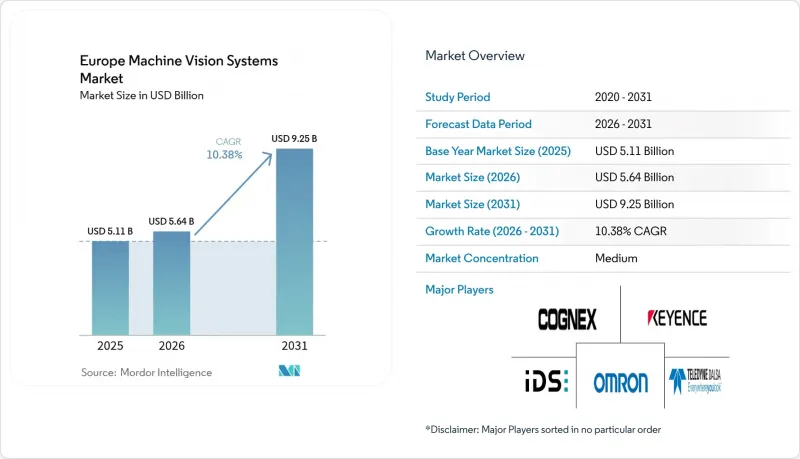
本報告按組件(硬體(視覺系統、攝影機、光學和照明系統等)和軟體)、產品(基於PC和基於智慧攝影機)、終端用戶產業(汽車、食品飲料等)、應用(品質檢測、測量和稱重等)以及地區進行細分。市場預測以價值(美元)表示。
歐洲機器視覺系統市場趨勢與洞察
對品質檢測和自動化日益成長的需求
為了應對人手不足並滿足更嚴格的品質標準,歐洲製造商正轉向視覺引導檢測。隨著歐7排放法規強制要求進行詳細的排放氣體監測,汽車製造商被迫將基於視覺的診斷功能整合到組裝線上。德國供應商杜爾公司已在其噴漆車間的機器人中整合了攝影機,透過更精確的噴漆工藝,實現了30%的能耗降低。像Stevanato集團這樣的製藥公司已經部署了人工智慧增強型系統,該系統每分鐘可檢測超過600個容器,無需人工干預。這些成功案例正在推動更多中型工廠採用這項技術,以維持生產水準並符合法規要求。
高精度缺陷檢測的需求日益成長
隨著電子和半導體生產公差的不斷縮小,對亞微米級視覺分析的需求日益成長。比利時公司Robovision已達到每分鐘100公尺的偵測速度,同時保持了PCB等級的精確度。食品和飲料加工商也紛紛效仿,引進了諸如Deep Detection公司的「PhotonAI」之類的X光設備。該設備能夠分析每秒每平方毫米2000萬個高密度光子,用於篩檢異物。隨著照明技術從紫外光發展到頻譜,識別以前肉眼無法看到的缺陷成為可能,從而拓展了機器視覺在歐洲的提案。
中小企業初期實施成本高昂
部署一套完整的視覺系統通常需要花費超過 10 萬歐元(約 11.3 萬美元),這構成了一大障礙,尤其對於人事費用具有競爭力的東歐小規模工廠而言。雖然像 MVTec 的 MERLIC 這樣的智慧相機和無代碼軟體現在售價低於 2.5 萬歐元(約 2.825 萬美元),降低了這一門檻,但並未完全消除。即將訂定的歐盟關於可維修性的消費者保護指令可能會增加產品生命週期成本,並延長投資回收期。
細分市場分析
到2025年,硬體在歐洲機器視覺系統市場將佔據主導地位,其中相機、光學元件和影像擷取卡將佔銷售額的62.55%。視覺系統相機將佔據主導地位,這主要得益於Basler和IDS Imaging等德國製造商提供的強大CMOS產品線。隨著軟體價值以12.68%的複合年成長率成長,硬體在歐洲機器視覺系統市場的佔有率預計將逐漸下降。軟體的成長主要受以下因素驅動:針對嵌入式晶片最佳化的AI模型、MVTec HALCON等獨立於供應商的平台,以及允許製程工程師在無需程式設計知識的情況下調整檢測規則的無程式碼介面。
第二代邊緣運算庫支援在無風扇系統上運行高階神經網路,從而降低整體擁有成本 (TCO)。雖然雲端分析在運算密集型任務中仍然發揮作用,但 GDPR 合規性促使許多工廠將敏感影像資料儲存在本地。因此,網路安全增強型容器和 ISO 27001 認證已成為採購清單上的標準項目。
2025年,基於PC的架構在歐洲機器視覺系統市場仍維持56.42%的市場佔有率,這得益於GPU加速技術在汽車漆面偵測和晶圓測量等領域實現的多攝影機處理能力。同時,智慧攝影機以13.55%的複合年成長率成長,在單一攝影機即可滿足需求的場景下,逐步從機架式解決方案手中奪取市場佔有率。透過減少佈線和機櫃硬體,成本得以降低;而得益於ARM架構和視覺處理單元,推理時間則保持在10毫秒以內。
醫療領域的應用案例清晰地展現了這一轉變。 Stevanat集團利用智慧攝影機以每分鐘600多個的速度檢驗管瓶的完整性,滿足了嚴格的藥品法規要求。移動機器人也同樣受益,因為空間限制使得光學和計算功能必須整合在單一外殼內。隨著韌體更新不斷添加新的神經網路層,智慧攝影機正成為中小企業考慮自動化時易於擴展的入門級解決方案。
其他好處
- Excel格式的市場預測(ME)表
- 3個月的分析師支持
目錄
第1章:引言
- 研究假設和市場定義
- 調查範圍
第2章:調查方法
第3章執行摘要
第4章 市場狀況
- 市場概覽
- 市場促進因素
- 對品質檢測和自動化日益成長的需求
- 高精度缺陷檢測的需求日益成長
- 工業4.0和智慧工廠的普及
- 相機感光元件解析度和處理速度的提升
- 歐盟永續發展法規促進能源效率審計
- 探索ASIC在邊緣AI推理中的新應用場景
- 市場限制因素
- 中小企業初期實施成本高昂
- 缺乏熟練人員來處理系統整合
- 分段式歐洲協調標準
- 基於雲端的視覺分析中的網路安全風險
- 產業價值鏈分析
- 宏觀經濟因素的影響
- 技術展望
- 監理情勢
- 波特五力分析
第5章 市場規模與成長預測
- 按組件
- 硬體
- 視覺系統
- 相機
- 光學和照明系統
- 影像擷取卡
- 其他
- 軟體
- 硬體
- 依產品
- 基於PC
- 智慧型攝影機底座
- 按最終用戶行業分類
- 車
- 電子和半導體
- 飲食
- 醫療和藥品
- 物流與零售
- 其他
- 透過使用
- 品質檢驗
- 測量和稱重
- 識別/代碼讀取
- 定位指南
- 機器人安全及其他
- 國家
- 德國
- 英國
- 義大利
- 其他歐洲國家
第6章 競爭情勢
- 市場集中度
- 策略趨勢
- 市佔率分析
- 公司簡介
- Cognex Corporation
- Keyence Corporation
- Omron Corporation
- Basler AG
- Sick AG
- Teledyne DALSA Inc.
- National Instruments Corporation
- Datalogic SpA
- Perceptron Inc.
- USS Vision Inc.
- IDS Imaging Development Systems GmbH
- Stemmer Imaging AG
- Isra Vision AG
- Vitronic Dr.-Ing. Stein Bildverarbeitungssysteme GmbH
- Baumer Optronic GmbH
- Vision Components GmbH
- LMI Technologies Inc.
- MVTec Software GmbH
- Sony Europe BV-Industrial Cameras
- Hikrobot Technology Co., Ltd.
第7章 市場機會與未來展望
According to Mordor Intelligence, Europe machine vision systems market size in 2026 is estimated at USD 5.64 billion, growing from 2025 value of USD 5.11 billion with 2031 projections showing USD 9.25 billion, growing at 10.38% CAGR over 2026-2031.
This report is Segmented by Component (Hardware (Vision Systems Cameras, Optics and Illumination Systems, Frame Grabbers, and More), and Software), Product (PC-Based, and Smart Camera-Based), End-User Industry (Automotive, Food and Beverage, and More), Application (Quality Inspection, Measurement and Metrology, and More), and Geography. The Market Forecasts are Provided in Terms of Value (USD).
Europe Machine Vision Systems Market Trends and Insights
Increasing Need for Quality Inspection and Automation
European manufacturers are turning to vision-guided inspection to offset labour shortages and satisfy stricter quality rules. Euro 7 requirements now oblige detailed emissions monitoring, pushing automakers to integrate vision-enabled diagnostics into assembly lines. German supplier Durr embedded cameras into paint-shop robotics, cutting energy use by 30% through more precise spraying. Pharmaceutical players such as Stevanato Group deploy AI-enhanced systems that inspect more than 600 containers per minute without human intervention. These successes encourage broader adoption across mid-sized plants seeking to safeguard yields and compliance.
Rising Demand for Accurate Defect Detection
Tolerance bands in electronics and semiconductor production continue to shrink, creating demand for sub-micron visual analytics. Belgian firm Robovision demonstrated 100 m-per-minute inspection speeds while maintaining PCB-grade accuracy. Food and beverage processors follow suit with X-ray units such as Deep Detection's PhotonAI, which analyzes 20 million photons / mm2 / s to screen for contaminants. Illumination advances from UV to multispectral help identify previously invisible flaws, widening the value proposition of machine vision in Europe.
High Initial Deployment Costs for SMEs
Full-line vision installations often exceed EUR 100 000 (USD 113 000) and deter smaller factories, especially in wage-competitive regions of Eastern Europe. Smart cameras and no-code software such as MVTec MERLIC now sell for under EUR 25,000 (USD 28,250), shrinking barriers but not eliminating them. Upcoming EU consumer-protection directives on repairability may add life-cycle costs and stretch payback periods.
Other drivers and restraints analyzed in the detailed report include:
- Growing Adoption of Industry 4.0 and Smart Factories
- Advancements in Camera Sensor Resolutions and Processing Speeds
- Lack of Skilled Personnel for System Integration
For complete list of drivers and restraints, kindly check the Table Of Contents.
Segment Analysis
Europe machine vision systems market size for hardware reached a commanding share in 2025, when cameras, optics, and frame grabbers represented 62.55% of revenue. Vision systems cameras accounted for the bulk, aided by German makers like Basler and IDS Imaging that supply robust CMOS lines. *Europe machine vision systems market share* for hardware is expected to erode gradually as software value rises at a 12.68% CAGR. Software's ascent stems from AI models optimized for embedded chips, vendor-agnostic platforms such as MVTec HALCON, and demand for no-code interfaces that let process engineers adjust inspection rules without coding knowledge.
Second-generation edge libraries now run sophisticated neural nets on fanless systems, lowering the total cost of ownership. Cloud analytics still plays a role for compute-heavy tasks, but GDPR compliance drives many factories to keep sensitive imagery on-premises. Cyber-hardened containers and ISO 27001 certifications have therefore become standard check-box items during procurement.
PC-based architectures retained 56.42% of Europe's machine vision systems market share in 2025, bolstered by GPU acceleration that handles multi-camera automotive paint inspection and wafer metrology. Smart cameras, however, are posting a 13.55% CAGR and chip away at rack-mounted solutions whenever one camera can do the job. Cost savings accrue from reduced cabling and cabinet hardware, while ARM and vision-processing units keep inference times under 10 ms.
Healthcare use cases exemplify this shift: Stevanato Group runs smart cameras to verify vial integrity at >600 units per minute and meets stringent pharma rules. Mobile robotics also benefits, as space constraints favour integrated optics and compute within a single housing. As firmware updates add new neural layers over time, smart cameras become an easily scalable entry point for SMEs testing automation waters.
Complete Report Scope:
- By Component
- Hardware
- Vision Systems
- Cameras
- Optics and Illumination Systems
- Frame Grabbers
- Other Hardware
- Software
- Hardware
- By Product
- PC-Based
- Smart Camera-Based
- By End-User Industry
- Automotive
- Electronics and Semiconductors
- Food and Beverage
- Healthcare and Pharmaceutical
- Logistics and Retail
- Other Industries
- By Application
- Quality Inspection
- Measurement and Metrology
- Identification and Code Reading
- Positioning and Guidance
- Robotics Safety and Others
- By Country
- Germany
- United Kingdom
- Italy
- Rest of Europe
List of Companies Covered in this Report:
- Cognex Corporation
- Keyence Corporation
- Omron Corporation
- Basler AG
- Sick AG
- Teledyne DALSA Inc.
- National Instruments Corporation
- Datalogic SpA
- Perceptron Inc.
- USS Vision Inc.
- IDS Imaging Development Systems GmbH
- Stemmer Imaging AG
- Isra Vision AG
- Vitronic Dr.-Ing. Stein Bildverarbeitungssysteme GmbH
- Baumer Optronic GmbH
- Vision Components GmbH
- LMI Technologies Inc.
- MVTec Software GmbH
- Sony Europe B.V. - Industrial Cameras
- Hikrobot Technology Co., Ltd.
Additional Benefits:
- The market estimate (ME) sheet in Excel format
- 3 months of analyst support
TABLE OF CONTENTS
1 INTRODUCTION
- 1.1 Study Assumptions and Market Definition
- 1.2 Scope of the Study
2 RESEARCH METHODOLOGY
3 EXECUTIVE SUMMARY
4 MARKET LANDSCAPE
- 4.1 Market Overview
- 4.2 Market Drivers
- 4.2.1 Increasing Need for Quality Inspection and Automation
- 4.2.2 Rising Demand for Accurate Defect Detection
- 4.2.3 Growing Adoption of Industry 4.0 and Smart Factories
- 4.2.4 Advancements in Camera Sensor Resolutions and Processing Speeds
- 4.2.5 EU Sustainability Rules Driving Energy-Efficiency Audits
- 4.2.6 Edge AI Inferencing ASICs Unlocking New Use-Cases
- 4.3 Market Restraints
- 4.3.1 High Initial Deployment Costs for SMEs
- 4.3.2 Lack of Skilled Personnel for System Integration
- 4.3.3 Fragmented European Harmonised Standards
- 4.3.4 Cyber-Security Risks in Cloud-Based Vision Analytics
- 4.4 Industry Value-Chain Analysis
- 4.5 Impact of Macroeconomic Factors
- 4.6 Technological Outlook
- 4.7 Regulatory Landscape
- 4.8 Porter's Five Forces Analysis
- 4.8.1 Bargaining Power of Suppliers
- 4.8.2 Bargaining Power of Consumers
- 4.8.3 Threat of New Entrants
- 4.8.4 Threat of Substitutes
- 4.8.5 Intensity of Competitive Rivalry
5 MARKET SIZE AND GROWTH FORECASTS (VALUE)
- 5.1 By Component
- 5.1.1 Hardware
- 5.1.1.1 Vision Systems
- 5.1.1.2 Cameras
- 5.1.1.3 Optics and Illumination Systems
- 5.1.1.4 Frame Grabbers
- 5.1.1.5 Other Hardware
- 5.1.2 Software
- 5.1.1 Hardware
- 5.2 By Product
- 5.2.1 PC-Based
- 5.2.2 Smart Camera-Based
- 5.3 By End-User Industry
- 5.3.1 Automotive
- 5.3.2 Electronics and Semiconductors
- 5.3.3 Food and Beverage
- 5.3.4 Healthcare and Pharmaceutical
- 5.3.5 Logistics and Retail
- 5.3.6 Other Industries
- 5.4 By Application
- 5.4.1 Quality Inspection
- 5.4.2 Measurement and Metrology
- 5.4.3 Identification and Code Reading
- 5.4.4 Positioning and Guidance
- 5.4.5 Robotics Safety and Others
- 5.5 By Country
- 5.5.1 Germany
- 5.5.2 United Kingdom
- 5.5.3 Italy
- 5.5.4 Rest of Europe
6 COMPETITIVE LANDSCAPE
- 6.1 Market Concentration
- 6.2 Strategic Moves
- 6.3 Market Share Analysis
- 6.4 Company Profiles (includes Global level Overview, Market level overview, Core Segments, Financials as available, Strategic Information, Market Rank/Share for key companies, Products and Services, and Recent Developments)
- 6.4.1 Cognex Corporation
- 6.4.2 Keyence Corporation
- 6.4.3 Omron Corporation
- 6.4.4 Basler AG
- 6.4.5 Sick AG
- 6.4.6 Teledyne DALSA Inc.
- 6.4.7 National Instruments Corporation
- 6.4.8 Datalogic SpA
- 6.4.9 Perceptron Inc.
- 6.4.10 USS Vision Inc.
- 6.4.11 IDS Imaging Development Systems GmbH
- 6.4.12 Stemmer Imaging AG
- 6.4.13 Isra Vision AG
- 6.4.14 Vitronic Dr.-Ing. Stein Bildverarbeitungssysteme GmbH
- 6.4.15 Baumer Optronic GmbH
- 6.4.16 Vision Components GmbH
- 6.4.17 LMI Technologies Inc.
- 6.4.18 MVTec Software GmbH
- 6.4.19 Sony Europe B.V. - Industrial Cameras
- 6.4.20 Hikrobot Technology Co., Ltd.
7 MARKET OPPORTUNITIES AND FUTURE OUTLOOK
- 7.1 White-space and unmet-need assessment

 全球機器視覺市場:機會與策略展望(至2035年)
 機器視覺市場-2026-2032年全球市場預測
 機器視覺市場預測至2034年—按產品類型、交付方式、掃描方式、技術、應用、最終用戶和地區分類的全球分析
 測試與分析設備市場-全球產業規模、佔有率、趨勢、機會、預測:按類型、產業垂直領域、地區和競爭格局分類,2021-2031年
 機器視覺市場報告:按產品、組件、應用、產業和地區分類(2026-2034 年)
 農業技術策略的歷史分析:全球和區域分析:畜牧業和種植業生產的過去策略和未來展望
 機器視覺市場分析與預測(至2035年):按類型、產品、服務、技術、組件、應用、部署方式、最終用戶、功能和解決方案分類
 機器視覺市場在採後品質分析的應用-全球及區域分析:按應用、產品和地區分類-分析與預測(2025-2035 年)
 機器視覺系統市場:按組件、類型和地區分類2026年全球機器視覺軟體市場報告