


 |
市場調查報告書
商品編碼
2155590
中波紅外線工業影像系統:市場佔有率分析、產業趨勢與統計及成長預測(2026-2031 年)MWIR Industrial Imaging Systems - Market Share Analysis, Industry Trends & Statistics, Growth Forecasts (2026 - 2031) |
||||||

※ 本網頁內容可能與最新版本有所差異。詳細情況請與我們聯繫。
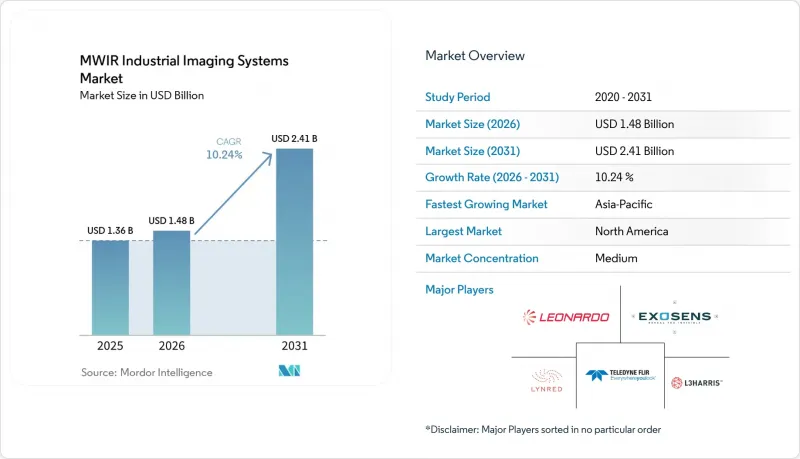
據 Mordor Intelligence 稱,2025 年中波紅外線工業成像系統市場價值為 13.6 億美元,預計從 2026 年的 14.8 億美元成長到 2031 年的 24.1 億美元。
預測期(2026-2031 年)的複合年成長率預計為 10.24%。
全球中波紅外線工業影像系統市場趨勢與洞察
工業自動化和預測性維護的引入
工業運營商正從例行檢查轉向與故障預測系統整合的連續熱成像監測。 2026 年 IEEE 的一項研究報告稱,採用卷積類神經網路和循環神經網路結合熱成像技術的多模態維護方法,故障檢測準確率高達 92%。研究也指出,實施這些工作流程後,維護成本降低了 35%。這凸顯了對可永久安裝在生產設備上的感測器的需求,而不僅限於例行檢查。因此,目的地設備製造商 (OEM) 對可整合到中波紅外線 (MWIR) 工業成像系統生產線中的相機核心和模組的興趣日益濃厚。 2026 年 2 月,Teledyne FLIR 發布了 A6450,該產品配備了高溫中波紅外線檢測器,冷卻器壽命長達 27,000 小時,專為連續工業應用而設計。
國防和邊境監視現代化
國防領域的客戶對用於監視、反無人機系統和邊防安全行動的小型化、冷卻型中波紅外線(MWIR)有效載荷的需求日益成長。預計到2024年,北約成員國的國防費用將佔GDP的2.2%,將進一步強化先進感測設備的採購環境。目前中波紅外線工業成像系統市場的升級週期傾向於採用比舊系統更小、更輕、功耗更低的模組,從而能夠部署在戰術無人機和攜帶式設備中。 II型超晶格檢測器材料技術的進步,使其能夠在更高的溫度下運行,從而推動了這一轉變。國防主導的、面向工業監視應用的檢測器研發,將使中波紅外線工業成像系統市場受益。
冷卻式中波紅外線系統的初始投資和生命週期成本較高
在中波紅外線(MWIR)工業影像系統市場,冷凍型中波紅外線設備的成本是同等非製冷型長波紅外線(LWIR)系統的5到10倍,這限制了其在成本敏感型設施中的應用。低溫冷卻器、光學元件和讀出電子設備推高了系統的初始成本。斯特林循環冷卻器8000到10000小時的維修週期也增加了持續運作成本。雖然新型高溫(HOT)系統在經濟性方面有所改進,但先進焦平面陣列的高昂成本仍然存在。泰萊達因-弗萊瑞爾公司(Teledyne FLIR)報告稱,其A6450冷卻器的使用壽命為27,000小時,顯示維修需求降低。中波紅外線工業影像系統市場仍受到限制,尤其是在東南亞、南美洲和非洲等資本投資預算有限的地區。
細分市場分析
到2025年,相機將佔據中波紅外線(MWIR)工業成像系統市場46.38%的佔有率。由於安裝和操作簡便,工業和國防領域的買家通常更傾向於選擇完整的相機產品。預計到2031年,相機核心組件和模組的複合年成長率將達到10.84%,成為所有產品中成長最快的。自動化設備製造商正在將這些組件應用於機器人單元、生產線和無人機有效載荷。由於能夠生產經認證的InSb、HgCdTe和T2SL元件的供應商數量有限,因此檢測器和焦平面陣列仍然是上游的主要阻礙因素。因此,擁有成熟檢測器製造能力的供應商在中波紅外線工業成像系統產業中佔據著舉足輕重的地位。
在中波紅外線(MWIR)工業成像系統市場,光學元件和鏡頭組件雖然單位成本低於相機和檢測器,但由於其供應鏈的穩定性,對系統成本和交付時間有顯著影響。相機製造商在採購鍺和硫系玻璃時可能面臨供應鏈集中化的風險。軟體、分析功能和配件在銷售收入方面產品類型最小。隨著分析功能能夠將硬體銷售轉化為持續的服務關係,它們的角色正在不斷擴大。邊緣運算也使得核心模組能夠作為自主偵測設備運作。這些變化意味著客戶現在不僅評估系統的影像效能,還評估其資料處理能力。
到2025年,低溫冷卻系統將佔據中波紅外線(MWIR)工業成像系統市場66.24%的佔有率。其低雜訊等效溫差(NETD)特性使其適用於國防、氣體成像和高要求的製程監控等應用。預計到2031年,高溫中波紅外線(HOT MWIR)技術將以10.67%的複合年成長率(CAGR)實現最高成長。 InAsSb和T2SL材質使焦平面陣列能夠在130–150 K的溫度下運作。更高的動作溫度降低了冷卻器的功耗、設備尺寸和維護需求。這些特性使得高溫產品即使在仍需傳統冷卻方式性能的應用中也同樣適用。
2025年發表的一項研究發現,InAs/InAsSb T2SL帶間級聯檢測器在高溫工作環境下展現出與傳統HgCdTe技術相當的中波紅外線(MWIR)偵測靈敏度。這項檢驗將促進檢測器供應商的材料多樣化。在靈敏度可接受的應用中,非製冷和室溫MWIR探測器仍然只佔小規模一部分。它們的未來取決於膠體量子點和其他新興檢測器材料的商業化。技術的融合將繼續區分對性能要求極高的應用和對成本敏感的應用。在對探測閾值要求極高的MWIR工業成像系統市場,冷凍和高溫平台將繼續佔據核心地位。
區域分析
到2025年,北美將佔據中波紅外線(MWIR)工業成像系統市場36.19%的佔有率。北美MWIR工業成像系統市場的發展動力主要來自廣泛的油氣基礎設施、積極的甲烷排放法規以及巨大的國防感測需求。美國是該地區的主要採購方,而加拿大則為油砂開採作業的需求提供了支援。墨西哥在汽車和電子產品生產領域逐漸形成新的需求基礎。美國環保署(EPA)的法規為在油氣設施中使用光學氣體成像技術制定了明確的合規標準。
預計到2031年,亞太地區將以11.12%的複合年成長率成為所有地區中成長最快的地區。台灣、韓國和日本正在擴大半導體產能,這需要高靈敏度的檢測和測量工具。日本也正在積極推動這項技術在精密製造和海上監控領域的應用。中國市場需求量龐大,但出口限制使得高性能冷卻系統難以普及。印度則透過國防採購和不斷發展的半導體生態系統推動市場需求。
2025年,歐洲中波紅外線(MWIR)工業影像系統市場將成為全球第三大區域市場。德國、法國和英國將透過製造、化學加工和採購項目來支持工業和國防需求。法國擁有Lynred公司,該公司為歐洲相機和國防製造商提供焦平面陣列。在中東,液化天然氣(LNG)和上游石油設施中氣體成像技術的應用日益增加。南美洲以巴西的油氣業務為中心,阿根廷和智利則滿足了化學相關需求。非洲仍處於起步階段,南非是主要的工業基本客群。
其他好處:
- Excel格式的市場預測(ME)表
- 3個月的分析師支持
目錄
第1章:引言
- 研究假設和市場定義
- 調查範圍
第2章:調查方法
第3章執行摘要
第4章 市場狀況
- 市場概覽
- 市場促進因素
- 工業自動化和預測性維護的實施
- 國防和邊境監視現代化
- 高溫製程的檢驗要求
- 人工智慧驅動的熱分析及工業物聯網整合
- 線上中波紅外線監測可提高半導體和電力電子裝置的良率。
- 甲烷和製程洩漏合規性的光學氣體成像
- 市場限制因素
- 冷卻式中波紅外線系統的初始投資和生命週期成本較高
- 檢測器的出口限制和供應限制
- 低溫冷凍機的可靠性和維護負擔
- 工業部門在輻射測量資料解讀方面的技術能力有限。
- 宏觀經濟因素對市場的影響
- 產業價值鏈分析
- 監理情勢
- 技術展望
- 波特五力分析
第5章 市場規模與成長預測
- 依產品類型
- 相機
- 相機核心模組
- 檢測器和焦平面陣列
- 光學元件和透鏡組件
- 軟體、分析工具及周邊設備
- 透過技術
- 中波紅外線低溫冷卻型(標準冷卻型)
- 高溫工作型(HOT)中波紅外光譜儀
- 非冷凍/室溫中波紅外線
- 透過使用
- 預測性維護和狀態監測
- 過程控制和品質檢驗
- 光學氣體成像和洩漏檢測
- 電氣檢查和故障定位識別
- 無損檢測和材料分析
- 研究、開發、測量
- 最終用戶
- 製造業(不包括通用和分立元件、半導體和電子設備)
- 半導體和電子學
- 石油和天然氣
- 化工/石油化工
- 發電和公共產業
- 航太/國防
- 研究機構和大學
- 其他工業終端用戶
- 按地區
- 北美洲
- 美國
- 加拿大
- 墨西哥
- 南美洲
- 巴西
- 阿根廷
- 智利
- 其他南美國家
- 歐洲
- 德國
- 法國
- 英國
- 義大利
- 其他歐洲國家
- 亞太地區
- 中國
- 日本
- 印度
- 韓國
- 其他亞太國家
- 中東
- 沙烏地阿拉伯
- 阿拉伯聯合大公國
- 其他中東國家
- 非洲
- 南非
- 奈及利亞
- 埃及
- 其他非洲國家
- 北美洲
第6章 競爭情勢
- 市場集中度
- 策略趨勢
- 市佔率分析
- 公司簡介
- New Infrared Technologies SL
- IRCameras LLC
- InfraTec GmbH
- VIGO Photonics SA
- Xenics NV
- Sierra-Olympic Technologies, Inc.
- Princeton Infrared Technologies, Inc.
- Optotherm, Inc.
- Opgal Optronic Industries Ltd.
- Lynred SAS
- Telops Inc.
- Hamamatsu Photonics KK
- HGH Infrared Systems
- AIM Infrarot-Module GmbH
- Leonardo SpA
- L3Harris Technologies, Inc.
- BAE Systems plc
- RTX Corporation
- Teledyne Technologies Incorporated
第7章 市場機會與未來展望
According to Mordor Intelligence, the MWIR industrial imaging systems market size was valued at USD 1.36 billion in 2025 and estimated to expand from USD 1.48 billion in 2026 to reach USD 2.41 billion by 2031, at a CAGR of 10.24% during the forecast period (2026-2031).
Global MWIR Industrial Imaging Systems Market Trends and Insights
Industrial Automation and Predictive Maintenance Adoption
Industrial operators are shifting from scheduled checks to continuous thermal monitoring connected to fault prediction systems. A 2026 IEEE study reported 92% fault-detection accuracy for multimodal maintenance methods that used thermal imaging with convolutional and recurrent neural networks. The same study reported a 35% reduction in maintenance costs when these workflows were deployed. This supports demand for sensors that can remain installed on production equipment rather than being used only during periodic inspections. The MWIR industrial imaging systems market is therefore seeing greater interest in camera cores and modules that original equipment manufacturers can build into production lines. Teledyne FLIR introduced the A6450 in February 2026 with a HOT MWIR detector and a 27,000-hour cooler life for continuous industrial use.
Defense and Border Surveillance Modernization
Defense customers are seeking smaller cooled MWIR payloads for surveillance, counter-unmanned aerial systems, and border operations. NATO members averaged defense spending equal to 2.2% of GDP in 2024, supporting a stronger procurement setting for advanced sensing equipment. The current upgrade cycle in the MWIR industrial imaging systems market favors modules with lower size, weight, and power requirements than older systems. This enables deployment on tactical unmanned aircraft and portable equipment. Material advances in type-II superlattice detectors are supporting this transition because they can operate at higher temperatures. The MWIR industrial imaging systems market benefits when defense-led detector development also becomes available for industrial surveillance applications.
High Capital and Lifecycle Cost of Cooled MWIR Systems
Cooled MWIR equipment in the MWIR industrial imaging systems market costs 5-10 times more than comparable uncooled LWIR systems, which limits adoption in cost-sensitive facilities. Cryocoolers, optics, and readout electronics add to the initial system cost. Historical Stirling-cycle cooler refurbishment intervals of 8,000-10,000 hours have also added recurring operating expense. Newer HOT systems improve the economics but do not remove the premium for advanced focal plane arrays. Teledyne FLIR reported a 27,000-hour cooler life for its A6450, showing progress on maintenance requirements. The MWIR industrial imaging systems market remains constrained where capital budgets are lower, particularly in Southeast Asia, South America, and Africa.
Other drivers and restraints analyzed in the detailed report include:
- High-Temperature Process Inspection Requirements
- AI-Enabled Thermal Analytics and IIoT Integration
- Export Controls and Restricted Detector Supply
For complete list of drivers and restraints, kindly check the Table Of Contents.
Segment Analysis
Cameras accounted for 46.38% of the MWIR industrial imaging systems market in 2025. Buyers in industrial and defense settings often prefer a complete camera because it simplifies installation and operation. Camera cores and modules are projected to record the highest product CAGR of 10.84% through 2031. Automation equipment makers use these components in robotic cells, production lines, and unmanned aircraft payloads. Detectors and focal plane arrays remain a key upstream constraint because only a limited group of suppliers produces qualified InSb, HgCdTe, and T2SL devices. This gives suppliers with established detector capability an important position in the MWIR industrial imaging systems industry.
Optics and lens assemblies in the MWIR industrial imaging systems market have a lower unit value than cameras and detectors, but their supply affects system cost and delivery schedules. Germanium and chalcogenide glass sourcing can expose camera producers to concentrated supply chains. Software, analytics, and accessories represent the smallest product category by revenue. Their role is increasing because analytics can turn a hardware sale into a recurring service relationship. Edge computing also allows core modules to act as autonomous inspection devices. These changes encourage customers to evaluate a system's data capability alongside its imaging performance.
Cryogenically cooled systems held 66.24% of the MWIR industrial imaging systems market size in 2025. Their low noise-equivalent temperature difference supports defense, gas imaging, and demanding process monitoring tasks. HOT MWIR is projected to record the fastest technology CAGR of 10.67% through 2031. InAsSb and T2SL materials allow focal plane arrays to operate at 130-150 K. Higher operating temperatures can reduce cooler power demand, equipment size, and maintenance needs. These attributes make HOT products relevant where conventional cooled performance remains necessary.
Research published in 2025 found that InAs/InAsSb T2SL interband cascade photodetectors offered MWIR detectivity competitive with older HgCdTe technologies at high operating temperatures. This validation supports material diversification among detector suppliers. Uncooled and room-temperature MWIR remains a smaller category for applications that accept lower sensitivity. Its future depends on the commercial progress of colloidal quantum dots and other emerging detector materials. The technology mix will continue to separate performance-critical uses from cost-sensitive uses. Cooled and HOT platforms should remain central to the MWIR industrial imaging systems market where detection thresholds cannot be compromised.
Complete Report Scope:
- By Product Type
- Cameras
- Camera Cores and Modules
- Detectors and Focal Plane Arrays
- Optics and Lens Assemblies
- Software, Analytics, and Accessories
- By Technology
- Cryogenically Cooled MWIR (Standard Cooled)
- High-Operating-Temperature (HOT) MWIR
- Uncooled / Room-Temperature MWIR
- By Application
- Predictive Maintenance and Condition Monitoring
- Process Control and Quality Inspection
- Optical Gas Imaging and Leak Detection
- Electrical Inspection and Fault Localization
- Non-Destructive Testing and Materials Analysis
- Research, Development, and Metrology
- By End-User
- Manufacturing (General and Discrete, excluding Semiconductor and Electronics)
- Semiconductor and Electronics
- Oil and Gas
- Chemicals and Petrochemicals
- Power Generation and Utilities
- Aerospace and Defense
- Research Institutes and Universities
- Rest of Industrial End-Users
- By Geography
- North America
- United States
- Canada
- Mexico
- South America
- Brazil
- Argentina
- Chile
- Rest of South America
- Europe
- Germany
- France
- United Kingdom
- Italy
- Rest of Europe
- Asia-Pacific
- China
- Japan
- India
- South Korea
- Rest of Asia-Pacific
- Middle East
- Saudi Arabia
- United Arab Emirates
- Rest of Middle East
- Africa
- South Africa
- Nigeria
- Egypt
- Rest of Africa
- North America
Geography Analysis
North America held 36.19% of the MWIR industrial imaging systems market share in 2025. The North American MWIR industrial imaging systems market combines extensive oil and gas infrastructure, active methane regulation, and major defense sensing demand. The United States leads regional purchasing, while Canada supports demand from oil sands operations. Mexico adds an emerging base in automotive and electronics production. EPA rules provide a defined compliance setting for optical gas imaging use at oil and natural gas sites.
Asia-Pacific is projected to record the fastest regional CAGR of 11.12% through 2031. Taiwan, South Korea, and Japan are expanding semiconductor capabilities that require sensitive inspection and metrology tools. Japan also supports its use in precision manufacturing and maritime surveillance. China is a large volume opportunity, but export restrictions affect access to top-performance cooled systems. India adds demand through defense procurement and a developing semiconductor ecosystem.
The European MWIR industrial imaging systems market held the third-largest regional position in 2025. Germany, France, and the United Kingdom support industrial and defense demand through manufacturing, chemical processing, and procurement programs. France is home to Lynred, which supplies focal plane arrays to European camera makers and defense manufacturers. The Middle East is increasing gas imaging use in liquefied natural gas and upstream oil facilities. South America is anchored by Brazil's oil and gas operations, while Argentina and Chile add chemicals-related demand. Africa remains early stage, with South Africa forming its main industrial customer base.
- New Infrared Technologies S.L.
- IRCameras LLC
- InfraTec GmbH
- VIGO Photonics S.A.
- Xenics NV
- Sierra-Olympic Technologies, Inc.
- Princeton Infrared Technologies, Inc.
- Optotherm, Inc.
- Opgal Optronic Industries Ltd.
- Lynred S.A.S.
- Telops Inc.
- Hamamatsu Photonics K.K.
- HGH Infrared Systems
- AIM Infrarot-Module GmbH
- Leonardo S.p.A.
- L3Harris Technologies, Inc.
- BAE Systems plc
- RTX Corporation
- Teledyne Technologies Incorporated
Additional Benefits:
- The market estimate (ME) sheet in Excel format
- 3 months of analyst support
TABLE OF CONTENTS
1 INTRODUCTION
- 1.1 Study Assumptions and Market Definition
- 1.2 Scope of the Study
2 RESEARCH METHODOLOGY
3 EXECUTIVE SUMMARY
4 MARKET LANDSCAPE
- 4.1 Market Overview
- 4.2 Market Drivers
- 4.2.1 Industrial Automation and Predictive Maintenance Adoption
- 4.2.2 Defense and Border-Surveillance Modernization
- 4.2.3 High-Temperature Process Inspection Requirements
- 4.2.4 AI-Enabled Thermal Analytics and IIoT Integration
- 4.2.5 Inline MWIR Monitoring for Semiconductor and Power-Electronics Yield
- 4.2.6 Optical Gas Imaging for Methane and Process-Leak Compliance
- 4.3 Market Restraints
- 4.3.1 High Capital and Lifecycle Cost of Cooled MWIR Systems
- 4.3.2 Export Controls and Restricted Detector Supply
- 4.3.3 Cryocooler Reliability and Maintenance Burden
- 4.3.4 Limited Industrial Skills for Radiometric Data Interpretation
- 4.4 Impact of Macroeconomic Factors on the Market
- 4.5 Industry Value Chain Analysis
- 4.6 Regulatory Landscape
- 4.7 Technological Outlook
- 4.8 Porter's Five Forces Analysis
- 4.8.1 Bargaining Power of Suppliers
- 4.8.2 Bargaining Power of Buyers
- 4.8.3 Threat of New Entrants
- 4.8.4 Threat of Substitutes
- 4.8.5 Intensity of Competitive Rivalry
5 MARKET SIZE AND GROWTH FORECASTS (VALUE)
- 5.1 By Product Type
- 5.1.1 Cameras
- 5.1.2 Camera Cores and Modules
- 5.1.3 Detectors and Focal Plane Arrays
- 5.1.4 Optics and Lens Assemblies
- 5.1.5 Software, Analytics, and Accessories
- 5.2 By Technology
- 5.2.1 Cryogenically Cooled MWIR (Standard Cooled)
- 5.2.2 High-Operating-Temperature (HOT) MWIR
- 5.2.3 Uncooled / Room-Temperature MWIR
- 5.3 By Application
- 5.3.1 Predictive Maintenance and Condition Monitoring
- 5.3.2 Process Control and Quality Inspection
- 5.3.3 Optical Gas Imaging and Leak Detection
- 5.3.4 Electrical Inspection and Fault Localization
- 5.3.5 Non-Destructive Testing and Materials Analysis
- 5.3.6 Research, Development, and Metrology
- 5.4 By End-User
- 5.4.1 Manufacturing (General and Discrete, excluding Semiconductor and Electronics)
- 5.4.2 Semiconductor and Electronics
- 5.4.3 Oil and Gas
- 5.4.4 Chemicals and Petrochemicals
- 5.4.5 Power Generation and Utilities
- 5.4.6 Aerospace and Defense
- 5.4.7 Research Institutes and Universities
- 5.4.8 Rest of Industrial End-Users
- 5.5 By Geography
- 5.5.1 North America
- 5.5.1.1 United States
- 5.5.1.2 Canada
- 5.5.1.3 Mexico
- 5.5.2 South America
- 5.5.2.1 Brazil
- 5.5.2.2 Argentina
- 5.5.2.3 Chile
- 5.5.2.4 Rest of South America
- 5.5.3 Europe
- 5.5.3.1 Germany
- 5.5.3.2 France
- 5.5.3.3 United Kingdom
- 5.5.3.4 Italy
- 5.5.3.5 Rest of Europe
- 5.5.4 Asia-Pacific
- 5.5.4.1 China
- 5.5.4.2 Japan
- 5.5.4.3 India
- 5.5.4.4 South Korea
- 5.5.4.5 Rest of Asia-Pacific
- 5.5.5 Middle East
- 5.5.5.1 Saudi Arabia
- 5.5.5.2 United Arab Emirates
- 5.5.5.3 Rest of Middle East
- 5.5.6 Africa
- 5.5.6.1 South Africa
- 5.5.6.2 Nigeria
- 5.5.6.3 Egypt
- 5.5.6.4 Rest of Africa
- 5.5.1 North America
6 COMPETITIVE LANDSCAPE
- 6.1 Market Concentration
- 6.2 Strategic Moves
- 6.3 Market Share Analysis
- 6.4 Company Profiles (includes Global Level Overview, Market Level Overview, Core Segments, Financials as available, Strategic Information, Market Rank/Share, Products and Services, Recent Developments)
- 6.4.1 New Infrared Technologies S.L.
- 6.4.2 IRCameras LLC
- 6.4.3 InfraTec GmbH
- 6.4.4 VIGO Photonics S.A.
- 6.4.5 Xenics NV
- 6.4.6 Sierra-Olympic Technologies, Inc.
- 6.4.7 Princeton Infrared Technologies, Inc.
- 6.4.8 Optotherm, Inc.
- 6.4.9 Opgal Optronic Industries Ltd.
- 6.4.10 Lynred S.A.S.
- 6.4.11 Telops Inc.
- 6.4.12 Hamamatsu Photonics K.K.
- 6.4.13 HGH Infrared Systems
- 6.4.14 AIM Infrarot-Module GmbH
- 6.4.15 Leonardo S.p.A.
- 6.4.16 L3Harris Technologies, Inc.
- 6.4.17 BAE Systems plc
- 6.4.18 RTX Corporation
- 6.4.19 Teledyne Technologies Incorporated
7 MARKET OPPORTUNITIES AND FUTURE OUTLOOK
- 7.1 White-Space and Unmet-Need Assessment

 雙筒式手持式熱成像器市場:全球市場預測(2026-2032年)
 全球手持式熱像儀市場規模、佔有率、趨勢及成長分析報告(2026-2034年)熱成像市場規模、佔有率、成長、全球產業分析、區域趨勢及2026年至2034年預測連續變焦中波長冷卻式熱成像器市場:全球市場預測,2026-2032年攜帶式紅外線熱成像相機市場:全球市場預測,2026-2032年非冷凍熱成像器市場:全球市場預測,2026-2032年
 中東和非洲熱成像系統:市場佔有率分析、行業趨勢和統計數據以及成長預測(2026-2031 年)亞太地區熱成像系統:市場佔有率分析、產業趨勢與統計及成長預測(2026-2031 年)熱成像系統:市場佔有率分析、產業趨勢與統計、成長預測(2026-2031)
 手持式熱像儀市場機會、成長促進因素、產業趨勢分析及2026-2035年預測