


 |
市場調查報告書
商品編碼
2121399
亞太地區熱成像系統:市場佔有率分析、產業趨勢與統計及成長預測(2026-2031 年)Asia-Pacific Thermal Imaging Systems - Market Share Analysis, Industry Trends & Statistics, Growth Forecasts (2026 - 2031) |
||||||

※ 本網頁內容可能與最新版本有所差異。詳細情況請與我們聯繫。
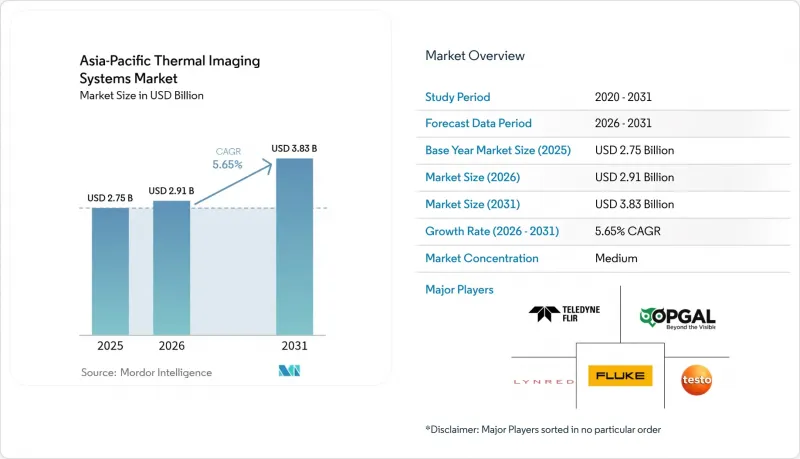
根據 Mordor Intelligence 預測,亞太地區熱成像系統市場在 2025 年的價值將達到 27.5 億美元,在 2026 年成長到 29.1 億美元,到 2031 年將達到 38.3 億美元,2026 年至 2031 年的複合年成長率為 5.65%。
本報告按應用領域(熱成像、海事和海岸監視、邊境監視、無人機/無人飛行器對抗、關鍵基礎設施安全等)、產品類型(熱像儀等)、技術類型(非製冷長波紅外線等)、終端用戶產業(航太和國防等)以及地區進行細分。市場預測以美元計價。
亞太地區熱成像系統市場趨勢及洞察。
降低非製冷微測輻射熱計感測器的成本
自2020年以來,12吋晶圓加工和焦平面組裝的自動化使氧化釩檢測器的價格降低了約30%。目前,消費級模組的零售價格低於200美元,這為智慧型手機附件和業餘無人機等領域的應用開闢了新的前景。中國晶圓廠每年出貨超過50萬個核心,擴大了生產規模。此外,12微米像素間距使陣列密度翻倍,同時最大限度地降低了成本。雖然高階供應商仍提供低雜訊等效溫差感測器,但商業用戶認為新型中階感測器足以滿足熱成像和安防應用的需求。
亞太地區國防和邊防安全支出增加
隨著各國加強海上監視能力和陸地邊境監視系統,該地區在光電和紅外線系統的支出在2024年至2025年間增加了18%。印度批准了用於步兵車輛的熱成像駕駛員夜視設備,作為一項價值80億美元的現代化計劃的一部分;日本在其2026會計年度預算中累計5200萬美元用於反無人機陣列。持續的組織需求顯而易見,韓國於2024年完成了邊境感測器升級,澳洲於2025年部署了不受《國際武器貿易條例》(ITAR)約束的熱成像無人機。
冷卻相機的初始成本高,且出口許可證受到限制。
冷卻式銻化銦 (InSb) 或碲鎘汞 (HgCdTe) 系統單價通常超過 5 萬美元,影格速率超過 60 Hz 或像素超過 11.1 萬的陣列需要美國出口授權。核准流程耗時 6 至 12 個月,迫使東南亞各國軍隊優先選擇性能適中且不受 ITAR 法規約束的替代方案,即使這意味著探測範圍會更窄。一些供應商為了規避許可證要求,將影格速率限制在 9 Hz,但這會限制其動態追蹤能力。
細分市場分析
到2025年,受邊境監控和關鍵基礎設施保護需求的推動,亞太地區安全監控產業將佔熱成像系統市場收入的38.19%。無人機(UAS)對抗計畫預計將以5.91%的複合年成長率成長,反映出在陸地和海上爭議邊界地區日益成長的優先事項。隨著各國軍隊將熱成像感測器與聲學和射頻干擾器整合,建構多層防禦體系,亞太地區與無人機對抗相關的熱成像系統市場規模預計將進一步擴大。同時,海事機構也傾向使用配備熱成像感測器的無人水面載具巡邏非法捕魚活動,從而實現全天候作業,且成本遠低於傳統有人駕駛艦艇。
隨著製造商將非製冷熱像儀與數位孿生軟體整合,使其能夠提前數週診斷設備故障,熱成像技術的應用範圍不斷擴大。消防員正在升級配備免手持熱成像疊加功能的頭盔,而智慧型手機和醫療領域的應用也使收入來源不再局限於傳統的安全市場。城市公共產業正在變電站部署固定攝影機,以減少誤報,相比之下,動作感測器的誤報率要低得多。所有這些變化預計將在預測期結束時推動民用市場佔有率超過國防市場佔有率。
預計到2025年,熱成像攝影機將佔銷售額的46.78%,繼續保持其在手持式檢測和固定位置監控領域的主要工具地位,在這些領域,即時可視性至關重要。然而,目前以5.88%的複合年成長率成長的模組核心市場佔有率正在不斷擴大,因為汽車和無人機製造商需要無需機殼或顯示器的基板級組件。這種嵌入式趨勢可將物料清單(BOM)減少約40%,並避免與出口許可證相關的延誤。在亞太地區的熱成像系統市場,隨著超低功耗50x50像素感測器在智慧家庭家用電子電器產品的應用,模組佔有率預計將進一步擴大。
瞄準鏡和瞄具在執法機關中仍然保持著一定的市場需求,他們需要的是能夠與現有武器相容的可靠光學設備。儘管光學設備製造商正致力於縮小像素間距和採用人工智慧影像校正技術,但可焊接在主機板上的模組化核心零件(適用於從機器人到農業技術等各個行業)將推動更廣泛的大規模生產。
其他好處:
- Excel格式的市場預測(ME)表
- 3個月的分析師支持
目錄
第1章:引言
- 研究假設和市場定義
- 調查範圍
第2章:調查方法
第3章執行摘要
第4章 市場狀況
- 市場概覽
- 市場促進因素
- 降低非製冷微測輻射熱計感測器的成本
- 亞太地區國防和邊防安全支出增加
- 工業領域預測性維護實施現狀
- 熱腐蝕在智慧型手機、無人機和ADAS的應用。
- 利用人工智慧和熱成像分析技術實施強制性畜牧生物安全措施。
- 硫系光學元件可降低鍺供應風險。
- 市場限制因素
- 冷卻相機的初始成本高,且出口許可證受到限制。
- 認證熱成像提供服務業者短缺
- 半導體級VOx/InSb晶圓供應的脆弱性
- 智慧城市隱私法規限制了熱成像監控
- 宏觀經濟因素對市場的影響
- 產業價值鏈分析
- 監理情勢
- 技術展望
- 波特五力分析
第5章 市場規模與成長預測
- 透過使用
- 熱成像
- 海上/沿海監視
- 邊境監控
- 反無人機/無人飛行器
- 關鍵基礎設施安全
- 其他(消防、智慧型手機、醫療、PVS)
- 依產品
- 熱像儀
- 熱成像瞄準鏡/瞄準器
- 熱模組/核心
- 透過技術
- 非製冷長波紅外線(VOx/a-Si)
- 冷卻式中波紅外線/長波紅外線(InSb,MCT)
- 短波紅外線頻譜
- 按行業分類的最終用戶
- 航太/國防
- 執法機關和公共安全
- 醫學和獸醫學
- 汽車與出行
- 石油和天然氣加工業
- 製造業和公用事業
- 其他
- 國家
- 中國
- 日本
- 印度
- 東南亞
- 韓國
- 澳洲和紐西蘭
- 其他亞太國家
第6章 競爭情勢
- 市場集中度
- 策略趨勢
- 市佔率分析
- 公司簡介
- Teledyne FLIR LLC
- Wuhan Guide Infrared Co., Ltd.
- Lynred
- Hangzhou Hikvision Digital Technology Co., Ltd.
- Fluke Corporation
- Opgal Optronic Industries Ltd.
- Testo SE and Co. KGaA
- Trijicon, Inc.
- Dongguan Xintai Instrument Co., Ltd.
- Thermoteknix Systems Ltd.
- Raytron Technology Co., Ltd.
- Zhejiang Dali Technology Co., Ltd.
- Meridian Innovation Ltd.
- Nippon Avionics Co., Ltd.
- NEC Avio Infrared Technologies Co., Ltd.
- Shenzhen SAT Infrared Technology Co., Ltd.
- Leonardo SpA
- L3Harris Technologies, Inc.
- BAE Systems plc
- Axis Communications AB
- Seek Thermal, Inc.
- InfraTec GmbH
- Infrared Cameras Inc.
- Tien-Yuan Technology Co., Ltd.
第7章 市場機會與未來展望
According to Mordor Intelligence, the Asia-Pacific thermal imaging systems market size was valued at USD 2.75 billion in 2025, rose to USD 2.91 billion in 2026, and is forecast to reach USD 3.83 billion by 2031, registering a 5.65% CAGR from 2026 to 2031.
This report is Segmented by Application (Thermography, Maritime and Coastal Surveillance, Border Surveillance, Counter-UAS/Drones, Critical Infrastructure Security, and More), Product (Thermal Cameras, and More), Technology (Uncooled LWIR, and More), End-User Vertical (Aerospace and Defence, and More), and Geography. The Market Forecasts are Provided in Terms of Value (USD).
Asia-Pacific Thermal Imaging Systems Market Trends and Insights
Declining Cost of Uncooled Micro-Bolometer Sensors
Twelve-inch wafer processing and automated focal-plane assembly have cut vanadium-oxide detector prices by about 30% since 2020. Consumer-grade modules now retail below USD 200, opening doors for smartphone attachments and hobby drones. Chinese fabs ship more than 500,000 cores yearly, raising scale while 12-µm pixel pitches double array density with minimal cost penalty. Premium suppliers still deliver lower noise-equivalent temperature difference, yet commercial buyers find the newer mid-tier sensors sufficient for thermography and security uses.
Rising Defense and Border-Security Spending in Asia-Pacific
Regional outlays on electro-optical and infrared systems rose 18% between 2024 and 2025 as nations strengthened maritime domain awareness and land-border surveillance. India approved thermal driver night sights for infantry vehicles under a USD 8 billion modernization package, while Japan budgeted USD 52 million for counter-drone arrays in fiscal 2026. South Korea finished a border-sensor upgrade in 2024, and Australia fielded ITAR-free thermal drones in 2025, signalling sustained institutional demand.
High Upfront Cost and Export-Licence Constraints for Cooled Cameras
Cooled indium-antimonide or mercury-cadmium-telluride systems often exceed USD 50,000 per unit and require U.S. export licences for frame rates above 60 Hz or arrays over 111,000 pixels. Approval cycles run six to twelve months, forcing Southeast Asian militaries to favour ITAR-free mid-performance alternatives despite reduced detection range. Vendors sometimes throttle frame rates to 9 Hz to avoid licensing, but that limits dynamic tracking capability.
Other drivers and restraints analyzed in the detailed report include:
- Industrial Predictive-Maintenance Adoption
- Smartphone, Drone and ADAS Integration of Thermal Cores
- Scarcity of Certified Thermography Service Providers
For complete list of drivers and restraints, kindly check the Table Of Contents.
Segment Analysis
In 2025, security and surveillance generated 38.19% of Asia-Pacific thermal imaging systems market revenue, buoyed by border monitoring and critical-infrastructure protection needs. Counter-unmanned-aerial-system projects are projected to log a 5.91% CAGR, reflecting new priorities along contested land and maritime boundaries. The Asia-Pacific thermal imaging systems market size tied to counter-UAS is set to climb as militaries integrate thermal sensors with acoustic and RF jammers for layered defense. A complementary trend is maritime agencies using unmanned surface vessels with thermal payloads for illegal-fishing patrols, allowing 24-hour operation at a fraction of conventional crewed vessel costs.
Thermography applications continue to expand as manufacturers link uncooled cameras to digital-twin software, diagnosing equipment faults weeks in advance. Fire-fighting brigades upgrade helmets with hands-free thermal overlays, while smartphone and medical uses diversify revenue beyond traditional safety markets. Urban utilities deploy fixed cameras at substations, reducing false alarms versus motion sensors. Collectively, these shifts position commercial verticals to overtake defense in market share before the forecast horizon ends.
Thermal cameras captured 46.78% revenue in 2025, remaining the tool of choice for handheld inspections and fixed surveillance where real-time viewing is critical. Yet the share of modules and cores, now 5.88% CAGR, is rising as automotive and drone manufacturers demand board-level components without housings or displays. This embedded trend trims the bill of materials by roughly 40% and avoids export-licence delays. The Asia-Pacific thermal imaging systems market share for modules will widen further as consumer electronics adopt ultra-low-power 50 X 50-pixel sensors in smart-home devices.
Scopes and sights maintain specialized traction among armed forces and law-enforcement units seeking ruggedized optics compatible with existing weapons. Optical companies emphasize pixel-pitch miniaturization and AI-assisted image enhancement, but broader volume growth will stay with modular cores that can be soldered onto motherboards across industries, from robotics to agritech.
Complete Report Scope:
- By Application
- Thermography
- Maritime and Coastal Surveillance
- Border Surveillance
- Counter-UAS / Drones
- Critical Infrastructure Security
- Other Applications (Fire-Fighting, Smartphones, Medical, PVS)
- By Product
- Thermal Cameras
- Thermal Scopes / Sights
- Thermal Modules / Cores
- By Technology
- Uncooled LWIR (VOx / a-Si)
- Cooled MWIR and LWIR (InSb, MCT)
- SWIR and Multispectral
- By End-User Vertical
- Aerospace and Defence
- Law-Enforcement and Public Safety
- Healthcare and Veterinary
- Automotive and Mobility
- Oil and Gas and Process Industries
- Manufacturing and Utilities
- Other End-User Verticals
- By Country
- China
- Japan
- India
- Southeast Asia
- South Korea
- Australia and New Zealand
- Rest of Asia-Pacific
List of Companies Covered in this Report:
- Teledyne FLIR LLC
- Wuhan Guide Infrared Co., Ltd.
- Lynred
- Hangzhou Hikvision Digital Technology Co., Ltd.
- Fluke Corporation
- Opgal Optronic Industries Ltd.
- Testo SE and Co. KGaA
- Trijicon, Inc.
- Dongguan Xintai Instrument Co., Ltd.
- Thermoteknix Systems Ltd.
- Raytron Technology Co., Ltd.
- Zhejiang Dali Technology Co., Ltd.
- Meridian Innovation Ltd.
- Nippon Avionics Co., Ltd.
- NEC Avio Infrared Technologies Co., Ltd.
- Shenzhen SAT Infrared Technology Co., Ltd.
- Leonardo S.p.A.
- L3Harris Technologies, Inc.
- BAE Systems plc
- Axis Communications AB
- Seek Thermal, Inc.
- InfraTec GmbH
- Infrared Cameras Inc.
- Tien-Yuan Technology Co., Ltd.
Additional Benefits:
- The market estimate (ME) sheet in Excel format
- 3 months of analyst support
TABLE OF CONTENTS
1 INTRODUCTION
- 1.1 Study Assumptions And Market Definition
- 1.2 Scope of the Study
2 RESEARCH METHODOLOGY
3 EXECUTIVE SUMMARY
4 MARKET LANDSCAPE
- 4.1 Market Overview
- 4.2 Market Drivers
- 4.2.1 Declining Cost of Uncooled Micro-Bolometer Sensors
- 4.2.2 Rising Defence and Border-Security Spending in Asia-Pacific
- 4.2.3 Industrial Predictive-Maintenance Adoption
- 4.2.4 Smartphone, Drone and ADAS Integration of Thermal Cores
- 4.2.5 Livestock Bio-Security Mandates Using AI-Thermal Analytics
- 4.2.6 Chalcogenide Optics Easing Germanium Supply Risk
- 4.3 Market Restraints
- 4.3.1 High Upfront Cost and Export-Licence Constraints for Cooled Cameras
- 4.3.2 Scarcity of Certified Thermography Service Providers
- 4.3.3 Semiconductor-Grade VOx / InSb Wafer Supply Fragility
- 4.3.4 Smart-City Privacy Rules Limiting Thermal Surveillance
- 4.4 Impact of Macroeconomic Factors on the Market
- 4.5 Industry Value-Chain Analysis
- 4.6 Regulatory Landscape
- 4.7 Technological Outlook
- 4.8 Porter's Five Forces Analysis
- 4.8.1 Threat of New Entrants
- 4.8.2 Bargaining Power of Buyers
- 4.8.3 Bargaining Power of Suppliers
- 4.8.4 Threat of Substitutes
- 4.8.5 Intensity of Competitive Rivalry
5 MARKET SIZE AND GROWTH FORECASTS (VALUE)
- 5.1 By Application
- 5.1.1 Thermography
- 5.1.2 Maritime and Coastal Surveillance
- 5.1.3 Border Surveillance
- 5.1.4 Counter-UAS / Drones
- 5.1.5 Critical Infrastructure Security
- 5.1.6 Other Applications (Fire-Fighting, Smartphones, Medical, PVS)
- 5.2 By Product
- 5.2.1 Thermal Cameras
- 5.2.2 Thermal Scopes / Sights
- 5.2.3 Thermal Modules / Cores
- 5.3 By Technology
- 5.3.1 Uncooled LWIR (VOx / a-Si)
- 5.3.2 Cooled MWIR and LWIR (InSb, MCT)
- 5.3.3 SWIR and Multispectral
- 5.4 By End-User Vertical
- 5.4.1 Aerospace and Defence
- 5.4.2 Law-Enforcement and Public Safety
- 5.4.3 Healthcare and Veterinary
- 5.4.4 Automotive and Mobility
- 5.4.5 Oil and Gas and Process Industries
- 5.4.6 Manufacturing and Utilities
- 5.4.7 Other End-User Verticals
- 5.5 By Country
- 5.5.1 China
- 5.5.2 Japan
- 5.5.3 India
- 5.5.4 Southeast Asia
- 5.5.5 South Korea
- 5.5.6 Australia and New Zealand
- 5.5.7 Rest of Asia-Pacific
6 COMPETITIVE LANDSCAPE
- 6.1 Market Concentration
- 6.2 Strategic Moves
- 6.3 Market Share Analysis
- 6.4 Company Profiles (includes Global Level Overview, Market Level Overview, Core Segments, Financials as available, Strategic Information, Market Rank/Share, Products and Services, Recent Developments)
- 6.4.1 Teledyne FLIR LLC
- 6.4.2 Wuhan Guide Infrared Co., Ltd.
- 6.4.3 Lynred
- 6.4.4 Hangzhou Hikvision Digital Technology Co., Ltd.
- 6.4.5 Fluke Corporation
- 6.4.6 Opgal Optronic Industries Ltd.
- 6.4.7 Testo SE and Co. KGaA
- 6.4.8 Trijicon, Inc.
- 6.4.9 Dongguan Xintai Instrument Co., Ltd.
- 6.4.10 Thermoteknix Systems Ltd.
- 6.4.11 Raytron Technology Co., Ltd.
- 6.4.12 Zhejiang Dali Technology Co., Ltd.
- 6.4.13 Meridian Innovation Ltd.
- 6.4.14 Nippon Avionics Co., Ltd.
- 6.4.15 NEC Avio Infrared Technologies Co., Ltd.
- 6.4.16 Shenzhen SAT Infrared Technology Co., Ltd.
- 6.4.17 Leonardo S.p.A.
- 6.4.18 L3Harris Technologies, Inc.
- 6.4.19 BAE Systems plc
- 6.4.20 Axis Communications AB
- 6.4.21 Seek Thermal, Inc.
- 6.4.22 InfraTec GmbH
- 6.4.23 Infrared Cameras Inc.
- 6.4.24 Tien-Yuan Technology Co., Ltd.
7 MARKET OPPORTUNITIES AND FUTURE OUTLOOK
- 7.1 White-Space And Unmet-Need Assessment

 中東和非洲熱成像系統:市場佔有率分析、行業趨勢和統計數據以及成長預測(2026-2031 年)熱成像系統:市場佔有率分析、產業趨勢與統計、成長預測(2026-2031)
 熱成像市場-2026-2032年全球市場預測
 手持式熱像儀市場機會、成長促進因素、產業趨勢分析及2026-2035年預測
 全球熱成像市場規模、佔有率、趨勢和成長分析報告(2026-2034年)
 全球手持熱像儀市場:按工作類別、價格範圍、分銷管道、應用、產業和地區分類-預測至2032年
 攜帶式熱成像市場:按技術、應用、終端用戶產業和地區分類熱成像市場:按應用、最終用戶和地區分類
 全球國防熱成像模組(冷卻型)市場:2026–2036攜帶式熱感雙筒望遠鏡市場:按技術、解析度、價格範圍、應用、最終用戶和分銷管道分類,全球預測,2026-2032年