


 |
市場調查報告書
商品編碼
2121423
中東和非洲熱成像系統:市場佔有率分析、行業趨勢和統計數據以及成長預測(2026-2031 年)Middle East And Africa Thermal Imaging Systems - Market Share Analysis, Industry Trends & Statistics, Growth Forecasts (2026 - 2031) |
||||||

※ 本網頁內容可能與最新版本有所差異。詳細情況請與我們聯繫。
根據 Mordor Intelligence 預測,中東和非洲的熱成像系統市場規模將從 2025 年的 8.3 億美元和 2026 年的 9.1 億美元成長到 2031 年的 14.1 億美元,2026 年至 2031 年的年複合成長率(CAGR)為 9.27%。
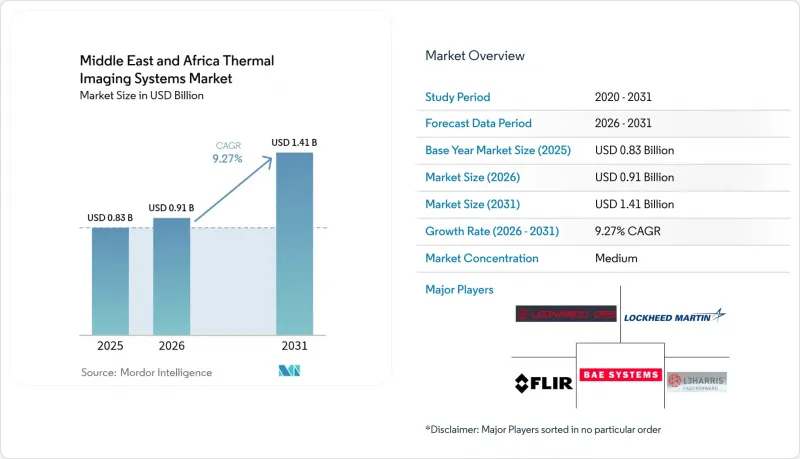
本報告按解決方案(硬體、軟體、服務)、產品類型(固定式熱像儀、手持式熱像儀)、應用領域(安防監控、監測偵測、偵測測量)、最終用戶(航太與國防、汽車及其他)和國家進行細分。市場預測以美元計價。
中東和非洲熱成像系統市場趨勢及洞察。
海灣合作理事會國家的國防現代化計劃
區域各國軍隊正以第三代熱成像設備取代傳統的光電系統,這些設備能夠擴大探測範圍並實現頻譜融合。沙烏地阿拉伯軍事工業組織與亨索爾特公司簽署了一份2024年合作備忘錄,旨在實現在地化生產,凸顯了其提升國內能力的努力。同時,美國陸軍授予泰萊達因-弗萊爾公司(Teledyne FLIR)的車輛感測器系統合約也帶動了對外軍售(FMS)管道的擴張,促使海灣合作理事會(GCC)國家開始採用冷卻式中波紅外線陣列。儘管出口許可仍然存在瓶頸,但雙邊協議正在縮短海灣地區可靠合作夥伴的批准週期。因此,硬體銷售額正在成長,而自動目標識別演算法也正在創造持續的軟體業務機會。
石油和天然氣產業預測性維護需求的擴展
國營石油公司目前正將熱成像數據與振動數據和歷史數據相結合,以提前數週預測故障。 2024年,阿布達比國家石油公司(ADNOC)在其所有上游資產中部署了AIQ公司的Neuron 5平台。沙烏地阿美公司與Gecko Robotics公司於2024年簽訂的一份合約重點介紹了機器人超音波和熱成像檢測技術,旨在取代傳統的鷹架勘測,從而避免代價高昂的停機時間。無人機搭載的攝影機掃描火炬塔和海底管線,以檢測指示腐蝕和洩漏的熱點,並將熱成像技術整合到數位孿生工作流程中。避免停機帶來的成本節約通常每次事故超過2000萬美元,因此有必要設立多年的檢測預算。
冷卻平台的初始成本和維修成本都很高
冷卻式中波長檢測器每個造價超過5萬美元,且依賴低溫冷卻系統,在多塵環境下需要每六個月維護一次。因此,非洲和海灣小規模國的預算緊張的機構被迫採用非冷卻式替代方案或推遲項目,從而減緩了銷售成長。將維護風險轉移給供應商的租賃模式正在興起,但其成功取決於信譽良好的買家和可預測的法律規範。
細分市場分析
預計到2025年,硬體銷售額將佔總銷售額的71.68%。這反映了各國政府持續採購用於國防邊境、石油接收站和智慧城市電網的攝影機、鏡頭和檢測器模組。隨著各國政府加大對邊境安全系統的升級投入,熱成像系統市場的硬體部分預計將穩定成長。同時,服務部分預計將超越其他所有類別,年複合成長率將達到10.39%,因為營運商簽訂了校準、分析和培訓契約,將資本支出轉化為可預測的營運成本。像先進能源工業公司(Advanced Energy Industries)這樣的先驅者正在透過打包年度服務計劃與客戶建立牢固的關係。
該服務業的成長也有助於解決區域內認證熱成像師短缺的問題。阿拉伯聯合大公國和南非的培訓機構對二級認證的收費高達1900美元,「非洲認證熱成像師網路」(Certified Thermographers Network-Africa)計畫於2024年啟動,旨在統一20多個國家的標準。軟體收入與硬體普及率同步成長,雲端託管的儀錶板和邊緣人工智慧引擎能夠以多年周期實現資料流的貨幣化。
到2025年,固定式監控系統將佔總銷售額的58.05%,這主要得益於對邊境、機場、石化廠及其他場所的廣泛監控。這些系統整合了可見光攝影機和雷達,能夠實現多層次的情境察覺。隨著價格降至5000美元以下,以及智慧型手機附加元件使電工和建築檢查員能夠進行「即拍即用」的診斷,預計到2031年,手持式監控設備的年複合成長率將達到9.64%。
Teledyne FLIR 的「Hadron 640」和 Gremsy 的「Vio F1」展示了小型化模組如何模糊固定平台和行動平台之間的界限。公共產業公司也開始向電力線路工人分發手持式熱像儀,用於即時故障檢測,這方面的需求正在成長。因此,隨著紅外線檢測成為現場診斷的常規環節,手持式熱成像系統的市場佔有率預計將會擴大。
其他好處:
- Excel格式的市場預測(ME)表
- 3個月的分析師支持
目錄
第1章:引言
- 研究假設和市場定義
- 調查範圍
第2章:調查方法
第3章執行摘要
第4章 市場狀況
- 市場概覽
- 產業價值鏈分析
- 宏觀經濟因素對市場的影響
- 監理情勢
- 技術展望
- 波特五力分析
第5章 市場動態
- 市場促進因素
- 海灣合作理事會國家的國防現代化計劃
- 石油和天然氣產業預測性維護需求的擴展
- 透過智慧城市計畫加速對城市安全的投資
- 低冷卻、非冷卻感知器正在推動商業化進程。
- 利用人工智慧熱視覺分析提高投資報酬率
- 一種堅固耐用的無人機搭載式熱成像有效載荷已問世,可用於沙漠作業。
- 市場限制因素
- 冷卻平台的初始成本和維修成本都很高
- 認證熱成像專家短缺
- 嚴格的出口管制制度限制了感測器的供應。
- 灰塵、潮濕和極端溫度會導致性能下降。
第6章 市場規模與成長預測
- 透過解決方案
- 硬體
- 軟體
- 服務
- 依產品類型
- 固定式熱像儀
- 手持式熱像儀
- 透過使用
- 安全監控
- 監測和檢查
- 檢測與測量
- 最終用戶
- 航太/國防
- 車
- 醫療保健和生命科學
- 石油和天然氣
- 食品/飲料
- 其他最終用戶
- 按地區
- 中東
- 沙烏地阿拉伯
- 阿拉伯聯合大公國
- 土耳其
- 其他中東國家
- 非洲
- 南非
- 肯亞
- 其他非洲國家
- 中東
第7章 競爭情勢
- 市場集中度
- 策略趨勢
- 市佔率分析
- 公司簡介
- Teledyne FLIR LLC
- L3Harris Technologies Inc.
- Lockheed Martin Corporation
- BAE Systems plc
- Leonardo DRS Inc.
- Elbit Systems Ltd.
- RTX Corporation(Raytheon Business Unit)
- Thermoteknix Systems Ltd.
- Hangzhou Hikvision Digital Technology Co. Ltd.
- Guide Infrared Co. Ltd.
- Zhejiang Dali Technology Co. Ltd.
- Silent Sentinel Holdings Ltd.
- Testo SE and Co. KGaA
- Seek Thermal Inc.
- Optris GmbH
- Ametek Land(Land Instruments International Ltd.)
- Wuhan Guide Infrared Co. Ltd.
- Infrared Cameras Inc.
- SATIR(Shenzhen SAT Infrared Technology Co. Ltd.)
- Ulirvision Technologies Co. Ltd.
- Seek Thermal Inc.
第8章 市場機會與未來展望
- 評估未開發的領域和未滿足的需求
According to Mordor Intelligence, the Middle East and Africa thermal imaging systems market size is projected to expand from USD 0.83 billion in 2025 and USD 0.91 billion in 2026 to USD 1.41 billion by 2031, registering a CAGR of 9.27% between 2026 to 2031.
This report is Segmented by Solutions (Hardware, Software, and Services), Product Type (Fixed Thermal Cameras, and Handheld Thermal Cameras), Application (Security and Surveillance, Monitoring and Inspection, and Detection and Measurement), End-User (Aerospace and Defense, Automotive, and More), and Country. The Market Forecasts are Provided in Terms of Value (USD).
Middle East And Africa Thermal Imaging Systems Market Trends and Insights
Defense Modernization Programs Across GCC States
Regional militaries are refreshing legacy electro-optical suites with third-generation thermal imagers that extend detection ranges and enable multispectral fusion. Saudi Arabia's State Authority for Military Industries signed a 2024 memorandum with Hensoldt to localize production, underscoring the push for indigenous capability. Parallel U.S. Army awards to Teledyne FLIR for vehicle sensor systems cascade into foreign military sales channels and guide GCC specifications toward cooled mid-wave infrared arrays. Export-license bottlenecks persist, yet bilateral agreements are trimming approval cycles for trusted Gulf partners. As a result, hardware revenue rises while automatic target-recognition algorithms open recurring software opportunities.
Expanding Oil and Gas Predictive Maintenance Requirements
National oil companies now fuse thermal data with vibration and historian feeds to predict failures weeks ahead. Abu Dhabi National Oil Company rolled out AIQ's Neuron 5 platform across upstream assets in 2024. Saudi Aramco's 2024 contract with Gecko Robotics highlights robotic ultrasonic and thermal inspections that displace scaffold-based surveys and avert costly shutdowns. Drone-mounted cameras scan flare stacks and subsea lines for hotspots that signal corrosion or leaks, embedding thermal vision into digital-twin workflows. Cost avoidance from averted outages, often exceeding USD 20 million per incident, validates multiyear inspection budgets.
High Acquisition and Maintenance Costs for Cooled Platforms
Cooled mid-wave detectors exceed USD 50,000 per unit and rely on cryogenic coolers that demand six-month service intervals in sandy environments. Budget-constrained agencies in Africa and minor Gulf states therefore default to uncooled alternatives or defer projects, slowing top-line growth. Leasing models that shift maintenance risk to vendors are emerging but hinge on creditworthy buyers and predictable regulatory frameworks.
Other drivers and restraints analyzed in the detailed report include:
- Rapid Urban Security Investments Through Smart-City Initiatives
- Lower-Cost Uncooled Sensors Boosting Commercial Adoption
- Stringent Export-Control Regimes Limiting Sensor Availability
For complete list of drivers and restraints, kindly check the Table Of Contents.
Segment Analysis
Hardware generated 71.68% of revenue in 2025, reflecting sustained procurement of cameras, lenses, and detector modules for defense borders, oil terminals, and smart-city grids. The thermal imaging systems market size for hardware is projected to expand steadily as governments fund perimeter upgrades. Services, however, will outpace all other categories at a 10.39% CAGR as operators lock in calibration, analytics, and training contracts that convert capital layouts into predictable operating expenses. Early adopters such as Advanced Energy Industries bundle annual service plans, fostering sticky client relationships.
The services trajectory also addresses the regional shortage of certified thermographers. Training providers in the UAE and South Africa charge up to USD 1,900 for Level II certification, and the 2024 launch of the Certified Thermographers Network - Africa aims to harmonize standards across 20-plus countries. Software revenue follows hardware penetration, as cloud-hosted dashboards and edge-AI engines monetize data streams over multiyear cycles.
Fixed installations commanded 58.05% revenue in 2025 owing to large-area surveillance of borders, airports, and petro-chemical hubs. These systems integrate with visible-light cameras and radars, enabling layered situational awareness. Handheld units will post a 9.64% CAGR through 2031 as price points fall below USD 5,000 and smartphone add-ons popularize point-and-shoot diagnostics for electricians and building inspectors.
Teledyne FLIR's Hadron 640 and Gremsy's Vio F1 illustrate how miniaturized modules blur delineations between fixed and mobile platforms. Demand also comes from utilities that now issue handheld cameras to line crews for real-time fault detection. Consequently, the thermal imaging systems market share for handhelds is set to widen as field diagnostics embed infrared checks into daily workflows.
Complete Report Scope:
- By Solutions
- Hardware
- Software
- Services
- By Product Type
- Fixed Thermal Cameras
- Handheld Thermal Cameras
- By Application
- Security and Surveillance
- Monitoring and Inspection
- Detection and Measurement
- By End-user
- Aerospace and Defense
- Automotive
- Healthcare and Life Sciences
- Oil and Gas
- Food and Beverages
- Other End-users
- By Geography
- Middle East
- Saudi Arabia
- United Arab Emirates
- Turkey
- Rest of Middle East
- Africa
- South Africa
- Kenya
- Rest of Africa
- Middle East
List of Companies Covered in this Report:
- Teledyne FLIR LLC
- L3Harris Technologies Inc.
- Lockheed Martin Corporation
- BAE Systems plc
- Leonardo DRS Inc.
- Elbit Systems Ltd.
- RTX Corporation (Raytheon Business Unit)
- Thermoteknix Systems Ltd.
- Hangzhou Hikvision Digital Technology Co. Ltd.
- Guide Infrared Co. Ltd.
- Zhejiang Dali Technology Co. Ltd.
- Silent Sentinel Holdings Ltd.
- Testo SE and Co. KGaA
- Seek Thermal Inc.
- Optris GmbH
- Ametek Land (Land Instruments International Ltd.)
- Wuhan Guide Infrared Co. Ltd.
- Infrared Cameras Inc.
- SATIR (Shenzhen SAT Infrared Technology Co. Ltd.)
- Ulirvision Technologies Co. Ltd.
- Seek Thermal Inc.
Additional Benefits:
- The market estimate (ME) sheet in Excel format
- 3 months of analyst support
TABLE OF CONTENTS
1 INTRODUCTION
- 1.1 Study Assumptions and Market Definition
- 1.2 Scope of the Study
2 RESEARCH METHODOLOGY
3 EXECUTIVE SUMMARY
4 MARKET LANDSCAPE
- 4.1 Market Overview
- 4.2 Industry Value Chain Analysis
- 4.3 Impact of Macroeconomic Factors on the Market
- 4.4 Regulatory Landscape
- 4.5 Technological Outlook
- 4.6 Porter's Five Forces Analysis
- 4.6.1 Threat of New Entrants
- 4.6.2 Bargaining Power of Buyers
- 4.6.3 Bargaining Power of Suppliers
- 4.6.4 Threat of Substitute Products
- 4.6.5 Intensity of Competitive Rivalry
5 MARKET DYNAMICS
- 5.1 Market Drivers
- 5.1.1 Defense Modernization Programs Across GCC States
- 5.1.2 Expanding Oil and Gas Predictive Maintenance Requirements
- 5.1.3 Rapid Urban Security Investments Through Smart-City Initiatives
- 5.1.4 Lower-Cost Uncooled Sensors Boosting Commercial Adoption
- 5.1.5 AI-enabled Thermal-Vision Analytics Improving ROI
- 5.1.6 Advent of Rugged, Drone-Mounted Thermal Payloads for Desert Operations
- 5.2 Market Restraints
- 5.2.1 High Acquisition and Maintenance Costs for Cooled Platforms
- 5.2.2 Shortage of Certified Thermography Professionals
- 5.2.3 Stringent Export-Control Regimes Limiting Sensor Availability
- 5.2.4 Performance Degradation Due to Dust, Humidity and Extreme Heat
6 MARKET SIZE AND GROWTH FORECASTS (VALUE)
- 6.1 By Solutions
- 6.1.1 Hardware
- 6.1.2 Software
- 6.1.3 Services
- 6.2 By Product Type
- 6.2.1 Fixed Thermal Cameras
- 6.2.2 Handheld Thermal Cameras
- 6.3 By Application
- 6.3.1 Security and Surveillance
- 6.3.2 Monitoring and Inspection
- 6.3.3 Detection and Measurement
- 6.4 By End-user
- 6.4.1 Aerospace and Defense
- 6.4.2 Automotive
- 6.4.3 Healthcare and Life Sciences
- 6.4.4 Oil and Gas
- 6.4.5 Food and Beverages
- 6.4.6 Other End-users
- 6.5 By Geography
- 6.5.1 Middle East
- 6.5.1.1 Saudi Arabia
- 6.5.1.2 United Arab Emirates
- 6.5.1.3 Turkey
- 6.5.1.4 Rest of Middle East
- 6.5.2 Africa
- 6.5.2.1 South Africa
- 6.5.2.2 Kenya
- 6.5.2.3 Rest of Africa
- 6.5.1 Middle East
7 COMPETITIVE LANDSCAPE
- 7.1 Market Concentration
- 7.2 Strategic Moves
- 7.3 Market Share Analysis
- 7.4 Company Profiles (includes Global level Overview, Market level overview, Core Segments, Financials as available, Strategic Information, Market Rank/Share for key companies, Products and Services, and Recent Developments)
- 7.4.1 Teledyne FLIR LLC
- 7.4.2 L3Harris Technologies Inc.
- 7.4.3 Lockheed Martin Corporation
- 7.4.4 BAE Systems plc
- 7.4.5 Leonardo DRS Inc.
- 7.4.6 Elbit Systems Ltd.
- 7.4.7 RTX Corporation (Raytheon Business Unit)
- 7.4.8 Thermoteknix Systems Ltd.
- 7.4.9 Hangzhou Hikvision Digital Technology Co. Ltd.
- 7.4.10 Guide Infrared Co. Ltd.
- 7.4.11 Zhejiang Dali Technology Co. Ltd.
- 7.4.12 Silent Sentinel Holdings Ltd.
- 7.4.13 Testo SE and Co. KGaA
- 7.4.14 Seek Thermal Inc.
- 7.4.15 Optris GmbH
- 7.4.16 Ametek Land (Land Instruments International Ltd.)
- 7.4.17 Wuhan Guide Infrared Co. Ltd.
- 7.4.18 Infrared Cameras Inc.
- 7.4.19 SATIR (Shenzhen SAT Infrared Technology Co. Ltd.)
- 7.4.20 Ulirvision Technologies Co. Ltd.
- 7.4.21 Seek Thermal Inc.
8 MARKET OPPORTUNITIES AND FUTURE OUTLOOK
- 8.1 White-space and Unmet-need Assessment

 亞太地區熱成像系統:市場佔有率分析、產業趨勢與統計及成長預測(2026-2031 年)熱成像系統:市場佔有率分析、產業趨勢與統計、成長預測(2026-2031)
 熱成像市場-2026-2032年全球市場預測
 手持式熱像儀市場機會、成長促進因素、產業趨勢分析及2026-2035年預測
 全球熱成像市場規模、佔有率、趨勢和成長分析報告(2026-2034年)
 全球手持熱像儀市場:按工作類別、價格範圍、分銷管道、應用、產業和地區分類-預測至2032年
 攜帶式熱成像市場:按技術、應用、終端用戶產業和地區分類熱成像市場:按應用、最終用戶和地區分類
 全球國防熱成像模組(冷卻型)市場:2026–2036攜帶式熱感雙筒望遠鏡市場:按技術、解析度、價格範圍、應用、最終用戶和分銷管道分類,全球預測,2026-2032年