


 |
市場調查報告書
商品編碼
2121235
熱成像系統:市場佔有率分析、產業趨勢與統計、成長預測(2026-2031)Thermal Imaging Systems - Market Share Analysis, Industry Trends & Statistics, Growth Forecasts (2026 - 2031) |
||||||

※ 本網頁內容可能與最新版本有所差異。詳細情況請與我們聯繫。
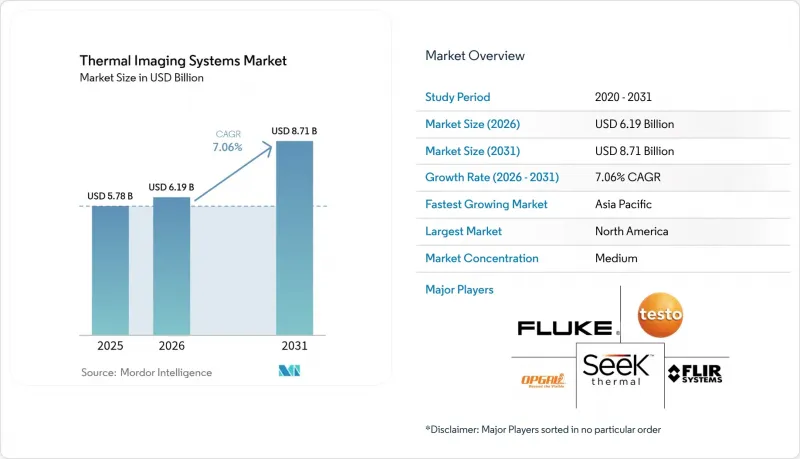
根據 Mordor Intelligence 預測,熱成像系統市場將從 2025 年的 57.8 億美元成長到 2026 年的 61.9 億美元,然後在 2031 年達到 87.1 億美元,2026 年至 2031 年的複合年成長率為 7.06%。
本報告按應用領域(安防監控、軍事國防、其他)、外形規格(手持成像設備、固定安裝設備、其他)、技術(非製冷長波紅外線、冷凍中波紅外線、其他)、組件(檢測器/核心組件、其他)、終端用戶產業(國防國防安全保障、工業、其他)和地區進行細分。市場預測以美元計價。
全球熱成像系統市場趨勢與洞察
非製冷微測輻射熱計價格下降
非製冷檢測器的成本曲線持續下降,拓展了國防和重工業以外的市場機會。規模經濟、簡化的製造流程以及LightPath等公司提供的替代硫系光學元件的技術,正在緩解傳統的鍺供應瓶頸。智慧型手機製造商正在試驗添加熱成像功能,車輛營運商也正在將熱成像檢測納入其環境、社會和治理(ESG)計畫的規範中。這種向商業領域的拓展,增強了能夠將原始影像轉化為可操作洞察的分析軟體的定價權。
擴大印太地區的國防情報、監視與偵察預算
區域安全競爭正在推動遠端監視系統的採購。美國太平洋威懾舉措已撥款99億美元用於先進感測器,而澳洲500億澳元(約347億美元)的國防藍圖也為頻譜成像平台提供了資金。此外,小型企業創新研究計畫(SBIR)津貼支持雙波段前視紅外線(FLIR)陣列,這些交易為檢測器代工廠和光學元件供應商提供了未來幾年穩定的訂單前景。
出口管制條例(ITAR 和 EAR)
由於美國出口管制趨勢,許多兩用焦面陣列和光學組件的許可已成為強制性要求,這延長了銷售週期並限制了國際商機。最近的提案考慮將先前不受管制的商用成像器也納入授權要求,迫使原始設備製造商 (OEM) 加快將其供應鏈本地化到美國以外的步伐。這種政策的不確定性造成了合規成本,這對小規模細分市場的創新者而言尤其沉重。
細分市場分析
到2025年,安防監控產業將佔總銷售額的37.62%,凸顯了周界安防在熱成像系統市場中的基礎性作用。邊境管控和關鍵基礎設施建設投入的增加將推動固定式和雲台變焦(PTZ)攝影機的持續採購,而人工智慧驅動的分析技術正在減輕操作人員的工作負擔。汽車高級駕駛輔助系統(ADAS)產業是成長最快的產業,年複合成長率達7.66%,受惠於行人安全和自動緊急煞車相關法規的不斷完善。在OEM設計週期中,紅外線功能曾經只是作為選配項,如今緊湊型模組已被整合到量產產品中,從而擴大了年出貨量。
隨著工廠遵守NFPA-70B標準,對熱成像服務的需求日益多元化,從而帶來持續的檢測收入。消防部門正在為第一線人員配備熱成像單筒望遠鏡,並利用衛星熱點警報進行快速部署。將智慧型手機與夾式微測輻射熱計相結合的新興行動應用程式,標誌著熱成像系統市場已進入消費化階段。
預計到2025年,手持式成像器將佔總銷售額的45.78%,這主要得益於其在預測性維護、執法和緊急應變等廣泛應用領域的多功能性。電池供電的便利性持續推動著巨大的更換需求,尤其是在檢測器解析度不斷提高的情況下。同時,整合式OEM模組預計將以7.13%的複合年成長率推動市場成長,從而促進熱成像系統在車輛、無人機和智慧家庭設備等領域的市場擴張。固定安裝解決方案對於需要全天候監控的周界安防和製程監控仍然至關重要。
在軍事採購中,尺寸、重量、功耗和成本 (SWaP-C) 的改進備受重視,專有的百葉窗校準技術和邊緣人工智慧正在被引入,以縮小有效載荷尺寸。目前正在開發的軟性紅外線感測器有望應用於未來的穿戴式設備,但在商業化之前仍需進行多項設計改進。
區域分析
北美市場引領潮流,預計2025年將佔全球支出的41.02%。這反映了國防領域的預算撥款,其中包括美國陸軍價值1.175億美元的第三代FLIR感測器訂單。符合NFPA-70B標準進一步加速了工業領域的應用,汽車產業的頂級供應商正在試行針對2027年車型的夜視系統。美國網路安全和基礎設施安全局(CISA)的網路安全指令推動了對抗攻擊韌體的高需求,這使得美國供應商能夠保持價格優勢。
隨著日本、韓國、印度和澳洲不斷拓展其情報、監視和偵察(ISR)設備的種類並擴大車輛出口,亞太地區預計將以8.08%的複合年成長率(CAGR)實現最高成長。 2019年至2020年間,中國在熱成像市場的佔有率從15%成長至63%,充分展現了中國製造業的規模。儘管國內感測器生態系統日趨成熟,但出口限制阻礙了中國取得美國尖端技術,這刺激了該地區的研發投入。
歐洲市場正經歷穩定成長,這主要得益於國防光電子產品訂單和汽車安全法規的需求。亨索爾特公司光電子部門銷售額成長34%,凸顯了強勁的採購趨勢。在中東和非洲,周界監控需求旺盛,泰萊達因FLIR公司已向沙烏地阿拉伯交付了多感測器吊艙。南美市場仍處於新興階段,但由於工業維護和公共安全預算的增加,預計將進一步成長。
其他好處:
- Excel格式的市場預測(ME)表
- 3個月的分析師支持
目錄
第1章:引言
- 研究假設和市場定義
- 調查範圍
第2章:調查方法
第3章執行摘要
第4章 市場狀況
- 市場概覽
- 市場促進因素
- 非製冷微測輻射熱計價格下降
- 擴大印太地區的國防情報、監視與偵察預算
- 根據 NFPA-70B 標準,對電氣安全進行強制性熱成像檢查。
- 汽車製造商正在推廣在 ADAS(高級駕駛輔助系統)中採用經濟高效的夜視功能。
- 人工智慧驅動的智慧工廠預測性維護
- 對監測氣候變遷引發的野火的需求
- 市場限制因素
- 出口管制體系(ITAR 和 EAR)
- 冷凍型中波紅外線相機的資本投入相對較高。
- 鍺光學元件供應鏈中的瓶頸
- 網路攝影機的網路安全風險
- 價值供應鏈分析
- 監理情勢
- 技術展望
- 波特五力模型
- 價格分析(按應用和技術分類)
第5章 市場規模與成長預測
- 透過使用
- 安全監控
- 軍事/國防
- 熱成像/檢測
- 消防部門
- 個人視覺系統
- 智慧型手機和平板電腦
- 汽車高級駕駛輔助系統(ADAS)
- 海事/航太
- 按外形規格
- 手持式成像設備
- 固定類型(旋轉類型/非旋轉類型)
- 整合式OEM模組
- 透過技術
- 非製冷長波紅外線
- 冷卻式中波紅外線
- 短波紅外線和頻譜
- 按組件
- 檢測器/核心
- 完成的相機
- 光學元件和透鏡組
- 軟體和分析
- 按最終用戶行業分類
- 國防與國防安全保障
- 產業
- 商業的
- 醫學領域
- 公安
- 按地區
- 北美洲
- 美國
- 加拿大
- 墨西哥
- 南美洲
- 巴西
- 阿根廷
- 其他南美國家
- 歐洲
- 德國
- 英國
- 法國
- 義大利
- 西班牙
- 俄羅斯
- 其他歐洲國家
- 亞太地區
- 中國
- 日本
- 韓國
- 印度
- 澳洲和紐西蘭
- 東協(細分)
- 其他亞太國家
- 中東和非洲
- 中東
- 沙烏地阿拉伯
- UAE
- 土耳其
- 其他中東國家
- 非洲
- 南非
- 奈及利亞
- 其他非洲國家
- 中東
- 北美洲
第6章 競爭情勢
- 市場集中度
- 策略趨勢
- 市佔率分析
- 公司簡介
- Teledyne FLIR
- Opgal Optronic Industries
- Fluke Corporation
- Seek Thermal
- Axis Communications
- Leonardo DRS
- Raytheon Technologies
- L3Harris Technologies
- Lockheed Martin
- Testo SE and Co. KGaA
- Bullard
- Hikmicro(Hikvision)
- Guide Sensmart
- Excelitas(Xenics)
- BAE Systems
- HT Italia
- Trijicon
- Zhejiang Dali
- Pelco
- Yantai IRay
第7章 市場機會與未來展望
According to Mordor Intelligence, the thermal imaging systems market size is expected to grow from USD 5.78 billion in 2025 to USD 6.19 billion in 2026 and is forecast to reach USD 8.71 billion by 2031 at 7.06% CAGR over 2026-2031.
This report is Segmented by Application (Security and Surveillance, Military and Defense, and More), Form Factor (Hand-Held Imaging Devices, Fixed-Mount, and More), Technology (Uncooled LWIR, Cooled MWIR, and More), Component (Detectors/Cores, and More), End-User Industry (Defense and Homeland Security, Industrial, and More), and by Geography. The Market Forecasts are Provided in Terms of Value (USD).
Global Thermal Imaging Systems Market Trends and Insights
Falling Price of Uncooled Micro-Bolometers
Cost curves for uncooled detectors continue to decline, enlarging addressable opportunities beyond defense and heavy industry. Scale economies, simplified fabrication, and alternative chalcogenide optics from firms such as LightPath are mitigating historic germanium bottlenecks. Smartphone OEMs are piloting thermal add-ons, and fleet operators are specifying thermographic inspections under corporate ESG programs. The broader commercial reach strengthens pricing power for analytics software that converts raw images into actionable insights.
Growing Defense ISR Budgets in Indo-Pacific
Regional security competition is stimulating long-range surveillance procurements. The United States' Pacific Deterrence Initiative allocates USD 9.9 billion for advanced sensors, while Australia's AUD 50 billion (USD 34.7 billion) defense roadmap earmarks funds for multispectral imaging platforms. Combined with SBIR grants supporting dual-band FLIR arrays, the pipeline sustains multi-year volume visibility for detector foundries and optics suppliers.
Export-Control Regimes (ITAR & EAR)
Evolving US export rules mandate licenses for many dual-use focal-plane arrays and optics kits, elongating sales cycles and limiting addressable international revenue. Recent proposals would pull previously uncontrolled commercial imagers into license categories, prompting OEMs to accelerate non-US supply-chain localization. The policy uncertainty introduces compliance costs that particularly burden small-volume niche innovators.
Other drivers and restraints analyzed in the detailed report include:
- Mandatory NFPA-70B Thermography for Electrical Safety
- Vehicle OEM Push for Cost-Effective ADAS Night-Vision
- High Cap-Ex for Cooled MWIR Cameras
For complete list of drivers and restraints, kindly check the Table Of Contents.
Segment Analysis
Security and surveillance held 37.62% of 2025 revenue, reinforcing the foundational role of perimeter protection in the thermal imaging systems market. Increasing border-control spending and critical infrastructure hardening sustain procurement of fixed and pan-tilt-zoom cameras, while AI-driven analytics cut operator workload. Automotive ADAS, the fastest-growing application at a 7.66% CAGR, capitalizes on regulatory nudges for pedestrian safety and automated emergency braking. OEM design cycles that once specified infrared as optional are now embedding compact modules into higher-volume trims, broadening annual shipment baselines.
Demand diversification is evident in thermography services as factories comply with NFPA-70B, creating annuity-style inspection revenue. Firefighting agencies are equipping frontline responders with thermal monoculars, leveraging satellite-driven hotspot alerts for rapid deployment. Emerging mobile apps pairing smartphones with clip-on micro-bolometers signal the consumerization phase of the thermal imaging systems market.
Hand-held imagers captured 45.78% of 2025 revenue, favored for versatility across preventive maintenance, law enforcement, and first-responder scenarios. The convenience of battery-operated units sustains significant replacement demand, especially as detector resolution improves. Integrated OEM modules, however, are set to outpace at a 7.13% CAGR, underpinning the expansion of the thermal imaging systems market size inside vehicles, drones, and smart appliances. Fixed-mount solutions remain indispensable in perimeter security and process monitoring where 24/7 coverage is mandatory.
Military procurement emphasizes Size, Weight, Power, and Cost (SWaP-C) gains, driving proprietary shutterless calibration and edge AI to compress payload footprints. Flexible infrared sensors in development promise future wearables, although commercialization is still several design iterations away.
Complete Report Scope:
- By Application
- Security and Surveillance
- Military and Defense
- Thermography / Inspection
- Firefighting
- Personal Vision Systems
- Smartphones and Tablets
- Automotive ADAS
- Maritime and Aerospace
- By Form Factor
- Hand-held Imaging Devices
- Fixed-mount (Rotary / Non-rotary)
- Integrated OEM Modules
- By Technology
- Uncooled LWIR
- Cooled MWIR
- SWIR and Multispectral
- By Component
- Detectors / Cores
- Complete Cameras
- Optics and Lens Sets
- Software and Analytics
- By End-user Industry
- Defense and Homeland Security
- Industrial
- Commercial
- Medical
- Public Safety
- By Geography
- North America
- United States
- Canada
- Mexico
- South America
- Brazil
- Argentina
- Rest of South America
- Europe
- Germany
- United Kingdom
- France
- Italy
- Spain
- Russia
- Rest of Europe
- Asia Pacific
- China
- Japan
- South Korea
- India
- Australia and NZ
- ASEAN (Break-up)
- Rest of Asia Pacific
- Middle East and Africa
- Middle East
- Saudi Arabia
- UAE
- Turkey
- Rest of Middle East
- Africa
- South Africa
- Nigeria
- Rest of Africa
- Middle East
- North America
Geography Analysis
North America led with 41.02% of 2025 spending, reflecting defense allocations such as the US Army's USD 117.5 million order for third-generation FLIR sensors. NFPA-70B compliance further bolsters industrial uptake, and automotive Tier-1s are piloting night-vision programs for 2027 model years. Cybersecurity directives from CISA drive premium demand for hardened firmware, enabling US-based vendors to maintain pricing discipline.
Asia-Pacific is projected to log the highest 8.08% CAGR as Japan, South Korea, India, and Australia diversify ISR fleets and expand vehicle exports. China's share shift from 15% to 63% in thermography during 2019-2020 illustrates the manufacturing scale at play. Indigenous sensor ecosystems are maturing, yet export controls restrict access to state-of-the-art US technology, fueling regional R&D investment.
Europe posts steady growth, buoyed by defense optronics orders and automotive safety regulations. HENSOLDT's 34% revenue surge in its Optronics segment underscores resilient procurement. Middle East and Africa register firm demand for perimeter surveillance, with Teledyne FLIR shipping multi-sensor pods to Saudi Arabia. South America remains emergent, but industrial maintenance and public-safety budgets point to incremental upside.
- Teledyne FLIR
- Opgal Optronic Industries
- Fluke Corporation
- Seek Thermal
- Axis Communications
- Leonardo DRS
- Raytheon Technologies
- L3Harris Technologies
- Lockheed Martin
- Testo SE and Co. KGaA
- Bullard
- Hikmicro (Hikvision)
- Guide Sensmart
- Excelitas (Xenics)
- BAE Systems
- HT Italia
- Trijicon
- Zhejiang Dali
- Pelco
- Yantai IRay
Additional Benefits:
- The market estimate (ME) sheet in Excel format
- 3 months of analyst support
TABLE OF CONTENTS
1 INTRODUCTION
- 1.1 Study Assumptions and Market Definition
- 1.2 Scope of the Study
2 RESEARCH METHODOLOGY
3 EXECUTIVE SUMMARY
4 MARKET LANDSCAPE
- 4.1 Market Overview
- 4.2 Market Drivers
- 4.2.1 Falling price of uncooled micro-bolometers
- 4.2.2 Growing defense ISR budgets in Indo-Pacific
- 4.2.3 Mandatory NFPA-70B thermography for electrical safety
- 4.2.4 Vehicle OEM push for cost-effective ADAS night-vision
- 4.2.5 AI-enabled predictive maintenance in smart factories
- 4.2.6 Climate-driven wildfire monitoring demand
- 4.3 Market Restraints
- 4.3.1 Export-control regimes (ITAR and EAR)
- 4.3.2 High cap-ex for cooled MWIR cameras
- 4.3.3 Supply-chain choke points in germanium optics
- 4.3.4 Cyber-security risks in networked cameras
- 4.4 Value / Supply-Chain Analysis
- 4.5 Regulatory Landscape
- 4.6 Technological Outlook
- 4.7 Porter's Five Forces
- 4.7.1 Bargaining Power of Suppliers
- 4.7.2 Bargaining Power of Buyers
- 4.7.3 Threat of New Entrants
- 4.7.4 Intensity of Competitive Rivalry
- 4.7.5 Threat of Substitutes
- 4.8 Pricing Analysis (by Application and Technology)
5 MARKET SIZE AND GROWTH FORECASTS (VALUE)
- 5.1 By Application
- 5.1.1 Security and Surveillance
- 5.1.2 Military and Defense
- 5.1.3 Thermography / Inspection
- 5.1.4 Firefighting
- 5.1.5 Personal Vision Systems
- 5.1.6 Smartphones and Tablets
- 5.1.7 Automotive ADAS
- 5.1.8 Maritime and Aerospace
- 5.2 By Form Factor
- 5.2.1 Hand-held Imaging Devices
- 5.2.2 Fixed-mount (Rotary / Non-rotary)
- 5.2.3 Integrated OEM Modules
- 5.3 By Technology
- 5.3.1 Uncooled LWIR
- 5.3.2 Cooled MWIR
- 5.3.3 SWIR and Multispectral
- 5.4 By Component
- 5.4.1 Detectors / Cores
- 5.4.2 Complete Cameras
- 5.4.3 Optics and Lens Sets
- 5.4.4 Software and Analytics
- 5.5 By End-user Industry
- 5.5.1 Defense and Homeland Security
- 5.5.2 Industrial
- 5.5.3 Commercial
- 5.5.4 Medical
- 5.5.5 Public Safety
- 5.6 By Geography
- 5.6.1 North America
- 5.6.1.1 United States
- 5.6.1.2 Canada
- 5.6.1.3 Mexico
- 5.6.2 South America
- 5.6.2.1 Brazil
- 5.6.2.2 Argentina
- 5.6.2.3 Rest of South America
- 5.6.3 Europe
- 5.6.3.1 Germany
- 5.6.3.2 United Kingdom
- 5.6.3.3 France
- 5.6.3.4 Italy
- 5.6.3.5 Spain
- 5.6.3.6 Russia
- 5.6.3.7 Rest of Europe
- 5.6.4 Asia Pacific
- 5.6.4.1 China
- 5.6.4.2 Japan
- 5.6.4.3 South Korea
- 5.6.4.4 India
- 5.6.4.5 Australia and NZ
- 5.6.4.6 ASEAN (Break-up)
- 5.6.4.7 Rest of Asia Pacific
- 5.6.5 Middle East and Africa
- 5.6.5.1 Middle East
- 5.6.5.1.1 Saudi Arabia
- 5.6.5.1.2 UAE
- 5.6.5.1.3 Turkey
- 5.6.5.1.4 Rest of Middle East
- 5.6.5.2 Africa
- 5.6.5.2.1 South Africa
- 5.6.5.2.2 Nigeria
- 5.6.5.2.3 Rest of Africa
- 5.6.5.1 Middle East
- 5.6.1 North America
6 COMPETITIVE LANDSCAPE
- 6.1 Market Concentration
- 6.2 Strategic Moves
- 6.3 Market Share Analysis
- 6.4 Company Profiles (includes Global level Overview, Market level overview, Core Segments, Financials as available, Strategic Information, Market Rank/Share for key companies, Products and Services, and Recent Developments)
- 6.4.1 Teledyne FLIR
- 6.4.2 Opgal Optronic Industries
- 6.4.3 Fluke Corporation
- 6.4.4 Seek Thermal
- 6.4.5 Axis Communications
- 6.4.6 Leonardo DRS
- 6.4.7 Raytheon Technologies
- 6.4.8 L3Harris Technologies
- 6.4.9 Lockheed Martin
- 6.4.10 Testo SE and Co. KGaA
- 6.4.11 Bullard
- 6.4.12 Hikmicro (Hikvision)
- 6.4.13 Guide Sensmart
- 6.4.14 Excelitas (Xenics)
- 6.4.15 BAE Systems
- 6.4.16 HT Italia
- 6.4.17 Trijicon
- 6.4.18 Zhejiang Dali
- 6.4.19 Pelco
- 6.4.20 Yantai IRay
7 MARKET OPPORTUNITIES AND FUTURE OUTLOOK
- 7.1 White-space and Unmet-need Assessment

 中東和非洲熱成像系統:市場佔有率分析、行業趨勢和統計數據以及成長預測(2026-2031 年)亞太地區熱成像系統:市場佔有率分析、產業趨勢與統計及成長預測(2026-2031 年)
 熱成像市場-2026-2032年全球市場預測
 手持式熱像儀市場機會、成長促進因素、產業趨勢分析及2026-2035年預測
 全球熱成像市場規模、佔有率、趨勢和成長分析報告(2026-2034年)
 全球手持熱像儀市場:按工作類別、價格範圍、分銷管道、應用、產業和地區分類-預測至2032年
 攜帶式熱成像市場:按技術、應用、終端用戶產業和地區分類熱成像市場:按應用、最終用戶和地區分類
 全球國防熱成像模組(冷卻型)市場:2026–2036攜帶式熱感雙筒望遠鏡市場:按技術、解析度、價格範圍、應用、最終用戶和分銷管道分類,全球預測,2026-2032年