


 |
市場調查報告書
商品編碼
2155275
物聯網計費和貨幣化軟體:市場佔有率分析、行業趨勢和統計數據以及成長預測(2026-2031 年)IoT Billing and Monetization Software - Market Share Analysis, Industry Trends & Statistics, Growth Forecasts (2026 - 2031) |
||||||

※ 本網頁內容可能與最新版本有所差異。詳細情況請與我們聯繫。
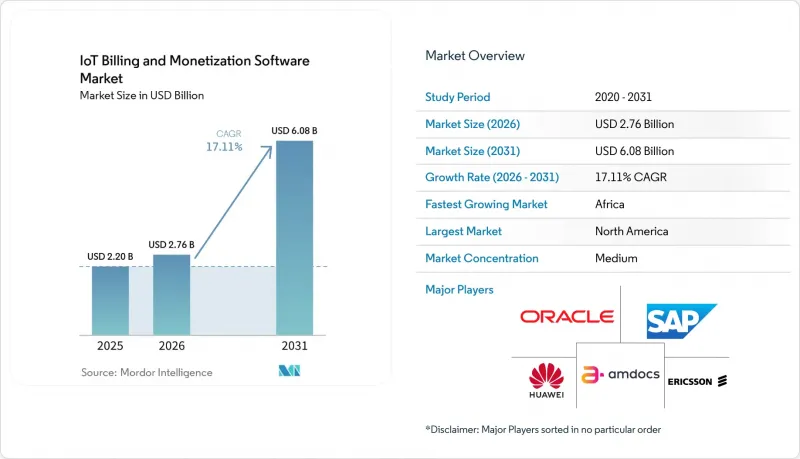
據 Mordor Intelligence 稱,物聯網收費和貨幣化軟體市場預計將從 2025 年的 22 億美元成長到 2026 年的 27.6 億美元,到 2031 年的複合年成長率為 17.11%。
全球物聯網收費及貨幣化軟體市場趨勢及洞察
連接設備和使用事件數量的增加
預計到2025年底,蜂巢式物聯網連接數將達到45億,到2031年,物聯網連接總數將達到471億,複合年成長率(CAGR)為13%。這種成長將增加收費平台需要收集、分類、評估和匹配的事件數量。例如,公用事業收費計量表會週期性地傳輸少量數據,而支援5G RedCap的視訊設備可能會產生持續流量,且服務品質(QoS)狀況會波動。為了因應這些不同的模式,需要製定能夠識別設備類型、使用等級、網路狀況和付款方的定價規則。在德國,預計到2026年底,將部署超過9,600萬張機器SIM卡,這將顯著擴大需要基於機器的收費流程的設備基數。因此,隨著電信業者能夠處理各種事件結構的平台取代為簡單的消費者流量設計的系統,物聯網收費和貨幣化軟體市場將從中受益。
引入訂閱和按使用量計費的經營模式
互聯產品供應商正從一次性設備銷售轉向訂閱、使用費和服務包模式。這種轉變需要一個能夠處理計量使用量、應用混合定價規則並在單一工作流程中支援收入確認的平台。 2026年3月,Stripe推出了機器支付協議(Machine Payments Protocol),這是一種用於編配自主機器間支付的開放式方法。這一趨勢表明,機器發起的支付事件正成為互聯服務供應商面臨的一項真正挑戰。 Golioth轉向模組化的基於使用量的定價模式也反映出,需要將細粒度的設備活動合理地分配到不同的設備群體中。隨著提供者需要可靠的記錄來了解哪些設備消耗了資源、應用了哪些合約以及應該向哪些客戶或合作夥伴收費,物聯網收費和貨幣化軟體市場的重要性日益凸顯。
整合傳統OSS/BSS系統的複雜性
在傳統的業務支援系統中,產品目錄、定價規則、配置流程和客戶記錄通常整合在緊密關聯的元件中。要在不中斷運作中的情況下隔離這些收費,需要並行運行、資料同步以及對每條產品線進行全面測試。此外,新的物聯網服務可能需要網路營運和收費系統之間進行額外的協調。當營運商需要連接多個裝置平台、合作夥伴應用程式和網路技術時,這會增加部署負擔。現代化專案啟動後,也可能出現未記錄的業務規則,導致計劃的服務發布延遲。這些問題會減緩物聯網收費和貨幣化軟體市場的普及速度,尤其是在服務供應商擁有眾多部署基地且對收費中斷接受度較低的情況下。
細分市場分析
2025年,軟體解決方案將佔據物聯網收費和貨幣化軟體市場71.98%的佔有率。此結果反映了定價、計費、收費、中介和支付軟體在互聯服務交付中的核心作用。當定價引擎整合到電信業者的生產環境中時,這些變更可能會影響現有客戶、產品目錄和合作夥伴協議。這會導致高昂的過渡成本,以及需要維護多年期的許可、支援和維護合約關係。在此領域,人們正逐漸轉向基於人工智慧的組態管理和可組合軟體,而不是完全取代現有平台。 2026年3月,Amdocs宣布將在CES26上推出一款專用的貨幣化代理,用於大規模服務交付和配置驅動的整合收費功能。 2026年5月,Aria Systems宣布推出獨立產品Aria Allegro,這反映了市場對無需替換整個技術堆疊即可部署的收費組件的需求。遵守 TM Forum 的開放數位架構也很重要,因為越來越多的買家正在尋求開放介面,以減少對未來整合的依賴。
服務包括整合、諮詢、遷移、配置和託管計費營運。隨著電信業者從傳統BSS系統遷移到雲端環境,這些活動仍然至關重要。服務供應商協助企業繪製舊定價邏輯、匹配資料、測試計費結果,並協助運作中客戶的遷移。隨著電信業者在現有消費者和企業產品的基礎上推出新的物聯網應用場景,對服務的需求可能會達到最高水準。同時,人工智慧驅動的規則制定可能會減少對勞動密集型專業服務的長期需求。因此,供應商需要在短期部署收入和更簡單、更可重複的軟體部署價值之間取得平衡。收費和貨幣化軟體產業依賴這兩方面,但軟體的價值在於它能夠持續嵌入現有的收費流程中。穩定的軟體基礎架構還可以支援客戶部署新產品、合作夥伴或設備組時的業務收益。
到 2025 年,基於雲端的部署將佔據物聯網收費和貨幣化軟體市場 67.11% 的佔有率。電信業者正在利用雲端容量來應對設備數量和交易量的波動,而無需為每個高峰需求建立相應的基礎設施。雲端原生收費系統支援透過可設定服務和容器化工作負載引入新的使用計畫。這支援根據資料使用量、設備狀態、服務等級或網路品質而變化的互聯服務。它還有助於提供者透過 API 將收費功能與面向客戶的應用程式整合。泰國 AIS 公司已部署 Netcracker 的雲端原生 BSS 平台,用於 B2C、B2B 和物聯網服務,展示如何在多個業務部門之間利用通用平台。此次部署提高了可擴展性,並縮短了新互聯服務的推出時間。這些優勢鞏固了雲端產品在物聯網收費和貨幣化軟體市場的地位。
當雲端託管受到隱私法規、安全策略或資料居住要求的限制時,本地部署仍然可行。一些電信業者也維護本地系統,因為他們現有的收費流程與內部應用程式緊密整合。歐盟資料法的資料存取要求可能會增加介面現代化的壓力,即使對於維護本地環境的客戶也是如此。雖然舊有系統可能需要自訂連接器來支援已記錄的資料存取流程,但雲端原生系統通常將 API 功能作為標準特性。 Cerillion 於 2025 年透過與 MVNX 的合作擴展了業務,增加了預付和後付費用戶的模組,並為 MVNO 客戶啟用了多租戶收費。此案例表明,面向 SaaS 的交付模式如何減輕服務供應商的資本和部署負擔。部署選擇將繼續取決於客戶的營運模式、合規義務以及他們實現傳統系統現代化的能力。
區域分析
2025年,北美將佔據物聯網收費和貨幣化軟體市場的32.22%。一級電信業者的現代化以及通用。 CMS代碼的變更也催生了醫療保健領域對連接遙測記錄和報銷工作流程的系統的需求。加拿大透過製造業和公共產業領域的企業項目為市場做出貢獻。墨西哥則透過聯網汽車遠端資訊處理和智慧公共產業項目做出貢獻。
在歐洲,大規模的企業部署計畫與嚴格的法規環境並存。歐盟資料法、不斷變化的資料收集預期以及即將訂定的《網路彈性法》的要求,都促使供應商將存取控制、安全性和報告控制視為產品特性。在德國,預計到2026年底將部署超過9,600萬張機器SIM卡,這將增加需要基於機器的收費和結算的連接數量。此外,德國電信計劃於2028年6月停止2G服務,這將成為支援舊款物聯網設備的營運商過渡到修訂後的收費系統的最後期限。英國資訊專員辦公室(ICO)於2026年6月11日更新了其關於消費者物聯網產品和服務的指南。 Hansen Technologies於2026年5月與德國電信續簽了夥伴關係,旨在將數百萬客戶遷移到基於雲端、人工智慧和API的BSS解決方案。鑑於這些情況,歐洲對於合規且適應性強的收費平台至關重要。
預計到2031年,非洲將以18.84%的複合年成長率成長,成為物聯網收費和貨幣化軟體市場中成長最快的地區。亞太地區擁有最龐大的連接基礎設施,其中東北亞地區到2025年底將佔蜂巢式物聯網連接量的70%。日本、韓國、中國和印度擁有大規模的設備用戶群,需要高吞吐量的收費處理能力。在中東,Cerillion對阿曼電信的改造顯示了在地託管需求如何影響平台架構。預計到2025年,行動技術將在非洲創造2,400億美元的經濟價值,到2030年將達到2,900億美元。根據GSMA的報告,截至2026年5月,非洲37個市場的61家電信業者已推出5G服務。在南美洲,巴西和阿根廷正在推進智慧公用事業計量和企業車輛管理專案。
其他好處:
- Excel格式的市場預測(ME)表
- 3個月的分析師支持
目錄
第1章:引言
- 研究假設和市場定義
- 調查範圍
第2章:調查方法
第3章執行摘要
第4章 市場狀況
- 市場概覽
- 宏觀經濟因素對市場的影響
- 市場促進因素
- 增加連網設備的數量及其使用機會。
- 引入訂閱和按使用量計費的經營模式
- 通訊和企業業務支撐系統的雲端原生轉型
- 對即時收入保障和收費準確性的要求
- 自主設備和機器對機器(M2M)商務
- 共用聯網基礎架構中的多方支付
- 市場限制因素
- 整合傳統OSS/BSS系統的複雜性
- 關於資料隱私、網路安全和資料主權的要求
- 設備協定碎片化和使用遙測數據不一致。
- 在低 ARPU 實施案例中,證明經濟價值的難度很高。
- 產業價值鏈分析
- 監理情勢
- 技術展望
- 波特五力分析
第5章 市場規模與成長預測
- 按組件
- 軟體解決方案
- 服務
- 部署模式
- 基於雲端的
- 現場
- 按組織規模
- 大公司
- 小型企業
- 透過使用
- 聯網汽車和車隊服務
- 工業IoT(IIoT) 和預測性維護
- 智慧公用事業和電錶到現金
- 智慧城市與智慧建築
- 互聯醫療保健和醫療設備
- 零售、支付、互聯商務
- 其他用途
- 最終用戶
- 電信營運商
- 公司
- 託管服務供應商
- 政府和公共部門組織
- 按地區
- 北美洲
- 美國
- 加拿大
- 墨西哥
- 南美洲
- 巴西
- 阿根廷
- 其他南美國家
- 歐洲
- 德國
- 英國
- 法國
- 義大利
- 其他歐洲國家
- 亞太地區
- 中國
- 日本
- 印度
- 韓國
- 澳洲
- 其他亞太國家
- 中東
- 阿拉伯聯合大公國
- 沙烏地阿拉伯
- 其他中東國家
- 非洲
- 南非
- 奈及利亞
- 其他非洲國家
- 北美洲
第6章 競爭情勢
- 市場集中度
- 策略趨勢
- 市佔率分析
- 公司簡介
- Amdocs Limited
- Oracle Corporation
- SAP SE
- Telefonaktiebolaget LM Ericsson(publ)
- Huawei Technologies Co., Ltd.
- CSG Systems International, Inc.
- Nokia Corporation
- Comarch SA
- MATRIXX Software, Inc.
- Cerillion plc
- Aria Systems, Inc.
- Zuora, Inc.
- LogiSense Corporation
- PortaOne, Inc.
- Optiva, Inc.
- Netcracker Technology Corporation
- Hansen Technologies Limited
- Eseye Limited
- Aeris Communications, Inc.
第7章 市場機會與未來展望
According to Mordor Intelligence, the IoT billing and monetization software market size is expected to increase from USD 2.20 billion in 2025 to USD 2.76 billion in 2026 and reach USD 6.08 billion by 2031, growing at a CAGR of 17.11% over 2026-2031.
Global IoT Billing and Monetization Software Market Trends and Insights
Expansion of Connected Device Fleets and Usage Events
Cellular IoT connections reached 4.5 billion at the end of 2025, while total IoT connections are projected to reach 47.1 billion by 2031 at a 13% CAGR. This scale increases the volume of events that billing platforms must collect, classify, rate, and reconcile. A utility meter may send periodic low-volume data, while a 5G RedCap video device can create continuous traffic that is subject to changing quality-of-service terms. These different patterns require pricing rules that recognize device type, usage level, network conditions, and the party responsible for payment. Germany was expected to have more than 96 million machine SIM cards by the end of 2026, adding a substantial device base that requires machine-oriented billing processes. The IoT billing and monetization software market therefore benefits when operators replace systems designed for simpler consumer traffic with platforms that handle diverse event structures.
Subscription and Usage-Based Business Model Adoption
Connected-product providers are shifting from one-time device sales toward subscriptions, usage charges, and service bundles. That shift requires a platform that can process metered usage, apply hybrid pricing rules, and support revenue recognition in one workflow. Stripe introduced its Machine Payments Protocol in March 2026 as an open approach for autonomous machine-to-machine payment orchestration. The development indicates that machine-originated payment events are becoming a practical consideration for connected-service providers. Golioth's move to modular usage-based pricing also reflected the need to attribute granular device activity across mixed fleets. The IoT billing and monetization software market gains relevance as providers need a reliable record of what a device consumed, which contract applied, and which customer or partner should be charged.
Legacy OSS/BSS Integration Complexity
Older business support systems often combine product catalogs, rating rules, provisioning processes, and customer records in tightly connected components. Separating these functions without disrupting active billing requires parallel operations, data synchronization, and extensive testing for each product line. New IoT services can also require additional links between network operations systems and billing systems. This creates an implementation burden when operators need to connect several device platforms, partner applications, and network technologies. Undocumented business rules may emerge after a modernization project starts and delay the intended service launch. These issues can slow adoption in the IoT billing and monetization software market, especially where a provider has a large installed base and limited tolerance for billing disruption.
Other drivers and restraints analyzed in the detailed report include:
- Cloud-Native Transformation of Telecom and Enterprise BSS
- Real-Time Revenue Assurance and Billing Accuracy Requirements
- Data Privacy, Cybersecurity, and Data Sovereignty Requirements
For complete list of drivers and restraints, kindly check the Table Of Contents.
Segment Analysis
Software solutions held 71.98% of the IoT billing and monetization software market share in 2025. The result reflected the central role of rating, charging, invoicing, mediation, and settlement software in a connected-service offering. Once a rating engine is integrated into an operator's production environment, changing it can affect active customers, product catalogs, and partner arrangements. This creates high switching costs and supports multiyear license, support, and maintenance relationships. The category is moving toward AI-supported configuration and composable software rather than complete platform replacement. Amdocs introduced CES26 in March 2026 with specialized monetization agents and configuration-driven convergent charging for large-scale service delivery. Aria Systems introduced Aria Allegro as a standalone product in May 2026, reflecting demand for billing components that can be adopted without replacing an entire stack. TM Forum Open Digital Architecture alignment also matters because buyers increasingly seek open interfaces that reduce future integration dependence.
Services include integration, consulting, migration, configuration, and managed billing operations. These activities remain important when operators move from older BSS systems to cloud-based environments. Service providers help organizations map legacy rating logic, reconcile data, test billing outcomes, and support the transition of live customers. The demand for services can be strongest when an operator adds new IoT use cases alongside existing consumer and enterprise products. At the same time, AI-supported rule configuration may reduce the long-term need for labor-intensive professional-service work. Vendors must therefore balance near-term implementation revenue with the value of simpler and more repeatable software deployment. The IoT billing and monetization software industry depends on both categories, but software retains the larger value position because it stays embedded in the recurring billing process. A stable software base can also support services revenue when customers introduce new products, partners, or device groups.
Cloud-based deployment accounted for 67.11% of the IoT billing and monetization software market share in 2025. Operators use cloud capacity to accommodate changes in device counts and transaction volumes without building equivalent infrastructure for every demand peak. Cloud-native billing systems can introduce new usage plans through configurable services and containerized workloads. This supports connected offers that change by data usage, device status, service tier, or network quality. It also helps providers connect billing functions with customer applications through APIs. AIS in Thailand deployed a Netcracker cloud-native BSS platform for B2C, B2B, and IoT services, illustrating the use of a common platform across several business lines. The deployment supported greater scalability and shorter time to launch new connected offerings. These capabilities strengthen the role of cloud delivery in the IoT billing and monetization software market.
On-premises installations remain relevant when privacy rules, security policies, or data residency requirements limit cloud hosting. Some operators also retain local systems because existing billing processes are deeply connected to internal applications. The EU Data Act's data-access requirements can increase the pressure to modernize interfaces, even where a customer retains an on-premises environment. Legacy systems may need custom connectors to support documented data-access processes, while cloud-native systems often include API functions as a standard element. Cerillion's 2025 expansion with MVNX added modules for prepaid and postpaid subscribers and enabled multi-tenant billing for MVNO customers. The case shows how SaaS-oriented delivery can reduce the capital and implementation burden for service providers. Deployment choices will remain shaped by a customer's operating model, compliance obligations, and ability to modernize older systems.
Complete Report Scope:
- By Component
- Software Solutions
- Services
- By Deployment Mode
- Cloud-Based
- On-Premises
- By Organization Size
- Large Enterprises
- Small and Medium-Sized Enterprises
- By Application
- Connected Vehicle and Fleet Services
- Industrial IoT and Predictive Maintenance
- Smart Utilities and Meter-to-Cash
- Smart Cities and Smart Buildings
- Connected Healthcare and Medical Devices
- Retail, Payments, and Connected Commerce
- Other Applications
- By End User
- Telecom Operators
- Enterprises
- Managed Service Providers
- Government and Public-Sector Organizations
- By Geography
- North America
- United States
- Canada
- Mexico
- South America
- Brazil
- Argentina
- Rest of South America
- Europe
- Germany
- United Kingdom
- France
- Italy
- Rest of Europe
- Asia-Pacific
- China
- Japan
- India
- South Korea
- Australia
- Rest of Asia-Pacific
- Middle East
- United Arab Emirates
- Saudi Arabia
- Rest of Middle East
- Africa
- South Africa
- Nigeria
- Rest of Africa
- North America
Geography Analysis
North America held 32.22% of the IoT billing and monetization software market share in 2025. The region's position was supported by Tier-1 telecom modernization and enterprise adoption of connected-service platforms. Amdocs and AWS announced a multiyear strategic collaboration in February 2026 that focused on cloud-based platforms for AI services, network APIs, and IoT connectivity. This reflects the demand for platforms that can price several digital services through a common operating environment. The CMS code changes also add a healthcare-related demand stream for systems that connect telemetry records with reimbursement workflows. Canada contributes through enterprise programs in manufacturing and utilities. Mexico contributes through connected-vehicle telematics and smart-utility programs.
Europe combines a substantial enterprise deployment pipeline with a demanding regulatory environment. The EU Data Act, changing data-collection expectations, and forthcoming Cyber Resilience Act obligations require vendors to treat access, security, and reporting controls as product capabilities. Germany was expected to have more than 96 million machine SIM cards by the end of 2026, increasing the number of connections that require machine-oriented charging and settlement. Deutsche Telekom's planned June 2028 2G shutdown also creates a deadline for re-rating migrations among operators supporting older IoT devices. The UK Information Commissioner's Office updated its guidance for consumer IoT products and services on June 11, 2026. Hansen Technologies renewed its Telefonica Germany partnership in May 2026 to support the migration of several million customers to cloud, AI, and API-powered BSS solutions. These conditions make Europe an important market for compliant and adaptable billing platforms.
Africa is projected to expand at an 18.84% CAGR through 2031, the fastest regional rate in the IoT billing and monetization software market. Asia-Pacific has the largest connection base, with North East Asia accounting for 70% of cellular IoT connections at the end of 2025. Japan, South Korea, China, and India operate large device fleets that require high-throughput billing capacity. In the Middle East, Cerillion's Omantel transformation showed how local hosting requirements can shape platform architecture. Mobile technologies generated USD 240 billion in economic value across Africa in 2025 and are projected to reach USD 290 billion by 2030. GSMA reported that 61 operators in 37 African markets had launched 5G services by May 2026. South America is progressing through smart-utility metering and enterprise fleet-management programs in Brazil and Argentina.
- Amdocs Limited
- Oracle Corporation
- SAP SE
- Telefonaktiebolaget LM Ericsson (publ)
- Huawei Technologies Co., Ltd.
- CSG Systems International, Inc.
- Nokia Corporation
- Comarch S.A.
- MATRIXX Software, Inc.
- Cerillion plc
- Aria Systems, Inc.
- Zuora, Inc.
- LogiSense Corporation
- PortaOne, Inc.
- Optiva, Inc.
- Netcracker Technology Corporation
- Hansen Technologies Limited
- Eseye Limited
- Aeris Communications, Inc.
Additional Benefits:
- The market estimate (ME) sheet in Excel format
- 3 months of analyst support
TABLE OF CONTENTS
1 INTRODUCTION
- 1.1 Study Assumptions and Market Definition
- 1.2 Scope of the Study
2 RESEARCH METHODOLOGY
3 EXECUTIVE SUMMARY
4 MARKET LANDSCAPE
- 4.1 Market Overview
- 4.2 Impact of Macroeconomic Factors on the Market
- 4.3 Market Drivers
- 4.3.1 Expansion of Connected Device Fleets and Usage Events
- 4.3.2 Subscription and Usage-Based Business Model Adoption
- 4.3.3 Cloud-Native Transformation of Telecom and Enterprise BSS
- 4.3.4 Real-Time Revenue Assurance and Billing Accuracy Requirements
- 4.3.5 Autonomous Device and Machine-to-Machine Commerce
- 4.3.6 Multi-Party Settlement for Shared IoT Infrastructure
- 4.4 Market Restraints
- 4.4.1 Legacy OSS/BSS Integration Complexity
- 4.4.2 Data Privacy, Cybersecurity, and Data Sovereignty Requirements
- 4.4.3 Fragmented Device Protocols and Inconsistent Usage Telemetry
- 4.4.4 Difficulty Proving Economic Value for Low-ARPU Deployments
- 4.5 Industry Value Chain Analysis
- 4.6 Regulatory Landscape
- 4.7 Technological Outlook
- 4.8 Porter's Five Forces Analysis
- 4.8.1 Threat of New Entrants
- 4.8.2 Bargaining Power of Suppliers
- 4.8.3 Bargaining Power of Buyers
- 4.8.4 Threat of Substitutes
- 4.8.5 Competitive Rivalry
5 MARKET SIZE AND GROWTH FORECASTS (VALUE)
- 5.1 By Component
- 5.1.1 Software Solutions
- 5.1.2 Services
- 5.2 By Deployment Mode
- 5.2.1 Cloud-Based
- 5.2.2 On-Premises
- 5.3 By Organization Size
- 5.3.1 Large Enterprises
- 5.3.2 Small and Medium-Sized Enterprises
- 5.4 By Application
- 5.4.1 Connected Vehicle and Fleet Services
- 5.4.2 Industrial IoT and Predictive Maintenance
- 5.4.3 Smart Utilities and Meter-to-Cash
- 5.4.4 Smart Cities and Smart Buildings
- 5.4.5 Connected Healthcare and Medical Devices
- 5.4.6 Retail, Payments, and Connected Commerce
- 5.4.7 Other Applications
- 5.5 By End User
- 5.5.1 Telecom Operators
- 5.5.2 Enterprises
- 5.5.3 Managed Service Providers
- 5.5.4 Government and Public-Sector Organizations
- 5.6 By Geography
- 5.6.1 North America
- 5.6.1.1 United States
- 5.6.1.2 Canada
- 5.6.1.3 Mexico
- 5.6.2 South America
- 5.6.2.1 Brazil
- 5.6.2.2 Argentina
- 5.6.2.3 Rest of South America
- 5.6.3 Europe
- 5.6.3.1 Germany
- 5.6.3.2 United Kingdom
- 5.6.3.3 France
- 5.6.3.4 Italy
- 5.6.3.5 Rest of Europe
- 5.6.4 Asia-Pacific
- 5.6.4.1 China
- 5.6.4.2 Japan
- 5.6.4.3 India
- 5.6.4.4 South Korea
- 5.6.4.5 Australia
- 5.6.4.6 Rest of Asia-Pacific
- 5.6.5 Middle East
- 5.6.5.1 United Arab Emirates
- 5.6.5.2 Saudi Arabia
- 5.6.5.3 Rest of Middle East
- 5.6.6 Africa
- 5.6.6.1 South Africa
- 5.6.6.2 Nigeria
- 5.6.6.3 Rest of Africa
- 5.6.1 North America
6 COMPETITIVE LANDSCAPE
- 6.1 Market Concentration
- 6.2 Strategic Moves
- 6.3 Market Share Analysis
- 6.4 Company Profiles (includes Global Level Overview, Market Level Overview, Core Segments, Financials as available, Strategic Information, Market Rank/Share, Products and Services, Recent Developments)
- 6.4.1 Amdocs Limited
- 6.4.2 Oracle Corporation
- 6.4.3 SAP SE
- 6.4.4 Telefonaktiebolaget LM Ericsson (publ)
- 6.4.5 Huawei Technologies Co., Ltd.
- 6.4.6 CSG Systems International, Inc.
- 6.4.7 Nokia Corporation
- 6.4.8 Comarch S.A.
- 6.4.9 MATRIXX Software, Inc.
- 6.4.10 Cerillion plc
- 6.4.11 Aria Systems, Inc.
- 6.4.12 Zuora, Inc.
- 6.4.13 LogiSense Corporation
- 6.4.14 PortaOne, Inc.
- 6.4.15 Optiva, Inc.
- 6.4.16 Netcracker Technology Corporation
- 6.4.17 Hansen Technologies Limited
- 6.4.18 Eseye Limited
- 6.4.19 Aeris Communications, Inc.
7 MARKET OPPORTUNITIES AND FUTURE OUTLOOK
- 7.1 White-Space and Unmet-Need Assessment

 南美洲訂閱和計費管理:市場佔有率分析、行業趨勢和統計數據以及成長預測(2026-2031 年)網路API貨幣化:市場佔有率分析、產業趨勢與統計、成長預測(2026-2031年)訂閱收費管理:市場佔有率分析、產業趨勢與統計、成長預測(2026-2031 年)
 個人財務管理及訂閱管理應用市場預測至2034年-全球平台類型、功能、獲利模式、產品類型、應用、使用者類型及區域分析
 訂閱收費管理市場機會、成長要素、產業趨勢分析及 2026-2035 年預測。
 2026年全球訂閱與計費管理市場報告2026年全球訂閱計費管理市場報告
 全球訂閱計費管理市場:依軟體、服務、部署類型、企業規模、最終用途和地區劃分 - 市場規模、行業趨勢、機會分析和預測(2026-2035年)全球訂閱收費管理市場:預測至 2032 年-按組件、部署方式、公司規模、技術、最終用戶和地區進行分析拉丁美洲訂閱和收費管理 -市場佔有率分析、行業趨勢和統計、成長預測(2025-2030)