

 |
市場調查報告書
商品編碼
2124579
訂閱收費管理:市場佔有率分析、產業趨勢與統計、成長預測(2026-2031 年)Subscription Billing Management - Market Share Analysis, Industry Trends & Statistics, Growth Forecasts (2026 - 2031) |
||||||

※ 本網頁內容可能與最新版本有所差異。詳細情況請與我們聯繫。
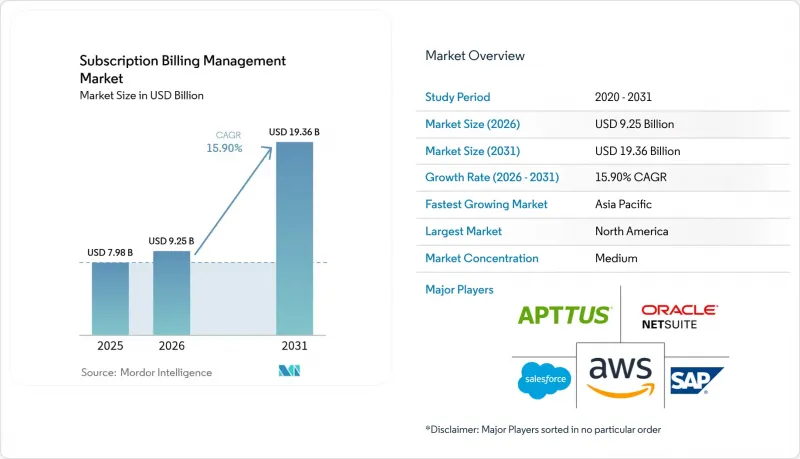
據 Mordor Intelligence 稱,訂閱收費管理市場預計到 2026 年價值 92.5 億美元,高於 2025 年的 79.8 億美元,預計到 2031 年將達到 193.6 億美元。
預計 2026 年至 2031 年的複合年成長率為 15.9%。
本報告按元件(軟體、服務)、部署模式(本地部署、雲端部署)、企業規模(大型企業、中小企業)、最終用戶產業(零售和電子商務、銀行、金融服務和保險、IT和電信、媒體和娛樂等)以及地區(北美、歐洲等)進行細分。市場預測以美元計價。
全球訂閱收費管理市場趨勢與洞察
透過「即服務」模式實現獲利,正在加速通訊業的收入多元化。
電信公司正將 5G 連接與娛樂、物聯網和邊緣運算等服務捆綁在一起,利用整合收費引擎在多個參與者之間共享收入,並調整混合使用費和訂閱費。 T-Mobile 的套餐(包括 Netflix)和 Verizon 的娛樂捆綁包清晰地展現了向以體驗為中心的服務模式的轉變。模組化平台可自動完成收費運算、中介服務和合作夥伴結算,進而縮短現金流到帳時間,支援可預測的現金流,並促進微服務實驗。諸如 Evergent 的數位商務橋等新興工具使電信業者能夠動態地疊加促銷和提升銷售,從而提高每位用戶平均收入 (ARPU)。
付費使用制正在改變雲端基礎設施的經濟格局。
AWS、Azure 和 Google Cloud 已將計量收費標準化,使企業客戶能夠要求按分鐘追蹤、基於閾值的警報以及使用後計費。 Snowflake 在基於使用量的合約方面取得的成功清楚地表明,當客戶的使用量與所交付的價值同步成長時,就會產生巨大的收入飛輪效應。現代收費系統能夠捕捉數十億次的使用事件,應用分級定價和突發定價,並即時處理跨區域的稅務結算。供應商報告稱,隨著初始合約金額的降低,購買門檻降低,並且提升銷售途徑被整合到數據驅動的定價曲線中,客戶維繫率提高了。
支付詐騙激增,對跨境訂閱模式構成威脅。
2023年,全球因詐欺造成的損失高達4,850億美元,其中「已通過核准推送支付詐騙」激增,消費者被誘騙授權看似合法的轉帳。訂閱服務供應商必須在流暢的續約流程和強而有力的反詐騙措施之間取得平衡。這就需要投資人工智慧驅動的模式識別工具,以減少誤報並維護客戶信任。監管政策的變化,例如英國的強制退款政策,正在將責任轉移到支付服務提供者身上,加速對自適應風險引擎和全網異常檢測的投資。
細分市場分析
預計到2025年,雲端採用將佔總收入的75.35%,這主要得益於對自動化擴展和全球分散式收費引擎的需求,這些引擎能夠減輕維護負擔。雲端採用領域的訂閱收費管理市場預計到2031年將以18.05%的複合年成長率成長,反映出企業對公共雲端安全認證的信心日益增強,以及基於使用量的成本結構更具吸引力。 Stripe Billing作為完全託管服務,透過為領先的科技公司提供精細化的收費計量和自動匹配功能,其年收入已超過5億美元。在資料居住必須得到保障的高度監管行業中,本地部署仍然存在,但由於加密技術的進步和私有雲端選項的不斷增加,這一細分市場正在萎縮。
每週更新、零停機升級以及供應商承諾與超過 40 家付款閘道進行原生整合,正在推動雲端遷移。混合架構將敏感資料保存在私有環境中,同時在雲端處理定價和計費,為謹慎的企業提供了過渡方案。隨著雲端採用率的提高,供應商正在投資可觀測性工具,使財務團隊能夠追蹤從資料來源到發票開立的每一個使用事件,從而降低審計風險並支持遵守《薩班斯-奧克斯利法案》。
至2025年,平台軟體將維持79.40%的收入佔有率,提供核心的計量、定價和收入管理功能。同時,隨著企業尋求諮詢、整合和託管營運支持,服務業正以19.05%的複合年成長率成長。供應商正在捆綁加速器套件、預先建造連接器和法規變更合規包,以縮短價值實現時間;而合作夥伴則在運營「配置即代碼」管道,將收費邏輯整合到DevOps工作流程中。
諮詢服務涵蓋定價模式設計、產品上市時間準備以及收入確認 (RevRec) 合規性——這些領域往往是財務和產品團隊缺乏足夠專業知識的領域。雖然低程式碼架構和可組合 API 的興起正在擴大目標市場,但隨著企業將分級訂閱與超額使用和通路經銷商利潤結合,複雜性也隨之增加。該服務領域的成長趨勢表明,訂閱收費管理市場的成功在很大程度上取決於領域專業知識以及軟體功能的廣度。
區域分析
北美地區佔全球整體收入的39.60%,這得益於成熟的SaaS滲透率、完善的卡組織網路以及優先考慮年度經常性收入(ARR)而非一次性銷售的投資者生態系統。該地區的法規環境鼓勵創新。加州消費者隱私法案(CCPA)明確了用戶同意的要求,但並未強制規定特定的收費架構,這使得供應商能夠自由創新。 Stripe、Zuora和Chargebee等美國領先公司已在全球部署了其平台,僅Stripe Billing就為Atlassian和OpenAI處理訂閱支付。
亞太地區是成長最快的地區,年複合成長率高達21.05%。支付創新,尤其是印度的UPI和新加坡的PayNow,正在降低交易成本,並支援以低於1美元的增量從錢包中扣款的微訂閱模式。東南亞國協政府正致力於協調跨境QR碼框架和資料保護法律,加速全球企業在該地區部署服務的步伐。中國本土的技術體系支撐著涵蓋電子商務、串流媒體和遊戲經濟的龐大訂閱生態系統,但供應商需要根據當地需求調整其稅務、計費和資料託管系統。
歐洲透過PSD2-SCA和即將訂定的歐盟數據法案,在製定合規標準方面繼續發揮至關重要的作用。該法案中的主權條款也影響歐盟以外地區的架構決策。預計美國供應商將在部署方面投入220億至500億美元,將推動分散式資料儲存節點和可設定資料共用儀表板的普及。儘管拉丁美洲、中東和非洲等新興地區在絕對值上落後於歐盟,但由於行動普及率的提高和即時支付基礎設施的成熟,這些地區正保持兩位數的成長率。
其他好處:
- Excel格式的市場預測(ME)表
- 3個月的分析師支持
目錄
第1章:引言
- 研究假設和市場定義
- 調查範圍
第2章:調查方法
第3章執行摘要
第4章 市場狀況
- 市場概覽
- 市場促進因素
- 北美電信和媒體產業透過「即服務」加速實現獲利,正在推動市場發展。
- 雲端基礎設施供應商中基於使用量的收費模式的出現正在推動市場成長。
- 根據歐盟的PSD2-SCA,推動透明的定期收費監管工作。
- 數位錢包和即時支付的融合正在推動亞洲零售訂閱業務的擴張。
- 工業軟體領域從永久授權轉向SaaS的轉變。
- 市場限制因素
- 在跨境循環支付領域,由於支付詐騙和扣回爭議帳款導致成本上升,阻礙了市場成長。
- 大型企業中傳統ERP/CRM系統整合的複雜性
- 歐盟和中東非共和國關於資料主權的法規限制了集中式主張。
- 高昂的遷移成本阻礙了中小企業從其內部開發的系統遷移。
- 價值鏈分析
- 監理展望
- 技術展望
- 市場宏觀經濟趨勢的評估
- 波特五力分析
第5章 市場規模與成長預測
- 按組件
- 軟體
- 服務
- 部署模式
- 現場
- 雲
- 按公司規模
- 大公司
- 中小企業
- 按最終用戶行業分類
- 零售與電子商務
- BFSI
- 資訊科技/通訊
- 媒體與娛樂
- 公共部門和公共產業
- 其他終端用戶產業
- 按地區
- 北美洲
- 美國
- 加拿大
- 墨西哥
- 歐洲
- 英國
- 德國
- 法國
- 其他歐洲國家
- 亞太地區
- 中國
- 印度
- 日本
- 東南亞
- 其他亞太國家
- 南美洲
- 巴西
- 阿根廷
- 其他南美國家
- 中東和非洲
- 中東
- GCC
- 土耳其
- 以色列
- 其他中東國家
- 非洲
- 南非
- 奈及利亞
- 肯亞
- 其他非洲國家
- 中東
- 北美洲
第6章 競爭情勢
- 市場集中度
- 策略趨勢
- 市佔率分析
- 公司簡介
- Apttus Corporation
- Oracle Corporation(NetSuite)
- SAP SE
- Salesforce.com Inc.
- Amazon Web Services
- Recurly Inc.
- Stripe Inc.
- Paddle.com Market Ltd.
- Chargify LLC(Scaleworks)
- Vindicia Inc.
- BillingPlatform.com
- Gotransverse LLC
- Zuora Inc.
- 2Checkout/Verifone
- Chargebee Inc.
- Zoho Corporation Pvt. Ltd.
- FastSpring
- PayPal Holdings Inc.
- CloudBlue(Ingram Micro)
- Payrix(Worldpay/FIS)
第7章 市場機會與未來展望
According to Mordor Intelligence, subscription billing management market size in 2026 is estimated at USD 9.25 billion, growing from 2025 value of USD 7.98 billion with 2031 projections showing USD 19.36 billion, growing at 15.9% CAGR over 2026-2031.
This report is Segmented by Component (Software, Services), Deployment Mode (On-Premise, Cloud), Enterprise Size (Large Enterprises, Small and Medium Enterprises), End-User Industry (Retail and E-Commerce, BFSI, IT and Telecom, Media and Entertainment, and More), and Geography (North America, Europe, and More). The Market Forecasts are Provided in Terms of Value (USD).
Global Subscription Billing Management Market Trends and Insights
As-a-Service monetization accelerates telecom revenue diversification
Telecom groups are pairing 5 G connectivity with entertainment, IoT, and edge-compute bundles, using unified billing engines to orchestrate multi-party revenue splits and hybrid usage plus subscription fees. T-Mobile's Netflix-inclusive plans and Verizon's entertainment bundles illustrate the pivot to experience-centric offerings. Modular platforms cut time-to-cash by automating rating, mediation, and partner settlement, supporting predictable cashflows while enabling micro-services experimentation. Emerging tools such as Evergent's Digital Commerce Bridge allow operators to layer promotions and upsells dynamically, widening average revenue per user.
Consumption-based pricing transforms cloud infrastructure economics
AWS, Azure, and Google Cloud normalised pay-as-you-use billing, prompting enterprise clients to demand minute-level metering, threshold-based alerts, and post-usage invoicing. Snowflake's success with usage-aligned contracts illustrates the revenue flywheel effect when customer consumption scales in lockstep with value delivered. Modern billing stacks ingest billions of usage events, apply tiered or burst prices, and reconcile taxes across regions in real time. Vendors report higher customer retention because smaller entry commitments reduce buyer friction, while upsell paths are embedded in data-driven price curves.
Payment-fraud escalation threatens cross-border subscription models
Global fraud losses hit USD 485 billion in 2023, with authorised push-payment scams surging as consumers are tricked into approving legitimate-looking transfers. Subscription merchants must balance frictionless renewal flows with strong anti-fraud layers, funding AI-powered pattern-recognition tools that cut false positives and retain customer trust. Regulatory responses such as the UK reimbursement mandate shift liability to payment firms, intensifying investment in adaptive risk engines and network-wide anomaly detection.
Other drivers and restraints analyzed in the detailed report include:
- EU PSD2-SCA mandates reshape payment authentication standards
- Digital-wallet integration accelerates Asian subscription adoption
- Legacy integration complexity delays enterprise billing modernisation
For complete list of drivers and restraints, kindly check the Table Of Contents.
Segment Analysis
Cloud deployment contributed 75.35% of 2025 revenue, underpinned by demand for auto-scaling, globally distributed billing engines that offload maintenance overheads. The subscription billing management market size for cloud deployment is expanding at an 18.05% CAGR through 2031, reflecting enterprise confidence in public-cloud security certifications and the appeal of usage-based cost structures. Stripe Billing, delivered entirely as a managed service, surpassed a USD 500 million annual run rate by supporting leading technology firms with granular metering and automated reconciliation. On-premise installations persist in highly regulated industries that require data residency guarantees, yet improved encryption and private-cloud options erode this niche.
Migration momentum is reinforced by vendor commitment to weekly release cadences, zero-downtime upgrades, and native integrations with over 40 payment gateways. Hybrid architectures-where sensitive data stays in a private environment while rating and invoicing happen in the cloud-act as transitional bridges for cautious enterprises. As cloud penetration rises, vendors invest in observability tooling that lets finance teams trace every usage event from source to invoice, mitigating audit risk and supporting Sarbanes-Oxley compliance.
Platform software retained 79.40% revenue share in 2025, supplying core metering, rating, and revenue management capabilities. Services, however, are growing at a 19.05% CAGR as enterprises seek advisory, integration, and managed-operations support. Vendors bundle accelerator kits, pre-built connectors, and regulatory change packs to shorten time-to-value, while partners run configuration-as-code pipelines that embed billing logic in DevOps workflows.
Consultative engagements cover pricing-model design, go-to-market readiness, and RevRec compliance, areas that finance and product teams often lack specialist resources for. The rise of low-code configuration and composable APIs widens addressable demand, but complexity spikes when firms blend tiered subscriptions with consumption overages and channel reseller margins. This services uptrend illustrates that success in the subscription billing management market depends as much on domain expertise as on software feature breadth.
Complete Report Scope:
- By Component
- Software
- Services
- By Deployment Mode
- On-Premise
- Cloud
- By Enterprise Size
- Large Enterprises
- Small and Medium Enterprises (SMEs)
- By End-user Industry
- Retail and E-commerce
- BFSI
- IT and Telecom
- Media and Entertainment
- Public Sector and Utilities
- Other End-user Industries
- By Geography
- North America
- United States
- Canada
- Mexico
- Europe
- United Kingdom
- Germany
- France
- Rest of Europe
- Asia-Pacific
- China
- India
- Japan
- South-East Asia
- Rest of Asia-Pacific
- South America
- Brazil
- Argentina
- Rest of South America
- Middle East and Africa
- Middle East
- GCC
- Turkey
- Israel
- Rest of Middle East
- Africa
- South Africa
- Nigeria
- Kenya
- Rest of Africa
- Middle East
- North America
Geography Analysis
North America generates 39.60% of global revenue, buoyed by mature SaaS penetration, established card networks, and an investor ecosystem that rewards annual recurring revenue over one-time sales. The region's regulatory environment encourages experimentation: the California Consumer Privacy Act clarifies consent requirements without prescribing specific billing architectures, allowing vendors to innovate freely. U.S. champions such as Stripe, Zuora, and Chargebee export their platforms worldwide, with Stripe Billing alone processing subscriptions for Atlassian and OpenAI.
Asia-Pacific is the fastest-growing geography at a 21.05% CAGR. Payment innovation, notably India's UPI and Singapore's PayNow, lowers transaction costs and supports micro-subscription models that debit wallets in sub-USD 1 increments. ASEAN governments coordinate cross-border QR frameworks and harmonise data-protection statutes, driving regional rollouts by global merchants. China's domestic technology stack supports vast subscription ecosystems across e-commerce, streaming, and in-game economies, though vendors must localise tax, invoicing, and data-hosting arrangements.
Europe maintains a pivotal role in shaping compliance standards through PSD2-SCA and the forthcoming EU Data Act, whose sovereignty clauses influence architecture decisions even outside the bloc. Implementation costs for U.S. vendors are projected between USD 22 billion and USD 50 billion, encouraging a shift toward distributed data-storage nodes and configurable data-sharing dashboards. Emerging regions in Latin America, the Middle East, and Africa trail in absolute value yet post double-digit growth rates as mobile penetration climbs and real-time payment rails mature.
- Apttus Corporation
- Oracle Corporation (NetSuite)
- SAP SE
- Salesforce.com Inc.
- Amazon Web Services
- Recurly Inc.
- Stripe Inc.
- Paddle.com Market Ltd.
- Chargify LLC (Scaleworks)
- Vindicia Inc.
- BillingPlatform.com
- Gotransverse LLC
- Zuora Inc.
- 2Checkout / Verifone
- Chargebee Inc.
- Zoho Corporation Pvt. Ltd.
- FastSpring
- PayPal Holdings Inc.
- CloudBlue (Ingram Micro)
- Payrix (Worldpay/FIS)
Additional Benefits:
- The market estimate (ME) sheet in Excel format
- 3 months of analyst support
TABLE OF CONTENTS
1 INTRODUCTION
- 1.1 Study Assumptions and Market Definition
- 1.2 Scope of the Study
2 RESEARCH METHODOLOGY
3 EXECUTIVE SUMMARY
4 MARKET LANDSCAPE
- 4.1 Market Overview
- 4.2 Market Drivers
- 4.2.1 Acceleration of as-a-Service monetization in telecom and media in North America drives the market
- 4.2.2 Emergence of consumption-based pricing among cloud infrastructure vendors drives the market
- 4.2.3 Regulatory push for transparent recurring billing under EU PSD2-SCA
- 4.2.4 Digital-wallet and real-time-payment integration driving retail subscriptions in Asia
- 4.2.5 Shift from perpetual licensing to SaaS in industrial software verticals
- 4.3 Market Restraints
- 4.3.1 Rising payment-fraud and charge-back cost in cross-border recurring payments hinders the market
- 4.3.2 Legacy ERP/CRM integration complexity for large enterprises
- 4.3.3 Data-sovereignty rules limiting centralized billing in EU and MEA
- 4.3.4 High switching costs curbing SMB migration from home-grown systems
- 4.4 Value Chain Analysis
- 4.5 Regulatory Outlook
- 4.6 Technological Outlook
- 4.7 Assessment of Macro Economic Trends on the Market
- 4.8 Porter's Five Forces Analysis
- 4.8.1 Bargaining Power of Suppliers
- 4.8.2 Bargaining Power of Buyers/Consumers
- 4.8.3 Threat of New Entrants
- 4.8.4 Threat of Substitutes
- 4.8.5 Intensity of Competitive Rivalry
5 MARKET SIZE AND GROWTH FORECASTS (VALUES)
- 5.1 By Component
- 5.1.1 Software
- 5.1.2 Services
- 5.2 By Deployment Mode
- 5.2.1 On-Premise
- 5.2.2 Cloud
- 5.3 By Enterprise Size
- 5.3.1 Large Enterprises
- 5.3.2 Small and Medium Enterprises (SMEs)
- 5.4 By End-user Industry
- 5.4.1 Retail and E-commerce
- 5.4.2 BFSI
- 5.4.3 IT and Telecom
- 5.4.4 Media and Entertainment
- 5.4.5 Public Sector and Utilities
- 5.4.6 Other End-user Industries
- 5.5 By Geography
- 5.5.1 North America
- 5.5.1.1 United States
- 5.5.1.2 Canada
- 5.5.1.3 Mexico
- 5.5.2 Europe
- 5.5.2.1 United Kingdom
- 5.5.2.2 Germany
- 5.5.2.3 France
- 5.5.2.4 Rest of Europe
- 5.5.3 Asia-Pacific
- 5.5.3.1 China
- 5.5.3.2 India
- 5.5.3.3 Japan
- 5.5.3.4 South-East Asia
- 5.5.3.5 Rest of Asia-Pacific
- 5.5.4 South America
- 5.5.4.1 Brazil
- 5.5.4.2 Argentina
- 5.5.4.3 Rest of South America
- 5.5.5 Middle East and Africa
- 5.5.5.1 Middle East
- 5.5.5.1.1 GCC
- 5.5.5.1.2 Turkey
- 5.5.5.1.3 Israel
- 5.5.5.1.4 Rest of Middle East
- 5.5.5.2 Africa
- 5.5.5.2.1 South Africa
- 5.5.5.2.2 Nigeria
- 5.5.5.2.3 Kenya
- 5.5.5.2.4 Rest of Africa
- 5.5.5.1 Middle East
- 5.5.1 North America
6 COMPETITIVE LANDSCAPE
- 6.1 Market Concentration
- 6.2 Strategic Moves
- 6.3 Market Share Analysis
- 6.4 Company Profiles (includes Global level Overview, Market level overview, Core Segments, Financials as available, Strategic Information, Market Rank/Share, Products and Services, Recent Developments)
- 6.4.1 Apttus Corporation
- 6.4.2 Oracle Corporation (NetSuite)
- 6.4.3 SAP SE
- 6.4.4 Salesforce.com Inc.
- 6.4.5 Amazon Web Services
- 6.4.6 Recurly Inc.
- 6.4.7 Stripe Inc.
- 6.4.8 Paddle.com Market Ltd.
- 6.4.9 Chargify LLC (Scaleworks)
- 6.4.10 Vindicia Inc.
- 6.4.11 BillingPlatform.com
- 6.4.12 Gotransverse LLC
- 6.4.13 Zuora Inc.
- 6.4.14 2Checkout / Verifone
- 6.4.15 Chargebee Inc.
- 6.4.16 Zoho Corporation Pvt. Ltd.
- 6.4.17 FastSpring
- 6.4.18 PayPal Holdings Inc.
- 6.4.19 CloudBlue (Ingram Micro)
- 6.4.20 Payrix (Worldpay/FIS)
7 MARKET OPPORTUNITIES AND FUTURE OUTLOOK
- 7.1 White-space and Unmet-Need Assessment

 網路API貨幣化:市場佔有率分析、產業趨勢與統計、成長預測(2026-2031年)
 訂閱/循環收費管理市場:按組件、經營模式、收費類型、部署模式、企業規模、應用和產業分類-2026-2032年全球市場預測
 API貨幣化市場預測—按組件、定價模式、部署類型、組織規模、應用程式、最終用戶和地區分類的全球分析—2034年個人財務管理及訂閱管理應用市場預測至2034年-全球平台類型、功能、獲利模式、產品類型、應用、使用者類型及區域分析
 訂閱收費管理市場機會、成長要素、產業趨勢分析及 2026-2035 年預測。訂閱收費和變現平台市場預測至 2034 年:按變現模式、收費功能、平台功能、部署方法和最終用戶分類的全球分析
 2026年全球訂閱計費軟體市場報告2026年全球訂閱與計費管理市場報告2026年全球訂閱計費管理市場報告
 全球訂閱計費管理市場規模、佔有率、趨勢和成長分析報告(2026-2034年)