

 |
市場調查報告書
商品編碼
2119269
網路API貨幣化:市場佔有率分析、產業趨勢與統計、成長預測(2026-2031年)Network API Monetization - Market Share Analysis, Industry Trends & Statistics, Growth Forecasts (2026 - 2031) |
||||||

※ 本網頁內容可能與最新版本有所差異。詳細情況請與我們聯繫。
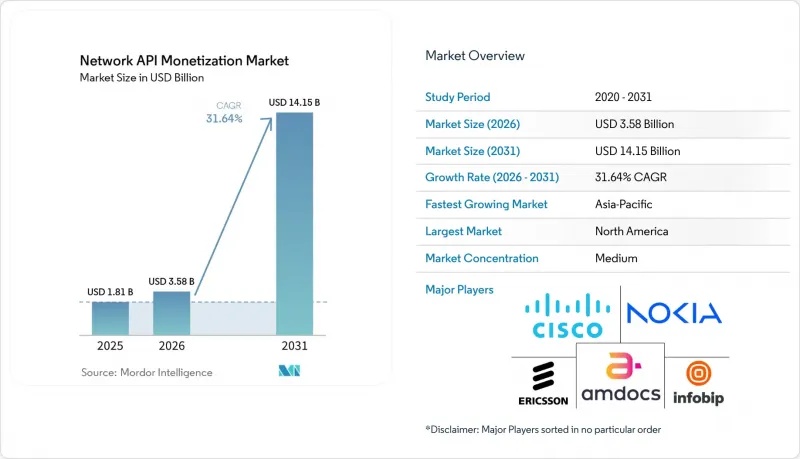
根據 Mordor Intelligence 預測,網路 API 貨幣化市場將從 2025 年的 18.1 億美元成長到 2026 年的 35.8 億美元,到 2031 年達到 141.5 億美元,2026 年至 2031 年的年複合成長率(CAGR)為 31.64%。
本報告按API類型(例如,按需品質API、電話號碼認證和SIM卡交換API)、組件(例如,API貨幣化平台、API閘道器和網路暴露功能)、部署模式(雲端、本地部署、混合部署)、最終用戶行業(例如,汽車和互聯出行)以及地區進行細分。市場預測以美元(USD)為單位。
全球網路API貨幣化市場趨勢與洞察
擴大 5G 獨立組網覆蓋範圍,為可程式設計貨幣化開闢了可能性。
獨立組網(SA)5G 為網路 API 貨幣化市場提供了技術基礎,因為其網路開放能力為外部應用程式提供了一條通往核心網路功能的標準化路徑。這使得開發者能夠即時請求會話管理、頻寬優先權和網路切片控制。這種方法無需直接存取營運商的專有系統即可保證服務品質(QoS)。在 2026 年的核心網路高峰會上,愛立信將詐欺偵測、面向企業設施的按需服務品質(QoD)以及透過固定無線存取實現貨幣化列為已準備好商業化的 API 群組。已在企業密度高的區域完成獨立組網部署的營運商可以在其他區域覆蓋範圍擴大之前,滿足對服務品質(QoS)和網路切片 API 的早期需求。截至 2026 年 1 月,僅有 22% 的 5G 業者部署了融合或完全獨立組網,這意味著未來部署中仍有巨大的應用空間。
企業對即時詐欺偵測和身份驗證 API 的需求正在推動短期收入成長。
在網路API貨幣化市場中,金融服務業的需求模式最為成熟。這是因為即時支付使得評估詐欺的時間非常有限。銀行和金融科技公司可以透過利用營運商訊號(例如SIM卡狀態、電話號碼保留期限和設備關聯)來增強身份驗證,並減少對簡訊動態密碼的依賴。 GSMA Intelligence在其2025年開放式閘道需求指數中,將銀行業和金融服務業列為所有評估產業之首。隨著號碼檢驗和SIM卡交換成為標準服務,營運商可以透過KYC匹配、用戶行為訊號和設備保留資料來脫穎而出。如果服務提供者不僅將這些服務作為技術API目錄來展示,而且還將其與減少詐欺損失、簡化註冊流程和滿足合規性要求聯繫起來,那麼他們更有可能採用這些服務。這個框架對於將API支出與採購和風險管理團隊可以評估的營運成果連結起來至關重要。
電信業者之間實施狀態的不一致以及 API 版本缺乏統一性,正在減緩跨業者的推廣速度。
部署方式的差異仍然是網路API貨幣化市場面臨的商業性障礙。這是因為即使採用通用的CAMARA規範,不同業者之間的延遲、授權和實施結果也可能存在差異。跨境應用需要考慮這些差異,從而增加整合成本並延緩開發者的投資。 GSMA技術指南要求在整個存取、報告和授權流程中同時支援CAMARA服務API和TM Forum Operate API。 Enea指出,即使採用標準化的北向介面,仍需要與各運營商獨特的網路基礎設施進行南向整合。因此,多運營商部署會被延遲,尤其是在歐洲和亞太地區運營商的商業發布計劃和技術準備情況存在差異的情況下。雖然這不會限制整體市場機會,但可能會減緩跨國企業應用所需的擴展速度。
細分市場分析
到2025年,號碼檢驗和SIM卡交換API將佔網路API貨幣化市場佔有率的21.14%,成為最大的API類別。這一地位反映了企業對運營商級身份驗證的需求,這種身份驗證可以簡化銀行、保險和電子商務註冊流程中動態密碼的繁瑣操作。用戶級SIM卡資料能夠提供第三方同等權限或規模無法複製的詐欺徵兆。 GSMA的「Unscammed」計畫正在推動美國、加拿大、英國和澳洲多家營運商部署協作式反詐騙API。這些部署表明,反詐騙正從個別試點階段發展到覆蓋整個網路API貨幣化市場的協作式實施。
網路切片和邊緣運算 API 預計到 2031 年將以 33.41% 的複合年成長率成長,成為所有 API 類型中成長最快的領域。汽車、工業IoT和遊戲應用需要可靠的延遲和頻寬,而盡力而為的連線無法滿足這些需求。按需品質 API 在媒體串流和企業視訊協作領域應用日益廣泛,因為這些領域需要對特定會話進行優先排序。設備定位和地理圍籬 API 已在物流、車輛管理和緊急服務領域得到早期應用。營運商收費、支付、設備狀態和連接 API 尚處於商業開發的早期階段,其應用主要集中在亞太市場,因為該地區的企業收費整合更為成熟。同時,在 MWC25 上,AECC 制定了 CAMARA 標準化的「按需品質」和「網路切片」API 的要求,用於聯網汽車。
到2025年,API貨幣化平台將佔網路API貨幣化市場規模的31.24%,成為最大的組成部分。電信業者的初期採購重點集中在支援多種CAMARA API類別的核心收費、存取控制和合作夥伴存取功能。這種支出模式表明,營運商更重視底層商業基礎設施,而非更高層級的開發者體驗和分析工具。愛立信於2025年12月投資LotusFlare,與其建立策略夥伴關係關係,以利用DNO雲端的授權管理和數位商務功能。此舉反映了將貨幣化平台與許可、存取和開發者工作流程整合的必要性。
預計從 2026 年到 2031 年,開發者入口網站和 API 市場的各個組成部分將以 33.14% 的複合年成長率 (CAGR) 成長。這一成長主要得益於網路 API 貨幣化市場競爭焦點的轉變,即轉向 API 發現、上線、沙箱品質和分發。與基礎文件入口網站相比,提供更完善的自助存取和軟體開發工具包 (SDK) 可以促進 API 的採用。計量、分析和可觀測性也變得越來越重要,因為基於使用量的收費需要對使用情況、延遲和錯誤率有清晰的了解。 WSO2 於 2025 年 11 月收購了 Moesif,並將其分析和貨幣化功能整合到 API 管理器生命週期中。計費、收入保障、安全、身分管理、授權管理和託管服務仍然是企業(尤其是那些內部 API 專案管理資源有限的企業)的關鍵支援元件。
區域分析
到2025年,北美將佔網路API貨幣化市場佔有率的34.12%。美國和加拿大的營運商率先透過CPaaS經銷商採用號碼檢驗和SIM卡交換服務。成熟的企業軟體採購流程也正在推動金融服務和零售業客戶採用API。 2025年7月,Aduna與包括愛立信、AT&T、T-Mobile和Verizon在內的12家業者合作,為開發者提供統一的分送層。在加拿大,Enstream正在將貝爾加拿大、羅傑斯和TELUS整合到一個通用的CAMARA API模型下。同時,墨西哥正處於發展初期,獨立組網5G覆蓋範圍不斷擴大,市場需求主要集中在普惠金融和支付認證。
在歐洲,2025年可觀的收入得益於英國四家營運商整合CAMARA API。沃達豐、維珍傳媒O2、BT/EE和Three承諾透過共用的開放閘道方案提供SIM卡更換、號碼檢驗、年齡驗證和使用期限驗證API。德國也透過與Aduna、Nokia、InfoVip和德國電信旗下Glide Identity的經銷協議,支援區域成長。法國、西班牙、義大利和其他市場正積極推動商業化進程,西班牙電信正努力獲得GSMA和TM Forum的聯合認證。 GDPR要求公開用戶資訊的API必須獲得明確同意。 2025年11月,AZOP對一家電信業者處以450萬歐元(490萬美元)的罰款,原因是違反了個人資料處理規定。這凸顯了在歐洲進行使用者同意管理的重要性。
預計亞太地區在2026年至2031年間將以33.28%的複合年成長率成長,成為網路API貨幣化市場所有區域中成長最快的地區。在中國,2025年將部署超過340萬個5G基地台,為網路API活動建置了廣泛的基礎設施。同時,中國聯通和中國電信已開始部署GSMA認證的“開放閘道器”,其中中國聯通表示,其覆蓋了國內70%的聯網汽車市場。 2025年,諾基亞與Bharti Airtel合作,透過其「網路即代碼」(Network as Code)入口網站在印度提供網路API。日本、韓國、澳洲以及中東和非洲的活動也在增加,卡達電信業者承諾在 2026 年擴大其 API 產品組合。另一方面,南美洲正成為一個新的機遇,這得益於巴西的 Pix 基礎設施以及金融科技領域對防詐欺的需求,阿根廷和智利的 API 試點計畫也為此提供了支持。
其他好處:
- Excel格式的市場預測(ME)表
- 3個月的分析師支持
目錄
第1章:引言
- 研究假設和市場定義
- 調查範圍
第2章:調查方法
第3章執行摘要
第4章 市場狀況
- 市場概覽
- 市場促進因素
- 5G獨立組網的廣泛應用
- 企業對即時防詐騙和身分驗證 API 的需求日益成長。
- 超大規模資料中心業者與電信營運商經銷夥伴
- API優先的數位經營模式和合作夥伴生態系統
- AI 代理和事件資料正在產生新的 API 使用量,這些使用量將產生收費。
- CAMARA 和 GSMA 開始將「開放式閘道器」標準化,以實現與營運商無關的存取。
- 市場限制因素
- 電信業者之間的實施狀態存在差異,API 版本也存在不一致。
- 開發商是否願意為網路功能付費尚不明確。
- API 安全、同意和資料保護責任
- 整合傳統OSS和BSS的複雜度。
- 宏觀經濟因素對市場的影響
- 產業價值鏈分析
- 技術展望
- 監理情勢
- 波特五力分析
第5章 市場規模與成長預測
- 按 API 類型
- 按需品質 API
- 號碼驗證和SIM卡更換API
- 設備位置資訊和地理圍籬 API
- 網路切片和邊緣應用介面
- 運營商收費和支付 API
- 設備狀態和連接性 API
- 其他 API 類型
- 按組件
- API貨幣化平台
- API閘道器和網路暴露功能
- 開發者入口網站和 API 市場
- 計量、分析、可觀測性
- 收費、發票和收入保證
- 安全、身分和同意管理
- 專業服務及託管服務
- 部署模式
- 雲
- 現場
- 混合
- 按最終用戶行業分類
- 金融服務和詐欺預防
- 汽車與互聯出行
- 企業物聯網與智慧製造
- 遊戲和即時媒體串流
- 醫療和緊急服務
- 零售與電子商務
- 航空/旅遊
- 政府和智慧城市
- 按地區
- 北美洲
- 美國
- 加拿大
- 墨西哥
- 南美洲
- 巴西
- 阿根廷
- 智利
- 其他南美國家
- 歐洲
- 德國
- 英國
- 法國
- 義大利
- 西班牙
- 其他歐洲國家
- 亞太地區
- 中國
- 日本
- 印度
- 韓國
- 澳洲
- 其他亞太國家
- 中東
- 阿拉伯聯合大公國
- 沙烏地阿拉伯
- 卡達
- 其他中東國家
- 非洲
- 南非
- 埃及
- 奈及利亞
- 其他非洲國家
- 北美洲
第6章 競爭情勢
- 市場集中度
- 策略趨勢
- 市佔率分析
- 公司簡介
- Kong Inc.
- WSO2, Inc.
- Axway Software SA
- Boomi, LP
- Gravitee, Inc.
- Tyk Technologies Ltd
- MuleSoft, LLC
- LotusFlare, Inc.
- Sinch AB
- Zuplo, Inc.
- Moesif, Inc.
- Apiable, Inc.
- Cerillion plc
- Amberflo, Inc.
- Lago, Inc.
- RapidAPI, Inc.
- Nokia Corporation
- Telefonaktiebolaget LM Ericsson
- Amdocs Limited
- MATRIXX Software, Inc.
- Mavenir Systems, Inc.
- Comviva Technologies Limited
- Netcracker Technology Corporation
- Vonage Holdings Corp.
第7章 市場機會與未來展望
According to Mordor Intelligence, the network API monetization market size is projected to expand from USD 1.81 billion in 2025 to USD 3.58 billion in 2026, and to USD 14.15 billion by 2031, registering a CAGR of 31.64% between 2026 and 2031.
This report is Segmented by API Type (Quality On Demand APIs, Number Verification and SIM Swap APIs, and More), Component (API Monetization Platform, API Gateway and Network Exposure Function, and More), Deployment Mode (Cloud, On-Premise, and Hybrid), End-User Industry (Automotive and Connected Mobility, and More), and Geography. The Market Forecasts are Provided in Terms of Value (USD).
Global Network API Monetization Market Trends and Insights
Expansion of 5G Standalone Network Exposure Unlocks Programmable Monetization
Standalone 5G provides the technical foundation for the Network API Monetization Market, as the Network Exposure Function offers external applications a standardized path to core network functions. It allows developers to request session management, bandwidth prioritization, and slice control in real time. This approach enables a guaranteed quality of service without requiring direct access to proprietary operator systems. Ericsson identified fraud detection, quality-on-demand for enterprise venues, and fixed wireless access monetization as commercially ready API groups at its 2026 Core Network Summit. Operators that complete standalone rollouts in enterprise-dense areas can address early demand for quality-of-service and network-slicing APIs before coverage improves elsewhere. In January 2026, only 22% of operators that had launched 5G had deployed converged or fully standalone networks, leaving material room for later rollout-led adoption.
Enterprise Demand for Real-Time Fraud and Identity APIs Drives Near-Term Revenue
Financial services provide the most mature demand pattern for the Network API Monetization Market because instant payments leave little time to evaluate fraud. Banks and fintech firms can use carrier signals such as SIM status, number tenure, and device associations to strengthen authentication and reduce reliance on SMS one-time passwords. GSMA Intelligence ranked banking and financial services first across the sectors assessed in its 2025 Open Gateway Demand Index. As Number Verification and SIM Swap become standard services, operators can seek differentiation through KYC Match, subscriber behavior signals, and device tenure data. Enterprises are more likely to adopt these services when providers link them to lower fraud losses, easier onboarding, and compliance needs rather than presenting a technical API catalog. This framing is important because it connects API spending to operational outcomes that procurement and risk teams can evaluate.
Fragmented Operator Rollouts and Inconsistent API Versions Slow Multi-Operator Deployments
Fragmented rollout practices remain a commercial obstacle for the Network API Monetization Market because a common CAMARA specification can still yield different latency, consent, and implementation outcomes across carriers. Cross-border applications must account for these differences, thereby raising integration costs and delaying developer investment. GSMA technical guidance requires support for both CAMARA Service APIs and TM Forum Operate APIs across onboarding, reporting, and consent processes. Enea noted that standardized northbound interfaces still require carrier-specific southbound integration with proprietary network infrastructure. The result is a delay in multi-operator deployments, particularly where commercial launch schedules and technical readiness differ across European and Asia-Pacific operators. It does not limit the overall opportunity, but it can postpone the scale needed for cross-border enterprise applications.
Other drivers and restraints analyzed in the detailed report include:
- Hyperscaler and Operator Distribution Partnerships Reshape the Monetization Value Chain
- API-First Digital Business Models and Partner Ecosystems Expand the Addressable Market
- Unclear Developer Willingness to Pay Suppresses Commercial Uptake Beyond Early Adopters
For complete list of drivers and restraints, kindly check the Table Of Contents.
Segment Analysis
Number Verification and SIM Swap APIs held 21.14% of the Network API Monetization Market share in 2025, making them the largest API category. Their position reflects enterprise demand for carrier-grade authentication that reduces friction from one-time passwords in banking, insurance, and e-commerce onboarding. Subscriber-level SIM data provides fraud signals that third parties cannot reproduce with the same authority or at the same scale. The GSMA Unscammed program is pursuing multi-operator fraud-prevention API deployments in the United States, Canada, the United Kingdom, and Australia. These deployments show that fraud prevention is progressing from isolated trials toward coordinated implementation across the Network API Monetization Market.
Network Slicing and Edge Enablement APIs are projected to expand at a 33.41% CAGR through 2031, the fastest growth rate among API types. Automotive, industrial IoT, and gaming applications require assured latency and bandwidth that best-effort connectivity cannot deliver. Quality-on-demand APIs are gaining use in media streaming and enterprise video collaboration, where selected sessions require priority. Device Location and Geofencing APIs are finding early use in logistics, fleet management, and emergency services. Carrier Billing, Payment, Device Status, and Connectivity APIs remain earlier in their commercial development, with activity concentrated in Asia-Pacific markets that have stronger enterprise billing integration, while the AECC set out requirements for CAMARA-standardized quality-on-demand and network-slicing APIs for connected vehicles at MWC25.
API Monetization Platform accounted for 31.24% of the Network API Monetization Market size in 2025, making it the largest component. Operators have focused the initial procurement on core billing, access control, and partner onboarding functions that support multiple CAMARA API categories. This spending pattern shows that foundational commercial infrastructure has taken priority over higher-layer developer experience and analytics tools. Ericsson invested in LotusFlare in December 2025 and formed a strategic partnership around DNO Cloud capabilities for consent management and digital commerce. The move reflected the need to connect monetization platforms with consent, access, and developer workflows.
Developer Portal and API Marketplace components are projected to expand at a 33.14% CAGR from 2026 to 2031. Their growth follows a shift in competition toward API discovery, onboarding, sandbox quality, and distribution across the Network API Monetization Market. Better self-service access and software development kits can increase API use compared with basic documentation portals. Metering, analytics, and observability are also becoming important because usage-based pricing requires visibility into consumption, latency, and error rates. WSO2 acquired Moesif in November 2025 and integrated its analytics and monetization capabilities into the API manager lifecycle. Billing, revenue assurance, security, identity, consent management, and managed services remain important supporting components for operators with different internal capabilities, particularly where in-house API program management resources are limited.
Complete Report Scope:
- By API Type
- Quality on Demand APIs
- Number Verification and SIM Swap APIs
- Device Location and Geofencing APIs
- Network Slicing and Edge Enablement APIs
- Carrier Billing and Payment APIs
- Device Status and Connectivity APIs
- Other API Types
- By Component
- API Monetization Platform
- API Gateway and Network Exposure Function
- Developer Portal and API Marketplace
- Metering, Analytics, and Observability
- Billing, Invoicing, and Revenue Assurance
- Security, Identity, and Consent Management
- Professional and Managed Services
- By Deployment Mode
- Cloud
- On-Premise
- Hybrid
- By End-User Industry
- Financial Services and Fraud Prevention
- Automotive and Connected Mobility
- Enterprise IoT and Smart Manufacturing
- Gaming and Real-Time Media Streaming
- Healthcare and Emergency Services
- Retail and E-commerce
- Aviation and Travel
- Government and Smart Cities
- By Geography
- North America
- United States
- Canada
- Mexico
- South America
- Brazil
- Argentina
- Chile
- Rest of South America
- Europe
- Germany
- United Kingdom
- France
- Italy
- Spain
- Rest of Europe
- Asia-Pacific
- China
- Japan
- India
- South Korea
- Australia
- Rest of Asia-Pacific
- Middle East
- United Arab Emirates
- Saudi Arabia
- Qatar
- Rest of Middle East
- Africa
- South Africa
- Egypt
- Nigeria
- Rest of Africa
- North America
Geography Analysis
North America held 34.12% of the Network API Monetization Market share in 2025. United States and Canadian carriers introduced Number Verification and SIM Swap services early through CPaaS distribution partners. Established enterprise software procurement processes also support API adoption among financial services and retail customers. Aduna was finalized in July 2025 with Ericsson and 12 operators, including AT&T, T-Mobile, and Verizon, to provide an aggregated distribution layer for developers. In Canada, Enstream brings Bell Canada, Rogers, and TELUS together around a shared CAMARA API model, while Mexico remains earlier in development, with standalone 5G coverage expanding and demand centered on financial inclusion and payment authentication.
Europe generated meaningful revenue in 2025, supported by the United Kingdom's four-operator CAMARA API collaboration. Vodafone, Virgin Media O2, BT/EE, and Three committed to SIM Swap, Number Verification, Age Verify, and Tenure APIs through a shared Open Gateway approach. Germany also supports regional growth through Deutsche Telekom T Wholesale distribution agreements with Aduna, Nokia, Infobip, and Glide Identity. France, Spain, Italy, and other markets are in active commercial stages, while Telefonica is progressing toward joint GSMA and TM Forum conformance certification. GDPR requires explicit consent for APIs that expose subscriber information, and the AZOP fined a telecommunications operator EUR 4,500,000 (USD 4,900,000) for personal data processing violations in November 2025, underscoring the importance of consent management in Europe.
Asia-Pacific is projected to expand at a 33.28% CAGR from 2026 to 2031, the highest regional rate in the Network API Monetization Market. China had more than 3.4 million 5G base stations in 2025, providing broad infrastructure for network API activity, while China Unicom and China Telecom launched GSMA-certified Open Gateway deployments, and China Unicom reported reach across 70% of the country's connected-vehicle market. Nokia partnered with Bharti Airtel in 2025 to provide pan-India network APIs through its Network as Code portal. Japan, South Korea, Australia, the Middle East, and Africa are also seeing activity develop, with Qatar operators committing to broaden their API portfolios in 2026, while South America is an emerging opportunity led by Brazil's Pix infrastructure and fintech fraud-prevention needs, and supported by API pilot activity in Argentina and Chile.
- Kong Inc.
- WSO2, Inc.
- Axway Software SA
- Boomi, LP
- Gravitee, Inc.
- Tyk Technologies Ltd
- MuleSoft, LLC
- LotusFlare, Inc.
- Sinch AB
- Zuplo, Inc.
- Moesif, Inc.
- Apiable, Inc.
- Cerillion plc
- Amberflo, Inc.
- Lago, Inc.
- RapidAPI, Inc.
- Nokia Corporation
- Telefonaktiebolaget LM Ericsson
- Amdocs Limited
- MATRIXX Software, Inc.
- Mavenir Systems, Inc.
- Comviva Technologies Limited
- Netcracker Technology Corporation
- Vonage Holdings Corp.
Additional Benefits:
- The market estimate (ME) sheet in Excel format
- 3 months of analyst support
TABLE OF CONTENTS
1 INTRODUCTION
- 1.1 Study Assumptions and Market Definition
- 1.2 Scope of the Study
2 RESEARCH METHODOLOGY
3 EXECUTIVE SUMMARY
4 MARKET LANDSCAPE
- 4.1 Market Overview
- 4.2 Market Drivers
- 4.2.1 Expansion of 5G Standalone Network Exposure
- 4.2.2 Enterprise Demand for Real-Time Fraud and Identity APIs
- 4.2.3 Hyperscaler and Operator Distribution Partnerships
- 4.2.4 API-First Digital Business Models and Partner Ecosystems
- 4.2.5 AI Agents and Event Data Creating New Billable API Consumption
- 4.2.6 CAMARA and GSMA Open Gateway Standardization Enabling Carrier-Agnostic Access
- 4.3 Market Restraints
- 4.3.1 Fragmented Operator Rollouts and Inconsistent API Versions
- 4.3.2 Unclear Developer Willingness to Pay for Network Capabilities
- 4.3.3 API Security, Consent, and Data-Protection Liability
- 4.3.4 Legacy OSS and BSS Integration Complexity
- 4.4 Impact of Macroeconomic Factors on the Market
- 4.5 Industry Value-Chain Analysis
- 4.6 Technology Outlook
- 4.7 Regulatory Landscape
- 4.8 Porter's Five Forces Analysis
- 4.8.1 Threat of New Entrants
- 4.8.2 Bargaining Power of Suppliers
- 4.8.3 Bargaining Power of Buyers
- 4.8.4 Threat of Substitutes
- 4.8.5 Intensity of Competitive Rivalry
5 MARKET SIZE AND GROWTH FORECASTS (VALUE)
- 5.1 By API Type
- 5.1.1 Quality on Demand APIs
- 5.1.2 Number Verification and SIM Swap APIs
- 5.1.3 Device Location and Geofencing APIs
- 5.1.4 Network Slicing and Edge Enablement APIs
- 5.1.5 Carrier Billing and Payment APIs
- 5.1.6 Device Status and Connectivity APIs
- 5.1.7 Other API Types
- 5.2 By Component
- 5.2.1 API Monetization Platform
- 5.2.2 API Gateway and Network Exposure Function
- 5.2.3 Developer Portal and API Marketplace
- 5.2.4 Metering, Analytics, and Observability
- 5.2.5 Billing, Invoicing, and Revenue Assurance
- 5.2.6 Security, Identity, and Consent Management
- 5.2.7 Professional and Managed Services
- 5.3 By Deployment Mode
- 5.3.1 Cloud
- 5.3.2 On-Premise
- 5.3.3 Hybrid
- 5.4 By End-User Industry
- 5.4.1 Financial Services and Fraud Prevention
- 5.4.2 Automotive and Connected Mobility
- 5.4.3 Enterprise IoT and Smart Manufacturing
- 5.4.4 Gaming and Real-Time Media Streaming
- 5.4.5 Healthcare and Emergency Services
- 5.4.6 Retail and E-commerce
- 5.4.7 Aviation and Travel
- 5.4.8 Government and Smart Cities
- 5.5 By Geography
- 5.5.1 North America
- 5.5.1.1 United States
- 5.5.1.2 Canada
- 5.5.1.3 Mexico
- 5.5.2 South America
- 5.5.2.1 Brazil
- 5.5.2.2 Argentina
- 5.5.2.3 Chile
- 5.5.2.4 Rest of South America
- 5.5.3 Europe
- 5.5.3.1 Germany
- 5.5.3.2 United Kingdom
- 5.5.3.3 France
- 5.5.3.4 Italy
- 5.5.3.5 Spain
- 5.5.3.6 Rest of Europe
- 5.5.4 Asia-Pacific
- 5.5.4.1 China
- 5.5.4.2 Japan
- 5.5.4.3 India
- 5.5.4.4 South Korea
- 5.5.4.5 Australia
- 5.5.4.6 Rest of Asia-Pacific
- 5.5.5 Middle East
- 5.5.5.1 United Arab Emirates
- 5.5.5.2 Saudi Arabia
- 5.5.5.3 Qatar
- 5.5.5.4 Rest of Middle East
- 5.5.6 Africa
- 5.5.6.1 South Africa
- 5.5.6.2 Egypt
- 5.5.6.3 Nigeria
- 5.5.6.4 Rest of Africa
- 5.5.1 North America
6 COMPETITIVE LANDSCAPE
- 6.1 Market Concentration
- 6.2 Strategic Moves
- 6.3 Market Share Analysis
- 6.4 Company Profiles (includes Global Level Overview, Market Level Overview, Core Segments, Financials as available, Strategic Information, Market Rank/Share, Products and Services, Recent Developments)
- 6.4.1 Kong Inc.
- 6.4.2 WSO2, Inc.
- 6.4.3 Axway Software SA
- 6.4.4 Boomi, LP
- 6.4.5 Gravitee, Inc.
- 6.4.6 Tyk Technologies Ltd
- 6.4.7 MuleSoft, LLC
- 6.4.8 LotusFlare, Inc.
- 6.4.9 Sinch AB
- 6.4.10 Zuplo, Inc.
- 6.4.11 Moesif, Inc.
- 6.4.12 Apiable, Inc.
- 6.4.13 Cerillion plc
- 6.4.14 Amberflo, Inc.
- 6.4.15 Lago, Inc.
- 6.4.16 RapidAPI, Inc.
- 6.4.17 Nokia Corporation
- 6.4.18 Telefonaktiebolaget LM Ericsson
- 6.4.19 Amdocs Limited
- 6.4.20 MATRIXX Software, Inc.
- 6.4.21 Mavenir Systems, Inc.
- 6.4.22 Comviva Technologies Limited
- 6.4.23 Netcracker Technology Corporation
- 6.4.24 Vonage Holdings Corp.
7 MARKET OPPORTUNITIES AND FUTURE OUTLOOK
- 7.1 White-Space and Unmet-Need Assessment

 訂閱收費管理:市場佔有率分析、產業趨勢與統計、成長預測(2026-2031 年)
 訂閱/循環收費管理市場:按組件、經營模式、收費類型、部署模式、企業規模、應用和產業分類-2026-2032年全球市場預測
 API貨幣化市場預測—按組件、定價模式、部署類型、組織規模、應用程式、最終用戶和地區分類的全球分析—2034年個人財務管理及訂閱管理應用市場預測至2034年-全球平台類型、功能、獲利模式、產品類型、應用、使用者類型及區域分析
 訂閱收費管理市場機會、成長要素、產業趨勢分析及 2026-2035 年預測。訂閱收費和變現平台市場預測至 2034 年:按變現模式、收費功能、平台功能、部署方法和最終用戶分類的全球分析
 2026年全球訂閱計費軟體市場報告2026年全球訂閱與計費管理市場報告2026年全球訂閱計費管理市場報告
 全球訂閱計費管理市場規模、佔有率、趨勢和成長分析報告(2026-2034年)