


 |
市場調查報告書
商品編碼
2155247
南美汽車電動執行器:市場佔有率分析、產業趨勢與統計及成長預測(2026-2031 年)South America Automotive Electric Actuators - Market Share Analysis, Industry Trends & Statistics, Growth Forecasts (2026 - 2031) |
||||||

※ 本網頁內容可能與最新版本有所差異。詳細情況請與我們聯繫。
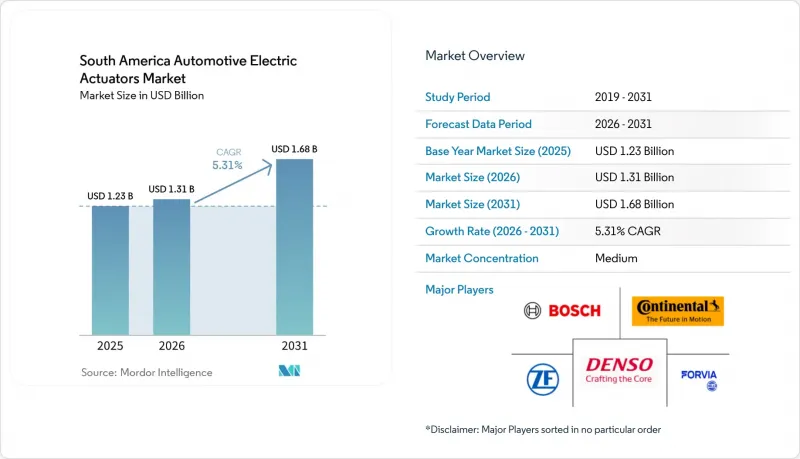
根據 Mordor Intelligence 預測,南美汽車電動執行器市場規模預計將在 2025 年達到 12.3 億美元,2026 年成長至 13.1 億美元,到 2031 年達到 16.8 億美元,在 2026 年至 2031 年的預測成長率內,複合年成長率將達到 5.31%。
南美洲汽車電動執行器市場趨勢與洞察
加速推廣電動車
2025年,該地區電動車銷量較2024年強勁成長。巴西在全部區域中佔據了相當大的佔有率。插電式混合動力汽車在南美洲電動車銷量中佔比很高。這類車輛需要執行器來控制內燃機和電動動力傳動系統系統,這會增加每輛車的零件數量。隨著汽車製造商將這些系統應用於各種價位的車型,南美洲汽車電動執行器市場正從中受益。比亞迪已投資55億巴西雷亞爾(約10.7億美元)用於其卡馬卡利工廠第一期工程。該工廠的年產能預計將擴大至30萬輛。比亞迪也計劃在2026年底實現50%的在地採購率。這將為巴西的認證供應商提供更清晰的途徑進入新的汽車項目,並將重點從進口零件轉向本地技術認證。如果供應商能夠滿足這些平台的營運和採購要求,南美汽車電動執行器市場將會受益。
ADAS整合正在穩步推進。
南美洲的安全標準和出口導向汽車生產正在推動高級駕駛輔助系統(ADAS)的普及。 「南美洲NCAP」協議預計將在不久的將來生效,並持續數年。該協議將更加重視自動緊急煞車、盲點監測和車道偏離預警系統。這些功能依賴於響應感測器和控制單元指令的電氣系統。電動執行器將這些指令轉化為煞車、轉向和開關動作。隨著這些功能在非高階車型中日益普及,南美洲的汽車電動執行器市場正在不斷擴大。
高昂的製造成本和電子元件成本
與亞洲和歐洲的供應商相比,南美洲的商品成本結構對執行器製造商可能不利。巴西對電子元件徵收的關稅可能超過申報價值的30%。對於節氣門控制器、ADAS相關產品和溫度控管閥而言,這部分成本是重要因素。這些應用需要進口汽車級電子元件。高昂的投入成本使得從亞洲採購時難以維持價格競爭力。在南美洲汽車電動執行器市場,能夠透過本地化降低風險的供應商將更具優勢。 2026年5月,博世決定在坎皮納斯投資10億雷亞爾(約1.71億美元)進行電子基板在地化生產。本地化生產將減少對進口基板的依賴,並最大限度地減少物流延誤。然而,此類投資所需的產量通常只有大型一級供應商才能勝任。中小企業可能缺乏投資本地電子元件生產的資金。因此,在南美汽車電動執行器產業,達到一定規模的供應商可能會獲得優惠待遇。
細分市場分析
到2025年,乘用車將佔南美洲汽車電動執行器市場73.23%的佔有率。這一細分市場的成長主要得益於私家車保有量的成長以及新車中電動元件的日益普及。因此,隨著該地區新型動力傳動系統架構的引入,每輛車的執行器數量也在增加。中檔乘用車擴大採用先前僅在高階車型上出現的ADAS(高級駕駛輔助系統)功能。南美NCAP碰撞測試的要求進一步提升了自動緊急煞車系統在所有價格區間的重要性。阿根廷高階市場的成長也推動了高價值座椅、車門和掀背式尾門等應用的發展。中國豪華車在巴西市場的崛起進一步推動了功能配置的擴展。即使汽車銷售成長速度不如上述成長速度,這些變化也提高了獲利能力。
預計到2031年,商用車銷售將以6.14%的複合年成長率成長,主要受車隊電氣化、電子商務物流和基礎設施投資的推動。巴西的物流和農產品綜合企業支撐著卡車需求,而南美洲其他地區的需求也不斷成長,這得益於最後一公里配送、貨運和基礎設施項目的擴張。南美洲汽車電動執行器市場預計將受益於對先進商用車控制系統的需求,包括動力傳動系統管理、煞車系統、轉向系統、空調系統以及自動駕駛應用。車隊營運商對效率、安全性和排放氣體法規合規性的重視也有望支撐市場需求。
其他好處:
- Excel格式的市場預測(ME)表
- 3個月的分析師支持
目錄
第1章:引言
- 研究假設和市場定義
- 調查範圍
第2章:調查方法
第3章執行摘要
第4章 市場狀況
- 市場概覽
- 市場促進因素
- 加速推廣電動車
- 加強排放和環境法規
- ADAS(進階駕駛輔助系統)的擴展
- 消費者對奢侈品和舒適品的需求日益成長。
- 工業領域的近岸外包和對汽車製造業的投資
- 小型化和向軟體定義功能的過渡
- 市場限制因素
- 製造成本和電子元件成本不斷上漲
- 經濟和政治波動
- 區域供應鏈脆弱性和瓶頸
- 公共充電基礎設施及高壓電網基礎設施建設延誤。
- 價值鍊和供應鏈分析
- 監理情勢
- 技術展望
- 波特五力分析
第5章 市場規模與成長預測
- 車輛類型
- 搭乘用車
- 商用車輛
- 按應用程式類型
- 節氣門執行器
- 座椅調整執行器
- 煞車執行器
- 關閉執行器
- 其他
- 透過分銷管道
- 目的地設備製造商(OEM)
- 售後市場
- 國家
- 巴西
- 阿根廷
- 智利
- 哥倫比亞
- 其他南美國家
第6章 競爭情勢
- 市場集中度
- 策略趨勢
- 市佔率分析
- 公司簡介
- Continental AG
- Robert Bosch GmbH
- Hella KGaA Hueck & Co.
- Wabco Holdings Inc.
- Sonceboz SA
- BorgWarner Inc
- Denso Corporation
- Johnson Electric
- CTS Corporation
- ZF Friedrichshafen AG
- Valeo SA
- Nidec Corporation
第7章 市場機會與未來展望
According to Mordor Intelligence, the South America automotive electric actuators market was valued at USD 1.23 billion in 2025 and is projected to grow from USD 1.31 billion in 2026 to USD 1.68 billion by 2031, registering a CAGR of 5.31% during the 2026-2031 forecast period.
South America Automotive Electric Actuators Market Trends and Insights
Accelerated Electric Vehicle Adoption
Regional EV sales recorded strong growth in 2025 compared with 2024. Brazil accounted for a significant share of the regional growth. Plug-in hybrid vehicles represented a substantial share of EV sales in South America. Those vehicles need actuation for both combustion and electric powertrain functions. This can raise the number of components used in each vehicle. The South American automotive electric actuators market benefits as vehicle makers introduce these systems across a wider range of price points . BYD committed BRL 5.5 billion, equivalent to USD 1.07 billion, for the first phase of its Camacari factory. The plant is planned to scale toward 300,000 vehicles per year. BYD also targeted 50% local component sourcing by the end of 2026. This gives Brazil-qualified suppliers a clearer route to new vehicle programs. It also shifts attention from imported parts toward local technical qualification. The South American automotive electric actuators market can gain when suppliers meet the operating and sourcing requirements of these platforms.
Growing Integration of ADAS
Safety-rating requirements and export-oriented vehicle production are supporting the adoption of advanced driver-assistance systems (ADAS) in South America. The South NCAP protocol is expected to take effect in the near term and remain in force for several years. It will place greater emphasis on autonomous emergency braking, blind-spot detection, and lane-departure warning systems. These functions depend on electrical systems that respond to commands from sensors and control units. Electric actuators convert these commands into braking, steering, and closure actions. As these features become increasingly common in vehicles beyond the premium segment, the South American automotive electric actuators market is expanding.
High Manufacturing and Electronic Component Costs
The landed cost structure in South America can disadvantage actuator producers compared with Asian and European suppliers. Brazilian duties on electronic components can exceed 30% of the declared value. The cost is important for throttle controllers, ADAS-related products, and thermal management valves. These applications need imported electronics with automotive-grade performance. Higher input costs make it harder to match prices when sourcing from Asia. The South American automotive electric actuators market rewards suppliers that can reduce exposure through localization. In May 2026, Bosch decided to localize electronic board production in Campinas as part of its BRL 1 billion (USD 171 million) investment. Local production can reduce exposure to imported boards and logistics delays. However, such investments require production volumes that major Tier-1 suppliers can more easily support. Smaller companies may lack the financial capacity to invest in local electronics production. Consequently, the South American automotive electric actuators industry may favor suppliers with established scale.
Other drivers and restraints analyzed in the detailed report include:
- Stricter Emission and Environmental Regulations
- Rising Consumer Demand for Luxury and Comfort Features
- Economic and Political Volatility
For complete list of drivers and restraints, kindly check the Table Of Contents.
Segment Analysis
Passenger cars held 73.23% of the South American automotive electric actuators market share in 2025. The segment is supported by private vehicle ownership and higher electrical content in new models. The result is higher actuator content per vehicle as new powertrain architectures enter the region. Mid-priced passenger cars are adding ADAS content that was previously concentrated in premium models. South NCAP requirements strengthen the value of automatic emergency braking across price levels. Premium growth in Argentina also supports higher-value seat and closure applications. Chinese luxury vehicles in Brazil add further pressure to increase feature content. These changes raise revenue potential even without a comparable increase in vehicle unit volumes.
Commercial vehicle sales are projected to grow at a CAGR of 6.14% through 2031, driven by fleet electrification, e-commerce logistics, and infrastructure investments. Brazil's logistics and agribusiness sectors support truck demand, while expanding last-mile delivery, freight transportation, and infrastructure projects increase demand across South America. The South American automotive electric actuators market is expected to benefit from demand for advanced commercial vehicle control systems, including powertrain management, braking, steering, HVAC, and automated vehicle applications. Fleet operators' focus on efficiency, safety, and emissions compliance is expected to support demand.
Complete Report Scope:
- By Vehicle Type
- Passenger Car
- Commercial Vehicle
- By Application Type
- Throttle Actuator
- Seat Adjustment Actuator
- Brake Actuator
- Closure Actuator
- Others
- By Distribution Channel
- Original Equipment Manufacturer (OEMs)
- Aftermarket
- By Country
- Brazil
- Argentina
- Chile
- Colombia
- Rest of South America
List of Companies Covered in this Report:
- Continental AG
- Robert Bosch GmbH
- Hella KGaA Hueck & Co.
- Wabco Holdings Inc.
- Sonceboz SA
- BorgWarner Inc
- Denso Corporation
- Johnson Electric
- CTS Corporation
- ZF Friedrichshafen AG
- Valeo SA
- Nidec Corporation
Additional Benefits:
- The market estimate (ME) sheet in Excel format
- 3 months of analyst support
TABLE OF CONTENTS
1 Introduction
- 1.1 Study Assumptions and Market Definition
- 1.2 Scope of the Study
2 Research Methodology
3 Executive Summary
4 Market Landscape
- 4.1 Market Overview
- 4.2 Market Drivers
- 4.2.1 Accelerated Electric Vehicle (EV) Adoption
- 4.2.2 Stricter Emission & Environmental Regulations
- 4.2.3 Growing Integration of ADAS (Advanced Driver Assistance Systems)
- 4.2.4 Rising Consumer Demand for Luxury & Comfort Features
- 4.2.5 Industrial Nearshoring & Automotive Manufacturing Investments
- 4.2.6 Transition to Miniaturized and Software-Defined Functionality
- 4.3 Market Restraints
- 4.3.1 High Manufacturing and Electronic Component Costs
- 4.3.2 Economic and Political Volatility
- 4.3.3 Regional Supply Chain Vulnerabilities and Bottlenecks
- 4.3.4 Lagging Public Charging and High-Voltage Grid Infrastructure
- 4.4 Value Chain and Supply-Chain Analysis
- 4.5 Regulatory Landscape
- 4.6 Technological Outlook
- 4.7 Porter's Five Forces Analysis
- 4.7.1 Threat of New Entrants
- 4.7.2 Bargaining Power of Buyers
- 4.7.3 Bargaining Power of Suppliers
- 4.7.4 Threat of Substitutes
- 4.7.5 Competitive Rivalry
5 Market Size & Growth Forecasts (Value (USD) and Volume (Units))
- 5.1 By Vehicle Type
- 5.1.1 Passenger Car
- 5.1.2 Commercial Vehicle
- 5.2 By Application Type
- 5.2.1 Throttle Actuator
- 5.2.2 Seat Adjustment Actuator
- 5.2.3 Brake Actuator
- 5.2.4 Closure Actuator
- 5.2.5 Others
- 5.3 By Distribution Channel
- 5.3.1 Original Equipment Manufacturer (OEMs)
- 5.3.2 Aftermarket
- 5.4 By Country
- 5.4.1 Brazil
- 5.4.2 Argentina
- 5.4.3 Chile
- 5.4.4 Colombia
- 5.4.5 Rest of South America
6 Competitive Landscape
- 6.1 Market Concentration
- 6.2 Strategic Moves
- 6.3 Market Share Analysis
- 6.4 Company Profiles (Includes Global Level Overview, Market Level Overview, Core Segments, Financials as Available, Strategic Information, Market Rank/Share for Key Companies, Products and Services, SWOT Analysis, and Recent Developments)
- 6.4.1 Continental AG
- 6.4.2 Robert Bosch GmbH
- 6.4.3 Hella KGaA Hueck & Co.
- 6.4.4 Wabco Holdings Inc.
- 6.4.5 Sonceboz SA
- 6.4.6 BorgWarner Inc
- 6.4.7 Denso Corporation
- 6.4.8 Johnson Electric
- 6.4.9 CTS Corporation
- 6.4.10 ZF Friedrichshafen AG
- 6.4.11 Valeo SA
- 6.4.12 Nidec Corporation
7 Market Opportunities & Future Outlook
- 7.1 White-space and Unmet-Need Assessment

 汽車執行器市場預測至2034年-全球分析(依執行器類型、車輛系統、推進系統、車輛類型、執行器機構、電壓、控制技術、應用、最終用戶和地區分類)
 電動廢氣旁通閥執行器市場規模、佔有率和成長分析:按車輛類型、驅動系統、銷售管道、應用和地區分類-2026-2033年產業預測
 汽車執行器市場規模、佔有率和趨勢分析報告:按產品類型、操作方式、車輛類型、驅動系統、應用、最終用途、地區和細分市場預測(2026-2033 年)
 汽車氣動執行器:市場佔有率分析、產業趨勢與統計、成長預測(2026-2031)日本汽車液壓執行器:市場佔有率分析、產業趨勢與統計及成長預測(2026-2031)汽車執行器:市場佔有率分析、產業趨勢與統計、成長預測(2026-2031)
 汽車電動執行器市場機會、成長要素、產業趨勢分析及2026-2035年預測
 汽車執行器市場報告:按產品類型、操作方式、車輛類型、銷售管道和地區分類(2026-2034 年)
 2026年全球汽車執行器市場報告
 汽車致動器市場規模、佔有率、成長及全球產業分析:按類型、應用和地區的洞察,2026-2034年的預測