


 |
市場調查報告書
商品編碼
2121926
汽車氣動執行器:市場佔有率分析、產業趨勢與統計、成長預測(2026-2031)Automotive Pneumatic Actuators - Market Share Analysis, Industry Trends & Statistics, Growth Forecasts (2026 - 2031) |
||||||

※ 本網頁內容可能與最新版本有所差異。詳細情況請與我們聯繫。
據 Mordor Intelligence 稱,2025 年汽車氣動執行器市值為 531.7 億美元,預計到 2031 年將達到 719.6 億美元,而 2026 年為 559.2 億美元,預測期(2026-2031 年)的複合年成長率為 5.17%。
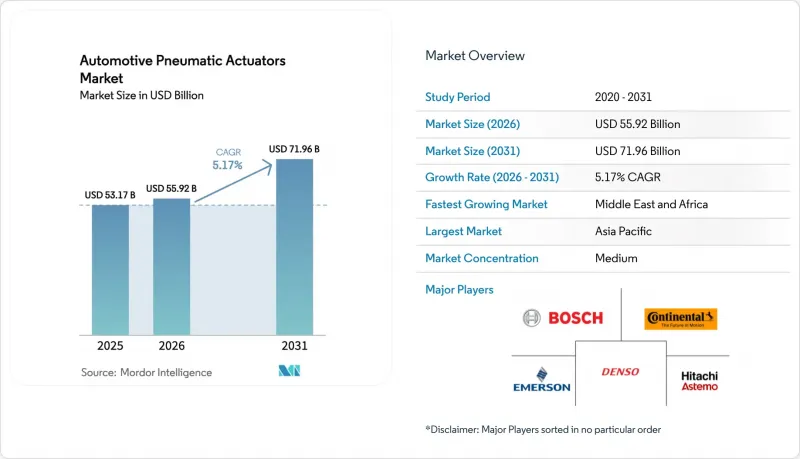
本報告按應用領域(節氣門執行器、燃油噴射執行器、煞車執行器等)、車輛類型(乘用車、輕型商用車等)、執行器機構(單膜片氣動執行器等)、銷售管道(OEM廠商等)和地區進行細分。市場預測以價值(美元)和銷售(台)表示。
全球汽車氣動致動器市場趨勢及洞察
更嚴格的排放氣體法規促使空燃比控制更精確。
美國環保署 (EPA) 的第三階段重型車輛排放氣體標準將於 2024 年生效,該標準提高了氮氧化物 (NOx) 的閾值,迫使柴油車製造商改進其廢氣再循環 (EGR) 和噴射策略,而這些策略依賴高解析度氣動閥。類似的歐 7 排放標準草案也導致歐洲市場需求激增。隨著現場檢驗測試取代實驗室循環測試,執行器需要在實際振動和溫度波動環境下保持精確度。擁有能夠完善數位回饋迴路的電控氣壓組件的供應商在競標中擁有明顯的優勢。監管時間表的加速正在促進訂單決策,並鞏固預測期內的收入前景。
全球汽車產量增加
小型和大型車輛產量的增加推高了所有氣動應用的基準需求,因為每輛組裝車輛都有多個執行器安裝位置。日本汽車製造商協會 (JAMA) 已確認,在 2025 年的 OEM 生產計劃中,氣動解決方案將繼續應用於煞車、節氣門和 EGR 迴路,以確保燃油效率和符合法規要求。平台共用進一步擴大了產量,因為同一執行器系列可以安裝在同系列車型上,從而提高了供應商的規模經濟效益。歐美製造商正將其最終組裝基地遷往東南亞,促使執行器製造商將其模組化生產線整合到該地區。因此,即使電動車競爭對手的成本競爭力日益增強,生產的復甦也鞏固了汽車氣動執行器市場的短期成長。
向節能型電動執行器過渡
電子機械系統能以高達 80% 的效率將電池電能轉換為動能,遠遠超過氣動系統 20% 的效率極限。在電動車領域,這種差異更為顯著,節省一瓦功率就能延長續航里程。生產線製造商也將焊接機器人和物料搬運機械手臂轉向電動汽缸,以提高軌跡精度。然而,在需要高推力的領域,例如重型卡車的鼓式煞車,氣動系統仍然佔據主導地位,因為壓縮空氣已經是汽車平臺的重要組成部分。因此,供應商正致力於研發混合式致動器,在保持壓力推力的同時,實現低能耗的位置控制。
細分市場分析
到2025年,煞車氣室和停車煞車卡鉗單元將佔汽車氣動執行器市場31.12%的佔有率。所有乘用車和商用車都必須安裝這些零件,確保了穩定的銷售量。雖然電子機械停車煞車在豪華轎車中越來越普遍,但重型卡車的鼓式煞車仍然依賴氣室,氣室能夠以更低的成本提供更高的扣夾力。渦輪增壓器廢氣旁通閥執行器緊隨其後,成為成長最快的細分市場,年複合成長率達6.43%。這主要是由於小型化汽油引擎需要精確控制增壓壓力以滿足動力和排放氣體法規的要求。節氣門、空調混合風門和廢氣再循環蝶閥分別在法規和舒適性要求的推動下,維持中等個位數的成長。
在巴西流行的某些軟性燃料車型中,氣動燃油噴射軌道穩壓器仍在使用;而對於注重成本的掀背車來說,車門鎖柱塞也依然常見。整體,供應商正在嘗試利用整合在執行器本體中的智慧壓力感測器,將狀態資料回饋到車輛控制網路。即使直驅式馬達正在縮小競爭差距,這些改進措施仍然保持了氣壓驅動裝置的重要性。總而言之,這種應用配置清晰地說明了汽車氣動執行器市場為何能保持兩位數的銷售額,超過10億美元,因為它涵蓋了所有車輛都至關重要的安全、排放氣體和舒適性功能。
到2025年,乘用車銷售量將佔總銷售量的56.05%,這反映了全球工廠龐大的生產規模。然而,重型商用車預計將以5.63%的複合年成長率推動汽車氣動執行器市場的成長。車隊營運商優先考慮在嚴苛的運作工況下氣煞車和空氣懸吊系統的耐久性,而更嚴格的二氧化碳排放配額要求則促使他們最佳化壓縮機管理,而非徹底更換技術。輕型商用車市場正實現強勁的複合年成長率,這主要得益於城市物流的成長,而城市物流的成長又與電子商務帶來的小包裹需求增加密切相關。建築和採礦設備市場則主要關注高溫排氣閥控制器和高可靠性轉向穩定器。
儘管摩托車市場仍是一個主要集中在某些亞洲國家的微型細分市場,但踏板車製造商正在試點使用低壓氣動伺服系統來實現自動離合器操作。這種多樣性凸顯了一種兩極化:郊區乘用車正因其NVH(噪音、振動和聲振粗糙度)優勢而轉向緊湊型電動動力系統,而高負載車輛則因其功率密度和成熟的可維護性而堅持使用氣動系統。這種分化正在塑造一級供應商未來的平台策略,迫使他們生產模組化產品系列,以便在不修改認證協議的情況下,實現從微型車到重型車的跨度擴展。
區域分析
預計到2025年,亞太地區將佔全球銷售量的45.08%,主要得益於中國多品牌乘用車生產和日本高精度閥門技術的推動。隨著越南、泰國和印度等地的供應鏈價值不斷提升,該地區預計將實現6.84%的複合年成長率,使其對全球汽車製造商的本地採購吸引力日益增強。韓國的電控氣動研發中心正利用該國先進的半導體生態系統,將壓力MEMS感測器整合到執行器PCB中,從而提升其競爭力。儘管電動車的普及率不斷提高,但在成本最佳化的緊湊型車市場,氣壓驅動的HVAC和渦輪增壓廢氣旁通閥單元仍然得到廣泛應用,這確保了供應商的穩定供應。
中東和非洲地區是成長最快的叢集,年複合成長率高達7.42%。沙烏地阿拉伯的「2030願景」產業政策吸引了CKD組裝線入駐,每條生產線都使用本地生產的執行器組件,為支持建築業蓬勃發展的商用卡車提供零件。阿拉伯聯合大公國(阿拉伯聯合大公國)正利用其自由區物流網路,將零件套件再出口到非洲內陸市場。土耳其正透過與歐洲的關稅同盟擴大零件出口,迫使氣動元件供應商擴建其在伊茲密爾和布爾薩的工廠。這些趨勢正將採購方式從跨洲運輸轉向更靠近市場的生產,從而縮短前置作業時間並減少排放氣體。
在南美洲,由於該地區獨特的軟性燃料引擎結構導致乙醇混合燃料的燃燒化學計量比每天都在變化,因此對廢氣再循環(EGR)和燃油軌道執行器的需求受到刺激。在地採購限制迫使跨國供應商在米納斯吉拉斯安裝彈性體硫化機,而不是進口密封件。在阿根廷,隨著貨幣穩定措施的實施,重型卡車組裝正在復甦,從而提振了對大容量煞車氣室的需求。貨幣波動和政治風險正在減緩市場前景,但現有設備的慣性使西半球的汽車氣動執行器市場保持強勁勢頭。
其他好處:
- Excel格式的市場預測(ME)表
- 3個月的分析師支持
目錄
第1章:引言
- 研究假設和市場定義
- 調查範圍
第2章:調查方法
第3章執行摘要
第4章 市場狀況
- 市場概覽
- 市場促進因素
- 更嚴格的排放氣體法規正在推動更精確的空燃比控制技術的發展。
- 全球汽車產量增加
- 隨著ADAS的普及,對高精度操作的要求越來越高。
- 減輕重量以提高燃油效率的趨勢
- 氫氣內燃機中氣門正時控制技術的應用
- OTA 執行器軟體的商業化
- 市場限制因素
- 向節能型電動執行器過渡
- 氣壓系統的複雜性和高昂的維護成本。
- 用於密封應用的高品質彈性體供不應求
- 一級冷媒的脫碳阻礙了氣動技術的研究與發展;
- 價值供應鏈分析
- 監理情勢
- 技術展望
- 波特五力分析
第5章 市場規模與成長預測
- 按應用程式類型
- 節氣門執行器
- 燃油噴射執行器
- 煞車執行器
- 廢氣再循環(EGR)執行器
- 渦輪增壓器廢氣旁通閥執行器
- 暖通空調執行器
- 門鎖執行器
- 其他
- 車輛類型
- 搭乘用車
- 輕型商用車
- 中型和大型商用車輛
- 非公路用車輛
- 摩托車
- 透過執行機構
- 單隔膜氣動空氣泵
- 真空增壓式氣動
- 電控氣動(EP)
- 伺服氣動型
- 齒輪齒條
- 轉葉
- 按銷售管道
- OEM
- 售後市場
- 按地區
- 北美洲
- 美國
- 加拿大
- 其他北美國家
- 南美洲
- 巴西
- 阿根廷
- 其他南美國家
- 歐洲
- 德國
- 英國
- 法國
- 西班牙
- 義大利
- 俄羅斯
- 其他歐洲國家
- 亞太地區
- 中國
- 印度
- 日本
- 韓國
- 澳洲和紐西蘭
- 其他亞太國家
- 中東和非洲
- 沙烏地阿拉伯
- 阿拉伯聯合大公國
- 土耳其
- 埃及
- 南非
- 其他中東和非洲國家
- 北美洲
第6章 競爭情勢
- 市場集中度
- 策略趨勢
- 市佔率分析
- 公司簡介
- Robert Bosch GmbH
- Continental AG
- Denso Corporation
- Emerson(ASCO Valve)
- Hitachi Astemo Ltd
- CTS Corporation
- Schrader Duncan Ltd
- Rotex Automation
- Nucon Industries Pvt Ltd
- Magneti Marelli SpA
- Mitsubishi Electric Corp
- Del-Tron Precision Inc
- Procon Engineering
- Valeo SA
- Aisin Corporation
- Mahle GmbH
- BorgWarner Inc
第7章 市場機會與未來展望
According to Mordor Intelligence, the automotive pneumatic actuators market size was valued at USD 53.17 billion in 2025 and estimated to grow from USD 55.92 billion in 2026 to reach USD 71.96 billion by 2031, at a CAGR of 5.17% during the forecast period (2026-2031).
This report is Segmented by Application Type (Throttle Actuators, Fuel Injection Actuators, Brake Actuators, and More), Vehicle Type (Passenger Cars, Light Commercial Vehicles, and More), Actuator Mechanism (Single-Diaphragm Pneumatic and More), Sales Channel (OEM and More), and Geography. The Market Forecasts are Provided in Terms of Value (USD) and Volume (Units).
Global Automotive Pneumatic Actuators Market Trends and Insights
Stricter emission norms driving precise air-fuel control
The US EPA's Phase 3 heavy-duty standards enacted in 2024 tighten NOx thresholds, compelling diesel makers to refine EGR and dosing strategies that rely on high-resolution pneumatic valves. Similar Euro 7 drafts trigger demand peaks in Europe. Field-valid testing replaces laboratory cycles, forcing actuators to sustain precision under real-world vibration and temperature excursions. Suppliers with electro-pneumatic packages that close the digital feedback loop enjoy distinct bidding advantages. The regulatory timetable accelerates award decisions, locking in revenue visibility for the forecast period.
Increasing global vehicle production
Rising light-duty and heavy-duty volumes lift baseline demand across all pneumatic applications because every unit assembled carries multiple actuator points. The Japan Automobile Manufacturers Association confirmed that OEM schedules for 2025 still embed pneumatic solutions in brake, throttle, and EGR circuits to assure fuel efficiency and compliance. Platform sharing further magnifies volumes because a single actuator family can now be fitted across sibling models, raising economies of scale for suppliers. Western manufacturers are repositioning final-assembly footprints toward Southeast Asia, which encourages actuator makers to co-locate module lines. The production rebound therefore secures near-term growth in the automotive pneumatic actuators market even as electric rivals sharpen their cost proposition.
Shift toward energy-efficient electric actuators
Electromechanical systems convert battery power into motion with up to 80% efficiency, dwarfing the 20% ceiling of air-driven counterparts. The delta becomes more pronounced in electric cars, where every watt saved extends range. Line-builders are also migrating their welding robots and material-handling arms to electric cylinders for tighter path accuracy. Yet pneumatics still dominates the highest-force nodes, such as heavy truck drum brakes, where compressed air is already integral to the vehicle platform. Consequently suppliers are channeling R&D toward mixed-technology actuators that preserve pressure-based force while embedding low-energy position control.
Other drivers and restraints analyzed in the detailed report include:
- ADAS proliferation demanding accurate actuation
- Lightweighting trend for fuel economy
- Complexity & high maintenance cost of pneumatics
For complete list of drivers and restraints, kindly check the Table Of Contents.
Segment Analysis
Brake chambers and parking brake caliper units commanded 31.12% share of the automotive pneumatic actuators market in 2025. Their presence is mandated across every passenger and commercial vehicle variant, cementing baseline volume. Electromechanical parking brakes are penetrating luxury sedans, but heavy truck drum brakes still rely on air chambers that deliver high clamping force at low unit cost. Turbocharger wastegate actuators follow as the fastest riser, posting a 6.43% CAGR because downsized gasoline engines depend on accurate boost management to meet power and emission targets. Throttle valves, HVAC blend doors, and EGR butterflies retain mid-single-digit growth, each backed by regulatory or comfort imperatives.
Pneumatic fuel-injection rail regulators survive in certain flex-fuel layouts popular in Brazil, while door-lock plungers remain common in cost-sensitive hatchbacks. Across the board, suppliers experiment with smart pressure sensors embedded in actuator bodies to supply health data back to the vehicle control network. The enhancements prolong relevance of pneumatically powered devices even as direct electric motor drives tighten competitive gaps. Overall, the application mix underscores why the automotive pneumatic actuators market maintains double-digit billion-dollar revenues: it spans mandatory safety, emissions, and comfort functions that every vehicle must carry.
Passenger cars generated 56.05% of 2025 revenue, reflecting sheer production volume across global plants. Yet heavy commercial vehicles are projected to pace the automotive pneumatic actuators market size expansion with a 5.63% CAGR. Fleet operators prize the durability of air-brake and air-suspension circuits under intense duty cycles, while stricter CO2 quotas push for optimized compressor management rather than wholesale technology swaps. Light commercial vans track e-commerce parcel demand and achieve a robust CAGR on the back of city-logistics growth. Construction and mining equipment are, chiefly for high-temperature exhaust-flap controllers and robust steering stabilizers.
Two-wheelers remain a micro-segment concentrated in select Asian economies, yet scooter OEMs are trialing low-pressure air servos for automatic clutch actuation. The diversity highlights a bifurcation: suburban passenger cars gravitate toward compact electric drives for NVH advantages, whereas high-payload vehicles sustain pneumatics for force density and proven maintainability. That divergence shapes future platform strategies of tier-1 suppliers, compelling them to produce modular families that scale from micro to heavy-duty ratings without rewriting qualification protocols.
Complete Report Scope:
- By Application Type
- Throttle Actuators
- Fuel Injection Actuators
- Brake Actuators
- Exhaust Gas Recirculation Actuators
- Turbocharger Wastegate Actuators
- HVAC Actuators
- Door Lock Actuators
- Others
- By Vehicle Type
- Passenger Cars
- Light Commercial Vehicles
- Medium and Heavy Commercial Vehicles
- Off-Highway Vehicles
- Two-Wheelers
- By Actuator Mechanism
- Single-Diaphragm Pneumatic
- Vacuum-Boost Pneumatic
- Electro-pneumatic (EP)
- Servo-pneumatic
- Rack-and-Pinion
- Rotary-Vane
- By Sales Channel
- OEM
- Aftermarket
- By Geography
- North America
- United States
- Canada
- Rest of North America
- South America
- Brazil
- Argentina
- Rest of South America
- Europe
- Germany
- United Kingdom
- France
- Spain
- Italy
- Russia
- Rest of Europe
- Asia-Pacific
- China
- India
- Japan
- South Korea
- Australia and New Zealand
- Rest of Asia-Pacific
- Middle East and Africa
- Saudi Arabia
- United Arab Emirates
- Turkey
- Egypt
- South Africa
- Rest of Middle East and Africa
- North America
Geography Analysis
Asia-Pacific generated 45.08% of global revenue in 2025, underpinned by China's multi-brand passenger car output and Japan's high-precision valve competence. The region is forecast to post a 6.84% CAGR as supply bases in Vietnam, Thailand, and India climb the value curve, making in-region sourcing attractive for global nameplates. Electro-pneumatic R&D centers in South Korea exploit the country's advanced semiconductor ecosystem to integrate pressure MEMS sensors onto actuator PCBs, heightening competitive edge. Notwithstanding electric-vehicle penetration, cost-optimized sub-compact segments still install pneumatically driven HVAC and turbo wastegate units, securing volume for suppliers.
Middle East & Africa stands out as the fastest-growing cluster at a robust CAGR of 7.42%. Saudi Vision 2030 industrial policy lures CKD assembly lines, each demanding localized actuator content for commercial trucks that service construction booms. The UAE leverages free-zone logistics to re-export spare parts kits deeper into African markets. Turkey's customs-union access to Europe boosts its component exports, compelling pneumatic suppliers to expand Izmir and Bursa facilities. These dynamics re-orient procurement away from trans-continental shipping toward near-market production, shortening lead times and cutting freight emissions.
In South America, flex-fuel engine architectures unique to the region stimulate EGR and fuel-rail actuator demand because ethanol blends alter combustion stoichiometry daily. Local content rules push multinational suppliers to site elastomer curing presses in Minas Gerais rather than import seal stacks. Argentine heavy-truck assembly rebounds after currency stabilization measures, adding lift for high-capacity brake chambers. Currency volatility and political risk temper the outlook, yet installed base inertia keeps the automotive pneumatic actuators market resilient in the hemisphere.
- Robert Bosch GmbH
- Continental AG
- Denso Corporation
- Emerson (ASCO Valve)
- Hitachi Astemo Ltd
- CTS Corporation
- Schrader Duncan Ltd
- Rotex Automation
- Nucon Industries Pvt Ltd
- Magneti Marelli SpA
- Mitsubishi Electric Corp
- Del-Tron Precision Inc
- Procon Engineering
- Valeo SA
- Aisin Corporation
- Mahle GmbH
- BorgWarner Inc
Additional Benefits:
- The market estimate (ME) sheet in Excel format
- 3 months of analyst support
TABLE OF CONTENTS
1 Introduction
- 1.1 Study Assumptions & Market Definition
- 1.2 Scope of the Study
2 Research Methodology
3 Executive Summary
4 Market Landscape
- 4.1 Market Overview
- 4.2 Market Drivers
- 4.2.1 Stricter emission norms driving precise air-fuel control
- 4.2.2 Increasing global vehicle production
- 4.2.3 ADAS proliferation demanding accurate actuation
- 4.2.4 Lightweighting trend for fuel economy
- 4.2.5 Hydrogen ICE valve-timing adoption
- 4.2.6 OTA-enabled actuator software monetisation
- 4.3 Market Restraints
- 4.3.1 Shift toward energy-efficient electric actuators
- 4.3.2 Complexity & high maintenance cost of pneumatics
- 4.3.3 Shortage of high-grade elastomers for seals
- 4.3.4 Tier-1 decarbonisation curbing pneumatic R&D
- 4.4 Value / Supply-Chain Analysis
- 4.5 Regulatory Landscape
- 4.6 Technological Outlook
- 4.7 Porter's Five Forces Analysis
- 4.7.1 Threat of New Entrants
- 4.7.2 Bargaining Power of Buyers
- 4.7.3 Bargaining Power of Suppliers
- 4.7.4 Threat of Substitutes
- 4.7.5 Competitive Rivalry
5 Market Size & Growth Forecasts (Value (USD) and Volume (Units))
- 5.1 By Application Type
- 5.1.1 Throttle Actuators
- 5.1.2 Fuel Injection Actuators
- 5.1.3 Brake Actuators
- 5.1.4 Exhaust Gas Recirculation Actuators
- 5.1.5 Turbocharger Wastegate Actuators
- 5.1.6 HVAC Actuators
- 5.1.7 Door Lock Actuators
- 5.1.8 Others
- 5.2 By Vehicle Type
- 5.2.1 Passenger Cars
- 5.2.2 Light Commercial Vehicles
- 5.2.3 Medium and Heavy Commercial Vehicles
- 5.2.4 Off-Highway Vehicles
- 5.2.5 Two-Wheelers
- 5.3 By Actuator Mechanism
- 5.3.1 Single-Diaphragm Pneumatic
- 5.3.2 Vacuum-Boost Pneumatic
- 5.3.3 Electro-pneumatic (EP)
- 5.3.4 Servo-pneumatic
- 5.3.5 Rack-and-Pinion
- 5.3.6 Rotary-Vane
- 5.4 By Sales Channel
- 5.4.1 OEM
- 5.4.2 Aftermarket
- 5.5 By Geography
- 5.5.1 North America
- 5.5.1.1 United States
- 5.5.1.2 Canada
- 5.5.1.3 Rest of North America
- 5.5.2 South America
- 5.5.2.1 Brazil
- 5.5.2.2 Argentina
- 5.5.2.3 Rest of South America
- 5.5.3 Europe
- 5.5.3.1 Germany
- 5.5.3.2 United Kingdom
- 5.5.3.3 France
- 5.5.3.4 Spain
- 5.5.3.5 Italy
- 5.5.3.6 Russia
- 5.5.3.7 Rest of Europe
- 5.5.4 Asia-Pacific
- 5.5.4.1 China
- 5.5.4.2 India
- 5.5.4.3 Japan
- 5.5.4.4 South Korea
- 5.5.4.5 Australia and New Zealand
- 5.5.4.6 Rest of Asia-Pacific
- 5.5.5 Middle East and Africa
- 5.5.5.1 Saudi Arabia
- 5.5.5.2 United Arab Emirates
- 5.5.5.3 Turkey
- 5.5.5.4 Egypt
- 5.5.5.5 South Africa
- 5.5.5.6 Rest of Middle East and Africa
- 5.5.1 North America
6 Competitive Landscape
- 6.1 Market Concentration
- 6.2 Strategic Moves
- 6.3 Market Share Analysis
- 6.4 Company Profiles (includes Global Level Overview, Market Level Overview, Core Segments, Financials as Available, Strategic Information, Market Rank/Share for Key Companies, Products and Services, SWOT Analysis, and Recent Developments)
- 6.4.1 Robert Bosch GmbH
- 6.4.2 Continental AG
- 6.4.3 Denso Corporation
- 6.4.4 Emerson (ASCO Valve)
- 6.4.5 Hitachi Astemo Ltd
- 6.4.6 CTS Corporation
- 6.4.7 Schrader Duncan Ltd
- 6.4.8 Rotex Automation
- 6.4.9 Nucon Industries Pvt Ltd
- 6.4.10 Magneti Marelli SpA
- 6.4.11 Mitsubishi Electric Corp
- 6.4.12 Del-Tron Precision Inc
- 6.4.13 Procon Engineering
- 6.4.14 Valeo SA
- 6.4.15 Aisin Corporation
- 6.4.16 Mahle GmbH
- 6.4.17 BorgWarner Inc
7 Market Opportunities & Future Outlook
- 7.1 White-space & Unmet-Need Assessment

 南美汽車電動執行器:市場佔有率分析、產業趨勢與統計及成長預測(2026-2031 年)
 汽車執行器市場預測至2034年-全球分析(依執行器類型、車輛系統、推進系統、車輛類型、執行器機構、電壓、控制技術、應用、最終用戶和地區分類)
 電動廢氣旁通閥執行器市場規模、佔有率和成長分析:按車輛類型、驅動系統、銷售管道、應用和地區分類-2026-2033年產業預測
 汽車執行器市場規模、佔有率和趨勢分析報告:按產品類型、操作方式、車輛類型、驅動系統、應用、最終用途、地區和細分市場預測(2026-2033 年)日本汽車液壓執行器:市場佔有率分析、產業趨勢與統計及成長預測(2026-2031)汽車執行器:市場佔有率分析、產業趨勢與統計、成長預測(2026-2031)
 汽車電動執行器市場機會、成長要素、產業趨勢分析及2026-2035年預測
 汽車執行器市場報告:按產品類型、操作方式、車輛類型、銷售管道和地區分類(2026-2034 年)
 2026年全球汽車執行器市場報告
 汽車致動器市場規模、佔有率、成長及全球產業分析:按類型、應用和地區的洞察,2026-2034年的預測