

 |
市場調查報告書
商品編碼
2120279
日本汽車液壓執行器:市場佔有率分析、產業趨勢與統計及成長預測(2026-2031)Japan Automotive Hydraulic Actuators - Market Share Analysis, Industry Trends & Statistics, Growth Forecasts (2026 - 2031) |
||||||

※ 本網頁內容可能與最新版本有所差異。詳細情況請與我們聯繫。
根據 Mordor Intelligence 預測,日本汽車液壓致動器市場規模將從 2025 年的 312 萬美元成長到 2026 年的 332 萬美元,然後在 2031 年達到 457 萬美元,2026 年至 2031 年的複合年成長率為 6.56%。
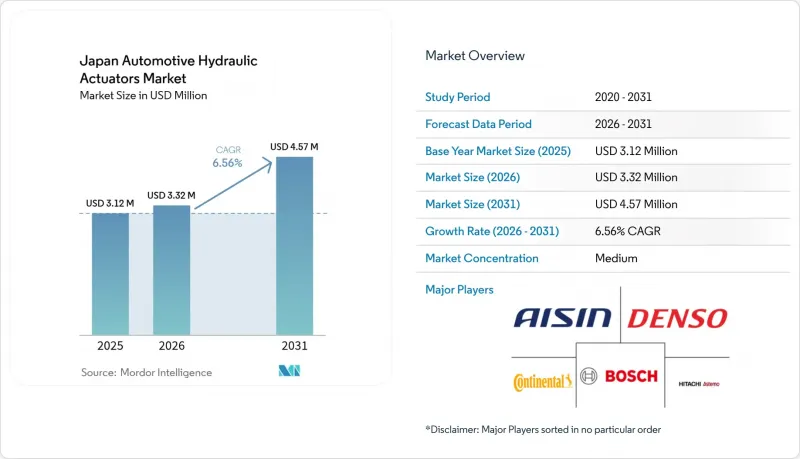
本報告按車輛類型(乘用車、輕型商用車、中重型商用車等)、應用領域(煞車執行器、節氣門執行器等)、執行器設計(線性液壓執行器、旋轉液壓執行器)和銷售管道(OEM、售後市場)進行分類。市場預測以價值(美元)和數量(台)兩種形式呈現。
日本汽車液壓執行器市場趨勢及洞察。
隨著高級駕駛輔助系統 (ADAS) 的日益普及,對高響應性液壓煞車致動器的需求也日益成長。
自動緊急煞車系統現已成為所有車型類別的強製配置,這催生了對響應時間小於50毫秒的液壓煞車致動器的需求。混合式線控刹車制動架構在保持液壓冗餘的同時,實現了電子控制的精確性,迫使供應商重新設計單元,以實現與ECU的無縫整合。 2023年車型的前向碰撞警報系統普及率已達94%,而符合更嚴格性能要求的零件製造商正在製定更高的價格。博世近期部署的線控刹車制動系統表明,電子控制系統仍然依賴液壓備份來確保故障安全運作。
JIS D 0801/UN R13-H 中安全標準的收緊增加了對液壓冗餘的需求。
新的煞車法規要求採用多迴路液壓系統,即使單一迴路發生故障也能維持殘餘壓力。這項法規推動了串聯主缸、雙泵增壓器和整合壓力感測器的應用。由於型式認證造假事件頻發,零件認證現在要求更嚴格的審計追蹤,這使得擁有完善品管系統的成熟製造商獲得了競爭優勢。
電動車向電子機械執行器的轉變正在降低液壓元件的比例。
電池式電動車(BEV)平台正擴大採用電子機械煞車和懸吊,從而減少液壓元件的使用量。採埃孚(ZF)已獲得一份500萬套全線控刹車系統的契約,該系統徹底消除了液壓管路。政府對純電動車和燃料電池汽車的補貼正在加速這一轉變,迫使現有的液壓元件供應商轉型為電子執行器領域。
細分市場分析
到2025年,乘用車將維持在日本汽車液壓執行器市場68.10%的佔有率,反映出個人出行需求的強勁成長。然而,到2031年,中型和重型商用車預計將以7.78%的複合年成長率(CAGR)實現最高成長。這主要得益於政府對氫燃料卡車的津貼,該政策強制要求採用配備耐腐蝕密封件的先進液壓單元。這一轉變將導致乘用車在預測期內的市場佔有率略有下降,而商用車由於其單車執行器容量更高,其總產值將有所成長。隨著最後一公里配送的擴展,輕型商用車的普及率也穩定提升。
由於商用車的需求,日本汽車液壓執行器市場正在獲得戰略深度。商用車需要能夠承受高工況循環、擁有長使用壽命且易於維護的設計。車隊營運商優先考慮具有整合狀態監控功能的執行器,以最大限度地減少停機時間,這推動了對配備感測器的執行器的需求。乘用車雖然成長放緩,但對生產的穩定性仍然至關重要,同時也是混合液壓和電子系統的試驗平台,這些系統未來將應用於更重的平台。
2025年,煞車執行器在日本汽車液壓執行器市場佔有44.60%的佔有率,由於安全法規和幾乎所有車型都標配煞車執行器,其市場佔有率得以維持。然而,由於汽車製造商為應對日益嚴格的排放法規而致力於提高燃燒效率,預計到2031年,排放氣體執行器將以7.01%的年複合成長率(CAGR)成為市場佔有率最高的產品。整合在噴油器執行器組件中的壓力和溫度感測器可實現預測性維護,從而減少引擎意外停機時間。
雖然用於空調系統的混合式車門和座椅調節系統的銷售量正在逐步成長,但其市場佔有率仍落後於動力傳動系統和安全相關應用。此外,預測性維護正在推動煞車執行器更換需求的成長。這是因為診斷數據現在可以精確識別踏板感覺惡化之前的壓力下降,從而促進售後市場銷售。
其他好處:
- Excel格式的市場預測(ME)表
- 3個月的分析師支持
目錄
第1章:引言
- 研究假設和市場定義
- 調查範圍
第2章:調查方法
第3章執行摘要
第4章 市場狀況
- 市場概覽
- 市場促進因素
- 隨著高級駕駛輔助系統 (ADAS) 的日益普及,對高響應性液壓煞車致動器的需求也日益成長。
- JIS D 0801 和 UN R13-H 安全法規的更嚴格要求增加了液壓系統冗餘的需求。
- 疫情後乘用車生產的復甦提振了整車製造商的需求。
- 隨著車輛老化,更換週期延長,導致售後市場需求增加。
- 內建智慧感測器的執行器能夠實現預測性維護。
- 對氫燃料卡車的補貼正在加速對專用液壓裝置的需求。
- 市場限制因素
- 電動車向電子機械執行器的轉變正在降低液壓元件的比例。
- 國內汽車產量下降限制了銷售成長。
- 熟練技工短缺導致精密油壓設備的製造成本上升。
- 對石油洩漏的環境處罰增加了合規成本的負擔。
- 價值供應鏈分析
- 監理情勢
- 技術展望
- 波特五力分析
第5章 市場規模與成長預測
- 車輛類型
- 搭乘用車
- 輕型商用車
- 中型和大型商用車輛
- 巴士和長途汽車
- 按應用程式類型
- 煞車執行器
- 節氣門執行器
- 座椅調整執行器
- 關閉執行器
- 燃油噴射執行器
- HVAC混合閘執行器
- 其他
- 不同類型的執行器
- 線性液壓執行器
- 旋轉液壓執行器
- 按銷售管道
- OEM
- 售後市場
第6章 競爭情勢
- 市場集中度
- 策略趨勢
- 市佔率分析
- 公司簡介
- Denso Corporation
- Aisin Corporation
- Hitachi Astemo Ltd.
- Mitsubishi Electric Corporation
- KYB Corporation
- Akebono Brake Industry Co., Ltd.
- Robert Bosch GmbH
- Continental AG
- BorgWarner Inc.
- Nabtesco Corporation
- NSK Ltd.
- JTEKT Corporation
- Nissin Kogyo Co., Ltd.
- Parker Hannifin KK
第7章 市場機會與未來展望
According to Mordor Intelligence, the Japan automotive hydraulic actuators market size is expected to grow from USD 3.12 million in 2025 to USD 3.32 million in 2026 and is forecast to reach USD 4.57 million by 2031 at 6.56% CAGR over 2026-2031.
This report is Segmented by Vehicle Type (Passenger Car, Light Commercial Vehicle, Medium and Heavy Commercial Vehicle, and More), Application Type (Brake Actuator, Throttle Actuator, and More), Actuator Design (Linear Hydraulic Actuators and Rotary Hydraulic Actuators), and Sales Channel (OEM and Aftermarket). The Market Forecasts are Provided in Terms of Value (USD) and Volume (Units).
Japan Automotive Hydraulic Actuators Market Trends and Insights
Rising ADAS Penetration Calls for High-Response Hydraulic Brake Actuators
Automatic emergency braking is now mandatory across vehicle categories, creating a need for hydraulic brake actuators that achieve sub-50-ms response times. Hybrid brake-by-wire architectures keep hydraulic redundancy while enabling electronic precision, pushing suppliers to redesign units for seamless ECU integration. Forward-collision warning adoption reached 94% by model year 2023, and component makers that meet the tighter performance window command premium pricing. Bosch's recent brake-by-wire rollouts illustrate how electronic control overlays still rely on hydraulic backup for fail-safe assurance .
Stricter JIS D 0801 / UN R13-H Safety Rules Raise Hydraulic Redundancy Needs
New braking rules require multi-circuit hydraulic systems able to retain residual pressure even under single-circuit failure. Compliance efforts spur uptake of tandem master cylinders, dual-pump boosters, and integrated pressure sensors. Component certification now involves tighter audit trails after widely publicized type-approval misconduct cases, giving incumbents with robust quality systems a competitive edge .
EV Shift Toward Electro-Mechanical Actuators Erodes Hydraulic Content
Battery-electric platforms increasingly specify electromechanical brakes and suspension, reducing hydraulic fitment. ZF won a 5 million-vehicle contract for full brake-by-wire systems that eliminate hydraulic lines entirely. Subsidies that favor BEVs and fuel-cell cars intensify the pivot, pushing incumbent hydraulic suppliers to diversify into electronic actuation.
Other drivers and restraints analyzed in the detailed report include:
- Passenger-Car Production Rebound Boosts OEM Demand
- Ageing Fleet Lengthens Replacement Cycles, Expanding Aftermarket Volumes
- Domestic Vehicle Production Decline Limits Volume Growth Potential
For complete list of drivers and restraints, kindly check the Table Of Contents.
Segment Analysis
Passenger cars retained a 68.10% share of the Japan automotive hydraulic actuators market in 2025, reflecting entrenched personal-mobility demand. Yet medium and heavy commercial vehicles will record the highest 7.78% CAGR to 2031, buoyed by hydrogen-truck incentives that specify advanced hydraulic units with corrosion-resistant seals. This shift marginally dilutes passenger-car share over the forecast window but enlarges total output value because commercial vehicles carry higher actuator content per unit. Light commercial vans continue to see steady adoption as last-mile delivery expands.
The Japan automotive hydraulic actuators market gains strategic depth from commercial-vehicle requirements for long-life, serviceable designs that withstand high duty cycles. Fleet operators prioritize actuators with integrated condition monitoring to minimize downtime, propelling demand for sensorized units. Passenger cars, though slower growing, remain vital for volume stability and serve as a testbed for hybrid hydraulic-electronic systems that later migrate to heavier platforms.
Brake actuators commanded 44.60% of the Japan automotive hydraulic actuators market size in 2025, sustained by safety regulations and near-universal fitment. However, fuel-injection actuators will be the fastest 7.01% CAGR through 2031 as OEMs refine combustion efficiency ahead of stricter emission caps. Embedded pressure and temperature sensors inside the injector actuator assembly enable predictive maintenance, reducing unplanned engine downtime.
HVAC blend-door and seat-adjustment systems add incremental volume, but their share trails powertrain and safety applications. Predictive maintenance also uplifts brake-actuator replacements because diagnostic data now pinpoints declining pressure build-up before pedal feel deteriorates, strengthening aftermarket sales.
Complete Report Scope:
- By Vehicle Type
- Passenger Car
- Light Commercial Vehicle
- Medium and Heavy Commercial Vehicle
- Buses and Coaches
- By Application Type
- Brake Actuator
- Throttle Actuator
- Seat Adjustment Actuator
- Closure Actuator
- Fuel-Injection Actuator
- HVAC Blend-Door Actuator
- Others
- By Actuator Design
- Linear Hydraulic Actuators
- Rotary Hydraulic Actuators
- By Sales Channel
- OEM
- Aftermarket
List of Companies Covered in this Report:
- Denso Corporation
- Aisin Corporation
- Hitachi Astemo Ltd.
- Mitsubishi Electric Corporation
- KYB Corporation
- Akebono Brake Industry Co., Ltd.
- Robert Bosch GmbH
- Continental AG
- BorgWarner Inc.
- Nabtesco Corporation
- NSK Ltd.
- JTEKT Corporation
- Nissin Kogyo Co., Ltd.
- Parker Hannifin K.K.
Additional Benefits:
- The market estimate (ME) sheet in Excel format
- 3 months of analyst support
TABLE OF CONTENTS
1 Introduction
- 1.1 Study Assumptions & Market Definition
- 1.2 Scope of the Study
2 Research Methodology
3 Executive Summary
4 Market Landscape
- 4.1 Market Overview
- 4.2 Market Drivers
- 4.2.1 Rising ADAS penetration calls for high-response hydraulic brake actuators
- 4.2.2 Stricter JIS D 0801 / UN R13-H safety rules raise hydraulic redundancy needs
- 4.2.3 Passenger-car production rebound post-pandemic boosts OEM demand
- 4.2.4 Ageing fleet lengthens replacement cycles, expanding aftermarket volumes
- 4.2.5 Smart-sensor-integrated actuators enable predictive-maintenance adoption
- 4.2.6 Hydrogen-truck subsidies accelerate demand for specialty hydraulic units
- 4.3 Market Restraints
- 4.3.1 EV shift toward electro-mechanical actuators erodes hydraulic content
- 4.3.2 Domestic vehicle production decline limits volume growth potential
- 4.3.3 Skilled-machinist shortage inflates precision hydraulic manufacturing costs
- 4.3.4 Oil-leak environmental penalties raise compliance cost pressures
- 4.4 Value/Supply-Chain Analysis
- 4.5 Regulatory Landscape
- 4.6 Technological Outlook
- 4.7 Porter's Five Forces Analysis
- 4.7.1 Threat of New Entrants
- 4.7.2 Bargaining Power of Buyers/Consumers
- 4.7.3 Bargaining Power of Suppliers
- 4.7.4 Threat of Substitute Products
- 4.7.5 Intensity of Competitive Rivalry
5 Market Size & Growth Forecasts (Value (USD) and Volume (Units))
- 5.1 By Vehicle Type
- 5.1.1 Passenger Car
- 5.1.2 Light Commercial Vehicle
- 5.1.3 Medium and Heavy Commercial Vehicle
- 5.1.4 Buses and Coaches
- 5.2 By Application Type
- 5.2.1 Brake Actuator
- 5.2.2 Throttle Actuator
- 5.2.3 Seat Adjustment Actuator
- 5.2.4 Closure Actuator
- 5.2.5 Fuel-Injection Actuator
- 5.2.6 HVAC Blend-Door Actuator
- 5.2.7 Others
- 5.3 By Actuator Design
- 5.3.1 Linear Hydraulic Actuators
- 5.3.2 Rotary Hydraulic Actuators
- 5.4 By Sales Channel
- 5.4.1 OEM
- 5.4.2 Aftermarket
6 Competitive Landscape
- 6.1 Market Concentration
- 6.2 Strategic Moves
- 6.3 Market Share Analysis
- 6.4 Company Profiles (Includes Global Level Overview, Market Level Overview, Core Segments, Financials as Available, Strategic Information, Market Rank/Share for Key Companies, Products and Services, SWOT Analysis, and Recent Developments)
- 6.4.1 Denso Corporation
- 6.4.2 Aisin Corporation
- 6.4.3 Hitachi Astemo Ltd.
- 6.4.4 Mitsubishi Electric Corporation
- 6.4.5 KYB Corporation
- 6.4.6 Akebono Brake Industry Co., Ltd.
- 6.4.7 Robert Bosch GmbH
- 6.4.8 Continental AG
- 6.4.9 BorgWarner Inc.
- 6.4.10 Nabtesco Corporation
- 6.4.11 NSK Ltd.
- 6.4.12 JTEKT Corporation
- 6.4.13 Nissin Kogyo Co., Ltd.
- 6.4.14 Parker Hannifin K.K.
7 Market Opportunities & Future Outlook
- 7.1 White-space & Unmet-Need Assessment

 南美汽車電動執行器:市場佔有率分析、產業趨勢與統計及成長預測(2026-2031 年)
 汽車執行器市場預測至2034年-全球分析(依執行器類型、車輛系統、推進系統、車輛類型、執行器機構、電壓、控制技術、應用、最終用戶和地區分類)
 電動廢氣旁通閥執行器市場規模、佔有率和成長分析:按車輛類型、驅動系統、銷售管道、應用和地區分類-2026-2033年產業預測
 汽車執行器市場規模、佔有率和趨勢分析報告:按產品類型、操作方式、車輛類型、驅動系統、應用、最終用途、地區和細分市場預測(2026-2033 年)汽車氣動執行器:市場佔有率分析、產業趨勢與統計、成長預測(2026-2031)汽車執行器:市場佔有率分析、產業趨勢與統計、成長預測(2026-2031)
 汽車電動執行器市場機會、成長要素、產業趨勢分析及2026-2035年預測
 汽車執行器市場報告:按產品類型、操作方式、車輛類型、銷售管道和地區分類(2026-2034 年)
 2026年全球汽車執行器市場報告
 汽車致動器市場規模、佔有率、成長及全球產業分析:按類型、應用和地區的洞察,2026-2034年的預測