


 |
市場調查報告書
商品編碼
2113190
汽車執行器:市場佔有率分析、產業趨勢與統計、成長預測(2026-2031)Automotive Actuators - Market Share Analysis, Industry Trends & Statistics, Growth Forecasts (2026 - 2031) |
||||||

※ 本網頁內容可能與最新版本有所差異。詳細情況請與我們聯繫。
據 Mordor Intelligence 稱,2025 年汽車執行器市值為 221.9 億美元,預計到 2031 年將達到 305.3 億美元,而 2026 年為 233.9 億美元,預測期(2026-2031 年)的複合年成長率為 5.4%。
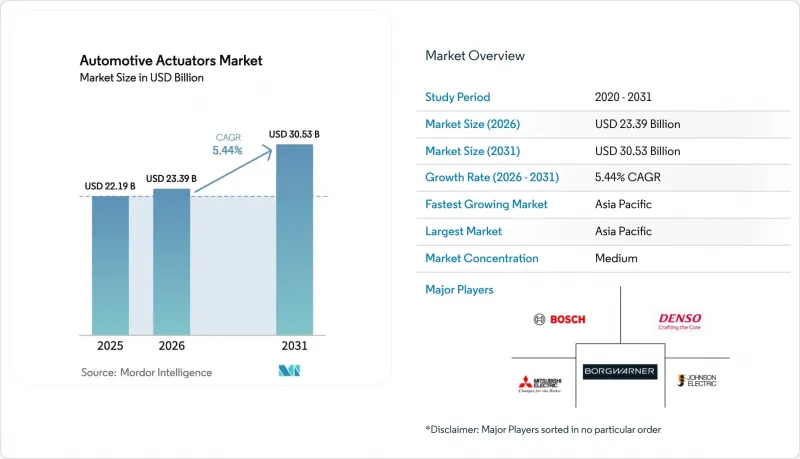
本報告按驅動技術(電動、電子機械等)、運行類型(線性、旋轉)、應用(油門、煞車等)、車輛動力系統(內燃機、混合動力等)、車輛類型(乘用車、輕型商用車等)、銷售管道(OEM、售後市場)和地區進行分類。市場預測以美元(USD)計價。
全球汽車執行器市場趨勢與洞察
對先進安全和舒適功能的需求日益成長
在全球高級駕駛輔助系統 (ADAS) 法規的推動下,執行器在轉向、煞車和懸吊組件中的整合持續推進。歐盟的《通用安全法規 II》強制要求所有在 2024 年 7 月之後推出的新車必須配備智慧速度輔助系統、自動緊急煞車系統和車道維持輔助系統,這確保了未來幾年對精密執行器的需求。在美國,國家公路交通安全管理局 (NHTSA) 修訂了其新車評估計畫 (NCAP),新增了四項 ADAS 技術,這些技術將作為測試標準保留至 2033 年。消費者對開放原始碼安全解決方案的付費意願表明,先進執行器技術仍有投資空間。大陸集團攝影機產量逐年成長,凸顯了一個值得關注的趨勢:隨著感測器產量的增加,執行器的應用也隨之擴展。觸覺感測器的創新集合成為傳統的電子機械系統注入了新的活力,有效彌合了自動駕駛中常見的感知差距。這項突破性的整合有望增強感官體驗,並在車輛與周圍環境之間創造更直覺的互動。
亞太地區乘用車產量擴張
2024年,中國汽車產量達到驚人的3,143.6萬輛,鞏固了其作為全球汽車強國的地位。同時,在泰國和印尼等國極具吸引力的激勵措施的推動下,東協地區正穩步邁向年汽車產量近600萬輛的目標,目標是在2030年代中期實現這一目標。泰國的創新「EV3.5」計畫引領這一趨勢,該計畫旨在促進本地零件生產,並推動轉向執行器區域供應鏈的發展。
隨著中國汽車製造商(OEM)推動垂直整合,它們不僅最佳化了成本結構,還促進了跨境專業製造技術的快速交流。中國在稀土元素礦物市場的主導地位進一步塑造了這一動態演變,顯著影響全球設計策略,並推動了不使用磁性材料的汽車架構的研發。
稀土元素磁鐵供應的波動推高了成本。
中國佔了稀土元素加工市場高達90%的佔有率,而近期推出的更嚴格的許可製度正開始對整個產業產生影響。福特等主要製造商已被迫停止在歐洲生產其Explorer電動車系列,凸顯了其供應鏈的脆弱性。
汽車創新聯盟發出嚴厲警告:供應緊張的進一步惡化可能導致北美地區大規模停產,對汽車產業的未來蒙上陰影。採埃孚高效的隔離勵磁同步馬達無需使用高濃度稀土元素,但需要新的模具和檢驗。到2040年,釹鏑的需求將持續成長,這將持續推高價格,同時研發週期也將延長,因此需要對Sm2Fe17N3和Fe16N2化合物進行研發。供應商正透過雙重採購和使用回收磁體來規避風險,但全面多元化預計仍需數年時間。
細分市場分析
到2025年,電動執行器將佔汽車執行器市場37.94%的佔有率。這主要歸功於原始設備製造商(OEM)優先考慮其可控性以及與集中式電子機械電氣(E/E)架構的無縫整合。在需要機械故障保護的混合動力傳動系統中,機電單元仍然是標準選擇。另一方面,由於重量和維護方面的缺點,液壓執行器在重型卡車以外的應用正在減少。形狀記憶合金(SMA)致動器正以9.60%的複合年成長率快速成長,利用其高力重比取代座椅、通風口和門鎖功能中的笨重電機,從而節省車廂空間。壓電驅動裝置能夠滿足燃油噴射器和觸覺儀表板中微秒級的精度要求,而氣動解決方案仍僅限於車載空氣系統已存在的細分商業領域。
成長前景取決於人工智慧賦能的自調節韌體,能夠延長使用壽命並縮短校準時間。電動執行器現在配備了嵌入式狀態監測晶片,可以預測故障模式,從而降低保固成本。形狀記憶合金 (SMA) 供應商正與一級製造商合作,以擴展燒結技術並進一步實現價格均衡。壓電供應商致力於在寬溫度範圍內實現汽車級可靠性,以確保其產品在駕駛座(HMI) 中的應用。隨著空中下載 (OTA) 解決方案的普及,韌體模組化使原始設備製造商 (OEM) 能夠在不更改硬體的情況下部署新的運行配置文件,從而進一步加速汽車執行器市場向軟體定義功能的轉變。
預計到2025年,線性機構將佔汽車執行器市場規模的62.01%,主要得益於車門關閉器、座椅導軌和主動避震器等產品的廣泛應用。原始設備製造商(OEM)的永續發展目標傾向於採用電動線性裝置,因為其能耗比液壓系統低20%,並且易於整合到48V電網中。基於雲端收集的行程資料的預測性維護儀錶板可以減少自我調整懸吊的意外故障,並提高乘坐舒適性。
旋轉執行器雖然數量相對較少,但對於線控轉向系統和主動側傾控制至關重要。此外,預計到2031年,旋轉致動器的設計將以7.72%的複合年成長率高速成長。諸如ZF的sMOTION等先進底盤系統可在0.5秒內實現80毫米的升程,充分展現了高扭力旋轉模組如何提升車輛的動態操控性能。新一代旋轉驅動器採用緊湊型磁鐵和無稀土元素架構,在保持扭矩密度的同時,有效規避了供應風險。供應商正在整合邊緣人工智慧晶片,用於記錄細微的振動模式,從而實現執行器在整個使用壽命期間的自動校準。這項功能與汽車執行器市場不斷擴展的基於服務的收入模式完美契合。
區域分析
預計到2025年,亞太地區將佔全球汽車執行器市場佔有率的41.86%,並在2031年之前以8.48%的複合年成長率成長。中國電動車產量的不斷成長,得益於政府補貼和大規模生產設施的支持,正在推動全部區域的需求。東協在本世紀中期實現600萬台的產量目標,使其成為吸引一級製造商工廠並降低地緣政治風險的輔助樞紐。日本和韓國正利用其在電子領域的專業技術出口高精度執行器,而印度則在擴大面向國內和出口市場的低成本生產。
在北美,受監管合規和回流獎勵的推動,電動汽車產業呈現穩定成長態勢。美國環保署的多污染物排放法規強制要求內燃機使用新型執行器,而《通膨控制法案》則支持電動車供應鏈的在地化。
歐洲在技術上依然領先,但其供應鏈受制於對稀土元素的依賴。歐7指令和通用安全法規II正在推動動力傳動系統和ADAS領域對執行器的需求。大陸集團1000萬台攝影機的生產以及採埃孚的線控刹車訂單顯示了大陸集團的領先地位,但原料避險和能源成本正在對其盈利構成壓力。中東、非洲和南美洲在法規方面落後於歐洲,但一旦價格更親民,智慧執行器的成本曲線更有利,這些地區仍有長期成長空間。
其他好處:
- Excel格式的市場預測(ME)表
- 3個月的分析師支持
目錄
第1章:引言
- 研究假設和市場定義
- 調查範圍
第2章:調查方法
第3章執行摘要
第4章 市場狀況
- 市場概覽
- 市場促進因素
- 對先進安全和舒適功能的需求日益成長
- 汽車電氣化和電動車產量快速成長
- 加強全球排放法規/加強燃油效率法規
- 亞太地區乘用車產量擴張
- 形狀記憶合金和壓電致動器拓展了車內空間的可能性。
- 透過OTA校準的軟體定義執行器可減少停機時間。
- 市場限制因素
- 下一代智慧型執行器的零件成本高昂
- 高溫運轉循環中的可靠性問題
- 固態電動驅動系統減少了每輛電動車的執行器數量。
- 稀土元素磁鐵供應的波動推高了成本。
- 價值供應鏈分析
- 監理情勢
- 技術展望
- 波特五力模型
第5章 市場規模與成長預測
- 透過驅動技術
- 電動執行器
- 電子機械執行器
- 液壓致動器
- 氣壓執行器
- 壓電動器
- 形狀記憶合金致動器
- 按操作類型
- 線性
- 旋轉
- 按應用程式類型
- 風門
- 煞車
- 變速箱/傳動系統
- 座椅調節
- 門/關閉
- 暖通空調/溫度控管
- 懸吊底盤
- 鏡子和燈光
- 車輛推進類型
- 內燃機(ICE)
- 混合動力電動車(HEV)
- 電池式電動車(BEV)
- 插電式混合動力車(PHEV)
- 燃料電池汽車(FCEV)
- 按車輛類型
- 搭乘用車
- 輕型商用車
- 大型商用車輛
- 非公路/特殊用途
- 按銷售管道
- OEM
- 售後市場
- 按地區
- 北美洲
- 美國
- 加拿大
- 其他北美國家
- 南美洲
- 巴西
- 阿根廷
- 其他南美國家
- 歐洲
- 德國
- 法國
- 英國
- 義大利
- 西班牙
- 俄羅斯
- 其他歐洲國家
- 亞太地區
- 中國
- 日本
- 印度
- 韓國
- 越南
- 印尼
- 菲律賓
- 泰國
- 澳洲
- 其他亞太國家
- 中東和非洲
- 阿拉伯聯合大公國
- 沙烏地阿拉伯
- 土耳其
- 埃及
- 南非
- 其他中東和非洲國家
- 北美洲
第6章 競爭情勢
- 市場集中度
- 策略趨勢
- 市佔率分析
- 公司簡介
- Robert Bosch GmbH
- Denso Corporation
- BorgWarner Inc.
- Johnson Electric Holdings Limited
- Mitsubishi Electric Corp.
- ZF Friedrichshafen AG
- Continental AG
- Valeo SA
- Aisin Corporation
- Hitachi Astemo
- Nidec Corporation
- CTS Corporation
- HELLA GmbH & Co. KGaA
- Magneti Marelli
- Mahle GmbH
- Knorr-Bremse AG
- Schaeffler AG
- Sensata Technologies Inc.
- Vitesco Technologies GmbH
第7章 市場機會與未來展望
According to Mordor Intelligence, the automotive actuators market size was valued at USD 22.19 billion in 2025 and estimated to grow from USD 23.39 billion in 2026 to reach USD 30.53 billion by 2031, at a CAGR of 5.44% during the forecast period (2026-2031).
This report is Segmented by Actuation Technology (Electric, Electromechanical, and More), Motion Type (Linear and Rotary), Application Type (Throttle, Brake, and More), Propulsion Type (Internal Combustion Engine, Hybrid, and More), Vehicle Type (Passenger Cars, Light Commercial, and More), Sales Channel (OEM and Aftermarket), and Geography. The Market Forecasts are Provided in Terms of Value (USD).
Global Automotive Actuators Market Trends and Insights
Rising Demand for Advanced Safety and Comfort Features
Global ADAS mandates continue to embed actuators in steering, braking, and suspension assemblies. The EU General Safety Regulation II requires intelligent speed assistance, autonomous emergency braking, and lane-keeping support in every new model launched after July 2024, locking in multi-year volume for precision actuators. In the United States, NHTSA updated its New Car Assessment Program to include four additional ADAS technologies that will remain test criteria through 2033 . Consumers' willingness to pay for open-source safety solutions, signaling purchasing headroom for advanced actuation. The annual surge in camera production at Continental showcases a remarkable trend: as sensor output expands, the implementation of actuators rises in tandem. The innovative fusion of haptic sensors breathes new life into traditional electromechanical systems, effectively narrowing the perception gaps that often challenge autonomous driving. This exciting integration promises to enhance the sensory experience, creating a more intuitive interaction between vehicles and their surroundings.
Ramp-Up of Passenger-Car Output in Asia-Pacific
In 2024, China achieved a remarkable production milestone by rolling out an impressive 31.436 million vehicles, solidifying its position as a global automotive powerhouse. Meanwhile, the ASEAN region is on a determined path to reach an annual vehicle output of nearly 6 million units by the mid-2030s, fueled by enticing incentives from Thailand and Indonesia. Thailand's innovative EV3.5 program is at the forefront, promoting localized component production and encouraging the development of regional supply chains for steering actuators.
As Chinese original equipment manufacturers (OEMs) embrace vertical integration, they are not only streamlining their cost structures but also fostering a swift exchange of specialized manufacturing expertise across borders. This dynamic evolution is further shaped by China's dominance in the rare-earth minerals market, which significantly influences global design strategies, steering them toward the development of magnet-free vehicle architectures.
Rare-Earth Magnet Supply Volatility Inflates Costs
China dominates the rare-earth processing market with a staggering 90% share, and the recent imposition of stricter export licensing has begun to ripple across the industry. Major manufacturers, like Ford, have already been compelled to halt production of their Explorer EV line in Europe, highlighting the fragility of the supply chain.
The Alliance for Automotive Innovation has issued a stark warning: if supply constraints worsen, North American operations could face significant shutdowns, casting a shadow over the future of the automotive sector. ZF's efficient separatively excited synchronous motor eliminates heavy rare-earth content but demands new tooling and validation. Rising neodymium and dysprosium demand through 2040 sustains price pressure, compelling R&D into Sm2Fe17N3 and Fe16N2 compounds, albeit with longer development cycles. Suppliers hedge with dual-sourcing and recycled magnets, yet complete diversification remains years away.
Other drivers and restraints analyzed in the detailed report include:
- Shape-Memory-Alloy and Piezo Micro-Actuators Unlock Interior Space
- OTA-Calibrated "Software-Defined" Actuators Reduce Downtime
- High BOM Cost of Next-Gen Smart Actuators
For complete list of drivers and restraints, kindly check the Table Of Contents.
Segment Analysis
Electric actuators captured 37.94% of the automotive actuators market size in 2025 as OEMs favored their controllability and seamless integration with centralized E/E architectures. Electromechanical units remain default choices for hybrid powertrains that require a mechanical fail-safe, whereas hydraulics decline outside heavy trucks due to weight and maintenance drawbacks. SMA actuators are advancing at a 9.60% CAGR, leveraging high force-to-mass ratios to replace bulky motors in seat, vent, and latch functions, thus unlocking cabin space savings. Piezo drives address microsecond precision needs in fuel injectors and haptic dashboards, while pneumatic solutions linger in niche commercial segments where onboard air systems already exist.
Growth prospects hinge on AI-enabled self-tuning firmware that prolongs life and cuts calibration time. Electric actuators now incorporate embedded condition-monitoring chips that predict failure modes, lowering warranty costs. SMA suppliers partner with Tier-1s to scale sintering techniques that bring unit cost parity closer. Piezo vendors push automotive-grade reliability at wide temperature bands to secure cockpit HMI wins. As OTA expands, firmware modularity lets OEMs roll out new actuation profiles without hardware changes, reinforcing the automotive actuators market's shift toward software-defined functionality.
Linear mechanisms accounted for 62.01% of the automotive actuators market size in 2025, underpinned by door closers, seat rails, and active dampers. OEM sustainability goals favor electric linear devices that consume 20% less energy than hydraulic equivalents and integrate easily into 48 V power nets. Predictive-maintenance dashboards originating from cloud-captured stroke data reduce unexpected collapses in adaptive suspension, enhancing ride comfort.
While smaller in volume, rotary actuators are essential for steer-by-wire systems and active roll control. Additionally, rotary designs are projected to gain the highest CAGR at 7.72% through 2031. Advanced chassis programs such as ZF's sMOTION deliver 80 mm lift in 0.5 s, demonstrating how high-torque rotary modules enhance dynamic handling. Next-generation rotary drives employ compact magnets or rare-earth-free architectures to sidestep supply risks while sustaining torque density. Suppliers integrate edge-AI chips that log micro-vibration signatures, allowing in-life recalibration, a feature well-suited to the automotive actuators market's growing service-based revenue models
Complete Report Scope:
- By Actuation Technology
- Electric Actuators
- Electromechanical Actuators
- Hydraulic Actuators
- Pneumatic Actuators
- Piezoelectric Actuators
- Shape-Memory-Alloy Actuators
- By Motion Type
- Linear
- Rotary
- By Application Type
- Throttle
- Brake
- Transmission / Drivetrain
- Seat Adjustment
- Door / Closure
- HVAC & Thermal
- Suspension & Chassis
- Mirror & Lighting
- By Vehicle Propulsion
- Internal Combustion Engine (ICE)
- Hybrid Electric Vehicles (HEV)
- Battery-Electric (BEV)
- Plug-in Hybrid Electric Vehicles (PHEV)
- Fuel-Cell Electric (FCEV)
- By Vehicle Type
- Passenger Cars
- Light Commercial Vehicles
- Heavy Commercial Vehicles
- Off-Highway & Special-Purpose
- By Sales Channel
- Original Equipment Manufacturers (OEM)
- Aftermarket
- By Geography
- North America
- United States
- Canada
- Rest of North America
- South America
- Brazil
- Argentina
- Rest of South America
- Europe
- Germany
- France
- United Kingdom
- Italy
- Spain
- Russia
- Rest of Europe
- Asia-Pacific
- China
- Japan
- India
- South Korea
- Vietnam
- Indonesia
- Philippines
- Thailand
- Australia
- Rest of Asia-Pacific
- Middle-East and Africa
- United Arab Emirates
- Saudi Arabia
- Turkey
- Egypt
- South Africa
- Rest of Middle-East and Africa
- North America
Geography Analysis
Asia-Pacific held 41.86% of the automotive actuators market size in 2025 and will grow 8.48% CAGR through 2031. China's boost in electric vehicle production is increasing regional demand, supported by state subsidies and large-scale manufacturing. ASEAN's six million-unit production target in the mid-to-next decade offers secondary hubs that attract Tier-1 factories, buffering geopolitical risk. Japan and South Korea leverage electronics expertise to export high-precision actuators, while India ramps up cost-efficient production for domestic and export markets.
North America is expanding steadily in terms of regulatory compliance and re-shoring incentives. The EPA's multi-pollutant rule compels new combustion-engine actuators, whereas the Inflation Reduction Act supports EV supply-chain localization.
Europe remains technologically advanced but supply-chain-constrained by rare-earth exposure. The Euro 7 directive and General Safety Regulation II sustain actuator demand in both powertrain and ADAS. Continental's 10-million-camera production and ZF's brake-by-wire wins illustrate Continental's leadership, yet raw-material hedging and energy costs challenge profitability. Middle East & Africa and South America lag in regulations but present long-term whitespace once affordability matches smart-actuator cost curves.
- Robert Bosch GmbH
- Denso Corporation
- BorgWarner Inc.
- Johnson Electric Holdings Limited
- Mitsubishi Electric Corp.
- ZF Friedrichshafen AG
- Continental AG
- Valeo SA
- Aisin Corporation
- Hitachi Astemo
- Nidec Corporation
- CTS Corporation
- HELLA GmbH & Co. KGaA
- Magneti Marelli
- Mahle GmbH
- Knorr-Bremse AG
- Schaeffler AG
- Sensata Technologies Inc.
- Vitesco Technologies GmbH
Additional Benefits:
- The market estimate (ME) sheet in Excel format
- 3 months of analyst support
TABLE OF CONTENTS
1 Introduction
- 1.1 Study Assumptions & Market Definition
- 1.2 Scope of the Study
2 Research Methodology
3 Executive Summary
4 Market Landscape
- 4.1 Market Overview
- 4.2 Market Drivers
- 4.2.1 Rising Demand for Advanced Safety and Comfort Features
- 4.2.2 Surge In Vehicle Electrification and EV Production
- 4.2.3 Stricter Global Emission / Fuel-Efficiency Regulations
- 4.2.4 Ramp-Up of Passenger-Car Output in Asia-Pacific
- 4.2.5 Shape-Memory-Alloy and Piezo Micro-Actuators Unlock Interior Space
- 4.2.6 OTA-Calibrated Software-Defined" Actuators Reduce Downtime"
- 4.3 Market Restraints
- 4.3.1 High BOM Cost of Next-Gen Smart Actuators
- 4.3.2 Reliability Concerns in High-Temperature Duty Cycles
- 4.3.3 Solid-State E-Drivetrains Cutting Actuator Counts Per EV
- 4.3.4 Rare-Earth Magnet Supply Volatility Inflates Costs
- 4.4 Value / Supply-Chain Analysis
- 4.5 Regulatory Landscape
- 4.6 Technological Outlook
- 4.7 Porter's Five Forces
- 4.7.1 Threat of New Entrants
- 4.7.2 Bargaining Power of Buyers
- 4.7.3 Bargaining Power of Suppliers
- 4.7.4 Threat of Substitutes
- 4.7.5 Competitive Rivalry
5 Market Size & Growth Forecasts (Value, USD)
- 5.1 By Actuation Technology
- 5.1.1 Electric Actuators
- 5.1.2 Electromechanical Actuators
- 5.1.3 Hydraulic Actuators
- 5.1.4 Pneumatic Actuators
- 5.1.5 Piezoelectric Actuators
- 5.1.6 Shape-Memory-Alloy Actuators
- 5.2 By Motion Type
- 5.2.1 Linear
- 5.2.2 Rotary
- 5.3 By Application Type
- 5.3.1 Throttle
- 5.3.2 Brake
- 5.3.3 Transmission / Drivetrain
- 5.3.4 Seat Adjustment
- 5.3.5 Door / Closure
- 5.3.6 HVAC & Thermal
- 5.3.7 Suspension & Chassis
- 5.3.8 Mirror & Lighting
- 5.4 By Vehicle Propulsion
- 5.4.1 Internal Combustion Engine (ICE)
- 5.4.2 Hybrid Electric Vehicles (HEV)
- 5.4.3 Battery-Electric (BEV)
- 5.4.4 Plug-in Hybrid Electric Vehicles (PHEV)
- 5.4.5 Fuel-Cell Electric (FCEV)
- 5.5 By Vehicle Type
- 5.5.1 Passenger Cars
- 5.5.2 Light Commercial Vehicles
- 5.5.3 Heavy Commercial Vehicles
- 5.5.4 Off-Highway & Special-Purpose
- 5.6 By Sales Channel
- 5.6.1 Original Equipment Manufacturers (OEM)
- 5.6.2 Aftermarket
- 5.7 By Geography
- 5.7.1 North America
- 5.7.1.1 United States
- 5.7.1.2 Canada
- 5.7.1.3 Rest of North America
- 5.7.2 South America
- 5.7.2.1 Brazil
- 5.7.2.2 Argentina
- 5.7.2.3 Rest of South America
- 5.7.3 Europe
- 5.7.3.1 Germany
- 5.7.3.2 France
- 5.7.3.3 United Kingdom
- 5.7.3.4 Italy
- 5.7.3.5 Spain
- 5.7.3.6 Russia
- 5.7.3.7 Rest of Europe
- 5.7.4 Asia-Pacific
- 5.7.4.1 China
- 5.7.4.2 Japan
- 5.7.4.3 India
- 5.7.4.4 South Korea
- 5.7.4.5 Vietnam
- 5.7.4.6 Indonesia
- 5.7.4.7 Philippines
- 5.7.4.8 Thailand
- 5.7.4.9 Australia
- 5.7.4.10 Rest of Asia-Pacific
- 5.7.5 Middle-East and Africa
- 5.7.5.1 United Arab Emirates
- 5.7.5.2 Saudi Arabia
- 5.7.5.3 Turkey
- 5.7.5.4 Egypt
- 5.7.5.5 South Africa
- 5.7.5.6 Rest of Middle-East and Africa
- 5.7.1 North America
6 Competitive Landscape
- 6.1 Market Concentration
- 6.2 Strategic Moves
- 6.3 Market Share Analysis
- 6.4 Company Profiles (Includes Global level Overview, Market level overview, Core Segments, Financials as available, Strategic Information, Market Rank/Share, Products & Services, Recent Developments)
- 6.4.1 Robert Bosch GmbH
- 6.4.2 Denso Corporation
- 6.4.3 BorgWarner Inc.
- 6.4.4 Johnson Electric Holdings Limited
- 6.4.5 Mitsubishi Electric Corp.
- 6.4.6 ZF Friedrichshafen AG
- 6.4.7 Continental AG
- 6.4.8 Valeo SA
- 6.4.9 Aisin Corporation
- 6.4.10 Hitachi Astemo
- 6.4.11 Nidec Corporation
- 6.4.12 CTS Corporation
- 6.4.13 HELLA GmbH & Co. KGaA
- 6.4.14 Magneti Marelli
- 6.4.15 Mahle GmbH
- 6.4.16 Knorr-Bremse AG
- 6.4.17 Schaeffler AG
- 6.4.18 Sensata Technologies Inc.
- 6.4.19 Vitesco Technologies GmbH
7 Market Opportunities & Future Outlook

 南美汽車電動執行器:市場佔有率分析、產業趨勢與統計及成長預測(2026-2031 年)
 汽車執行器市場預測至2034年-全球分析(依執行器類型、車輛系統、推進系統、車輛類型、執行器機構、電壓、控制技術、應用、最終用戶和地區分類)
 電動廢氣旁通閥執行器市場規模、佔有率和成長分析:按車輛類型、驅動系統、銷售管道、應用和地區分類-2026-2033年產業預測
 汽車執行器市場規模、佔有率和趨勢分析報告:按產品類型、操作方式、車輛類型、驅動系統、應用、最終用途、地區和細分市場預測(2026-2033 年)汽車氣動執行器:市場佔有率分析、產業趨勢與統計、成長預測(2026-2031)日本汽車液壓執行器:市場佔有率分析、產業趨勢與統計及成長預測(2026-2031)
 汽車電動執行器市場機會、成長要素、產業趨勢分析及2026-2035年預測
 汽車執行器市場報告:按產品類型、操作方式、車輛類型、銷售管道和地區分類(2026-2034 年)
 2026年全球汽車執行器市場報告
 汽車致動器市場規模、佔有率、成長及全球產業分析:按類型、應用和地區的洞察,2026-2034年的預測