


 |
市場調查報告書
商品編碼
2154980
工業密封件:市場佔有率分析、產業趨勢與統計、成長預測(2026-2031)Industrial Seals - Market Share Analysis, Industry Trends & Statistics, Growth Forecasts (2026 - 2031) |
||||||

※ 本網頁內容可能與最新版本有所差異。詳細情況請與我們聯繫。
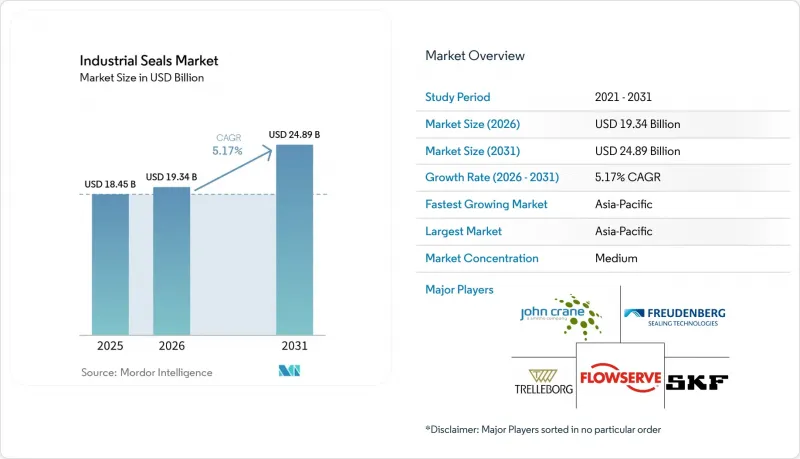
據 Mordor Intelligence 稱,工業密封件市場預計在 2025 年達到 184.5 億美元,預計在預測期(2026-2031 年)內將以 5.17% 的複合年成長率成長,從 2026 年的 193.4 億美元成長到 2031 億美元的 2031 億美元。
全球工業密封件市場趨勢與洞察
提高工業自動化和現有工廠的可靠性
對老舊製程裝置進行自動化維修,會產生一系列更新周期,而這些週期無法完全納入傳統的資本投資規劃。對於當初設計用於定期檢查而非持續狀態監測的設備而言,這種情況尤其突出。可靠性改進專案會為運作時間較長的旋轉設備(可能包含不同生產年份的設備)加裝感測器、變速驅動器和狀態監控系統。由於維修的設備需要在更嚴格的監測條件下運作,且操作人員的目標是減少意外維護事件,因此這些項目通常需要採用性能更優的動態密封組件,而非簡單地更換同等部件。先進的測量設備能夠識別出傳統維護計劃無法檢測到的劣化,而這些退化往往要等到出現故障、計劃停機或產品品質問題時才會顯現。弗勞恩霍夫DigiSeal計畫將人工智慧和營運經驗應用於機械軸封的維護,其明確目標是延長使用壽命並減少意外故障。初始維修規範將引導企業逐步過渡到更高附加價值的組件和後續服務契約,從而在工業密封市場中建立一種更加以應用為導向的現有設備更換模式。
電動汽車電池、溫度控管和電動動力傳動系統總成密封
電動車平台需要對電池機殼、冷卻迴路、馬達軸介面和電力電子設備外殼進行密封,而不僅依賴內燃機動力動力傳動系統的傳統要求。每個位置對熱膨脹、介電液、防潮性、耐化學腐蝕性以及在重複運行循環中的使用壽命都有不同的要求。這些需求催生了在傳統車輛佈局中不那麼重要的特殊密封位置。同時,動力傳動系統的改進可能會減少對某些傳統油封應用的需求。因此,儘管內燃機汽車憑藉其龐大的現有用戶群繼續推動替換需求,但工業密封市場正迎來新的規範開發機會。材料可追溯性和可靠的性能有利於那些擁有完善的材料庫、檢驗的製造流程以及能夠從設計到生產全程支援客戶認證工作的供應商。特瑞堡密封系統於2025年推出了CellXPro,這是一種專為應對化學腐蝕和嚴苛熱環境而設計的電池密封技術。這體現了該公司在該工業密封市場細分領域的策略。
無密封幫浦和黏合劑黏合的電動車電池蓋
在某些危險流體應用中,無密封磁力幫浦可取代傳統的機械軸封。它們在設備設計中特別有效,因為在這些設計中,密封性能比維護密封件的便利性更為重要。在化學、製藥和半導體行業,無密封磁力泵的重要性尤其突出,因為這些行業的密封性能、製程安全和排放控制是核心設計考量。 2025年3月,福斯公司發布了INNOMAG TB-MAG雙碟泵,這是一款採用雙氣密密封結構的無密封磁力泵。該產品表明,成熟的密封件供應商也在參與設備設計,在某些泵浦應用中無需使用傳統密封件,並且此類設計並非僅被視為外部競爭對手。在電動車領域,某些電池單體封裝設計採用結構性黏著劑進行電池密封,有些機殼結構則部分取代了單一周邊密封件。雖然這些方法並非普遍適用,但它們可以在某些設計中減少傳統密封件的使用,同時對剩餘密封件在溫度、化學腐蝕和防護性能方面提出了更嚴格的要求。
細分市場分析
到2025年,徑向密封件將佔全球銷售額的33.21%,這反映了它們在泵浦軸、馬達軸承、變速箱輸出段和其他旋轉介面中的廣泛應用。徑向密封件的良好口碑支撐了其在汽車製造、加工廠和通用工業機械領域的持續更換需求,在這些領域,週期性磨損和流體滯留仍然是主要的維護問題。石油天然氣、發電和傳統汽車生產仍然是重要的訂單來源,因為這些行業都運作大量的旋轉部件,並按既定的檢查週期進行維護。軸向密封件用於沿軸運動且推力負荷與徑向配置不同的應用,例如轉向柱和軸流式壓縮機。碳密封件則用於特殊的航太和高速渦輪機械環境,這些環境的熱工和離心力條件可能非常嚴苛,因此其應用範圍較窄,但要求也更為嚴格。
另一類是用於電力驅動橋的混合型結構,可同時承受徑向和軸向負荷。雖然目前規模仍然相對較小,但由於電力驅動系統能夠在緊湊的封裝內組合多種載荷條件,從而為客製化設計創造了空間,因此這類結構正吸引研發者的注意。機械軸封是成長最快的類型,預計2026年至2031年的複合年成長率將達到6.13%。半導體和氫能基礎設施項目正在推動其在嚴苛工藝環境中的應用,這些環境需要工程化的密封表面、精心挑選的材料和檢驗的製造程序。 2025年,約翰·克萊恩公司推出了一種耐積炭、非接觸式氣體潤滑密封件,與傳統結構相比,可降低90-95%的能耗,並將更換密封件的停機時間限制在一天以內。
區域分析
預計到2025年,亞太地區將佔全球銷售額的38.43%,並在2031年之前以5.86%的複合年成長率成長。中國透過化學加工、國內半導體研發和汽車生產支撐著區域需求,這些產業共同創造了標準和特種密封應用領域的需求。日本仍然是精密密封件和半導體級氟聚合物的重要市場,而韓國則憑藉半導體製造地和相關設備供應鏈的需求,推動了市場發展。該地區工業密封件市場需求多元化,大規模終端用戶生產基地與先進材料和製程設備供應商並存。印度正成為製造業投資的新興中心,特瑞堡密封系統公司於2026年4月宣佈在班加羅爾興建園區便是一個例證。該園區將專注於聚四氟乙烯(PTFE)產品、機械端面密封、旋轉軸密封、聚氨酯解決方案以及研發和測試活動。
北美和歐洲是工業密封件市場第二大需求叢集。在這兩個地區,老化的工業資產和旨在符合監管要求的升級改造推動了對高級產品的需求,同時,現有設備也催生了對售後服務、維護支援以及幫助營運商提升設備可靠性的解決方案的需求。在北美,美國環保署 (EPA) 的要求促使煉油和中游天然氣作業更加關注減少洩漏的配置。在加拿大和墨西哥,與油砂、石化和沿海供應策略相關的需求也隨之而來,客戶在新計畫和現有營運中都尋求可靠的供應。在歐洲,氫氣基礎設施需要能夠應對快速氣體減壓和高壓運作的系統,歐洲工業氣體協會 (EIGA) 第 261 號文件規定了用戶設施中氫氣管道的要求。
南美洲、中東和非洲雖然收入規模較小,但往往需要高附加價值系統。在巴西,需求主要來自糖業、乙醇產業以及深海油氣開發;在阿根廷,需求源於化工和採礦業,有時需要針對特定應用的設備支援;沙烏地阿拉伯的能源轉型計畫和碳捕獲投資催生了對專用包裝產品的需求;南非的採礦業則需要在嚴苛的運作環境下使用耐泥漿的機械軸封。由於意外更換可能既困難又昂貴,並可能中斷工廠運營,因此長途、海上和偏遠地區的物流路線通常更傾向於選擇高耐久性、高規格的組件,而不是成本最低的選項。 2026年6月,特瑞堡在卡薩布蘭卡開設了一家專門的航太工廠,為波音和空中巴士生產聚合物密封和引擎零件。
其他好處:
- Excel格式的市場預測(ME)表
- 3個月的分析師支持
目錄
第1章:引言
- 研究假設和市場定義
- 調查範圍
第2章:調查方法
第3章執行摘要
第4章 市場狀況
- 市場概覽
- 市場促進因素
- 提高工業自動化和現有設備的可靠性
- 電動汽車電池、溫度控管和電動動力傳動系統密封
- 半導體晶圓廠的擴張和日益嚴苛的製程條件
- 符合排放洩漏和零洩漏法規
- 氫能、液化天然氣和綠色氨基礎設施
- 市場限制因素
- 無密封幫浦和電動車電池蓋採用黏合劑黏合。
- 特種氟樹脂和碳化矽的供應波動
- 新化合物和設計方案的認證週期很長
- 價值鏈分析
- 波特五力分析
第5章 市場規模與成長預測
- 按類型
- 徑向密封
- 機械軸封
- 軸向密封
- 碳密封
- 其他
- 材料
- 彈性體密封件
- 熱塑性樹脂密封件
- 金屬密封件
- 複合材料密封件
- 其他
- 按最終用途行業分類
- 車
- 石油和天然氣
- 化工/石油化工
- 發電和公共產業
- 半導體
- 航太/國防
- 食品/飲料
- 製藥和生命科學
- 採礦和金屬
- 其他
- 按地區
- 亞太地區
- 中國
- 印度
- 日本
- 韓國
- 東南亞國協
- 其他亞太國家
- 北美洲
- 美國
- 加拿大
- 墨西哥
- 歐洲
- 德國
- 英國
- 法國
- 義大利
- 北歐國家
- 其他歐洲國家
- 南美洲
- 巴西
- 阿根廷
- 其他南美國家
- 中東和非洲
- 沙烏地阿拉伯
- 南非
- 其他中東和非洲國家
- 亞太地區
第6章 競爭情勢
- 市場集中度
- 策略趨勢
- 市佔率和排名分析
- 公司簡介
- AW Chesterton Company
- AESSEAL
- Dana Seals
- EagleBurgmann
- Enpro Inc.
- Flowserve Corporation
- Freudenberg Sealing Technologies
- Hutchinson SA
- James Walker
- John Crane
- NOK Corporation
- PARKER HANNIFIN CORP
- SKF
- The Timken Company
- Trelleborg AB
第7章 市場機會與未來展望
According to Mordor Intelligence, the industrial seals market size was estimated at USD 18.45 billion in 2025 and is estimated to grow from USD 19.34 billion in 2026 to USD 24.89 billion by 2031, at a CAGR of 5.17% during the forecast period (2026-2031).
Global Industrial Seals Market Trends and Insights
Industrial Automation and Brownfield Reliability Upgrades
Automation retrofits in older process plants are creating a replacement cycle that conventional capital expenditure plans may not fully capture, particularly where assets were designed around periodic inspections rather than continuous condition monitoring. Reliability programs add sensors, variable-speed drives, and condition-monitoring systems to rotating assets that already have many years of operating history and may include equipment of varying vintages. These programs often require upgraded dynamic sealing components rather than simple like-for-like replacements, because the revised equipment operates under more closely observed conditions and operators seek to reduce unplanned maintenance events. Better instrumentation identifies deterioration that earlier maintenance schedules may not have detected until a failure, a planned shutdown, or a production-quality issue occurs. The Fraunhofer DigiSeal project applies AI and operational knowledge to mechanical-seal maintenance, with the stated aim of extending service life and reducing unexpected failures. The initial retrofit specification can shift operators toward higher-value parts and later support service arrangements, giving the industrial seals market a more application-led replacement pattern across the installed base.
EV Battery, Thermal Management, and E-Powertrain Sealing
Electric vehicle platforms require seals for battery enclosures, cooling circuits, e-motor shaft interfaces, and power electronics housings, rather than relying solely on the established requirements of internal-combustion powertrains. Each location presents different requirements for thermal movement, dielectric fluids, moisture protection, chemical exposure, and long service life over repeated operating cycles. These needs introduce specialized sealing points that were less relevant in conventional vehicle layouts, even though several conventional oil-seal applications may decline as drivetrains change. The industrial seals market therefore gains new specification opportunities, while internal combustion vehicles continue to drive replacement demand from their large installed base. Material traceability and documented performance favor suppliers with established material libraries, validated production processes, and the ability to support customer qualification work from design through production. Trelleborg Sealing Solutions introduced CellXPro in 2025 as a battery-cell sealing technology designed for chemical resistance and demanding thermal conditions, reflecting the company's product focus in this segment of the industrial seals market.
Seal-Less Pumps and Adhesive-Bonded EV Battery Closures
Sealless magnetic-drive pumps can replace conventional mechanical seals in selected hazardous-fluid applications, particularly where equipment design prioritizes containment over access for seal maintenance. Their relevance is greatest in chemical, pharmaceutical, and semiconductor operations where containment, process safety, and emissions control are central design considerations. Flowserve introduced the INNOMAG TB-MAG Dual Drive Pump in March 2025 as a sealless magnetic-drive product with dual hermetic containment. This product demonstrates that established sealing suppliers also participate in equipment designs that eliminate the need for conventional seals in specific pump applications, rather than treating such designs solely as external competition. In electric vehicles, certain cell-to-pack designs use structural adhesives for battery closures and partially replace discrete perimeter-sealing components in selected enclosure configurations. These approaches are not universal, but they can reduce conventional seal content in selected designs while subjecting remaining seals to stricter performance requirements for temperature, chemical exposure, and protection.
Other drivers and restraints analyzed in the detailed report include:
- Semiconductor Fab Expansion, Hydrogen, LNG, and Green-Ammonia Infrastructure
- Fugitive-Emission and Zero-Leakage Compliance
- Specialty Material Volatility and Long Qualification Cycles
For complete list of drivers and restraints, kindly check the Table Of Contents.
Segment Analysis
Radial seals held 33.21% of global revenue in 2025, reflecting their use on pump shafts, motor bearings, gearbox outputs, and other rotating interfaces. Their installed base supports repeat replacement demand across automotive manufacturing, process plants, and general industrial machinery, where routine wear and fluid retention remain core maintenance concerns. Oil and gas, power generation, and conventional vehicle production remain important sources of orders, as each operates large populations of rotating assets with established service intervals. Axial seals serve thrust-loading applications, including steering columns and axial compressors, where movement occurs along the shaft and design requirements differ from those of radial arrangements. Carbon seals are used in specialized aerospace and high-speed turbomachinery settings where thermal and centrifugal conditions can be demanding, resulting in a narrower application scope but more exacting requirements.
The other category includes hybrid geometries for e-axles that experience radial and axial loads simultaneously. This group remains smaller but is receiving development attention because electric drive systems can combine several load conditions in compact packages, creating room for customized designs. Mechanical seals are the fastest-growing type, with a forecast CAGR of 6.13% from 2026 to 2031. Semiconductor and hydrogen infrastructure projects support their use in demanding process environments that favor engineered faces, carefully selected materials, and validated manufacturing processes. In 2025, John Crane introduced a coke-resistant non-contacting gas-lubricated seal that reduced energy use by 90%-95% compared with a legacy configuration and limited replacement downtime to one day.
Complete Report Scope:
- By Type
- Radial Seals
- Mechanical Seals
- Axial Seals
- Carbon Seals
- Others
- By Material
- Elastomer Seals
- Thermoplastic Seals
- Metal Seals
- Composite Seals
- Others
- By End-Use Industry
- Automotive
- Oil and Gas
- Chemicals and Petrochemicals
- Power Generation and Utilities
- Semiconductor
- Aerospace and Defense
- Food and Beverage
- Pharmaceuticals and Life Sciences
- Mining and Metals
- Others
- By Geography
- Asia-Pacific
- China
- India
- Japan
- South Korea
- ASEAN Countries
- Rest of Asia-Pacific
- North America
- United States
- Canada
- Mexico
- Europe
- Germany
- United Kingdom
- France
- Italy
- NORDIC Countries
- Rest of Europe
- South America
- Brazil
- Argentina
- Rest of South America
- Middle East and Africa
- Saudi Arabia
- South Africa
- Rest of Middle East and Africa
- Asia-Pacific
Geography Analysis
Asia-Pacific accounted for 38.43% of global revenue in 2025 and is forecast to grow at a 5.86% CAGR through 2031. China supports regional demand through chemical processing, domestic semiconductor development, and vehicle production, which together create requirements across both standard and specialty sealing applications. Japan remains important for precision sealing materials and semiconductor-grade fluoropolymers, while South Korea adds demand from its semiconductor manufacturing base and related equipment supply chain. The region combines large end-user production centers with suppliers of advanced materials and process equipment, supporting a varied demand base for the industrial seals market. India is a greenfield location for manufacturing investment, including a Trelleborg Sealing Solutions campus in Bengaluru, announced in April 2026, that will cover PTFE products, mechanical face seals, rotary shaft seals, polyurethane solutions, and research and testing activities.
North America and Europe form the second-largest demand cluster for the industrial seals market. Older industrial assets and compliance-driven replacement programs support demand for premium products in both regions, while the installed base generates demand for aftermarket service, maintenance support, and solutions that help operators manage equipment reliability. In North America, EPA requirements drive attention to lower-leakage configurations in refining and midstream gas operations. Canada and Mexico add demand linked to oil sands, petrochemicals, and nearshore supply strategies, with customers seeking dependable supply for both new projects and existing operations. In Europe, hydrogen infrastructure requires systems capable of handling rapid gas decompression and high-pressure service, while European Industrial Gases Association (EIGA) Document 261 sets out requirements for hydrogen piping at user locations.
South America, the Middle East, and Africa account for smaller revenue pools but often require higher-value systems. Brazil supports demand through sugar-ethanol operations and deepwater oil and gas activity, while Argentina contributes chemical processing and mining demand that may require application-specific equipment support. Saudi Arabian conversion programs and carbon-capture investment create demand for specialized packages, while South African mining requires slurry-resistant mechanical seals in high-wear operating environments. Long logistics routes to offshore and remote sites can favor durable, high-specification parts over the lowest initial-cost option, as unplanned replacement can be difficult, expensive, and disruptive to plant operations. Trelleborg opened a dedicated aerospace facility in Casablanca in June 2026 to manufacture polymer seals and engine components for Boeing and Airbus.
- A.W. Chesterton Company
- AESSEAL
- Dana Seals
- EagleBurgmann
- Enpro Inc.
- Flowserve Corporation
- Freudenberg Sealing Technologies
- Hutchinson SA
- James Walker
- John Crane
- NOK Corporation
- PARKER HANNIFIN CORP
- SKF
- The Timken Company
- Trelleborg AB
Additional Benefits:
- The market estimate (ME) sheet in Excel format
- 3 months of analyst support
TABLE OF CONTENTS
1 Introduction
- 1.1 Study Assumptions and Market Definition
- 1.2 Scope of the Study
2 Research Methodology
3 Executive Summary
4 Market Landscape
- 4.1 Market Overview
- 4.2 Market Drivers
- 4.2.1 Industrial Automation and Brownfield Reliability Upgrades
- 4.2.2 EV Battery, Thermal Management and E-Powertrain Sealing
- 4.2.3 Semiconductor Fab Expansion and Aggressive Process Conditions
- 4.2.4 Fugitive-Emission and Zero-Leakage Compliance
- 4.2.5 Hydrogen, LNG and Green-Ammonia Infrastructure
- 4.3 Market Restraints
- 4.3.1 Seal-Less Pumps and Adhesive-Bonded EV Battery Closures
- 4.3.2 Specialty Fluoropolymer and Silicon-Carbide Supply Volatility
- 4.3.3 Long Qualification Cycles for New Compounds and Designs
- 4.4 Value Chain Analysis
- 4.5 Porter's Five Forces Analysis
- 4.5.1 Bargaining Power of Suppliers
- 4.5.2 Bargaining Power of Buyers
- 4.5.3 Threat of New Entrants
- 4.5.4 Threat of Substitutes
- 4.5.5 Competitive Rivalry
5 Market Size and Growth Forecasts (Value)
- 5.1 By Type
- 5.1.1 Radial Seals
- 5.1.2 Mechanical Seals
- 5.1.3 Axial Seals
- 5.1.4 Carbon Seals
- 5.1.5 Others
- 5.2 By Material
- 5.2.1 Elastomer Seals
- 5.2.2 Thermoplastic Seals
- 5.2.3 Metal Seals
- 5.2.4 Composite Seals
- 5.2.5 Others
- 5.3 By End-Use Industry
- 5.3.1 Automotive
- 5.3.2 Oil and Gas
- 5.3.3 Chemicals and Petrochemicals
- 5.3.4 Power Generation and Utilities
- 5.3.5 Semiconductor
- 5.3.6 Aerospace and Defense
- 5.3.7 Food and Beverage
- 5.3.8 Pharmaceuticals and Life Sciences
- 5.3.9 Mining and Metals
- 5.3.10 Others
- 5.4 By Geography
- 5.4.1 Asia-Pacific
- 5.4.1.1 China
- 5.4.1.2 India
- 5.4.1.3 Japan
- 5.4.1.4 South Korea
- 5.4.1.5 ASEAN Countries
- 5.4.1.6 Rest of Asia-Pacific
- 5.4.2 North America
- 5.4.2.1 United States
- 5.4.2.2 Canada
- 5.4.2.3 Mexico
- 5.4.3 Europe
- 5.4.3.1 Germany
- 5.4.3.2 United Kingdom
- 5.4.3.3 France
- 5.4.3.4 Italy
- 5.4.3.5 NORDIC Countries
- 5.4.3.6 Rest of Europe
- 5.4.4 South America
- 5.4.4.1 Brazil
- 5.4.4.2 Argentina
- 5.4.4.3 Rest of South America
- 5.4.5 Middle East and Africa
- 5.4.5.1 Saudi Arabia
- 5.4.5.2 South Africa
- 5.4.5.3 Rest of Middle East and Africa
- 5.4.1 Asia-Pacific
6 Competitive Landscape
- 6.1 Market Concentration
- 6.2 Strategic Moves
- 6.3 Market Share (%)/Ranking Analysis
- 6.4 Company Profiles (includes Global Overview, Market Overview, Core Segments, Financials as available, Strategic Information, Products and Services, and Recent Developments)
- 6.4.1 A.W. Chesterton Company
- 6.4.2 AESSEAL
- 6.4.3 Dana Seals
- 6.4.4 EagleBurgmann
- 6.4.5 Enpro Inc.
- 6.4.6 Flowserve Corporation
- 6.4.7 Freudenberg Sealing Technologies
- 6.4.8 Hutchinson SA
- 6.4.9 James Walker
- 6.4.10 John Crane
- 6.4.11 NOK Corporation
- 6.4.12 PARKER HANNIFIN CORP
- 6.4.13 SKF
- 6.4.14 The Timken Company
- 6.4.15 Trelleborg AB
7 Market Opportunities and Future Outlook
- 7.1 White-Space and Unmet-Need Assessment

 半自動平行縫焊接機市場:全球市場預測(2026-2032年)聚硫化物基密封劑市場:全球市場預測(2026-2032年)強勁的汽車蠟和密封劑市場:全球市場預測,2026-2032年
 工業密封件市場規模、佔有率、成長、全球產業分析、區域趨勢及2026年至2034年預測。
 耐燃料塗料市場規模、佔有率和成長分析:按樹脂類型、形態、應用、最終用戶、固化方法和地區分類-2026-2033年產業預測衛生密封劑市場:全球市場預測,2026-2032年
 玻璃和金屬密封件市場:按類型、材料、應用、國家和地區分類-全球產業分析、市場規模、市場佔有率及2026年至2033年預測
 法國密封膠:市場佔有率分析、產業趨勢與統計、成長預測(2026-2031)2026-2034年全球建築和施工密封劑市場規模、佔有率、趨勢和成長分析報告新加坡密封劑:市場佔有率分析、行業趨勢和統計數據、成長預測(2026-2031)