


 |
市場調查報告書
商品編碼
2154913
南美洲罐頭食品:市佔率分析、產業趨勢與統計及成長預測(2026-2031 年)South America Food Cans - Market Share Analysis, Industry Trends & Statistics, Growth Forecasts (2026 - 2031) |
||||||

※ 本網頁內容可能與最新版本有所差異。詳細情況請與我們聯繫。
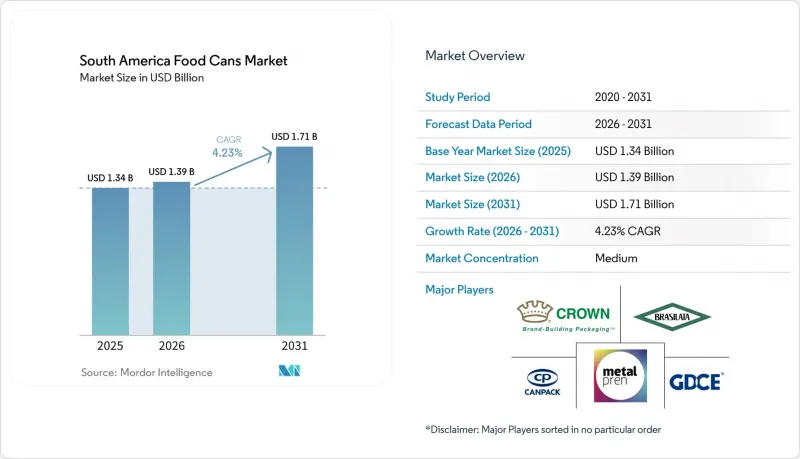
據 Mordor Intelligence 稱,2025 年南美罐頭食品市場價值 13.4 億美元,預計將從 2026 年的 13.9 億美元成長到 2031 年的 17.1 億美元。
預測期(2026-2031 年)的複合年成長率預計為 4.23%。
南美洲罐頭食品市場趨勢與洞察
對方便、保存期限長的食品的需求
2022年至2024年的供應中斷導致南美洲家庭食品囤積增加。這使得罐裝蔬菜、番茄製品和罐裝蛋白質產品的需求更加穩定。金屬容器在需要常溫長期儲存的食品中仍扮演著重要角色。巴西國家衛生監督局(ANVISA)第RDC 854/2024號決議降低了重金屬污染物的允許限值,並加強了對金屬食品包裝材料的衛生和遷移控制。這些法規提高了進口罐頭的合規要求,並鞏固了現有材料供應商的地位。巴西和阿根廷的社會福利計畫也推動了機構對罐裝蛋白質產品的定期採購。
調理食品和加工食品的擴張
罐裝調理食品正在不斷擴展,不再局限於傳統的鹹牛肉和燉菜等產品。生產商正為都市區家庭推出更多種類的預調味、單份裝蛋白質產品。加工食品佔據了極大的需求佔有率,這反映出罐裝產品(例如罐裝番茄、豆類、肉類和醬料)的重要性。隨著消費者對保存期限更長、使用更便利的產品的需求日益成長,調理食品市場預計將穩定擴張。這種轉變導致消費者更傾向於選擇適合單份食用的中小型罐頭。南美洲罐頭食品市場正受益於生產商利用裝飾性罐頭來區分現代零售通路中的調理食品。
與軟包裝袋和塑膠包裝的競爭
在包裝食品領域,軟包裝袋和無菌包裝仍是限制市場競爭的因素。它們的優勢在非正式零售和線上管道尤為突出,因為在這些管道,每份價格是關鍵因素。同時,罐頭食品在商用採購、蒸餾加工和較長的保存期限方面仍然佔據主導地位。巴西和哥倫比亞的年輕消費者更傾向於選擇方便快速的軟包裝袋,這使得食品品牌在選擇填充生產線時面臨更大的挑戰。寵物食品和水產品業對軟包裝袋的使用相對有限,這使其在南美洲罐頭食品市場繼續佔據更穩固的地位。
細分市場分析
到2025年,鋼和馬口鐵將佔據67.23%的市場佔有率,在南美食品罐頭市場佔據主導地位。三片式馬口鐵罐仍廣泛用於沙丁魚、鮪魚、鯖魚、豆類以及其他需要嚴格殺菌處理的產品。智利、秘魯和巴西的海鮮加工商依賴這些罐頭,因為它們能夠承受高壓蒸餾釜和長時間的熱處理。現有的填充系統和供應關係也支持鋼罐的繼續使用。這些因素表明,在預測期內,鋼罐不太可能被其他材質迅速取代。
到2031年,鋁材將是成長最快的材料類別。其在高階寵物食品和調理食品領域佔據主導地位,因為這些領域對輕量化和印刷裝飾的要求很高。巴西的「綠色系統」(Selo Verde)框架基於ABNT NBR 17298:2026標準,更重視複合鋁材供應中的碳會計和能源可追溯性。波爾公司(Ball Corporation)和馬裡薩集團(Grupo Mariza)於2026年3月推出了巴西首款帶有ASI「負責任鋁材採購」標籤的果汁罐。對於小規模加工商而言,生產兩片式鋁罐所需的資本投入是更艱難的選擇。因此,南美食品罐產業很可能將同時維持鋼鐵和鋁材的供應鏈。
預計到2025年,三片式罐頭將佔據50.66%的市場佔有率,這得益於其在灌裝、蒸餾和物流系統相容性方面的成功應用。沙丁魚、鮪魚和豆類加工商長期以來一直在生產線上使用焊接圓筒罐。更換這些設備可能需要大量的資金投入。此外,這種包裝形式對於主食和商用包裝而言仍然具有成本效益。鑑於這些情況,預計三片式罐頭將繼續在南美洲食品罐頭市場發揮重要作用。
預計到2031年,兩片式罐的年複合成長率將達到4.72%。寵物食品和調理食品行業的投資越來越傾向於粉碎成型和壓製成型生產線,因為這些生產線能夠減輕材料重量並省去內部焊接。 Trivium Packaging在2025年發布的報告顯示,主要的寵物食品客戶正在從鋼製三片式罐轉向鋁製兩片式罐。兩片式結構也非常適合線上印刷,並能提高生產效率。 Brazirata擁有食品罐製造的FSSC 22000認證,並提供多種規格的食品罐生產能力。隨著這種規格的日益普及,市場對符合食品接觸塗層標準的認證鋁捲和塗層的需求也不斷成長。
其他好處:
- Excel格式的市場預測(ME)表
- 3個月的分析師支持
目錄
第1章:引言
- 研究假設和市場定義
- 調查範圍
第2章:調查方法
第3章執行摘要
第4章 市場狀況
- 市場概覽
- 市場促進因素
- 對方便、保存期限長的食品的需求
- 調理食品和加工食品的擴張
- 寵物食品消費量成長
- 水產品和園藝作物加工的擴張
- 專注於本地小批量罐裝特色食品。
- 引入可追溯的低碳鋁包裝
- 市場限制因素
- 與軟包裝袋和塑膠包裝的競爭
- 金屬、能源和貨運價格的波動
- 食品罐用鋼材和塗層廢料的回收利用並不均衡。
- 對特種板材、邊角料和塗層的進口依賴性
- 產業價值鏈分析
- 監理情勢
- 宏觀經濟因素對市場的影響
- 技術展望
- 波特五力分析
第5章 市場規模與成長預測
- 材料類型
- 鋼/馬口鐵
- 鋁
- 可輸入
- 兩件套罐
- 三件組罐
- 按罐體尺寸
- 小號(200公克或以下)
- 中型(201-500克)
- 大號(超過 500 克)
- 食品用途
- 調理食品
- 魚貝類
- 水果和蔬菜
- 加工食品
- 寵物食品
- 其他食品用途
- 按地區
- 巴西
- 阿根廷
- 哥倫比亞
- 智利
- 秘魯
- 其他南美國家
第6章 競爭情勢
- 市場集中度
- 策略趨勢
- 市佔率分析
- 公司簡介
- Crown Holdings, Inc.
- CANPACK SA
- Ball Corporation
- Trivium Packaging BV
- Brasilata
- Metalpren
- Gomes da Costa Embalagens
- Conservas Oderich SA
- Industrias El Nihuil
- Companhia Metalgraphica Paulista
- Envases Universales, SAPI de CV
- Massilly
- Mauser Packaging Solutions Holding Company
- Sonoco Products Company
- Greif, Inc.
- Ardagh Metal Packaging SA
- Wells Can Company Ltd.
- Allstate Can Corporation
- Silgan Holdings Inc.
第7章 市場機會與未來展望
According to Mordor Intelligence, the South America food cans market size was valued at USD 1.34 billion in 2025 and estimated to expand from USD 1.39 billion in 2026 to reach USD 1.71 billion by 2031, at a CAGR of 4.23% during the forecast period (2026-2031).
South America Food Cans Market Trends and Insights
Demand for Convenient, Shelf-Stable Food
Supply disruptions between 2022 and 2024 increased pantry-stocking behavior among South American households. This created a steadier base for canned vegetables, tomato products, and canned proteins. Metal containers remain important for foods that require ambient storage over extended periods. Brazil's ANVISA Resolution RDC No. 854/2024 tightened limits for heavy-metal contaminants and strengthened hygiene and migration controls for metallic food packaging. These rules increase compliance requirements for imported cans and reinforce the position of established material suppliers. Social programs in Brazil and Argentina also support recurring institutional purchases of canned protein products.
Expansion of Ready Meals and Processed Foods
Canned ready meals are moving beyond traditional corned beef and stew products. Producers are introducing seasoned, portion-controlled, and more varied protein products for urban households. Processed food accounted for a significant share of demand, reflecting the importance of canned tomato products, beans, meat, and sauces. Ready meals are expected to expand steadily as consumers seek convenient products with longer shelf life. This shift favors medium and small formats suited to individual servings. The South America food cans market benefits when processors use decorated cans to distinguish ready meals in modern retail channels.
Competition From Flexible Pouches and Plastic Packaging
Flexible pouches and aseptic cartons remain a competitive constraint in packaged meals. Their appeal is strongest in informal retail and online channels where the price per serving is important. Food cans retain advantages in institutional procurement, retort processing, and longer pantry storage. Younger consumers in Brazil and Colombia have shown a stronger preference for pouch formats in convenience meals. This makes filling-line choices more difficult for food brands. Pet food and seafood continue to offer a more defensible base for the South America food cans market because pouch use is more limited in those applications.
Other drivers and restraints analyzed in the detailed report include:
- Growth in Pet Food Consumption
- Expansion of Seafood and Horticultural Processing
- Volatility in Metal, Energy, and Freight Costs
For complete list of drivers and restraints, kindly check the Table Of Contents.
Segment Analysis
Steel and tin held 67.23% of the market in 2025, giving the material the leading South America food cans market share. Three-piece tinplate cans remain widely used for sardines, tuna, mackerel, legumes, and other products requiring demanding sterilization cycles. Seafood processors in Chile, Peru, and Brazil depend on these cans because they withstand high retort pressure and prolonged heat treatment. Existing filling systems and supply relationships also support continued steel use. These factors make a rapid replacement of steel unlikely over the forecast period.
Aluminum is the fastest-growing material segment through 2031. Its position is strongest in premium pet food and ready-meal formats where lower weight and printed decoration are valued. Brazil's Selo Verde framework under ABNT NBR 17298:2026 has made carbon accounting and energy traceability more relevant for laminated aluminum supply. Ball Corporation and Grupo Mariza launched Brazil's first canned juice carrying the ASI Responsible Aluminum Sourcing label in March 2026. Smaller converters face a more difficult choice because two-piece aluminum equipment requires capital investment. The South America food cans industry is therefore likely to retain parallel steel and aluminum supply chains.
Three-piece cans held 50.66% of the market in 2025, supported by the installed base of compatible filling, retort, and logistics systems. Sardine, tuna, and legume processors have long used welded cylinders in their production lines. Replacing this equipment can require major capital spending. The format also remains cost-effective for staple foods and institutional packs. These conditions preserve a large role for three-piece cans in the South America food cans market.
Two-piece cans are projected to expand at a 4.72% CAGR through 2031. New pet food and ready-meal investments increasingly favor drawn-and-ironed lines because they reduce material weight and remove interior welds. Trivium Packaging reported in 2025 that a major pet food customer was shifting from steel three-piece cans to aluminum two-piece cans. Two-piece designs also suit inline printing and faster production throughput. Brasilata maintains FSSC 22000 certification for food can production and offers multi-format food can capability. Greater use of this format increases demand for verified aluminum coil and compliant food-contact coatings.
Complete Report Scope:
- By Material Type
- Steel/Tin
- Aluminum
- By Can Type
- 2-Piece Cans
- 3-Piece Cans
- By Can Size
- Small (Less Than or Equal to 200 g)
- Medium (201-500 g)
- Large (More Than 500 g)
- By Food Application
- Ready Meals
- Fish and Seafood
- Fruits and Vegetables
- Processed Food
- Pet Food
- Other Food Applications
- By Geography
- Brazil
- Argentina
- Colombia
- Chile
- Peru
- Rest of South America
List of Companies Covered in this Report:
- Crown Holdings, Inc.
- CANPACK S.A.
- Ball Corporation
- Trivium Packaging B.V.
- Brasilata
- Metalpren
- Gomes da Costa Embalagens
- Conservas Oderich S.A.
- Industrias El Nihuil
- Companhia Metalgraphica Paulista
- Envases Universales, S.A.P.I. de C.V.
- Massilly
- Mauser Packaging Solutions Holding Company
- Sonoco Products Company
- Greif, Inc.
- Ardagh Metal Packaging S.A.
- Wells Can Company Ltd.
- Allstate Can Corporation
- Silgan Holdings Inc.
Additional Benefits:
- The market estimate (ME) sheet in Excel format
- 3 months of analyst support
TABLE OF CONTENTS
1 INTRODUCTION
- 1.1 Study Assumptions and Market Definition
- 1.2 Scope of the Study
2 RESEARCH METHODOLOGY
3 EXECUTIVE SUMMARY
4 MARKET LANDSCAPE
- 4.1 Market Overview
- 4.2 Market Drivers
- 4.2.1 Demand for Convenient, Shelf-Stable Food
- 4.2.2 Expansion of Ready Meals and Processed Foods
- 4.2.3 Growth in Pet Food Consumption
- 4.2.4 Expansion of Seafood and Horticultural Processing
- 4.2.5 Regional Small-Batch Canning for Specialty Foods
- 4.2.6 Traceable Low-Carbon Aluminum Packaging Adoption
- 4.3 Market Restraints
- 4.3.1 Competition from Flexible Pouches and Plastic Packaging
- 4.3.2 Volatility in Metal, Energy, and Freight Costs
- 4.3.3 Fragmented Recovery of Food-Can Steel and Coated Scrap
- 4.3.4 Import Exposure for Specialty Sheet, Ends, and Coatings
- 4.4 Industry Value Chain Analysis
- 4.5 Regulatory Landscape
- 4.6 Impact of Macroeconomic Factors on the Market
- 4.7 Technological Outlook
- 4.8 Porter's Five Forces Analysis
- 4.8.1 Bargaining Power of Suppliers
- 4.8.2 Bargaining Power of Buyers
- 4.8.3 Threat of New Entrants
- 4.8.4 Threat of Substitutes
- 4.8.5 Competitive Rivalry
5 MARKET SIZE AND GROWTH FORECASTS (VALUE)
- 5.1 By Material Type
- 5.1.1 Steel/Tin
- 5.1.2 Aluminum
- 5.2 By Can Type
- 5.2.1 2-Piece Cans
- 5.2.2 3-Piece Cans
- 5.3 By Can Size
- 5.3.1 Small (Less Than or Equal to 200 g)
- 5.3.2 Medium (201-500 g)
- 5.3.3 Large (More Than 500 g)
- 5.4 By Food Application
- 5.4.1 Ready Meals
- 5.4.2 Fish and Seafood
- 5.4.3 Fruits and Vegetables
- 5.4.4 Processed Food
- 5.4.5 Pet Food
- 5.4.6 Other Food Applications
- 5.5 By Geography
- 5.5.1 Brazil
- 5.5.2 Argentina
- 5.5.3 Colombia
- 5.5.4 Chile
- 5.5.5 Peru
- 5.5.6 Rest of South America
6 COMPETITIVE LANDSCAPE
- 6.1 Market Concentration
- 6.2 Strategic Moves
- 6.3 Market Share Analysis
- 6.4 Company Profiles (includes Global Level Overview, Market Level Overview, Core Segments, Financials as available, Strategic Information, Market Rank/Share, Products and Services, Recent Developments)
- 6.4.1 Crown Holdings, Inc.
- 6.4.2 CANPACK S.A.
- 6.4.3 Ball Corporation
- 6.4.4 Trivium Packaging B.V.
- 6.4.5 Brasilata
- 6.4.6 Metalpren
- 6.4.7 Gomes da Costa Embalagens
- 6.4.8 Conservas Oderich S.A.
- 6.4.9 Industrias El Nihuil
- 6.4.10 Companhia Metalgraphica Paulista
- 6.4.11 Envases Universales, S.A.P.I. de C.V.
- 6.4.12 Massilly
- 6.4.13 Mauser Packaging Solutions Holding Company
- 6.4.14 Sonoco Products Company
- 6.4.15 Greif, Inc.
- 6.4.16 Ardagh Metal Packaging S.A.
- 6.4.17 Wells Can Company Ltd.
- 6.4.18 Allstate Can Corporation
- 6.4.19 Silgan Holdings Inc.
7 MARKET OPPORTUNITIES AND FUTURE OUTLOOK
- 7.1 White-Space and Unmet-Need Assessment

 食品金屬罐市場規模、佔有率和成長分析:按罐型、金屬類型、罐體形狀、應用、封裝方式和地區分類-2026-2033年產業預測
 亞洲和非洲食品罐頭市場:市場佔有率分析、行業趨勢和統計數據以及成長預測(2026-2031 年)食品罐頭:市佔率分析、產業趨勢與統計、成長預測(2026-2031)
 食品罐頭市場:機會、成長要素、產業趨勢分析及2026-2035年預測
 食品罐頭市場:2026-2032年全球市場預測(依材料、罐型、製造流程、罐頭形狀、封蓋類型、罐頭尺寸、產品類型、最終用戶和分銷管道分類)
 食品罐頭市場分析及預測(至2035年):類型、產品類型、材質類型、應用、技術、最終用戶、製程、功能、設備、解決方案
 2026年全球食品罐頭市場報告2034年全球食品罐頭(不含飲料罐頭)市場機會與策略
 2030 年食品罐市場預測:按類型、材質、容量、蓋子類型、應用和地區進行的全球分析
 食品罐頭市場:未來預測(2025-2030年)