


 |
市場調查報告書
商品編碼
2019082
食品罐頭市場:機會、成長要素、產業趨勢分析及2026-2035年預測Food Cans Market Opportunity, Growth Drivers, Industry Trend Analysis, and Forecast 2026 - 2035 |
||||||

預計到 2025 年,全球罐頭食品市場價值將達到 1,159 億美元,預計到 2035 年將以 3.2% 的複合年成長率成長,達到 1,584 億美元。
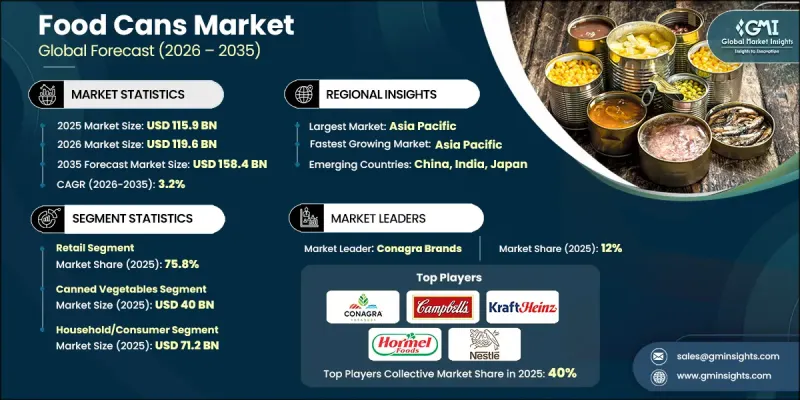
加工食品和罐頭食品需求的不斷成長,以及即食食品(RTE)市場的快速發展,是推動市場成長的主要動力。消費者追求保存期限長、易於儲存且便於攜帶的產品,促使製造商開發耐用且外觀精美的罐體設計。向永續包裝的轉變也促進了市場擴張,環保罐頭也越來越受到具有環保意識的消費者的青睞。罐體製造技術的進步,包括材料和保鮮技術的改進,使生產商能夠提供更堅固、更安全、更具吸引力的包裝選擇,在滿足不斷變化的消費者生活方式的同時,也支撐了市場的上升趨勢。
| 市場範圍 | |
|---|---|
| 開始年份 | 2025 |
| 預測期 | 2026-2035 |
| 初始市場規模 | 1159億美元 |
| 預測金額 | 1584億美元 |
| 複合年成長率 | 3.2% |
預計到2035年,線上和電子商務通路將以4.4%的複合年成長率成長,這主要得益於網路普及率和智慧型手機使用量的不斷提高,這將使消費者能夠宅配購買罐頭食品。電子商務平台憑藉其豐富的產品種類、極具競爭力的價格和訂閱式促銷活動,吸引了忙碌且精通技術的消費者,從而推動了在線銷售的擴張。
受便利、營養、便攜食品需求的推動,即食食品市場預計到2035年將以4.5%的複合年成長率成長。隨著都市化、生活節奏的加快以及人們對省時用餐選擇的需求日益成長,生產商正致力於生產包裝精美、口味濃郁、營養豐富的即食罐頭食品。
預計到2025年,北美罐頭食品市佔率將達到31.4%。該地區的成長主要得益於零售、食品加工和已烹調食品產業的擴張。消費者越來越傾向選擇便利、環保且能長期維持產品品質的包裝。推動這一市場發展的因素包括:消費者對保存期限長、營養價值高、永續包裝的加工食品的強勁需求,以及提升產品可及性的強大電子商務生態系統。
目錄
第1章:調查方法和範圍
第2章執行摘要
第3章業界考察
- 生態系分析
- 供應商情況
- 利潤率分析
- 成本結構
- 每個階段增加的價值
- 影響價值鏈的因素
- 中斷
- 影響產業的因素
- 促進因素
- 增加可在室溫下儲存的包裝解決方案
- 對永續包裝的需求日益成長
- 即食食品(RTE)市場的成長
- 對加工食品和罐頭食品的需求不斷成長
- 罐體設計的技術進步
- 產業潛在風險與挑戰
- 來自替代包裝的競爭
- 原物料價格波動
- 市場機遇
- 拓展新興市場
- 智慧包裝創新
- 促進因素
- 成長潛力分析
- 監理情勢
- 北美洲
- 歐洲
- 亞太地區
- 拉丁美洲
- 中東和非洲
- 波特五力分析
- PESTEL 分析
- 科技與創新趨勢
- 當前技術趨勢
- 新興技術
- 價格趨勢
- 按地區
- 依產品
- 定價策略
- 新興經營模式
- 合規要求
- 專利和智慧財產權分析
第4章 競爭情勢
- 介紹
- 企業市佔率分析
- 按地區
- 北美洲
- 歐洲
- 亞太地區
- 拉丁美洲
- 中東和非洲
- 按地區
- 主要企業的競爭標竿分析
- 財務績效比較
- 銷售量
- 利潤率
- 研究與開發
- 產品系列比較
- 產品線寬度
- 科技
- 創新
- 區域擴張比較
- 全球擴張分析
- 服務網路覆蓋
- 按地區分類的市場滲透率
- 競爭定位矩陣
- 領導者
- 挑戰者
- 追蹤者
- 小眾玩家
- 財務績效比較
- 主要進展
- 併購
- 夥伴關係和聯盟
- 技術進步
- 業務拓展與投資策略
- 數位轉型計劃
- 新興競爭對手和Start-Ups競爭對手的發展趨勢
第5章 市場估算與預測:依產品類型分類,2022-2035年
- 罐裝蔬菜
- 番茄
- 玉米
- 豆子
- 豌豆
- 什錦蔬菜
- 菇
- 其他
- 罐裝魚貝類
- 鮪魚
- 鮭魚
- 沙丁魚
- 鯖魚
- 鳳尾魚
- 貝類
- 其他
- 罐裝水果
- 桃
- 鳳梨
- 混合水果
- 其他
- 罐裝肉
- 雞肉
- 牛肉
- 豬肉
- 其他
- 速食
- 湯
- 燉菜
- 義式麵食
- 其他
- 其他
第6章 市場估計與預測:依通路分類,2022-2035年
- 零售
- 超級市場和大賣場
- 便利商店
- 特色食品店
- 線上/電子商務
- 食品服務業
- 餐廳
- 飯店餐飲
- 對機構而言
第7章 市場估計與預測:依最終用途分類,2022-2035年
- 一般家庭/消費者
- 食品加工業
- 機構和大買家
第8章 市場估計與預測:依地區分類,2022-2035年
- 北美洲
- 美國
- 加拿大
- 歐洲
- 德國
- 英國
- 法國
- 西班牙
- 義大利
- 荷蘭
- 亞太地區
- 中國
- 印度
- 日本
- 澳洲
- 韓國
- 拉丁美洲
- 巴西
- 墨西哥
- 阿根廷
- 中東和非洲
- 南非
- 沙烏地阿拉伯
- 阿拉伯聯合大公國
第9章:公司簡介
- 主要企業
- Conagra Brands
- Campbell Soup Company
- Kraft Heinz Company
- Hormel Foods Corporation
- Nestle SA
- General Mills
- 按地區分類的主要企業
- 北美洲
- Del Monte Foods
- B&G Foods
- Dole Food Company
- 歐洲
- Grupo Calvo
- Danish Crown
- Rhodes Food Group
- Bolton Group
- Bonduelle Group
- 亞太地區
- Dongwon Industries
- JBS SA
- 北美洲
- 小眾/顛覆者
- Ayam Brand
The Global Food Cans Market was valued at USD 115.9 billion in 2025 and is estimated to grow at a CAGR of 3.2% to reach USD 158.4 billion by 2035.
Rising demand for processed and canned foods, coupled with the rapid growth of the ready-to-eat (RTE) segment, is a key factor supporting market growth. Consumers are seeking products that offer long shelf life, easy storage, and portability, prompting manufacturers to innovate with durable and visually appealing can designs. The shift toward sustainable packaging also contributes to market expansion, as eco-friendly cans gain traction among environmentally conscious buyers. Technological advancements in can manufacturing, including enhanced materials and preservation methods, are enabling producers to offer stronger, safer, and more attractive packaging options, reinforcing the market's upward trajectory while catering to evolving consumer lifestyles.
| Market Scope | |
|---|---|
| Start Year | 2025 |
| Forecast Year | 2026-2035 |
| Start Value | $115.9 Billion |
| Forecast Value | $158.4 Billion |
| CAGR | 3.2% |
The online and e-commerce channels segment is expected to grow at a CAGR of 4.4% through 2035, as increasing internet penetration and smartphone usage allow consumers to purchase canned products for home delivery. E-commerce platforms appeal to busy, tech-savvy consumers by offering wide product selections, competitive pricing, and subscription-based promotions, driving higher online sales.
The ready-to-eat meals segment is projected to grow at a CAGR of 4.5% through 2035, fueled by demand for convenient, nutritious, and portable food solutions. Urbanization, busy lifestyles, and the need for time-saving meal options are encouraging manufacturers to produce RTE canned meals with appealing packaging, rich taste, and nutritional value.
North America Food Cans Market accounted for a 31.4% share in 2025. Growth in this region is supported by expanding retail, food processing, and RTE meal sectors. Consumers increasingly prefer packaging that is convenient, environmentally friendly, and maintains product quality over time. The market is driven by strong demand for packaged foods offering extended shelf life, nutritional value, and sustainable packaging, combined with a robust e-commerce ecosystem that enhances accessibility.
Key companies in the Global Food Cans Market include Nestle S.A., Conagra Brands, Campbell Soup Company, Del Monte Foods, Kraft Heinz Company, Hormel Foods Corporation, Dole Food Company, B&G Foods, General Mills, Grupo Calvo, Danish Crown, JBS S.A., Dongwon Industries, Rhodes Food Group, Bolton Group, Ayam Brand, and Bonduelle Group. Companies in the Food Cans Market are leveraging strategies such as innovation in can design and material selection to enhance shelf life, durability, and visual appeal. They are focusing on sustainable and recyclable packaging to address environmental concerns and strengthen brand perception. Expanding online sales channels and strategic partnerships with food manufacturers improve market reach and consumer accessibility. Additionally, firms are adopting digital marketing and subscription-based services to engage busy consumers. Portfolio diversification, including RTE meal cans and specialty product packaging, allows companies to cater to evolving dietary preferences.
Table of Contents
Chapter 1 Methodology and Scope
- 1.1 Market scope and definition
- 1.2 Research design
- 1.2.1 Research approach
- 1.2.2 Data collection methods
- 1.3 Data mining sources
- 1.3.1 Global
- 1.3.2 Regional/Country
- 1.4 Base estimates and calculations
- 1.4.1 Base year calculation
- 1.4.2 Key trends for market estimation
- 1.5 Primary research and validation
- 1.5.1 Primary sources
- 1.6 Forecast model
- 1.7 Research assumptions and limitations
Chapter 2 Executive Summary
- 2.1 Industry 360° synopsis, 2022 - 2035
- 2.2 Key market trends
- 2.2.1 Product type trends
- 2.2.2 Distribution channel trends
- 2.2.3 End use trends
- 2.2.4 Regional trends
- 2.3 TAM analysis, 2026-2035
- 2.4 CXO perspectives: Strategic imperatives
Chapter 3 Industry Insights
- 3.1 Industry ecosystem analysis
- 3.1.1 Supplier landscape
- 3.1.2 Profit margin analysis
- 3.1.3 Cost structure
- 3.1.4 Value addition at each stage
- 3.1.5 Factor affecting the value chain
- 3.1.6 Disruptions
- 3.2 Industry impact forces
- 3.2.1 Growth drivers
- 3.2.1.1 Increase in shelf-stable packaging solutions
- 3.2.1.2 Rising demand for sustainable packaging
- 3.2.1.3 Growth in the ready-to-eat (RTE) food segment
- 3.2.1.4 Increasing demand for processed and canned foods
- 3.2.1.5 Technological advancements in can design
- 3.2.2 Industry pitfalls and challenges
- 3.2.2.1 Competition from alternative packaging
- 3.2.2.2 Fluctuating raw material prices
- 3.2.3 Market opportunities
- 3.2.3.1 Expansion in emerging markets
- 3.2.3.2 Innovations in smart packaging
- 3.2.1 Growth drivers
- 3.3 Growth potential analysis
- 3.4 Regulatory landscape
- 3.4.1 North America
- 3.4.2 Europe
- 3.4.3 Asia Pacific
- 3.4.4 Latin America
- 3.4.5 Middle East & Africa
- 3.5 Porter's analysis
- 3.6 PESTEL analysis
- 3.7 Technology and innovation landscape
- 3.7.1 Current technological trends
- 3.7.2 Emerging technologies
- 3.8 Price trends
- 3.8.1 By region
- 3.8.2 By product
- 3.9 Pricing Strategies
- 3.10 Emerging Business Models
- 3.11 Compliance Requirements
- 3.12 Patent and IP analysis
Chapter 4 Competitive Landscape, 2025
- 4.1 Introduction
- 4.2 Company market share analysis
- 4.2.1 By region
- 4.2.1.1 North America
- 4.2.1.2 Europe
- 4.2.1.3 Asia Pacific
- 4.2.1.4 Latin America
- 4.2.1.5 Middle East & Africa
- 4.2.1 By region
- 4.3 Competitive benchmarking of key players
- 4.3.1 Financial performance comparison
- 4.3.1.1 Revenue
- 4.3.1.2 Profit margin
- 4.3.1.3 R&D
- 4.3.2 Product portfolio comparison
- 4.3.2.1 Product range breadth
- 4.3.2.2 Technology
- 4.3.2.3 Innovation
- 4.3.3 Geographic presence comparison
- 4.3.3.1 Global footprint analysis
- 4.3.3.2 Service network coverage
- 4.3.3.3 Market penetration by region
- 4.3.4 Competitive positioning matrix
- 4.3.4.1 Leaders
- 4.3.4.2 Challengers
- 4.3.4.3 Followers
- 4.3.4.4 Niche players
- 4.3.1 Financial performance comparison
- 4.4 Key developments
- 4.4.1 Mergers and acquisitions
- 4.4.2 Partnerships and collaborations
- 4.4.3 Technological advancements
- 4.4.4 Expansion and investment strategies
- 4.4.5 Digital transformation initiatives
- 4.5 Emerging/ startup competitors landscape
Chapter 5 Market Estimates and Forecast, By Product Type, 2022 - 2035 (USD Billion & Kilo Tons)
- 5.1 Key trends
- 5.2 Canned vegetables
- 5.2.1 Tomatoes
- 5.2.2 Corn
- 5.2.3 Beans
- 5.2.4 Peas
- 5.2.5 Mixed vegetables
- 5.2.6 Mushrooms
- 5.2.7 Others
- 5.3 Canned fish & seafood
- 5.3.1 Tuna
- 5.3.2 Salmon
- 5.3.3 Sardines
- 5.3.4 Mackerel
- 5.3.5 Anchovies
- 5.3.6 Shellfish
- 5.3.7 Others
- 5.4 Canned fruits
- 5.4.1 Peaches
- 5.4.2 Pineapple
- 5.4.3 Mixed fruits
- 5.4.4 Others
- 5.5 Canned meat
- 5.5.1 Chicken
- 5.5.2 Beef
- 5.5.3 Pork
- 5.5.4 Others
- 5.6 Ready-to-eat meals
- 5.6.1 Soups
- 5.6.2 Stews
- 5.6.3 Pasta
- 5.6.4 Others
- 5.7 Others
Chapter 6 Market Estimates and Forecast, By Distribution Channel, 2022 - 2035 (USD Billion & Kilo Tons)
- 6.1 Key trends
- 6.2 Retail
- 6.2.1 Supermarkets and hypermarkets
- 6.2.2 Convenience stores
- 6.2.3 Specialty food stores
- 6.3 Online/E-commerce
- 6.3.1 Foodservice
- 6.3.2 Restaurants
- 6.3.3 Hotels & catering
- 6.3.4 Institutional
Chapter 7 Market Estimates and Forecast, By End Use, 2022 - 2035 (USD Billion & Kilo Tons)
- 7.1 Key trends
- 7.2 Household/consumer
- 7.3 Food processing industry
- 7.4 Institutional & bulk users
Chapter 8 Market Estimates and Forecast, By Region, 2022 - 2035 (USD Billion & Kilo Tons)
- 8.1 Key trends
- 8.2 North America
- 8.2.1 U.S.
- 8.2.2 Canada
- 8.3 Europe
- 8.3.1 Germany
- 8.3.2 UK
- 8.3.3 France
- 8.3.4 Spain
- 8.3.5 Italy
- 8.3.6 Netherlands
- 8.4 Asia Pacific
- 8.4.1 China
- 8.4.2 India
- 8.4.3 Japan
- 8.4.4 Australia
- 8.4.5 South Korea
- 8.5 Latin America
- 8.5.1 Brazil
- 8.5.2 Mexico
- 8.5.3 Argentina
- 8.6 Middle East and Africa
- 8.6.1 South Africa
- 8.6.2 Saudi Arabia
- 8.6.3 UAE
Chapter 9 Company Profiles
- 9.1 Global Key Players
- 9.1.1 Conagra Brands
- 9.1.2 Campbell Soup Company
- 9.1.3 Kraft Heinz Company
- 9.1.4 Hormel Foods Corporation
- 9.1.5 Nestle S.A.
- 9.1.6 General Mills
- 9.2 Regional Key Players
- 9.2.1 North America
- 9.2.1.1 Del Monte Foods
- 9.2.1.2 B&G Foods
- 9.2.1.3 Dole Food Company
- 9.2.2 Europe
- 9.2.2.1 Grupo Calvo
- 9.2.2.2 Danish Crown
- 9.2.2.3 Rhodes Food Group
- 9.2.2.4 Bolton Group
- 9.2.2.5 Bonduelle Group
- 9.2.3 Asia Pacific
- 9.2.3.1 Dongwon Industries
- 9.2.3.2 JBS S.A.
- 9.2.1 North America
- 9.3 Niche / Disruptors
- 9.3.1 Ayam Brand

 食品罐頭:市佔率分析、產業趨勢與統計、成長預測(2026-2031)
 食品罐頭市場:2026-2032年全球市場預測(依材料、罐型、製造流程、罐頭形狀、封蓋類型、罐頭尺寸、產品類型、最終用戶和分銷管道分類)
 食品罐頭市場分析及預測(至2035年):類型、產品類型、材質類型、應用、技術、最終用戶、製程、功能、設備、解決方案
 2026年全球食品罐頭市場報告
 食品罐市場規模、佔有率和成長分析(按材料、罐型、蓋型、應用和地區分類)-2026-2033年產業預測2034年全球食品罐頭(不含飲料罐頭)市場機會與策略
 2030 年食品罐市場預測:按類型、材質、容量、蓋子類型、應用和地區進行的全球分析
 食品罐頭市場:未來預測(2025-2030年)亞非罐頭食品 -市場佔有率分析、行業趨勢和統計、成長預測(2025-2030 年)
 全球金屬食品市場,2024-2028