

 |
市場調查報告書
商品編碼
2154841
南美正排泵:市場佔有率分析、行業趨勢和統計數據以及成長預測(2026-2031 年)South America Positive Displacement Pump - Market Share Analysis, Industry Trends & Statistics, Growth Forecasts (2026 - 2031) |
||||||

※ 本網頁內容可能與最新版本有所差異。詳細情況請與我們聯繫。
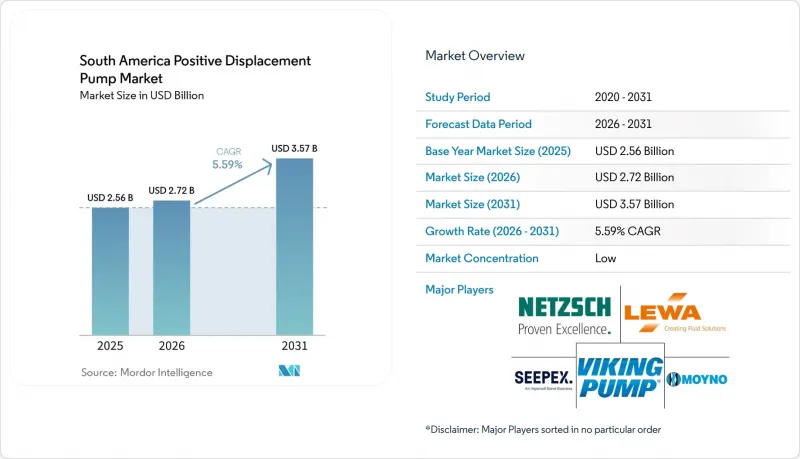
據 Mordor Intelligence 稱,2025 年南美洲容積式泵浦市值為 25.6 億美元,預計到 2031 年將從 2026 年的 27.2 億美元成長至 35.7 億美元,預測期(2026-2031 年)複合年成長率為 5.59%。
南美容積式幫浦市場趨勢與洞察
對海上油氣流體處理系統的投資
巴西石油公司(Petrobras)2026-2030年的1,090億美元資本計畫中,超過780億美元累計上游探勘和生產,以滿足南美容積式泵浦市場對高性能系統的需求。浮體式生產儲裝運(FPSO)利用幫浦進行甲醇注入、化學品注入、原油輸送和注水。這些應用需要在流體性質和工作壓力變化的情況下進行流量控制。 2026年5月,巴西石油公司與SBM Offshore公司簽署了一項建設-營運-移交(BOT)協議,將在塞爾希培-阿拉戈斯盆地建造兩座SEAP型浮體式生產儲裝運(FPSO)。該投資超過600億巴西雷亞爾(約120億美元)。這兩座船預計總合原油日產能為24萬桶。阿根廷的瓦卡穆爾塔計畫推動了對化學注入、生產水資源管理和壓裂液輸送系統的需求增加,從而支撐了南美洲的容積式泵市場。
擴大用水和污水基礎設施
巴西的衛生改革已吸引超過680億美元的私人投資,但要到2033年實現99%的飲用水供應率和90%的污水收集率,每年還需要額外80億美元。在市政系統中,單軸螺旋泵浦和隔膜泵被用於污泥、磨蝕性化學品和化學藥劑注入等應用。這些應用滿足了市場需求,因為穩定的流量控制在處理過程中至關重要。一項並行的特許特許經營計劃有望使已獲得主要公共產業認可的供應商受益,從而在產品供應之外提供實際優勢。在開發銀行的支持下,新設立的特許經營特許經營包括化學藥劑注入、污泥輸送和水輸送設施的多年安裝計劃。這項基礎設施建設活動正在為南美容積式泵市場創造新的需求管道,而不僅限於石油和天然氣行業的投資。
與離心泵相比,生命週期成本更高
與離心泵相比,容積式泵浦的生命週期成本可能更高,尤其是在小規模工業和市政設施中。單軸螺旋泵浦幫浦需要維護定子,往復式幫浦需要維護閥門和閥座,隔膜幫浦則需要更換彈性體。在流體條件允許的情況下,這些成本可能會促使負責人選擇成本較低的替代方案。在黏性介質和磨蝕性介質中,效率優勢並不總是能透過簡單的價格比較來體現。數位化監控可以為操作人員提供更可靠的運作和維護計劃資訊。然而,這些系統在巴西海上油氣產業和大規模工業客戶中仍然很常見,因此它們對整個南美容積式幫浦市場的影響有限。
細分市場分析
到2025年,旋轉泵將在南美洲容積式泵市場佔據54.28%的佔有率。齒輪泵、螺桿泵、凸輪泵和葉片泵等設計廣泛應用於高黏度原油輸送、食品加工和化學品處理等領域。多螺旋泵因其即使在惡劣條件下也能確保穩定的流量,而被廣泛應用於浮體式生產儲裝運裝置(FPSO)的流體處理系統中。 2024年4月,耐馳位於波梅羅德的NOTOS多螺旋泵浦製造廠正式運作,開始本地生產功率高達1000千瓦的泵浦組。
預計2026年至2031年間,往復泵的複合年成長率將達到6.37%,成為南美容積式幫浦市場成長最快的產品類型。活塞式、柱塞式和隔膜式往復泵廣泛應用於高壓化學藥劑注入、油井測試和精密計量。深海工程需要嚴格控制流量的甲醇和水輸液設備。瓦卡穆爾塔油田的開發也需要用於壓裂液管理及相關輸送作業的設備。具備高壓測試能力和成熟海上作業經驗的供應商在訂單這些訂單時擁有顯著優勢。
其他好處:
- Excel格式的市場預測(ME)表
- 3個月的分析師支持
目錄
第1章:引言
- 研究假設和市場定義
- 調查範圍
第2章:調查方法
第3章執行摘要
第4章 市場狀況
- 市場概覽
- 市場促進因素
- 擴大用水和污水基礎設施
- 對海上油氣流體處理系統的投資
- 礦山泥漿、尾礦和脫水需求
- 化工、食品和製藥業的高精度稱重
- 產業本地化與縮短進口前置作業時間
- 鋰鹵水及重要礦物處理試點項目
- 市場限制因素
- 與離心式產品相比,生命週期成本更高
- 磨蝕性液體造成的運作和維護造成的停機時間
- 外匯波動與資本投資延後
- 高性能設備的進口依賴性
- 宏觀經濟因素對市場的影響
- 產業價值鏈分析
- 監理情勢
- 技術展望
- 波特五力分析
第5章 市場規模與成長預測
- 依產品類型
- 往復式(活塞式、柱塞式、膜片式)
- 旋轉式(齒輪、螺桿、凸輪、葉片)
- 蠕動
- 按壓力等級
- 低於 50 巴
- 51-150 巴
- 超過 150 巴
- 按最終用戶行業分類
- 石油和天然氣
- 發電
- 水和污水處理
- 化工/石油化工
- 食品/飲料
- 製藥和生物技術
- 採礦和礦產
- 紙漿和造紙
- 其他終端用戶產業
- 按地區
- 巴西
- 智利
- 阿根廷
- 其他南美國家
第6章 競爭情勢
- 市場集中度
- 策略趨勢
- 市佔率分析
- 公司簡介
- NETZSCH Pumpen & Systeme GmbH
- SEEPEX GmbH
- LEWA GmbH
- Viking Pump, Inc.
- Moyno, Inc.
- Abel Pumps, LP
- PCM SAS
- Verder International BV
- ProMinent GmbH
- Fristam Pumpen KG(GmbH & Co.)
- Wangen Pumpen GmbH
- Borger GmbH
- Roto Pumps Limited
- SANDPIPER Pump
- Tapflo AB
- Verder Liquids BV
- Pump Solutions Group
- Bombas Geremia Industria e Comercio Ltda.
- Industrial Flow South America LTDA
- FB Bombas Industria e Comercio Ltda.
第7章 市場機會與未來展望
According to Mordor Intelligence, the South America positive displacement pump market size was valued at USD 2.56 billion in 2025 and estimated to grow from USD 2.72 billion in 2026 to reach USD 3.57 billion by 2031, at a CAGR of 5.59% during the forecast period (2026-2031).
South America Positive Displacement Pump Market Trends and Insights
Investment in Offshore Oil and Gas Fluid-Handling Systems
Petrobras' USD 109 billion 2026-2030 capital program includes more than USD 78 billion for upstream exploration and production, supporting demand for high-specification systems in the South America Positive Displacement Pump Market. Floating production, storage, and offloading vessels use pumps for methanol injection, chemical dosing, crude transfer, and water injection. These applications require controlled flow across changing fluid properties and operating pressures. In May 2026, Petrobras signed build-operate-transfer contracts with SBM Offshore for 2 SEAP floating production, storage, and offloading units in the Sergipe-Alagoas Basin, with investments exceeding BRL 60 billion (USD 12 billion). The units are intended to provide a combined oil production capacity of 240,000 barrels per day. Argentina's Vaca Muerta program increases demand for chemical injection, produced-water management, and fracturing-fluid transfer equipment, thereby supporting the South America Positive Displacement Pump Market.
Expansion of Water and Wastewater Infrastructure
Brazil's sanitation reform has contracted more than USD 68 billion in private investment and requires USD 8 billion in annual additional capital to achieve 99% potable-water coverage and 90% wastewater collection by 2033. Municipal systems use progressive cavity and diaphragm equipment for sludge, abrasive chemical media, and dosing duties. These duties support demand because stable flow control is important for treatment processes. Concurrent concession programs can favor suppliers already approved by major utilities, creating a practical advantage beyond product availability. New concessions, structured with development-bank support, include a multi-year installation schedule for dosing, sludge-transfer, and water-transfer equipment. This infrastructure activity provides the South America Positive Displacement Pump Market with a demand channel beyond oil and gas investment.
High Lifecycle Costs Compared with Centrifugal Alternatives
Positive displacement designs can have higher lifecycle costs than centrifugal alternatives, especially in smaller industrial and municipal installations. Progressive cavity pumps need stator maintenance, reciprocating models require valve and seat service, and diaphragm units need elastomer replacement. These expenses can direct purchasing teams toward lower-cost alternatives when fluid conditions permit. The efficiency benefit for viscous or abrasive media is not always reflected in a basic purchase-price comparison. Digital monitoring can give operators better evidence on uptime and maintenance planning. However, these systems remain more common in Brazil's offshore and larger industrial accounts, limiting their impact across the South America Positive Displacement Pump Market.
Other drivers and restraints analyzed in the detailed report include:
- Mining Slurry, Tailings, and Dewatering Requirements
- Precision Dosing in Chemicals, Food, and Pharmaceutical Industries
- Abrasive-Fluid Wear and Maintenance Downtime
For complete list of drivers and restraints, kindly check the Table Of Contents.
Segment Analysis
Rotary pumps held 54.28% of the South America Positive Displacement Pump Market share in 2025. Gear, screw, lobe, and vane designs are used for viscous crude transfer, food processing, and chemical handling. Multi-screw pumps are used in floating production, storage, and offloading fluid-handling packages because they can provide consistent flow under demanding conditions. NETZSCH commissioned its NOTOS multi-screw pump facility in Pomerode in April 2024, providing local production for units up to 1,000 kilowatts.
Reciprocating pumps are forecast to grow at a 6.37% CAGR from 2026 to 2031, making them the fastest-growing product category in the South America Positive Displacement Pump Market. Piston, plunger, and diaphragm models are used for high-pressure chemical injection, well testing, and precision dosing. Deepwater projects need methanol injection and water-injection equipment with strict flow control. Vaca Muerta development also requires equipment for fracturing-fluid management and related transfer duties. Suppliers with high-pressure test capacity and documented offshore compliance are better placed to compete for these orders.
Complete Report Scope:
- By Product Type
- Reciprocating (Piston, Plunger, and Diaphragm)
- Rotary (Gear, Screw, Lobe, and Vane)
- Peristaltic
- By Pressure Rating
- Up to 50 Bar
- 51 to 150 Bar
- Above 150 Bar
- By End-User Industry
- Oil and Gas
- Power Generation
- Water and Wastewater
- Chemicals and Petrochemicals
- Food and Beverage
- Pharmaceuticals and Biotechnology
- Mining and Minerals
- Pulp and Paper
- Other End-User Industries
- By Geography
- Brazil
- Chile
- Argentina
- Rest of South America
List of Companies Covered in this Report:
- NETZSCH Pumpen & Systeme GmbH
- SEEPEX GmbH
- LEWA GmbH
- Viking Pump, Inc.
- Moyno, Inc.
- Abel Pumps, L.P.
- PCM S.A.S.
- Verder International B.V.
- ProMinent GmbH
- Fristam Pumpen KG (GmbH & Co.)
- Wangen Pumpen GmbH
- Borger GmbH
- Roto Pumps Limited
- SANDPIPER Pump
- Tapflo AB
- Verder Liquids B.V.
- Pump Solutions Group
- Bombas Geremia Industria e Comercio Ltda.
- Industrial Flow South America LTDA
- FB Bombas Industria e Comercio Ltda.
Additional Benefits:
- The market estimate (ME) sheet in Excel format
- 3 months of analyst support
TABLE OF CONTENTS
1 INTRODUCTION
- 1.1 Study Assumptions and Market Definition
- 1.2 Scope of the Study
2 RESEARCH METHODOLOGY
3 EXECUTIVE SUMMARY
4 MARKET LANDSCAPE
- 4.1 Market Overview
- 4.2 Market Drivers
- 4.2.1 Expansion of Water and Wastewater Infrastructure
- 4.2.2 Investment in Offshore Oil and Gas Fluid-Handling Systems
- 4.2.3 Mining Slurry, Tailings, and Dewatering Requirements
- 4.2.4 Precision Dosing in the Chemicals, Food, and Pharmaceutical Industries
- 4.2.5 Industrial Localization and Reduced Import Lead Times
- 4.2.6 Lithium-Brine and Critical-Mineral Processing Pilots
- 4.3 Market Restraints
- 4.3.1 High Lifecycle Costs Compared with Centrifugal Alternatives
- 4.3.2 Abrasive-Fluid Wear and Maintenance Downtime
- 4.3.3 Currency Volatility and Delayed Capital Expenditure
- 4.3.4 Import Dependence for Advanced-Specification Equipment
- 4.4 Impact of Macroeconomic Factors on the Market
- 4.5 Industry Value Chain Analysis
- 4.6 Regulatory Landscape
- 4.7 Technological Outlook
- 4.8 Porter's Five Forces Analysis
- 4.8.1 Bargaining Power of Suppliers
- 4.8.2 Bargaining Power of Buyers
- 4.8.3 Threat of New Entrants
- 4.8.4 Threat of Substitutes
- 4.8.5 Intensity of Competitive Rivalry
5 MARKET SIZE AND GROWTH FORECASTS (VALUE)
- 5.1 By Product Type
- 5.1.1 Reciprocating (Piston, Plunger, and Diaphragm)
- 5.1.2 Rotary (Gear, Screw, Lobe, and Vane)
- 5.1.3 Peristaltic
- 5.2 By Pressure Rating
- 5.2.1 Up to 50 Bar
- 5.2.2 51 to 150 Bar
- 5.2.3 Above 150 Bar
- 5.3 By End-User Industry
- 5.3.1 Oil and Gas
- 5.3.2 Power Generation
- 5.3.3 Water and Wastewater
- 5.3.4 Chemicals and Petrochemicals
- 5.3.5 Food and Beverage
- 5.3.6 Pharmaceuticals and Biotechnology
- 5.3.7 Mining and Minerals
- 5.3.8 Pulp and Paper
- 5.3.9 Other End-User Industries
- 5.4 By Geography
- 5.4.1 Brazil
- 5.4.2 Chile
- 5.4.3 Argentina
- 5.4.4 Rest of South America
6 COMPETITIVE LANDSCAPE
- 6.1 Market Concentration
- 6.2 Strategic Moves
- 6.3 Market Share Analysis
- 6.4 Company Profiles (includes Global Level Overview, Market Level Overview, Core Segments, Financials as available, Strategic Information, Market Rank/Share, Products and Services, Recent Developments)
- 6.4.1 NETZSCH Pumpen & Systeme GmbH
- 6.4.2 SEEPEX GmbH
- 6.4.3 LEWA GmbH
- 6.4.4 Viking Pump, Inc.
- 6.4.5 Moyno, Inc.
- 6.4.6 Abel Pumps, L.P.
- 6.4.7 PCM S.A.S.
- 6.4.8 Verder International B.V.
- 6.4.9 ProMinent GmbH
- 6.4.10 Fristam Pumpen KG (GmbH & Co.)
- 6.4.11 Wangen Pumpen GmbH
- 6.4.12 Borger GmbH
- 6.4.13 Roto Pumps Limited
- 6.4.14 SANDPIPER Pump
- 6.4.15 Tapflo AB
- 6.4.16 Verder Liquids B.V.
- 6.4.17 Pump Solutions Group
- 6.4.18 Bombas Geremia Industria e Comercio Ltda.
- 6.4.19 Industrial Flow South America LTDA
- 6.4.20 FB Bombas Industria e Comercio Ltda.
7 MARKET OPPORTUNITIES AND FUTURE OUTLOOK
- 7.1 White-Space and Unmet-Need Assessment

 氣體循環幫浦市場:全球市場預測,2026-2032年
 中東和非洲容積式幫浦:市場佔有率分析、產業趨勢和統計數據以及成長預測(2026-2031 年)亞太地區正壓泵:市場佔有率分析、產業趨勢與統計及成長預測(2026-2031)
 可變排量幫浦市場分析與預測(至2035年):類型、產品、技術、組件、應用、最終用戶、功能、安裝類型、設備、解決方案容積式幫浦:市場佔有率分析、產業趨勢與統計、成長預測(2026-2031 年)容積式幫浦市場-2026-2032年全球市場預測
 2026-2030年全球往復式柱塞泵浦市場
 容積式幫浦市場報告:依產品類型、容量、幫浦特性、原料、終端用戶產業和地區分類(2026-2034 年)
 全球正壓泵市場規模、佔有率、趨勢和成長分析報告(2026-2034)
 容積式幫浦市場:按類型、應用、最終用戶和地區分類