


 |
市場調查報告書
商品編碼
2114106
容積式幫浦:市場佔有率分析、產業趨勢與統計、成長預測(2026-2031 年)Positive Displacement Pumps - Market Share Analysis, Industry Trends & Statistics, Growth Forecasts (2026 - 2031) |
||||||

※ 本網頁內容可能與最新版本有所差異。詳細情況請與我們聯繫。
根據 Mordor Intelligence 預測,容積式幫浦市場規模將從 2025 年的 293.8 億美元成長到 2026 年的 306 億美元,然後在 2031 年達到 375.3 億美元,2026 年至 2031 年的複合年成長率為 4.16%。
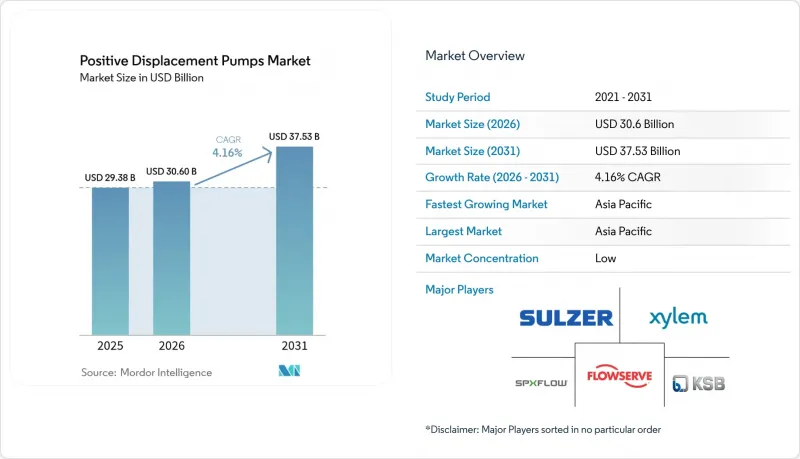
本報告按類型(往復式、旋轉式、蠕動式)、額定壓力(低於 50 巴、51-150 巴、高於 150 巴)、最終用戶行業(石油和天然氣、發電、水和用水和污水處理、化學品和石化、食品和飲料、製藥和生物技術、採礦和礦物、紙漿和造紙等)以及地區分類(北美、亞太漿和造紙等地區)以及地區分類(北美、亞太漿和造紙等地區)。
全球容積式幫浦市場趨勢及洞察
為確保遵守工業污水法規,支出激增
美國環保署 (EPA) 針對排煙脫硫污水製定的零排放法規,正在推動資本投資計劃,這些計劃優先考慮高可靠性的計量系統和能夠處理強腐蝕性化學品的軟管泵。歐洲也出現了類似的法規收緊趨勢,而亞洲的晶圓代工廠和半導體工廠正在採用高回收率的逆滲透膜和蒸發迴路,這些系統依賴精密計量系統來控制阻垢劑和 pH 值。資金籌措勢頭強勁。美國兩黨共同支持的《基礎設施法案》已撥款 500 億美元用於用水和污水維修,為營運商提供了簽訂多年泵組框架協議所需的預算確定性。此外,隨著微電子產業零液體排放的推進,對能夠全天候運作的高壓往復泵的需求也不斷增加。能夠將物聯網賦能的狀態監測和效能分析功能相結合的供應商,正在縮小其產品與離心泵相比的總擁有成本 (TCO) 差距。
上游油氣產業的棕地維修週期
深水作業者正在對成熟油田進行再投資,而高壓海底多相泵浦在這些再開發計畫中發揮核心作用。 SLB OneSubsea 從 BP 卡斯基達油田訂單表明,額定壓力超過 15,000 psi 的人工泵組如何在減少地面壓縮機面積的同時,實現更高的採收率。更高的液壓效率、更高的馬達額定功率和緊湊的設計使得這些泵組能夠從更小的浮體式設施部署,從而降低每桶原油的資本支出。訂單數據也印證了這個趨勢。貝克休斯公司在 2024 年第四季錄得價值 30.3 億美元的工業和能源技術項目訂單,連續第五個季度訂單額超過 30 億美元。其中,泵浦和壓縮機佔了相當大的佔有率。油田作業者發現,變速驅動裝置能夠降低功率並最大限度地減少部分負荷運行時的能耗,進一步提升了其價值。
與離心泵相比,運轉維護成本較高
由於離心式幫浦浦零件少、維護簡便,目前仍佔據石油服務市場90%以上的佔有率。往復泵的密封件更換週期有時可短至離心式幫浦的三分之一,而容積式泵在遠低於其最高效率運作時會消耗更多能源。因此,對於大型輸水和灌溉應用中注重成本的業者而言,除非在黏度、吸入性能或計量精度方面的要求超過了經濟優勢,否則他們通常不會採用容積式幫浦技術。
細分市場分析
就2025年的銷售額而言,往復式泵浦在容積式泵浦市場佔據主導地位,市佔率高達43.30%。這凸顯了其在煉油廠、化學反應器和高壓鍋爐給水應用中無與倫比的壓力性能和精確的逐次衝程控制能力。相較之下,蠕動幫浦預計將以6.78%的複合年成長率成長,這主要得益於無菌生物製程、實驗室自動化和黏合劑點膠等應用領域的需求。 Quantum和PERIPRO系列軟管幫浦即使在黏度超過50,000 cSt的情況下,也能實現連續流量,偏差小於±1%——此性能範圍先前僅限於專用齒輪幫浦。取消動態密封件最大限度地降低了交叉污染的風險,這對疫苗生產商至關重要。由於一次性軟管縮短了換型時間,蠕動幫浦供應商提供的機型能夠實現與不銹鋼隔膜幫浦相當的總擁有成本(TCO)。
齒輪泵、螺旋泵和LOBE泵仍然是潤滑、瀝青和巧克力輸送管線中的標準產品,這些應用對剪切敏感性和操作輕柔要求較高。整合式變頻驅動裝置可最佳化扭矩並抑制壓力峰值,從而延長軸承壽命。轉葉幫浦適用於小型工具機和暖通空調潤滑循環系統,在中型細分市場中佔據相當大的市場。
區域分析
預計到2025年,亞太地區將佔全球銷售額的42.60%,複合年成長率(CAGR)高達5.53%。這主要得益於中國100億元人民幣的抽水蓄能水力發電計畫和印度2,700億美元的工業用水相關投資計畫。儘管本土核能發電廠馬達冷卻水泵的訂單,但歐美品牌仍然是醫藥級軟管泵的首選。日本荏原公司正投資160億日圓建設液氫泵試驗基地,體現了日本對清潔能源載體的長期重視。
在北美,煉油廠和頁岩油氣開採領域仍擁有大規模的安裝基礎,儘管新建設投資停滯不前,但售後市場收益依然強勁。政府支持的 PFAS 排放法規也推動了各州對高級氧化處理系統和膜分離系統的資金投入,而這兩種系統都依賴化學計量泵。在歐洲,儘管面臨能源成本波動,但嚴格的廢水處理法規和食品安全標準正在執行,這維持了備件業務的健康發展。在拉丁美洲,採礦業的擴張推動了對高壓漿料輸送的需求,儘管貨幣貶值可能會減緩資本投資。在中東和非洲,海水淡化和生產水回注是預算限制下的優先事項,這為耐腐蝕雙相鋼三缸泵浦創造了商機。
其他好處:
- Excel格式的市場預測(ME)表
- 3個月的分析師支持
目錄
第1章:引言
- 研究假設和市場定義
- 調查範圍
第2章:調查方法
第3章執行摘要
第4章 市場狀況
- 市場概覽
- 市場促進因素
- 為確保遵守工業污水法規而進行的支出正在激增。
- 上游油氣產業現有設施的維修週期
- 透過流程自動化實現高精度管理
- 衛生泵需符合嚴格的食品安全標準
- 生物製藥產業使用的模組化撬裝設備需要微型PD幫浦。
- 電動遠程採礦需要節能型容積式幫浦。
- 市場限制因素
- 與離心式替代方案相比,運作和維護成本更高。
- 高通量製程中的黏度限制
- 不銹鋼和合金價格波動劇烈
- 無閥微流體技術正在蠶食實驗室的需求。
- 供應鏈分析
- 監理情勢
- 技術展望
- 波特五力模型
第5章 市場規模與成長預測
- 按類型
- 往復式(活塞式、柱塞式、膜片式)
- 旋轉式(齒輪式、螺桿式、凸輪式、葉片式)
- 蠕動
- 額定壓力
- 50巴或更低
- 51~150 bar
- 150巴或以上
- 按最終用戶行業分類
- 石油和天然氣
- 發電
- 水和污水處理
- 化工/石油化工
- 食品/飲料
- 製藥和生物技術
- 採礦和礦產
- 紙漿和造紙
- 其他
- 按地區
- 北美洲
- 美國
- 加拿大
- 墨西哥
- 歐洲
- 德國
- 英國
- 法國
- 義大利
- 西班牙
- 北歐國家
- 俄羅斯
- 其他歐洲國家
- 亞太地區
- 中國
- 印度
- 日本
- 韓國
- 東南亞
- 其他亞太國家
- 南美洲
- 巴西
- 阿根廷
- 智利
- 其他南美國家
- 中東和非洲
- 沙烏地阿拉伯
- 阿拉伯聯合大公國
- 南非
- 埃及
- 其他中東和非洲國家
- 北美洲
第6章 競爭情勢
- 市場集中度
- 策略趨勢
- 市佔率分析
- 公司簡介
- Flowserve Corporation
- Xylem Inc.
- Sulzer AG
- KSB SE & Co. KGaA
- SPX FLOW Inc.
- ITT Inc.
- Ampco Pumps Company Inc.
- NETZSCH Holding
- Pentair PLC
- LEWA GmbH
- Grundfos Holding A/S
- Dover Corp.(PSG)
- Ingersoll Rand(Gardner Denver)
- Alfa Laval AB
- Atlas Copco AB
- Graco Inc.
- Gorman-Rupp Co.
- IDEX Corporation
- Wilo SE
- Tsurumi Pump
第7章 市場機會與未來展望
According to Mordor Intelligence, the positive displacement pumps market size is expected to grow from USD 29.38 billion in 2025 to USD 30.6 billion in 2026 and is forecast to reach USD 37.53 billion by 2031 at 4.16% CAGR over 2026-2031.
This report is Segmented by Type (Reciprocating, Rotary, and Peristaltic), Pressure Rating (Up To 50 Bar, 51 To 150 Bar, and Above 150 Bar), End-User Industry (Oil and Gas, Power Generation, Water and Wastewater, Chemical and Petrochemical, Food and Beverage, Pharmaceutical and Biotechnology, Mining and Minerals, Pulp and Paper, and Others), and Geography (North America, Asia-Pacific, and More).
Global Positive Displacement Pumps Market Trends and Insights
Industrial Wastewater Compliance Spending Surge
Zero-discharge limits adopted by the United States Environmental Protection Agency for flue-gas desulfurization wastewater are driving capital programs that favor high-reliability metering and hose pumps capable of handling aggressive chemistries. Similar tightening is observable in Europe, while Asian foundries and semiconductor fabs adopt high-recovery reverse-osmosis and evaporation loops that rely on precision metering systems for antiscalant and pH control. Funding momentum is strong: the US Bipartisan Infrastructure Law allocates USD 50 billion for water and wastewater upgrades, providing owners with the budget certainty needed to finalize multi-year framework agreements for pump packages. The adoption of zero liquid discharge in microelectronics is also increasing demand for high-pressure reciprocating units capable of 24/7 operation. Suppliers that bundle IoT-enabled condition monitoring and performance analytics are closing total-cost-of-ownership gaps versus centrifugal alternatives.
Upstream Oil & Gas Brown-Field Upgrade Cycle
Deep-water operators are reinvesting in mature basins, and high-pressure subsea multiphase pumps play a central role in these redevelopment plans. SLB OneSubsea's award for BP's Kaskida field demonstrates how artificial-lift packages rated beyond 15,000 psi can unlock incremental recovery while reducing topside compression footprints . Hydraulic efficiency improvements, larger motor ratings, and compact footprint designs are enabling deployment from smaller floating facilities, reducing capital expenditure per barrel. Orders data underscore the trend: Baker Hughes booked USD 3.03 billion in Industrial & Energy Technology projects in Q4 2024, its fifth consecutive quarter above USD 3 billion, with pumps and compressors accounting for a material portion. Field operators see additional value in adjustable-speed drives that allow output turndown, minimizing energy draw during partial-load operation.
High O&M Costs vs. Centrifugal Alternatives
Centrifugal pumps still account for more than 90% of petroleum service due to their lower parts count and simpler maintenance routines . Seal replacement intervals for reciprocating designs can be one-third those of centrifugal machines, and energy consumption penalties rise when positive displacement pumps run far below the best-efficiency point. Cost-conscious operators in bulk water transfer and irrigation applications, therefore, hesitate to specify positive displacement technology unless viscosity, suction performance, or metering accuracy demands override economics.
Other drivers and restraints analyzed in the detailed report include:
- Process-Automation Driven Precision Dosing
- Strict Food-Safety Standards for Sanitary Pumps
- Volatile Stainless-Steel & Alloy Prices
For complete list of drivers and restraints, kindly check the Table Of Contents.
Segment Analysis
Reciprocating units dominated 2025 revenue with 43.30% positive displacement pumps market share, a testament to their unrivaled pressure capabilities and precise stroke-by-stroke control in refineries, chemical reactors, and high-pressure boiler feed duties. In contrast, peristaltic solutions are expected to headline growth at a 6.78% CAGR, driven by sterile bioprocessing, laboratory automation, and adhesive dispensing requirements. Quantum and PERIPRO series hose pumps achieve continuous flow with a deviation of <=+-1%, even at viscosities above 50,000 cSt, a performance window previously limited to specialty gear pumps. The elimination of dynamic seals minimizes the risk of cross-contamination, a decisive factor for vaccine producers. As single-use cartridge hoses reduce changeover time, peristaltic suppliers are marketing total-cost-of-ownership models matching those of stainless-steel diaphragm alternatives.
Gear, screw, and lobe variants remain fixtures in lubrication, asphalt, and chocolate transfer lines, where shear sensitivity demands gentle handling. Integrated variable-frequency drives optimize torque and mitigate pressure spikes, extending bearing life. Rotary vane configurations cater to compact machine tools and HVAC lubricant circulation systems, sustaining a sizeable mid-volume niche.
Complete Report Scope:
- By Type
- Reciprocating (Piston, Plunger, Diaphragm)
- Rotary (Gear, Screw, Lobe, Vane)
- Peristaltic
- By Pressure Rating
- Up to 50 bar
- 51 to 150 bar
- Above 150 bar
- By End-user Industry
- Oil and Gas
- Power Generation
- Water and Wastewater
- Chemical and Petrochemical
- Food and Beverage
- Pharmaceutical and Biotechnology
- Mining and Minerals
- Pulp and Paper
- Others
- By Geography
- North America
- United States
- Canada
- Mexico
- Europe
- Germany
- United Kingdom
- France
- Italy
- Spain
- NORDIC Countries
- Russia
- Rest of Europe
- Asia-Pacific
- China
- India
- Japan
- South Korea
- Southeast Asia
- Rest of Asia-Pacific
- South America
- Brazil
- Argentina
- Chile
- Rest of South America
- Middle East and Africa
- Saudi Arabia
- United Arab Emirates
- South Africa
- Egypt
- Rest of Middle East and Africa
- North America
Geography Analysis
Asia-Pacific held 42.60% of 2025 revenue and delivered the strongest 5.53% CAGR, underwritten by China's 10 billion yuan pumped-storage program and India's USD 270 billion industrial water spend pipeline . Local OEMs are upgrading casting quality to secure nuclear motor coolant orders, but Western brands continue to be preferred for pharmaceutical-grade hose pumps. Japan's Ebara is building a 16 billion yen liquid-hydrogen pump testing hub, signaling a long-term national focus on clean-energy carriers.
North America retains a large installed base across refineries and shale operations, providing robust aftermarket revenue even as new-build investment flattens. Government-backed PFAS discharge rules are also boosting state-level funding for advanced oxidation and membrane systems, both of which depend on chemical metering pumps. Europe grapples with energy cost volatility yet enforces strict effluent and food safety codes, sustaining a healthy spare parts business. Latin America's mining expansion drives demand for high-pressure slurry transfer, although currency depreciation occasionally delays capital expenditures. The Middle East and Africa prioritize desalination and produced-water reinjection, generating opportunities for corrosion-resistant duplex-steel triplex pumps despite budget sensitivity.
- Flowserve Corporation
- Xylem Inc.
- Sulzer AG
- KSB SE & Co. KGaA
- SPX FLOW Inc.
- ITT Inc.
- Ampco Pumps Company Inc.
- NETZSCH Holding
- Pentair PLC
- LEWA GmbH
- Grundfos Holding A/S
- Dover Corp. (PSG)
- Ingersoll Rand (Gardner Denver)
- Alfa Laval AB
- Atlas Copco AB
- Graco Inc.
- Gorman-Rupp Co.
- IDEX Corporation
- Wilo SE
- Tsurumi Pump
Additional Benefits:
- The market estimate (ME) sheet in Excel format
- 3 months of analyst support
TABLE OF CONTENTS
1 Introduction
- 1.1 Study Assumptions & Market Definition
- 1.2 Scope of the Study
2 Research Methodology
3 Executive Summary
4 Market Landscape
- 4.1 Market Overview
- 4.2 Market Drivers
- 4.2.1 Industrial wastewater compliance spending surge
- 4.2.2 Upstream oil & gas brown-field upgrade cycle
- 4.2.3 Process-automation driven precision dosing
- 4.2.4 Strict food?safety standards for sanitary pumps
- 4.2.5 Biopharma modular skids require micro-PD pumps
- 4.2.6 Electrified remote mining needs energy-efficient PD pumps
- 4.3 Market Restraints
- 4.3.1 High O&M costs vs. centrifugal alternatives
- 4.3.2 Viscosity limits in high-throughput processes
- 4.3.3 Volatile stainless-steel & alloy prices
- 4.3.4 Valve-less micro-fluidics cannibalising lab demand
- 4.4 Supply-Chain Analysis
- 4.5 Regulatory Landscape
- 4.6 Technological Outlook
- 4.7 Porter's Five Forces
- 4.7.1 Bargaining Power of Suppliers
- 4.7.2 Bargaining Power of Consumers
- 4.7.3 Threat of New Entrants
- 4.7.4 Threat of Substitutes
- 4.7.5 Intensity of Competitive Rivalry
5 Market Size & Growth Forecasts
- 5.1 By Type
- 5.1.1 Reciprocating (Piston, Plunger, Diaphragm)
- 5.1.2 Rotary (Gear, Screw, Lobe, Vane)
- 5.1.3 Peristaltic
- 5.2 By Pressure Rating
- 5.2.1 Up to 50 bar
- 5.2.2 51 to 150 bar
- 5.2.3 Above 150 bar
- 5.3 By End-user Industry
- 5.3.1 Oil and Gas
- 5.3.2 Power Generation
- 5.3.3 Water and Wastewater
- 5.3.4 Chemical and Petrochemical
- 5.3.5 Food and Beverage
- 5.3.6 Pharmaceutical and Biotechnology
- 5.3.7 Mining and Minerals
- 5.3.8 Pulp and Paper
- 5.3.9 Others
- 5.4 By Geography
- 5.4.1 North America
- 5.4.1.1 United States
- 5.4.1.2 Canada
- 5.4.1.3 Mexico
- 5.4.2 Europe
- 5.4.2.1 Germany
- 5.4.2.2 United Kingdom
- 5.4.2.3 France
- 5.4.2.4 Italy
- 5.4.2.5 Spain
- 5.4.2.6 NORDIC Countries
- 5.4.2.7 Russia
- 5.4.2.8 Rest of Europe
- 5.4.3 Asia-Pacific
- 5.4.3.1 China
- 5.4.3.2 India
- 5.4.3.3 Japan
- 5.4.3.4 South Korea
- 5.4.3.5 Southeast Asia
- 5.4.3.6 Rest of Asia-Pacific
- 5.4.4 South America
- 5.4.4.1 Brazil
- 5.4.4.2 Argentina
- 5.4.4.3 Chile
- 5.4.4.4 Rest of South America
- 5.4.5 Middle East and Africa
- 5.4.5.1 Saudi Arabia
- 5.4.5.2 United Arab Emirates
- 5.4.5.3 South Africa
- 5.4.5.4 Egypt
- 5.4.5.5 Rest of Middle East and Africa
- 5.4.1 North America
6 Competitive Landscape
- 6.1 Market Concentration
- 6.2 Strategic Moves
- 6.3 Market Share Analysis
- 6.4 Company Profiles (includes Global-level Overview, Market-level Overview, Core Segments, Financials as available, Strategic Information, Market Rank/Share, Products & Services, Recent Developments)
- 6.4.1 Flowserve Corporation
- 6.4.2 Xylem Inc.
- 6.4.3 Sulzer AG
- 6.4.4 KSB SE & Co. KGaA
- 6.4.5 SPX FLOW Inc.
- 6.4.6 ITT Inc.
- 6.4.7 Ampco Pumps Company Inc.
- 6.4.8 NETZSCH Holding
- 6.4.9 Pentair PLC
- 6.4.10 LEWA GmbH
- 6.4.11 Grundfos Holding A/S
- 6.4.12 Dover Corp. (PSG)
- 6.4.13 Ingersoll Rand (Gardner Denver)
- 6.4.14 Alfa Laval AB
- 6.4.15 Atlas Copco AB
- 6.4.16 Graco Inc.
- 6.4.17 Gorman-Rupp Co.
- 6.4.18 IDEX Corporation
- 6.4.19 Wilo SE
- 6.4.20 Tsurumi Pump
7 Market Opportunities & Future Outlook
- 7.1 White-space & Unmet-need Assessment

 中東和非洲容積式幫浦:市場佔有率分析、產業趨勢和統計數據以及成長預測(2026-2031 年)亞太地區正壓泵:市場佔有率分析、產業趨勢與統計及成長預測(2026-2031)
 可變排量幫浦市場分析與預測(至2035年):類型、產品、技術、組件、應用、最終用戶、功能、安裝類型、設備、解決方案
 容積式幫浦市場-2026-2032年全球市場預測
 2026-2030年全球往復式柱塞泵浦市場
 容積式幫浦市場報告:依產品類型、容量、幫浦特性、原料、終端用戶產業和地區分類(2026-2034 年)
 全球正壓泵市場規模、佔有率、趨勢和成長分析報告(2026-2034)
 容積式幫浦市場:按類型、應用、最終用戶和地區分類活塞泵和柱塞泵市場按泵類型、驅動類型、流量、壓力、安裝方式、最終用途行業和配銷通路分類,全球預測,2026-2032年線性泵浦市場按類型、技術、流量、材料、終端用戶產業和分銷管道分類,全球預測,2026-2032年