


 |
市場調查報告書
商品編碼
2125366
亞太地區正壓泵:市場佔有率分析、產業趨勢與統計及成長預測(2026-2031)Asia-Pacific Positive Displacement Pumps - Market Share Analysis, Industry Trends & Statistics, Growth Forecasts (2026 - 2031) |
||||||

※ 本網頁內容可能與最新版本有所差異。詳細情況請與我們聯繫。
據 Mordor Intelligence 稱,2025 年亞太地區容積式泵浦市場價值為 115.3 億美元,預計到 2031 年將從 2026 年的 120.2 億美元成長至 147.9 億美元,預測期(2026-2031 年)複合年成長率為 4.24%。
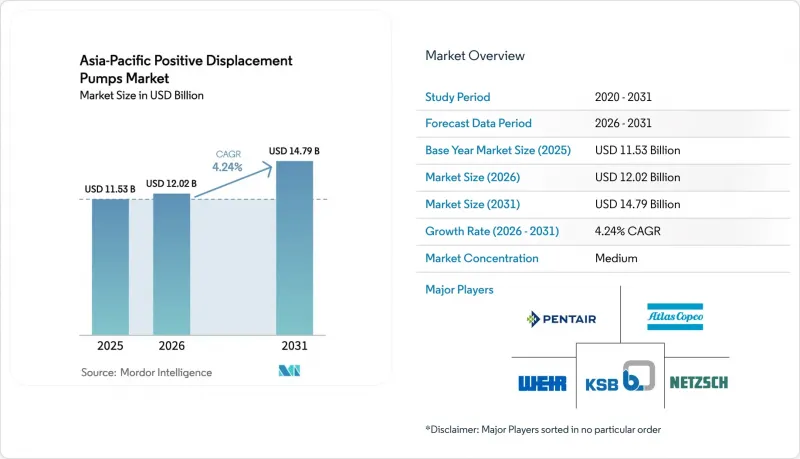
本報告按泵浦類型(往復式、旋轉式、螺桿式、蠕動式)、驅動系統(電動馬達、柴油/內燃機等)、材質(鑄鐵、不銹鋼及其他)、終端用戶產業(石油天然氣、化學、食品飲料、廢棄物污水等)和國家進行細分。市場預測以美元(USD)計價。
亞太地區容積式幫浦市場趨勢及洞察
亞洲都市污水基礎設施的快速發展
都市污水網的擴張推動了對能夠以穩定流量處理黏稠污泥的單軸螺旋泵浦和螺旋泵的持續訂單,使其成為生物處理和化學藥劑注入的首選泵。中國和印度正獎勵策略扶持分散式污水處理設施,而東南亞國家則在尋求可快速部署於城市邊緣的模組化撬裝設備。因此,單軸螺旋泵浦浦供應商正在銷售包含監控感測器的成套設備,用於偵測轉子和定子磨損,從而減少現場維修次數。印尼和越南的本土製造商也在增加鑄鐵泵的生產,以滿足預算緊張的市政需求,儘管在生命週期評估中,不銹鋼泵仍然佔據主導地位。亞太地區的容積式泵浦市場正受益於供水事業簽訂的長期服務契約,這些合約保證了10年特許經營期內的處理能力。
中國特種化學品叢集的VOC排放標準更加嚴格
嚴格的法規要求洩漏檢測閾值低於2000 ppm,這迫使製造商採用磁力驅動密封設計,雖然增加了材料成本,但降低了洩漏排放的法律責任。泵浦製造商正在採用具有感測器整合壓力補償的雙機械軸封,以確保在初始檢查期間符合監管審計的要求。隨著監管合規期限的臨近,江蘇、山東和廣東等省份工業園區的泵浦更換週期正在加快,這為亞太地區容積式泵浦市場的維修工程帶來了絕佳的創收機會。提供VOC監測和分析服務的公司正在與特種聚合物製造商簽訂框架協議,要求這些製造商向當地環保部門提供即時報告。
不銹鋼和銅價格的波動推高了泵浦的物料清單成本。
原物料成本佔成品幫浦成本的60%之多,如果成本無法迅速轉嫁,不鏽鋼價格上漲15%可能會導致毛利率下降300個基點。供應商正在拓展產品線,將雙相鋼和低鉬鋼納入其中,並重新設計泵殼以在不影響耐壓性的前提下減小壁厚。雖然大型原始設備製造商(OEM)已與鋼廠簽訂年度契約,但小型製造商正面臨現金流緊張的風險,這正在推動亞太地區容積式泵市場的行業重組。 「成本導向設計」正在加速將非關鍵性泵殼零件轉向複合聚合物零件,從而降低價格波動風險。
細分市場分析
預計到2025年,旋轉泵將佔亞太地區容積式泵銷售額的51.12%,佔據該地區容積式泵市場最大佔有率,這主要得益於其在化工、石油天然氣和食品加工等行業的廣泛應用。同時,蠕動泵的出貨量正以7.06%的複合年成長率快速成長,滿足了對零污染要求極高的單次使用生物製程和化學品供應作業的需求。
齒輪幫浦和雙螺旋泵幫浦現在都配備了振動和壓力感測器,可以將數據傳輸到OEM雲端控制面板,從而加速亞太地區容積式幫浦市場預測性維護的普及。LOBE泵的需求主要來自不斷成長的乳製品和飲料產業,而葉片幫浦則在潤滑迴路中佔有一席之地。
預計到2025年,電動馬達幫浦的銷售將佔亞太地區容積式幫浦市場總銷量的63.21%,鞏固其在工廠自動化和輸送應用領域的領先地位。太陽能幫浦雖然仍屬於小眾市場,但預計其複合年成長率將達到9.32%,這主要得益於農業灌溉和偏遠地區供水計畫中太陽能發電成本的下降。
變頻驅動器與高效能IE4馬達結合,可降低整個生命週期的能耗,而日益嚴格的排放氣體法規正迫使柴油機組退居應急和離網應用領域。在本質安全優先於能源效率的危險環境中,氣壓系統仍佔有一定的地位。
其他好處:
- Excel格式的市場預測(ME)表
- 3個月的分析師支持
目錄
第1章:引言
- 研究假設和市場定義
- 調查範圍
第2章:調查方法
第3章執行摘要
第4章 市場狀況
- 市場概覽
- 市場促進因素
- 亞洲都市污水基礎設施的快速發展
- 中國特種化學品叢集的VOC排放標準更加嚴格
- 海上平台的電氣化將增加對低剪切泵浦的需求。
- 採用一次性蠕動幫浦撬裝設備的微型生物製藥生產設施。
- 向配備智慧感測器的旋轉泵過渡(OEM廠商主導的主流產品)
- 後疫情時代食品飲料加工生產線資本投資的復甦(主流)
- 市場限制因素
- 不銹鋼和銅的價格波動推高了泵浦部件的成本。
- 複雜螺桿泵浦的MRO(維修、技術純熟勞工短缺。
- 製藥業對無密封磁力驅動離心機的需求不斷成長。
- 印度BIS認證流程耗時過長,延緩了公司在印度的擴張。
- 價值鏈分析
- 監理情勢
- 技術展望
- 波特五力分析
- 市場宏觀經濟趨勢的評估
第5章 市場規模與成長預測
- 泵浦類型
- 往復泵
- 活塞
- 隔膜
- 旋轉泵
- 齒輪
- 長袍
- 擰緊
- 貝恩
- 漸進性齲齒
- 蠕動
- 往復泵
- 透過驅動系統
- 電動機
- 柴油/內燃機
- 氣壓
- 油壓
- 太陽的
- 材料
- 鑄鐵
- 不銹鋼
- 其他
- 按最終用戶行業分類
- 石油和天然氣
- 化學品
- 食品/飲料
- 廢棄物和污水
- 製藥和生物技術
- 發電
- 紙漿和造紙
- 採礦和金屬
- 其他
- 國家
- 中國
- 日本
- 印度
- 韓國
- 澳洲和紐西蘭
- 其他亞太國家
第6章 競爭情勢
- 市場集中度
- 策略趨勢
- 市佔率分析
- 公司簡介
- Atlas Copco AB
- The Weir Group PLC
- KSB SE and Co. KGaA
- NETZSCH Holding GmbH
- Pentair plc
- SPX FLOW, Inc.
- Sulzer Ltd.
- Xylem Inc.
- Grundfos Holding A/S
- Tsurumi Manufacturing Co., Ltd.
- Ebara Corporation
- Flowserve Corporation
- Dover Corporation(PSG)
- IDEX Corporation
- Alfa Laval AB
- Kirloskar Brothers Ltd.
- Shakti Pumps(India)Ltd.
- Yamada Corporation
- Sepex Corporation
- Tapflo Group
第7章 市場機會與未來展望
According to Mordor Intelligence, the APAC positive displacement pumps market size was valued at USD 11.53 billion in 2025 and estimated to grow from USD 12.02 billion in 2026 to reach USD 14.79 billion by 2031, at a CAGR of 4.24% during the forecast period (2026-2031).
This report is Segmented by Pump Type (Reciprocating, Rotary, Progressive Cavity, and Peristaltic), Driving Method (Electric Motor, Diesel/IC Engine, and More), Material (Cast Iron, Stainless Steel, and Other Materials), End-User Industry (Oil and Gas, Chemicals, Food and Beverage, Waste and Wastewater, and More), and Country. The Market Forecasts are Provided in Terms of Value (USD).
Asia-Pacific Positive Displacement Pumps Market Trends and Insights
Rapid Build-out of Asia's Municipal Wastewater Infrastructure
Expanding municipal wastewater networks spur recurring orders for progressive cavity and screw units that handle viscous sludges with stable flow, making these pumps a preferred choice for biological treatment and chemical dosing. China and India allocate significant stimulus to decentralized plants, and Southeast Asian nations seek modular skid packages that can be deployed quickly in peri-urban areas. Progressive cavity suppliers therefore bundle monitoring sensors to flag wear on rotors and stators, reducing on-site service calls. Local fabricators in Indonesia and Vietnam also scale up cast iron models for budget-sensitive municipalities, but stainless variants continue to dominate lifecycle assessments. The APAC positive displacement pumps market benefits as water utilities anchor long-term service agreements that guarantee throughput performance across 10-year concessions.
Tightening VOC Discharge Limits in China's Specialty-Chemicals Clusters
Stringent rules mandating leak detection thresholds below 2,000 ppm push processors to specify magnetic-drive and hermetically sealed designs, creating a material premium yet reducing fugitive emissions liability. Pump makers integrate dual mechanical seals with sensor-enabled pressure compensation to ensure regulatory audits pass on first inspection. Compliance deadlines intensify replacement cycles in Jiangsu, Shandong and Guangdong complexes, positioning the APAC positive displacement pumps market for retrofit revenue. Companies offering VOC-monitoring analytics secure framework agreements with specialty polymer producers that require real-time reporting to local environmental bureaus.
Volatile Stainless-Steel and Copper Prices Inflate Pump BOM Cost
Raw materials account for up to 60% of finished-pump cost; a 15% spike in stainless price can cut gross margins by 300 bps if not passed through swiftly. Suppliers diversify into duplex or low-molybdenum grades and redesign housings to reduce wall thickness without compromising pressure ratings. Larger OEMs lock annual contracts with mills, while smaller fabricators risk cash-flow tightness, prompting consolidation within the APAC positive displacement pumps market. Design-for-cost engineering accelerates the transition to composite polymer components in non-critical housings, easing volatility exposure.
Other drivers and restraints analyzed in the detailed report include:
- Electrification of Offshore Platforms Raises Demand for Low-Shear Pumps
- Mini-Bulk Biopharma Facilities Adopting Single-Use Peristaltic Skids
- Skilled-Labor Shortage for Complex Progressive-Cavity Pump MRO
For complete list of drivers and restraints, kindly check the Table Of Contents.
Segment Analysis
Rotary units contributed 51.12% of 2025 revenue, equating to the largest slice of the APAC positive displacement pumps market size and validating their versatility in chemicals, oil and gas and food handling applications. Peristaltic pumps, however, lead volume growth at a 7.06% CAGR by satisfying single-use bioprocessing protocols and chemical-feed duties where zero contamination is non-negotiable.
Gear and twin-screw products now ship with vibration and pressure sensors that feed OEM cloud dashboards, accelerating predictive-maintenance uptake across the APAC positive displacement pumps market. Lobe designs ride demand from dairy and beverage expansions, while vane variants maintain niche roles in lubrication circuits.
Electric-motor models delivered 63.21% of 2025 revenue, underscoring their entrenched role in factory automation and conveying applications across the APAC positive displacement pumps market share. Solar-powered packages, though still a niche, achieve a 9.32% CAGR as agricultural irrigation and remote water supply projects benefit from declining photovoltaic costs.
Variable-frequency drives paired with high-efficiency IE4 motors cut lifecycle energy use, while diesel units retreat to emergency and off-grid roles under tightening emission norms. Pneumatic systems retain a foothold in hazardous environments where intrinsic safety trumps energy efficiency.
Complete Report Scope:
- By Pump Type
- Reciprocating Pumps
- Piston
- Diaphragm
- Rotary Pumps
- Gear
- Lobe
- Screw
- Vane
- Progressive Cavity
- Peristaltic
- Reciprocating Pumps
- By Driving Method
- Electric Motor
- Diesel/IC Engine
- Pneumatic
- Hydraulic
- Solar
- By Material
- Cast Iron
- Stainless Steel
- Other Materials
- By End-user Industry
- Oil and Gas
- Chemicals
- Food and Beverage
- Waste and Wastewater
- Pharmaceutical and Biotech
- Power Generation
- Pulp and Paper
- Mining and Metals
- Other Industries
- By Country
- China
- Japan
- India
- South Korea
- Australia and New Zealand
- Rest of Asia-Pacific
List of Companies Covered in this Report:
- Atlas Copco AB
- The Weir Group PLC
- KSB SE and Co. KGaA
- NETZSCH Holding GmbH
- Pentair plc
- SPX FLOW, Inc.
- Sulzer Ltd.
- Xylem Inc.
- Grundfos Holding A/S
- Tsurumi Manufacturing Co., Ltd.
- Ebara Corporation
- Flowserve Corporation
- Dover Corporation (PSG)
- IDEX Corporation
- Alfa Laval AB
- Kirloskar Brothers Ltd.
- Shakti Pumps (India) Ltd.
- Yamada Corporation
- Sepex Corporation
- Tapflo Group
Additional Benefits:
- The market estimate (ME) sheet in Excel format
- 3 months of analyst support
TABLE OF CONTENTS
1 INTRODUCTION
- 1.1 Study Assumptions and Market Definition
- 1.2 Scope of the Study
2 RESEARCH METHODOLOGY
3 EXECUTIVE SUMMARY
4 MARKET LANDSCAPE
- 4.1 Market Overview
- 4.2 Market Drivers
- 4.2.1 Rapid build-out of Asia's municipal wastewater infrastructure
- 4.2.2 Tightening VOC discharge limits in China's specialty-chemicals clusters
- 4.2.3 Electrification of offshore platforms raises demand for low-shear pumps
- 4.2.4 Mini-bulk biopharma facilities adopting single-use peristaltic skids
- 4.2.5 OEM shift to smart sensor-enabled rotary pumps (mainstream)
- 4.2.6 Post-COVID capex rebound in FandB processing lines (mainstream)
- 4.3 Market Restraints
- 4.3.1 Volatile stainless-steel and copper prices inflate pump BOM cost
- 4.3.2 Skilled-labor shortage for complex progressive-cavity pump MRO
- 4.3.3 Rising preference for seal-less mag-drive centrifugals in pharma
- 4.3.4 Lengthy BIS certification cycle delays India roll-outs
- 4.4 Value Chain Analysis
- 4.5 Regulatory Landscape
- 4.6 Technological Outlook
- 4.7 Porter's Five Forces Analysis
- 4.7.1 Bargaining Power of Suppliers
- 4.7.2 Bargaining Power of Buyers
- 4.7.3 Threat of New Entrants
- 4.7.4 Threat of Substitutes
- 4.7.5 Intensity of Competitive Rivalry
- 4.8 Assessment of Macro Economic Trends on the Market
5 MARKET SIZE AND GROWTH FORECASTS (VALUES)
- 5.1 By Pump Type
- 5.1.1 Reciprocating Pumps
- 5.1.1.1 Piston
- 5.1.1.2 Diaphragm
- 5.1.2 Rotary Pumps
- 5.1.2.1 Gear
- 5.1.2.2 Lobe
- 5.1.2.3 Screw
- 5.1.2.4 Vane
- 5.1.3 Progressive Cavity
- 5.1.4 Peristaltic
- 5.1.1 Reciprocating Pumps
- 5.2 By Driving Method
- 5.2.1 Electric Motor
- 5.2.2 Diesel/IC Engine
- 5.2.3 Pneumatic
- 5.2.4 Hydraulic
- 5.2.5 Solar
- 5.3 By Material
- 5.3.1 Cast Iron
- 5.3.2 Stainless Steel
- 5.3.3 Other Materials
- 5.4 By End-user Industry
- 5.4.1 Oil and Gas
- 5.4.2 Chemicals
- 5.4.3 Food and Beverage
- 5.4.4 Waste and Wastewater
- 5.4.5 Pharmaceutical and Biotech
- 5.4.6 Power Generation
- 5.4.7 Pulp and Paper
- 5.4.8 Mining and Metals
- 5.4.9 Other Industries
- 5.5 By Country
- 5.5.1 China
- 5.5.2 Japan
- 5.5.3 India
- 5.5.4 South Korea
- 5.5.5 Australia and New Zealand
- 5.5.6 Rest of Asia-Pacific
6 COMPETITIVE LANDSCAPE
- 6.1 Market Concentration
- 6.2 Strategic Moves
- 6.3 Market Share Analysis
- 6.4 Company Profiles (includes Global level Overview, Market level overview, Core Segments, Financials as available, Strategic Information, Market Rank/Share for key companies, Products and Services, and Recent Developments)
- 6.4.1 Atlas Copco AB
- 6.4.2 The Weir Group PLC
- 6.4.3 KSB SE and Co. KGaA
- 6.4.4 NETZSCH Holding GmbH
- 6.4.5 Pentair plc
- 6.4.6 SPX FLOW, Inc.
- 6.4.7 Sulzer Ltd.
- 6.4.8 Xylem Inc.
- 6.4.9 Grundfos Holding A/S
- 6.4.10 Tsurumi Manufacturing Co., Ltd.
- 6.4.11 Ebara Corporation
- 6.4.12 Flowserve Corporation
- 6.4.13 Dover Corporation (PSG)
- 6.4.14 IDEX Corporation
- 6.4.15 Alfa Laval AB
- 6.4.16 Kirloskar Brothers Ltd.
- 6.4.17 Shakti Pumps (India) Ltd.
- 6.4.18 Yamada Corporation
- 6.4.19 Sepex Corporation
- 6.4.20 Tapflo Group
7 MARKET OPPORTUNITIES AND FUTURE OUTLOOK
- 7.1 White-space and Unmet-Need Assessment

 中東和非洲容積式幫浦:市場佔有率分析、產業趨勢和統計數據以及成長預測(2026-2031 年)
 可變排量幫浦市場分析與預測(至2035年):類型、產品、技術、組件、應用、最終用戶、功能、安裝類型、設備、解決方案容積式幫浦:市場佔有率分析、產業趨勢與統計、成長預測(2026-2031 年)
 容積式幫浦市場-2026-2032年全球市場預測
 2026-2030年全球往復式柱塞泵浦市場
 容積式幫浦市場報告:依產品類型、容量、幫浦特性、原料、終端用戶產業和地區分類(2026-2034 年)
 全球正壓泵市場規模、佔有率、趨勢和成長分析報告(2026-2034)
 容積式幫浦市場:按類型、應用、最終用戶和地區分類活塞泵和柱塞泵市場按泵類型、驅動類型、流量、壓力、安裝方式、最終用途行業和配銷通路分類,全球預測,2026-2032年線性泵浦市場按類型、技術、流量、材料、終端用戶產業和分銷管道分類,全球預測,2026-2032年