


 |
市場調查報告書
商品編碼
2154840
南美洲離心式幫浦:市場佔有率分析、產業趨勢與統計、成長預測(2026-2031)South America Centrifugal Pumps - Market Share Analysis, Industry Trends & Statistics, Growth Forecasts (2026 - 2031) |
||||||

※ 本網頁內容可能與最新版本有所差異。詳細情況請與我們聯繫。
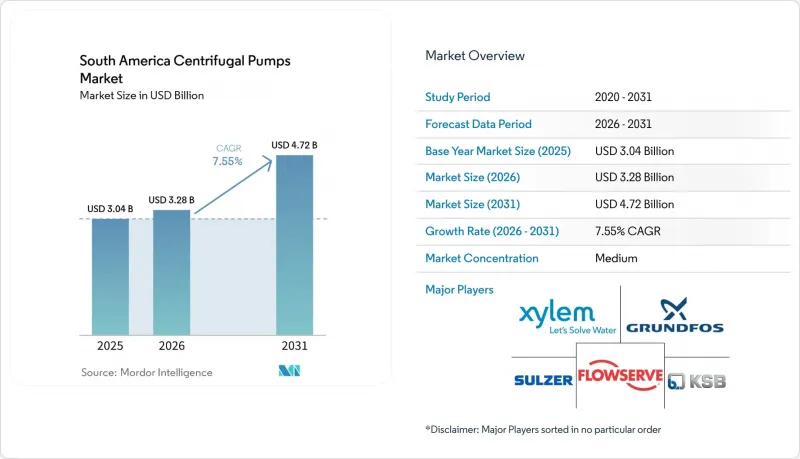
據 Mordor Intelligence 稱,2025 年南美洲離心式幫浦市值為 30.4 億美元,預計到 2031 年將從 2026 年的 32.8 億美元成長至 47.2 億美元,預測期(2026-2031 年)複合年成長率為 7.55%。
南美洲離心式幫浦市場趨勢與洞察
巴西對衛生基礎設施和水泵更換的投資
巴西的衛生設施特許經營項目是南美洲離心式幫浦市場短期需求的主要驅動力。截至2026年2月,該衛生設施框架下的合約投資額已超過680億美元。該框架的目標是到2033年實現99%的飲用水供應率和90%的污水收集率,儘管目前仍有超過3,500萬人無法取得飲用水。在馬拉尼昂州,特許經營計畫已經制定。涵蓋整個帕拉州的「Aegea」特許經營項目已獲得約40億美元的投資,而聖卡塔琳娜州的公共產業項目則獲得了超過54億美元的投資。這些項目不僅支援設備的交付,還支援建設後的持續服務。
海上油氣和煉油廠的擴張
石油和天然氣行業的投資推動了對高可靠性、高材料要求的工程泵系統的需求。煉油廠維修和深海開發案對公用設施泵浦、輸送泵浦和高壓泵浦的需求日益成長。這些項目需要能夠承受連續製程運作、腐蝕性流體以及嚴格的現場安全規程的設備。供應商還需要具備關鍵服務應用的認證工程資格。現場技術支援在安裝、試運行和維護過程中至關重要。這些因素進一步凸顯了超越標準設備供應能力的重要性。
大宗商品價格波動導致資本項目延誤
在採礦和能源項目中,如果大宗商品價格下跌或專案假設發生變化,設備採購可能會延遲。這會影響南美洲離心式幫浦市場,因為大型項目往往涉及巨額的單筆訂單金額。礦山擴建的延誤可能會同時導致供水、排水和製程設備的安裝延遲。高海拔項目的設計需要考慮水的化學性質、固態的暴露、海拔高度和冷卻條件。財務上的不確定性也可能導致公共和國企業重新考慮基礎設施預算分配。擁有豐富安裝經驗的供應商受到的影響較小,因為即使新計畫延期,他們也能維持業務收益。
細分市場分析
到2025年,單級幫浦的銷售量將佔總銷售量的64.29%,主要成長動力來自城市給水、暖氣冷氣和一般製程應用。其低廉的單價促進了大規模已安裝系統的更換購買。對於當地服務供應商,日常維護也相對容易。此外,巴西和阿根廷的供應商已建立了標準單級配置的供應鏈。此供應鏈使客戶能夠有效地管理停機時間和更換需求。在運作條件不需要多級壓力的情況下,單級幫浦仍然發揮著至關重要的作用。南美洲離心式幫浦市場在典型的公共產業和工藝應用中仍然依賴這一類別。
預計2026年至2031年,多級幫浦市場將以8.13%的複合年成長率成長。高揚程輸水、逆滲透(RO)供水系統和海上註入服務是推動南美洲離心式幫浦市場多級泵浦規模成長的主要因素。沿海礦山供水系統需要高壓設備將水長距離輸送到高海拔作業地點。 SADDN專案生動地展現了這種運作環境的嚴苛條件。煉油廠維修也可能需要在關鍵應用中使用多級泵浦組。雖然這些設備對技術要求更高,但每次安裝也能帶來更高的附加價值。供應商必須在設計、試運行和維護階段提供技術支援。
2025年,輻流泵在南美洲離心式幫浦市場佔據73.82%的銷售佔有率。其廣泛的運作範圍使其適用於石油天然氣迴路、供水事業、化學品輸送和一般工業應用。使用者只需少量徑流泵型號即可滿足多種應用需求,從而簡化庫存計劃和備件管理。這種設計也適用於需要在各種安裝地點保持設備性能一致的客戶。其領先地位反映了南美各地廣泛的工業和市政應用。本地和國際製造商均參與了這一成熟領域的競爭。
預計到2031年,混流泵的年複合成長率將達到8.43%。這類幫浦系統適用於高流量、低揚程至中揚程的應用。灌溉泵站、礦山排水系統和都市區雨水處理設施是其主要需求領域。國內製造商可以透過將本地生產與認證供應鏈結合,參與工業合約的競爭。本地生產也有助於提高零件的可得性。軸流泵仍然是排水和防洪領域的重要選擇,尤其適用於需要極高流量和低揚程的應用。
其他好處:
- Excel格式的市場預測(ME)表
- 3個月的分析師支持
目錄
第1章:引言
- 研究假設和市場定義
- 調查範圍
第2章:調查方法
第3章執行摘要
第4章 市場狀況
- 市場概覽
- 市場促進因素
- 巴西衛生設施投資及水泵更換
- 採礦中的脫水和尾礦管理
- 海上油氣和煉油廠的擴張
- 灌溉現代化和農產品擴張
- 節能維修和引入變速電機
- 在地化工程和更短的備件前置作業時間
- 市場限制因素
- 大宗商品價格波動導致資本項目延誤
- 對能源消耗和生命週期成本的敏感性
- 系統設計不當和水質波動導致的空化現象
- 國內低成本競爭對手和對進口零件的依賴。
- 宏觀經濟因素對市場的影響
- 產業價值鏈分析
- 監理情勢
- 技術展望
- 波特五力分析
第5章 市場規模與成長預測
- 逐階段
- 單級泵浦
- 多級泵浦
- 水泵設計
- 輻流泵
- 混合流量泵
- 軸流泵
- 葉輪式
- 開放式葉輪
- 半開放式葉輪
- 密封葉輪
- 透過使用
- 水和污水處理
- 化工/石油化工
- 暖通空調及建築設施
- 石油和天然氣
- 食品/飲料
- 採礦和金屬
- 發電
- 製藥和生物技術
- 其他用途
- 按地區
- 巴西
- 智利
- 阿根廷
- 其他南美國家
第6章 競爭情勢
- 市場集中度
- 策略趨勢
- 市佔率分析
- 公司簡介
- Grundfos Holding A/S
- Xylem Inc.
- Flowserve Corporation
- Sulzer Ltd
- KSB SE & Co. KGaA
- Wilo SE
- Ebara Corporation
- The Weir Group PLC
- ITT Inc.
- Baker Hughes Company
- Ruhrpumpen Group
- Pentair plc
- SPX FLOW, Inc.
- Kirloskar Brothers Limited
- Tsurumi Manufacturing Co., Ltd.
- ANDRITZ AG
- Torishima Pump Mfg. Co., Ltd.
- FAMAC Motobombas Ltda.
- IMBIL, Industria e Manutencao de Bombas ITA Ltda.
- Fabricadora de Bombas Industrias e Comercio Ltda.
- OMEL Bombas e Compressores Ltda.
- Capua Equipamentos Industriais Ltda.
第7章 市場機會與未來展望
According to Mordor Intelligence, the South America centrifugal pumps market size was valued at USD 3.04 billion in 2025 and estimated to grow from USD 3.28 billion in 2026 to reach USD 4.72 billion by 2031, at a CAGR of 7.55% during the forecast period (2026-2031).
South America Centrifugal Pumps Market Trends and Insights
Brazil Sanitation Investment and Pump Replacement
Brazil's sanitation concession program is a major near-term driver of demand for the South America Centrifugal Pumps Market. Contracted investment under the sanitation framework exceeded USD 68 billion by February 2026. The framework seeks 99% potable-water coverage and 90% wastewater collection by 2033, even as more than 35 million people still lack potable-water access. Maranhao planned a concession covering 214 municipalities and USD 3.4 billion in investment. Para's statewide Aegea concession involved nearly USD 4 billion, while Santa Catarina's utility program involved more than USD 5.4 billion. These programs support both equipment deliveries and the ongoing service cycle that follows construction.
Offshore Oil and Gas and Refinery Expansion
Oil and gas investment supports demand for engineered pumping systems with demanding reliability and materials requirements. Refinery upgrades and deepwater developments support utility, transfer, and high-pressure pumping requirements. Such projects require equipment built for continuous process duty, corrosive fluids, and strict site safety procedures. Suppliers also need recognized engineering qualifications for critical service applications. Local technical support is important during installation, commissioning, and maintenance. These conditions raise the importance of capability beyond standard equipment supply.
Capital-Project Delays from Commodity-Price Volatility
Mining and energy projects can defer equipment purchases when commodity prices weaken or planning assumptions change. This affects the South America Centrifugal Pumps Market because large projects can represent substantial individual orders. A delayed mine expansion can delay water transfer, dewatering, and process-equipment packages simultaneously. High-altitude projects require designs that reflect water chemistry, solids exposure, elevation, and cooling conditions. Fiscal uncertainty can also lead public entities and state-linked companies to reallocate infrastructure budgets. Suppliers with broad installed bases are less exposed because service revenue can continue when new projects are postponed.
Other drivers and restraints analyzed in the detailed report include:
- Mining Dewatering and Tailings-Water Management
- Irrigation Modernization and Agribusiness Expansion
- Energy Consumption and Lifecycle-Cost Sensitivity
For complete list of drivers and restraints, kindly check the Table Of Contents.
Segment Analysis
Single-stage pumps accounted for 64.29% of revenue in 2025, supported by municipal water, heating and cooling, and general process uses. Their lower unit cost supports replacement purchases for large installed fleets. Routine maintenance is comparatively straightforward for local service providers. Brazilian and Argentine suppliers also have established supply chains for standard single-stage configurations. This availability helps customers manage downtime and replacement needs. Single-stage equipment remains important where duty conditions do not require several pressure stages. The South America Centrifugal Pumps Market continues to rely on this category for regular utility and process applications.
Multistage pumps are forecast to grow at an 8.13% CAGR from 2026 to 2031. High-head water transfer, reverse-osmosis feed systems, and offshore injection services support the South America Centrifugal Pumps Market size for multistage pumps. Coastal mining water systems need high-pressure equipment for long-distance transfer to elevated operations. The SADDN project demonstrates the demanding conditions of this operating environment. Refinery upgrades can also require stacked-stage pump packages for critical services. These units carry higher engineering requirements and support greater value per installation. Suppliers must provide technical support throughout the design, commissioning, and maintenance phases.
Radial-flow pumps accounted for 73.82% revenue share in 2025 within the South America Centrifugal Pumps Market. Their broad operating range supports oil and gas circuits, water utilities, chemical transfer, and general industrial duties. Operators can cover many applications with a limited range of radial-flow models. This simplifies inventory planning and spare-parts management. The design also suits customers who require consistent equipment performance across varied sites. Its leading position reflects the breadth of industrial and municipal applications across South America. Local and international manufacturers both participate in this established category.
Mixed-flow pumps are forecast to advance at an 8.43% CAGR through 2031. These systems are suited to high-volume services with low-to-moderate head requirements. Irrigation lift stations, mine dewatering systems, and urban stormwater facilities are relevant areas of demand. Domestic manufacturers can compete for industrial contracts by combining local manufacturing with certified supply chains. Their local production can also improve access to replacement parts. Axial-flow pumps remain focused on drainage and flood-control duties where very high flow and low head are
Complete Report Scope:
- By Stage
- Single-Stage Pumps
- Multistage Pumps
- By Pump Design
- Radial-Flow Pumps
- Mixed-Flow Pumps
- Axial-Flow Pumps
- By Impeller Type
- Open Impellers
- Semi-Open Impellers
- Enclosed Impellers
- By Application
- Water and Wastewater
- Chemicals and Petrochemicals
- HVAC and Building Services
- Oil and Gas
- Food and Beverages
- Mining and Metals
- Power Generation
- Pharmaceuticals and Biotechnology
- Other Applications
- By Geography
- Brazil
- Chile
- Argentina
- Rest of South America
List of Companies Covered in this Report:
- Grundfos Holding A/S
- Xylem Inc.
- Flowserve Corporation
- Sulzer Ltd
- KSB SE & Co. KGaA
- Wilo SE
- Ebara Corporation
- The Weir Group PLC
- ITT Inc.
- Baker Hughes Company
- Ruhrpumpen Group
- Pentair plc
- SPX FLOW, Inc.
- Kirloskar Brothers Limited
- Tsurumi Manufacturing Co., Ltd.
- ANDRITZ AG
- Torishima Pump Mfg. Co., Ltd.
- FAMAC Motobombas Ltda.
- IMBIL, Industria e Manutencao de Bombas ITA Ltda.
- Fabricadora de Bombas Industrias e Comercio Ltda.
- OMEL Bombas e Compressores Ltda.
- Capua Equipamentos Industriais Ltda.
Additional Benefits:
- The market estimate (ME) sheet in Excel format
- 3 months of analyst support
TABLE OF CONTENTS
1 INTRODUCTION
- 1.1 Study Assumptions and Market Definition
- 1.2 Scope of the Study
2 RESEARCH METHODOLOGY
3 EXECUTIVE SUMMARY
4 MARKET LANDSCAPE
- 4.1 Market Overview
- 4.2 Market Drivers
- 4.2.1 Brazil Sanitation Investment and Pump Replacement
- 4.2.2 Mining Dewatering and Tailings-Water Management
- 4.2.3 Offshore Oil and Gas and Refinery Expansion
- 4.2.4 Irrigation Modernization and Agribusiness Expansion
- 4.2.5 Energy-Efficiency Retrofits and Variable-Speed Adoption
- 4.2.6 Localized Engineering and Shorter Spare-Parts Lead Times
- 4.3 Market Restraints
- 4.3.1 Capital-Project Delays from Commodity-Price Volatility
- 4.3.2 Energy Consumption and Lifecycle-Cost Sensitivity
- 4.3.3 Cavitation from Poor System Design and Variable Water Quality
- 4.3.4 Low-Cost Local Competition and Imported Component Exposure
- 4.4 Impact of Macroeconomic Factors on the Market
- 4.5 Industry Value Chain Analysis
- 4.6 Regulatory Landscape
- 4.7 Technological Outlook
- 4.8 Porter's Five Forces Analysis
- 4.8.1 Bargaining Power of Suppliers
- 4.8.2 Bargaining Power of Buyers
- 4.8.3 Threat of New Entrants
- 4.8.4 Threat of Substitutes
- 4.8.5 Intensity of Competitive Rivalry
5 MARKET SIZE AND GROWTH FORECASTS (VALUE)
- 5.1 By Stage
- 5.1.1 Single-Stage Pumps
- 5.1.2 Multistage Pumps
- 5.2 By Pump Design
- 5.2.1 Radial-Flow Pumps
- 5.2.2 Mixed-Flow Pumps
- 5.2.3 Axial-Flow Pumps
- 5.3 By Impeller Type
- 5.3.1 Open Impellers
- 5.3.2 Semi-Open Impellers
- 5.3.3 Enclosed Impellers
- 5.4 By Application
- 5.4.1 Water and Wastewater
- 5.4.2 Chemicals and Petrochemicals
- 5.4.3 HVAC and Building Services
- 5.4.4 Oil and Gas
- 5.4.5 Food and Beverages
- 5.4.6 Mining and Metals
- 5.4.7 Power Generation
- 5.4.8 Pharmaceuticals and Biotechnology
- 5.4.9 Other Applications
- 5.5 By Geography
- 5.5.1 Brazil
- 5.5.2 Chile
- 5.5.3 Argentina
- 5.5.4 Rest of South America
6 COMPETITIVE LANDSCAPE
- 6.1 Market Concentration
- 6.2 Strategic Moves
- 6.3 Market Share Analysis
- 6.4 Company Profiles (includes Global Level Overview, Market Level Overview, Core Segments, Financials as available, Strategic Information, Market Rank/Share, Products and Services, Recent Developments)
- 6.4.1 Grundfos Holding A/S
- 6.4.2 Xylem Inc.
- 6.4.3 Flowserve Corporation
- 6.4.4 Sulzer Ltd
- 6.4.5 KSB SE & Co. KGaA
- 6.4.6 Wilo SE
- 6.4.7 Ebara Corporation
- 6.4.8 The Weir Group PLC
- 6.4.9 ITT Inc.
- 6.4.10 Baker Hughes Company
- 6.4.11 Ruhrpumpen Group
- 6.4.12 Pentair plc
- 6.4.13 SPX FLOW, Inc.
- 6.4.14 Kirloskar Brothers Limited
- 6.4.15 Tsurumi Manufacturing Co., Ltd.
- 6.4.16 ANDRITZ AG
- 6.4.17 Torishima Pump Mfg. Co., Ltd.
- 6.4.18 FAMAC Motobombas Ltda.
- 6.4.19 IMBIL, Industria e Manutencao de Bombas ITA Ltda.
- 6.4.20 Fabricadora de Bombas Industrias e Comercio Ltda.
- 6.4.21 OMEL Bombas e Compressores Ltda.
- 6.4.22 Capua Equipamentos Industriais Ltda.
7 MARKET OPPORTUNITIES AND FUTURE OUTLOOK
- 7.1 White-Space and Unmet-Need Assessment

 離心式引擎套筒聯軸器市場:全球市場預測,2026-2032年離心式牛奶幫浦市場:全球市場預測,2026-2032年離心泵離心式幫浦(雙吸式):全球市場預測,2026-2032年
 PFA襯裡離心式幫浦市場規模、佔有率和成長分析(按泵浦類型、襯裡類型、應用、最終用戶產業、運作方式和地區分類):產業預測(2026-2033年)
 高溫熔鹽幫浦:市場佔有率分析、產業趨勢與統計、成長預測(2026-2031)中東和非洲離心式幫浦:市場佔有率分析、產業趨勢和統計數據以及成長預測(2026-2031 年)多級離心式幫浦:市場佔有率分析、行業趨勢和統計數據、成長預測(2026-2031)
 離心式幫浦市場預測至2034年—按類型、設計、材料、流量、最終用戶和地區分類的全球分析
 高溫離心式幫浦市場規模:按類型、應用、地區和預測。離心式幫浦市場:按泵浦類型、材質、流量、壓力範圍和最終用途產業分類-全球預測,2026-2032年