


 |
市場調查報告書
商品編碼
2125384
多級離心式幫浦:市場佔有率分析、行業趨勢和統計數據、成長預測(2026-2031)Multi-Stage Centrifugal Pumps - Market Share Analysis, Industry Trends & Statistics, Growth Forecasts (2026 - 2031) |
||||||

※ 本網頁內容可能與最新版本有所差異。詳細情況請與我們聯繫。
根據 Mordor Intelligence 預測,多級離心式幫浦市場規模預計將在 2026 年達到 75.6 億美元,並在 2031 年擴大到 93.8 億美元,預測期內複合年成長率為 4.42%。
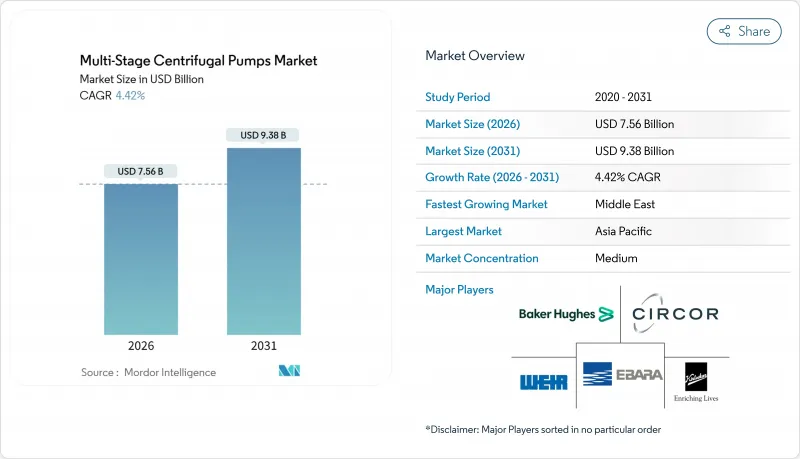
本報告按泵類型(水平泵和立式泵)、級數(2-5級、6-10級、10級以上)、材質(鑄鐵、不銹鋼、雙相鋼和超級雙相鋼以及其他材質)、終端用戶行業(石油天然氣、化學、食品飲料等)和地區進行細分。市場預測以美元計價,並基於現有數據。
全球多級離心式幫浦市場趨勢及洞察
水和污水基礎設施支出激增
用於管道更換和水處理廠維修的公共資金直接推動了對多級加壓泵的需求。美國兩黨基礎設施法案已撥款550億美元用於供水網路,而全國超過40%的市政水泵已使用超過30年。在歐洲,德國25億歐元(約26.7億美元)的市政項目以及歐洲投資銀行的支持性資金也推動了類似的趨勢。美國能源局將於2025年生效的新的能源效率標準正在加速低效單級設備的更換。這些趨勢共同推動了該行業有史以來規模最大的設備更換,其中臥式泵浦因其維護程序簡化而備受青睞。
在缺水國家擴大海水淡化項目
隨著海灣合作理事會(GCC)成員國累計投資超過1000億美元,能夠運作60-80巴壓力的高壓多級泵浦訂單紛至沓來。沙烏地阿拉伯的多個大型項目,例如延布4號和舒艾巴3號項目,均指定使用十餘台14級雙相不銹鋼幫浦。在沿岸地區以外,埃及阿布基爾電廠和阿拉伯聯合大公國哈西揚計畫也採用了能源回收系統,可將泵浦的能耗降低三分之一。因此,泵浦的材料成分也在變化,隨著耐氯化物腐蝕性能標準的提高,雙相不銹鋼和超級雙相不銹鋼正逐漸取代316L不銹鋼。
原物料價格波動正在推動OEM製造商增加資本投資。
2025年鎳和鉻價格的飆升導致雙相鋼原料成本兩位數成長,對與地方政府簽訂多年合約的供應商的毛利率帶來壓力。福斯公司表示,由於難以將合金附加費轉嫁給客戶,其2025年的利潤率下降了220個基點。外匯波動進一步加劇了規劃風險,尤其是對於那些以美元購買亞洲鍛造件的歐洲原始設備製造商而言。儘管一些製造商目前正透過批量採購不銹鋼鑄件或實現供應商多元化來對沖風險,但持續的價格波動仍然對短期盈利構成壓力。
細分市場分析
預計立式離心幫浦細分市場將以 5.45% 的複合年成長率成長,比整體多級離心式幫浦浦市場成長高出 100 多個基點。水平離心泵憑藉其在水處理和工業冷卻應用中較低的安裝面積,佔據了多級離心式幫浦市場 61.0% 的佔有率。然而,在高層建築和海上平台項目中,緊湊的佔地面積至關重要,這促使整合驅動裝置的垂直泵組逐漸成為市場趨勢。威樂 (Wilo) 於 2025 年推出的「Helix EXCEL」系列,與同類臥式幫浦相比,面積減少了 40%,在高檔都市區地下室中具有顯著優勢。海上油井也呈現類似的趨勢。模組化立式泵浦組可安裝在 9 吋套管內,並可下潛至 3,500 公尺以上的深度,用於沙烏地阿美 (Saudi Aramco) 馬爾詹 (Marjan) 油田的流體輸送作業。隨著終端用戶轉向預測性維護,垂直安裝的振動感測器可提供更清晰的資料流,並支援分析平台,而無需昂貴的改造。
水平機組仍將在發電冷卻迴路中佔據主導地位,其線上安裝方式簡化了汽輪機驅動的備用系統。許多公共產業都為臥式泵浦儲備了備件,這限制了其轉換率。然而,隨著亞洲和中東地區高密度商業塔的穩定發展,立式解決方案必將逐步蠶食臥式機組的市場佔有率,尤其是在建築法規限制機房占地面積的地區。提供配備IE4馬達和雲端控制器的即插即用型立式撬裝幫浦的供應商預計將超越整個多級離心式幫浦市場。
2025年,2至5級葉輪的離心泵佔據了多級離心式幫浦市場45.2%的佔有率,但隨著海水淡化、二氧化碳捕集和深層儲存開採的擴展,預計到2031年,10級及以上級的離心泵將以5.21%的複合年成長率成長。沙烏地阿拉伯的延布4號工廠採用了一台額定壓力為75巴的14級泵,以抵消鹽度高達45,000 ppm的海水滲透壓,這表明級數會隨著鹽度和揚程的增加而增加。同樣,挪威的北極光碳捕獲系統使用一台16級壓縮機將液態二氧化碳壓縮至150巴,為未來的碳封存計畫樹立了典範。
中型6至10級泵浦仍然是鍋爐給水和化學製程應用中的主力設備,在這些應用中,資本成本和運作成本之間的平衡比峰值排出壓力更為重要。然而,隨著葉輪數量的增加,機械複雜性也隨之增加,因此原始設備製造商(OEM)採用陶瓷塗層耐磨環和推力平衡設計來維持兩次大修之間的平均運作。透過計算流體力學(CFD)模擬產生的數位孿生模型可以預測內部循環模式,使OEM能夠在製造鑄坯之前微調級數。這正逐漸成為多級離心式幫浦市場提高效率的新途徑。
區域分析
2025年,亞太地區佔全球銷售額的36.7%。這主要得益於中國5.4兆元人民幣(約7,400億美元)的農村供水計畫和印度的「飲用水入戶計畫」(Jal Jeevan Mission)。該計畫預計2025年12月將1.48億戶家庭連接到供水網路。印度政府的「總理庫蘇姆計畫」(PM-KUSUM)補貼了18萬台太陽能農業水泵,凸顯了印度大規模的離網市場。日本厚生勞動省已累計1.2兆日圓(約81億美元)更換老舊供水管,這意味著到2028年,中小型水泵的需求將持續成長。東南亞,特別是越南和印尼的灌溉項目,將推動該地區短期訂單成長。儘管本土製造商擁有成本優勢,但全球品牌在需要第三方認證的高規格建設專案中仍保持著市場佔有率。
在中東地區,海水淡化廠和核能發電廠的建設推動了壓力幫浦的採購,預計2026年至2031年間,壓力幫浦的年複合成長率將達到5.62%,成為該地區成長最快的市場。沙烏地阿拉伯的延布4號和舒艾巴3號核電廠、卡達的E設施以及阿拉伯聯合大公國的哈西揚計畫等,都是雙相鋼多級泵浦訂單集中度較高的主要項目。土耳其阿庫尤核能正在新增96台一次和二次冷卻泵,進一步提振了該地區的需求。主權財富基金和開發銀行的資金籌措降低了商品價格波動風險,並確保了穩定的競標節奏。
預計到2025年,北美和歐洲合計將佔全球銷售額的38%,而新的能源效率標準強制要求基於生命週期的更換將推動銷售成長。由於美國能源局法規將於2025年1月生效,以及歐洲IE4馬達法規將於2027年生效,變速多級幫浦的普及速度正在加快。拉丁美洲的擴張主要集中在巴西和阿根廷,灌溉和採礦是這兩個國家的關鍵產業。同時,南非的賴索托王國高地水利工程二期計畫和肯亞的太陽能灌溉計畫正在塑造非洲的市場前景。儘管各地區的基礎建設情況不盡相同,但所有地區都對提高效率和減少意外運作有著通用的需求,而這正是現代多級離心式幫浦市場的關鍵產品特性。
其他好處:
- Excel格式的市場預測(ME)表
- 三個月的分析師支持
目錄
第1章:引言
- 研究假設和市場定義
- 調查範圍
第2章:調查方法
第3章執行摘要
第4章 市場狀況
- 市場概覽
- 市場促進因素
- 北美和歐洲對用水和污水基礎設施的投資激增
- 在缺水經濟體中擴大海水淡化項目
- 越來越多的深油田專案需要高揚程泵
- 向節能型幫浦設計轉型,以ESG目標為驅動
- 整合支援工業物聯網的預測性維護平台
- 亞太地區政府加大對農村灌溉的補貼力道。
- 市場限制因素
- 由於原物料價格波動,OEM公司正在增加資本投入。
- 來自低成本區域製造商的競爭加劇
- 核能和電力產業的認證流程越來越長。
- 替代容積式泵浦技術的應用日益廣泛
- 產業價值鏈分析
- 監理情勢
- 技術展望
- 波特五力分析
- 宏觀經濟因素對市場的影響
第5章 市場規模與成長預測
- 按類型
- 水平泵浦
- 立式泵浦
- 逐階段
- 第二至第五階段
- 第6-10階段
- 10 級或以上
- 材料
- 鑄鐵
- 不銹鋼
- 雙相鋼與超級雙相鋼
- 其他材料
- 按最終用戶行業分類
- 石油和天然氣
- 化學品
- 食品/飲料
- 水和污水處理
- 發電
- 製藥
- 金屬和採礦
- 其他終端用戶產業
- 按地區
- 北美洲
- 美國
- 加拿大
- 墨西哥
- 南美洲
- 巴西
- 阿根廷
- 其他南美國家
- 歐洲
- 德國
- 法國
- 英國
- 義大利
- 俄羅斯
- 其他歐洲國家
- 亞太地區
- 中國
- 印度
- 日本
- 韓國
- 其他亞太國家
- 中東
- 沙烏地阿拉伯
- 阿拉伯聯合大公國
- 土耳其
- 其他中東國家
- 非洲
- 南非
- 奈及利亞
- 埃及
- 其他非洲國家
- 北美洲
第6章 競爭情勢
- 市場集中度
- 策略趨勢
- 市佔率分析
- 公司簡介
- Kirloskar Brothers Limited
- Baker Hughes Company
- Circor International Inc.
- Ebara Corporation
- The Weir Group plc
- Grundfos Holding A/S
- Pentair plc
- Sulzer Ltd
- Tsurumi Manufacturing Co. Ltd
- Wilo SE
- Xylem Inc.
- KSB SE & Co. KGaA
- Flowserve Corporation
- Ruhrpumpen Group
- ANDRITZ AG
- SPX FLOW Inc.
- ITT Inc.(Goulds Pumps)
- Dab Pumps SpA
- Shakti Pumps(India)Ltd
- Flowrox Oy
第7章 市場機會與未來展望
According to Mordor Intelligence, the multi-stage centrifugal pumps market size reached USD 7.56 billion in 2026 and is projected to climb to USD 9.38 billion by 2031, translating into a 4.42% CAGR through the forecast period.
This report is Segmented by Type (Horizontal Pumps, and Vertical Pumps), Stage (2-5 Stage, 6-10 Stage, and Above 10 Stage), Material (Cast Iron, Stainless Steel, Duplex and Super Duplex Steel, Other Materials), End-User Industry (Oil and Gas, Chemicals, Food and Beverage, and More), and Geography. The Market Forecasts are Provided in Terms of Value (USD), Based On Availability.
Global Multi-Stage Centrifugal Pumps Market Trends and Insights
Surging Water and Wastewater Infrastructure Spending
Public funding for pipe replacement and treatment upgrades is translating directly into demand for pressure-boosting multi-stage units. The United States Bipartisan Infrastructure Law earmarked USD 55 billion for water networks, and over 40% of municipal pumps in the country have surpassed 30-year service life. Similar momentum in Europe is led by Germany's EUR 2.5 billion (USD 2.67 billion) municipal program and supportive financing from the European Investment Bank. Compliance with new U.S. Department of Energy energy-index thresholds that took effect in 2025 is accelerating the swap-out of inefficient single-stage equipment. Together, these dynamics underpin the largest installed-base refresh ever seen in the segment, favoring horizontal configurations that simplify maintenance procedures.
Expansion of Desalination Projects in Water-Scarce Economies
Committed capital topping USD 100 billion across the Gulf Cooperation Council has catalyzed a wave of orders for high-pressure multi-stage pumps capable of operating at 60-80 bar. Flagship sites such as Yanbu 4 and Shuaibah 3 in Saudi Arabia each specify more than a dozen 14-stage duplex-steel models. Outside the Gulf, Egypt's Abu Qir plant and the United Arab Emirates' Hassyan project are adopting energy-recovery devices that cut pump power draw by a third. The material mix is shifting accordingly, with duplex and super duplex steels displacing 316L stainless steel as chloride-induced corrosion limits rise.
Volatility in Raw-Material Prices Raising Capex for OEMs
Nickel and chromium price spikes in 2025 lifted duplex-steel input costs by double digits, squeezing gross margins at suppliers locked into multi-year municipal contracts. Flowserve cited a 220-basis-point margin contraction in 2025 as it struggled to pass through higher alloy surcharges. Currency swings exacerbate planning risk, especially for European OEMs purchasing Asian forgings in U.S. dollars. Some manufacturers now hedge by bulk-buying stainless-steel castings and diversifying supplier bases, yet sustained volatility still weighs on near-term profitability.
Other drivers and restraints analyzed in the detailed report include:
- Increasing Deep-Well Oilfield Projects Requiring High-Head Pumping
- Shift Toward Energy-Efficient Pump Designs Driven by ESG Targets
- Intensifying Competition from Low-Cost Regional Manufacturers
For complete list of drivers and restraints, kindly check the Table Of Contents.
Segment Analysis
The vertical subsegment is projected to grow at 5.45% CAGR, a pace that outstrips the overall multi-stage centrifugal pumps market by more than 100 basis points. Horizontal models maintain a 61.0% multi-stage centrifugal pumps market share on the strength of lower installation expense in water treatment and industrial cooling duty. However, high-rise construction and offshore platform projects prioritize compact footprints, tipping procurement toward vertical stacks equipped with integrated drives. Wilo's Helix EXCEL line, introduced in 2025, saves 40% floor space relative to comparable horizontals, a decisive advantage in premium urban basements. Offshore wells reinforce the same preference; modular vertical assemblies fit 9-inch casings and can descend beyond 3,500 meters to lift fluids in Saudi Aramco's Marjan field. As end users shift to predictive maintenance, vibration sensors mounted on vertical axes offer cleaner data streams, supporting analytics platforms without costly retrofits.
Horizontal units will continue to dominate power-generation cooling circuits where inline layouts simplify turbine-driven back-up arrangements. Many public utilities own existing spare parts inventories geared toward horizontal pumps, tempering the conversion rate. Nevertheless, the steady rollout of high-density commercial towers in Asia and the Middle East will ensure that vertical solutions steadily erode horizontal share, particularly where building regulations cap mechanical-room footprints. Suppliers that deliver plug-and-play vertical skids with IE4 motors and cloud-ready controllers are positioned to outpace the broader multi-stage centrifugal pumps market.
Units carrying 2-5 impellers represented 45.2% of the multi-stage centrifugal pumps market size in 2025, but above-10-stage machines will advance at a 5.21% CAGR through 2031 as desalination, carbon-capture, and deep-reservoir oil lifts proliferate. Saudi Arabia's Yanbu 4 plant employs 14-stage pumps rated at 75 bar to offset the osmotic pressure of 45,000 ppm seawater, illustrating how multi-stage counts rise in tandem with salinity and head height. Similarly, Norway's Northern Lights carbon-capture system compresses liquefied CO2 to 150 bar using 16-stage compressors, a template for future sequestration hubs.
Mid-range 6-10 stage pumps remain workhorses in boiler feedwater and chemical processing, where balanced capital and operating costs matter more than peak discharge pressure. Yet each additional impeller adds mechanical complexity, so OEMs deploy ceramic-coated wear rings and thrust-balancing designs to sustain mean time between overhaul. Digital twins created during computational-fluid-dynamics simulations now predict internal recirculation patterns, enabling OEMs to fine-tune stage counts before casting billets, an emerging efficiency lever within the multi-stage centrifugal pumps market.
Complete Report Scope:
- By Type
- Horizontal Pumps
- Vertical Pumps
- By Stage
- 2-5 Stage
- 6-10 Stage
- Above 10 Stage
- By Material
- Cast Iron
- Stainless Steel
- Duplex and Super Duplex Steel
- Other Materials
- By End-User Industry
- Oil and Gas
- Chemicals
- Food and Beverage
- Water and Wastewater
- Power Generation
- Pharmaceuticals
- Metals and Mining
- Other End-User Industries
- By Geography
- North America
- United States
- Canada
- Mexico
- South America
- Brazil
- Argentina
- Rest of South America
- Europe
- Germany
- France
- United Kingdom
- Italy
- Russia
- Rest of Europe
- Asia Pacific
- China
- India
- Japan
- South Korea
- Rest of Asia Pacific
- Middle East
- Saudi Arabia
- United Arab Emirates
- Turkey
- Rest of Middle East
- Africa
- South Africa
- Nigeria
- Egypt
- Rest of Africa
- North America
Geography Analysis
Asia Pacific accounted for 36.7% of global revenue in 2025, buoyed by China's CNY 5.4 trillion (USD 740 billion) rural water program and India's Jal Jeevan Mission that linked 148 million homes to piped networks by December 2025. Government subsidies under India's PM-KUSUM scheme funded 180,000 solar-powered agricultural pumps, spotlighting a sizeable off-grid niche. Japan's Ministry of Health, Labour and Welfare earmarked JPY 1.2 trillion (USD 8.1 billion) to replace aging mains, implying elevated demand for small and mid-size units through 2028. Southeast Asian irrigation projects in Vietnam and Indonesia round out the region's near-term pipeline. Local manufacturers enjoy cost advantages, yet global brands preserve share in high-specification builds that require third-party certification.
The Middle East is forecast to register the fastest 5.62% CAGR across 2026-2031 as desalination and nuclear power construction drive high-pressure pump procurement. Saudi Arabia's Yanbu 4 and Shuaibah 3 plants, Qatar's Facility E, and the UAE's Hassyan project headline a dense order book for duplex-steel multistage units. Turkey's Akkuyu nuclear complex adds another 96 primary and secondary cooling pumps to regional demand. Financing from sovereign wealth funds and development banks mitigates commodity-price volatility, ensuring a steady tender cadence.
North America and Europe together represented 38% of 2025 turnovers, with sales propelled by lifecycle-driven replacements mandated by new energy-efficiency standards. The U.S. Department of Energy rules effective January 2025 and Europe's IE4 motor stipulations effective 2027 advance variable-speed multi-stage adoption. Latin America's expansion concentrates in Brazil and Argentina where irrigation and mining hold sway, whereas Africa's outlook is shaped by South Africa's Lesotho Highlands Water Project Phase II and Kenya's solar-pump irrigation program. Despite divergent baselines, all regions converge on a common requirement for higher efficiency and lower unplanned downtime, hallmarks of modern multi-stage centrifugal pumps market offerings.
- Kirloskar Brothers Limited
- Baker Hughes Company
- Circor International Inc.
- Ebara Corporation
- The Weir Group plc
- Grundfos Holding A/S
- Pentair plc
- Sulzer Ltd
- Tsurumi Manufacturing Co. Ltd
- Wilo SE
- Xylem Inc.
- KSB SE & Co. KGaA
- Flowserve Corporation
- Ruhrpumpen Group
- ANDRITZ AG
- SPX FLOW Inc.
- ITT Inc. (Goulds Pumps)
- Dab Pumps S.p.A.
- Shakti Pumps (India) Ltd
- Flowrox Oy
Additional Benefits:
- The market estimate (ME) sheet in Excel format
- 3 months of analyst support
TABLE OF CONTENTS
1 INTRODUCTION
- 1.1 Study Assumptions and Market Definition
- 1.2 Scope of the Study
2 RESEARCH METHODOLOGY
3 EXECUTIVE SUMMARY
4 MARKET LANDSCAPE
- 4.1 Market Overview
- 4.2 Market Drivers
- 4.2.1 Surging Water and Wastewater Infrastructure Spending in North America and Europe
- 4.2.2 Expansion of Desalination Projects in Water-Scarce Economies
- 4.2.3 Increasing Deep-Well Oilfield Projects Requiring High-Head Pumping
- 4.2.4 Shift Toward Energy-Efficient Pump Designs Driven by ESG Targets
- 4.2.5 Integration of IIoT-Enabled Predictive Maintenance Platforms
- 4.2.6 Growing Government Subsidies for Rural Irrigation in Asia Pacific
- 4.3 Market Restraints
- 4.3.1 Volatility in Raw Material Prices Raising Capex for OEMs
- 4.3.2 Intensifying Competition from Low-Cost Regional Manufacturers
- 4.3.3 Lengthy Certification Cycles in Nuclear and Power Applications
- 4.3.4 Rising Adoption of Alternative Positive-Displacement Pump Technologies
- 4.4 Industry Value-Chain Analysis
- 4.5 Regulatory Landscape
- 4.6 Technological Outlook
- 4.7 Porter's Five Forces Analysis
- 4.7.1 Bargaining Power of Suppliers
- 4.7.2 Bargaining Power of Buyers
- 4.7.3 Threat of New Entrants
- 4.7.4 Threat of Substitutes
- 4.7.5 Intensity of Competitive Rivalry
- 4.8 Impact of Macroeconomic Factors on the Market
5 MARKET SIZE AND GROWTH FORECASTS (VALUE)
- 5.1 By Type
- 5.1.1 Horizontal Pumps
- 5.1.2 Vertical Pumps
- 5.2 By Stage
- 5.2.1 2-5 Stage
- 5.2.2 6-10 Stage
- 5.2.3 Above 10 Stage
- 5.3 By Material
- 5.3.1 Cast Iron
- 5.3.2 Stainless Steel
- 5.3.3 Duplex and Super Duplex Steel
- 5.3.4 Other Materials
- 5.4 By End-User Industry
- 5.4.1 Oil and Gas
- 5.4.2 Chemicals
- 5.4.3 Food and Beverage
- 5.4.4 Water and Wastewater
- 5.4.5 Power Generation
- 5.4.6 Pharmaceuticals
- 5.4.7 Metals and Mining
- 5.4.8 Other End-User Industries
- 5.5 By Geography
- 5.5.1 North America
- 5.5.1.1 United States
- 5.5.1.2 Canada
- 5.5.1.3 Mexico
- 5.5.2 South America
- 5.5.2.1 Brazil
- 5.5.2.2 Argentina
- 5.5.2.3 Rest of South America
- 5.5.3 Europe
- 5.5.3.1 Germany
- 5.5.3.2 France
- 5.5.3.3 United Kingdom
- 5.5.3.4 Italy
- 5.5.3.5 Russia
- 5.5.3.6 Rest of Europe
- 5.5.4 Asia Pacific
- 5.5.4.1 China
- 5.5.4.2 India
- 5.5.4.3 Japan
- 5.5.4.4 South Korea
- 5.5.4.5 Rest of Asia Pacific
- 5.5.5 Middle East
- 5.5.5.1 Saudi Arabia
- 5.5.5.2 United Arab Emirates
- 5.5.5.3 Turkey
- 5.5.5.4 Rest of Middle East
- 5.5.6 Africa
- 5.5.6.1 South Africa
- 5.5.6.2 Nigeria
- 5.5.6.3 Egypt
- 5.5.6.4 Rest of Africa
- 5.5.1 North America
6 COMPETITIVE LANDSCAPE
- 6.1 Market Concentration
- 6.2 Strategic Moves
- 6.3 Market Share Analysis
- 6.4 Company Profiles {(includes Global Level Overview, Market Level Overview, Core Segments, Financials as Available, Strategic Information, Market Rank/Share for Key Companies, Products and Services, and Recent Developments)}
- 6.4.1 Kirloskar Brothers Limited
- 6.4.2 Baker Hughes Company
- 6.4.3 Circor International Inc.
- 6.4.4 Ebara Corporation
- 6.4.5 The Weir Group plc
- 6.4.6 Grundfos Holding A/S
- 6.4.7 Pentair plc
- 6.4.8 Sulzer Ltd
- 6.4.9 Tsurumi Manufacturing Co. Ltd
- 6.4.10 Wilo SE
- 6.4.11 Xylem Inc.
- 6.4.12 KSB SE & Co. KGaA
- 6.4.13 Flowserve Corporation
- 6.4.14 Ruhrpumpen Group
- 6.4.15 ANDRITZ AG
- 6.4.16 SPX FLOW Inc.
- 6.4.17 ITT Inc. (Goulds Pumps)
- 6.4.18 Dab Pumps S.p.A.
- 6.4.19 Shakti Pumps (India) Ltd
- 6.4.20 Flowrox Oy
7 MARKET OPPORTUNITIES AND FUTURE OUTLOOK
- 7.1 White-Space and Unmet-Need Assessment

 中東和非洲離心式幫浦:市場佔有率分析、產業趨勢和統計數據以及成長預測(2026-2031 年)
 離心式幫浦市場預測至2034年—按類型、設計、材料、流量、最終用戶和地區分類的全球分析
 高溫離心式幫浦市場規模:按類型、應用、地區和預測。
 離心式幫浦市場:按泵浦類型、材質、流量、壓力範圍和最終用途產業分類-全球預測,2026-2032年離心式幫浦:市場佔有率分析、產業趨勢與統計、成長預測(2026-2031)
 離心式幫浦市場規模、佔有率、趨勢和預測:按葉輪類型、級數、流量類型、流量、最終用戶和地區分類,2026-2034年雙吸泵市場報告:按類型、材質、應用和地區分類(2026-2034 年)雙吸泵市場:2026-2032年全球市場預測(按泵浦設計、級數、葉輪材料、泵浦尺寸、驅動系統、軸承類型、安裝方向、銷售管道和最終用途產業分類)
 離心式幫浦市場:按產品類型、容量和地區分類長聯軸器離心式幫浦市場:按級數、流量、額定輸出、墊片類型、材質、應用、最終用途分類,全球預測(2026-2032年)