


 |
市場調查報告書
商品編碼
2154348
高溫熔鹽幫浦:市場佔有率分析、產業趨勢與統計、成長預測(2026-2031)High-Temperature Molten-Salt Pumps - Market Share Analysis, Industry Trends & Statistics, Growth Forecasts (2026 - 2031) |
||||||

※ 本網頁內容可能與最新版本有所差異。詳細情況請與我們聯繫。
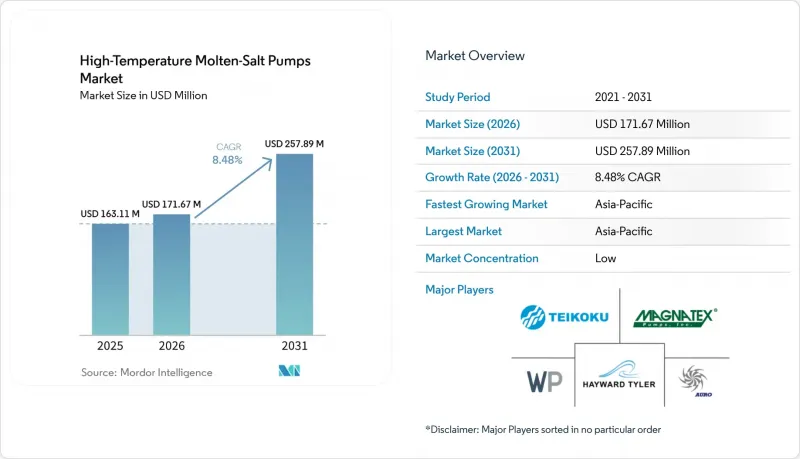
根據 Mordor Intelligence 預測,高溫熔鹽泵的市場規模預計將從 2025 年的 1.6311 億美元成長到 2026 年的 1.7167 億美元,到 2031 年達到 2.5789 億美元,2026 年至 2031 年的複合年成長率為 8.48%。
全球高溫熔鹽泵浦市場趨勢及洞察
提高聚光太陽能發電和儲熱能力將促進水泵採購。
2025年,中國總合9個聚光型太陽熱能發電(CSP)專案併網發電,總裝置容量達900兆瓦,累積設備容量達1,738.2兆瓦。同時,截至年底,還有25個項目在建,總合3000兆瓦。這些在建工程構成了高溫熔鹽泵市場最明確的短期需求基礎。塔式專案佔中國技術組合的71%,需要分別為高溫和低溫配備獨立的泵浦組。因此,與同等裝置容量的槽式專案相比,塔式專案可能需要更多的設備。中國2030年15,000兆瓦的裝置容量目標,是在2025年的基礎上增加13,300兆瓦。此外,2025年底,兩座獨立的350兆瓦太陽熱能發電發電廠動工。這些新增項目為高溫熔鹽幫浦市場創造了明確的設備和服務需求。中廣核青海專案裝置容量為 350 兆瓦,於 2026 年 6 月投入運作,熔鹽儲熱容量為 15 小時和 11,747 兆瓦時,目前是泵浦系統採購的領先範例。
對可調節再生能源的需求正在擴大水泵需求,使其超出太陽能發電的範疇。
電網營運商利用熱能儲存技術吸收過剩電力,並在需求增加時釋放能量。這使得高溫熔鹽泵市場的應用範圍超越了太陽能發電設備。在聚光型太陽熱能發電擁有成熟應用經驗的泵浦系統也可應用於獨立電網平衡和工業供熱設備。透過利用現有的設計技術,可以減少確定新型熱能儲存配置的泵浦規格所需的工作量。這使得高溫熔鹽幫浦市場的供應商能夠在不更換其核心液壓平台的情況下,拓展到鄰近的應用領域。 2025年4月,蘇爾壽和海姆能源宣布合作開發一種600 度C的熔融氫氧化物熱能儲存系統,該系統採用垂直渦輪泵在現有工業基礎設施內進行鹽輸送。 2026年7月,中國一座由600兆瓦燃煤電廠機組維修的蒸氣抽取式熔鹽熱能儲存設施投入運作。該設施具有100兆瓦的抑低尖峰負載能力,可提供超過6小時的電力支援。這些應用將熔鹽循環系統定位為提高電力系統柔軟性的更廣泛項目的一部分。
氯化物鹽的使用過程中產生的腐蝕限制了下一代產品的性能。
在第三代聚光型太陽熱能發電和先進核子反應爐應用中,泵浦的運作溫度必須高於 600 度C必須使用氯化物。氯化物的腐蝕性遠強於運作中大多數商用系統中所使用的硝酸鹽。美國能源局和橡樹嶺國家實驗室在 2024 年進行的一項研究表明,如果不進行重新設計,市售軸承材料不適用於氯化物鹽泵。該專案雖然利用 Haynes 244 和氧化釔穩定氧化鋯建立了測試基礎設施,但在完成全尺寸軸承測試之前就已終止。能源部的另一項研究報告稱,IN625 在 800 度C的氯化物熔鹽中每年腐蝕深度超過 1.1 英吋。這些尚未解決的材料問題限制了能夠應對最嚴苛熱應用的高溫熔鹽泵市場的短期發展。這些問題也促使人們更加關注專有塗層和金屬陶瓷複合材料,但這些材料面臨獨特的供應限制。因此,一種商業性驗證的氯化物鹽溶液可能需要 3 到 5 年的時間才能達到專案實施規模。
細分市場分析
到2025年,離心式幫浦將佔據高溫熔鹽泵市場57.4%的佔有率。這一主導地位反映了其在北非、中東和中國拋物槽式和早期塔式熔鹽計畫的高溫和低溫鹽循環系統中久經考驗的良好口碑。其成熟的水力設計以及對ISO 13709和API 610標準的廣泛符合性,使得這些泵浦為商業硝酸鹽工廠的採購團隊所熟知。在專案營運商優先考慮成熟鑄造材料和維護實踐的情況下,離心泵是理想之選。其良好的口碑也為工廠整個運作週期內的更換和維護工作提供了有力保障。
預計到2031年,立式渦輪泵的複合年成長率將達到10.2%,在所有泵型中成長率最高。這類幫浦適用於雙槽儲槽系統,其深浸式設計可確保穩定的吸入,並降低吸入柱結冰的風險。在這種配置中,幫浦可能需要安裝在鹽面以下12至20公尺處。 2024年,蘇爾壽為中國一個100兆瓦塔式專案的熱力循環和冷凍循環系統提供了18米立式渦輪泵機組。在熔融態鹽類反應爐中,由於零洩漏設計要求,傳統的軸封無法使用,因此罐式馬達幫浦佔據了小規模而高階的細分市場。同樣在高溫熔鹽泵浦產業,隨著工業用戶優先考慮防洩漏和易於維護,水下泵浦、磁力驅動泵浦和罐式馬達泵浦的設計也變得越來越重要。
區域分析
到2025年,亞太地區將佔據高溫熔鹽泵市場42.6%的佔有率,預計到2031年將以10.5%的複合年成長率成長。 2025年,中國透過九個聚光型太陽熱能發電計畫併網發電900兆瓦,累積裝置容量達1,738.2兆瓦。 2030年15,000兆瓦的目標也意味著較2025年基數顯著成長。此外,中國的採購趨勢正轉向經認證的國內供應商。江蘇雙達的RY(L)系列產品在青海省某工廠運作24個月後,於2025年7月獲得中國機械工業協會認證。凱泉在敦煌首航專案中展示了高溫、低溫和溫控泵浦的運作後,也於2025年3月獲得同一協會認證。在印度、日本和韓國,由於工業熱能儲存和小模組化爐的建設,需求正在增加,但預計到 2025 年,這三個國家的總佔有率將不到全部區域供應量的 10%。
在北美和歐洲,主要驅動力是核子反應爐示範、集中式太陽能太陽熱能發電設施的運作以及工業部門的脫碳,而非新建太陽熱能發電發電廠。美國能源局正在支持凱羅斯電力公司(Kairos Power)的赫爾墨斯(Hermes)核子反應爐,並設立了核子反應爐試驗計畫以加快許可核准流程。在歐洲,除了西班牙和摩洛哥的太陽熱能發電的維護工作外,新的工業儲熱計畫也在進行中,其中包括京都集團(Kyoto Group)的56兆瓦時HeatCube儲熱系統,該系統已於2025年10月在匈牙利投入運作。蘇爾壽公司(Sulzer)正在為Highview Power公司的卡靈頓(Carrington)液態空氣儲能計畫提供八台熔鹽泵,該計畫於2027年3月投入運作。這些項目正在將高溫熔鹽泵的市場拓展到傳統太陽熱能發電發電廠領域之外。
南美洲、中東和非洲雖然規模較小,但各自擁有獨特的市場需求。沙烏地阿拉伯和阿拉伯聯合大公國(阿拉伯聯合大公國)正利用聚光型太陽熱能發電作為其能源多元化計畫的一部分;智利阿塔卡馬地區陽光充足,正在大力發展聚光型太陽熱能發電和儲熱技術。摩洛哥的努爾瓦爾紮紮特三期高溫熔鹽儲存槽正在進行升級改造;南非的紅聚光型太陽熱能發電計畫已於2024年併網發電。根據REN21的報告,除中國和一些成熟市場外,2024年沒有新的聚光型太陽熱能發電計畫啟動。因此,高溫熔鹽泵的採購市場仍集中在少數活躍地區。
其他好處:
- Excel格式的市場預測(ME)表
- 3個月的分析師支持
目錄
第1章:引言
- 研究假設和市場定義
- 調查範圍
第2章:調查方法
第3章執行摘要
第4章 市場狀況
- 市場概覽
- 市場促進因素
- 提高聚光太陽能發電和儲熱能力
- 可調節的可再生能源和電網柔軟性要求
- 高溫工業熱利用的擴展
- 先進核子反應爐示範計劃
- 對無密封和防漏泵浦設計的需求
- 熔鹽泵浦製造的區域位置
- 市場限制因素
- 氯化物環境中的腐蝕與侵蝕
- 防凍和熱循環引起的併發症
- 特殊合金和陶瓷軸承的供應限制
- 核能和聚光太陽能發電專案的認證週期較長
- 供應鏈分析
- 波特五力分析
- 科技趨勢
- 監理情勢
- 投資分析
第5章 市場規模與成長預測
- 泵浦類型
- 離心式幫浦
- 直立式渦輪泵
- 加套馬達泵
- 潛水泵
- 其他泵浦類型
- 最終用戶
- 聚光型太陽熱能發電發電廠
- 能源儲存系統
- 熔融態鹽類反應爐
- 工業熱能和製程應用
- 其他最終用戶
- 按地區
- 北美洲
- 美國
- 加拿大
- 墨西哥
- 歐洲
- 德國
- 法國
- 義大利
- 西班牙
- 英國
- 波蘭
- 俄羅斯
- 其他歐洲國家
- 亞太地區
- 中國
- 印度
- 日本
- 韓國
- 澳洲
- 印尼
- 越南
- 泰國
- 其他亞太國家
- 南美洲
- 巴西
- 阿根廷
- 智利
- 其他南美國家
- 中東和非洲
- 沙烏地阿拉伯
- 阿拉伯聯合大公國
- 埃及
- 南非
- 摩洛哥
- 其他中東和非洲國家
- 北美洲
第6章 競爭情勢
- 市場集中度
- 策略趨勢
- 市佔率分析
- 公司簡介
- Arvind Corrotech Ltd.
- AURO PUMPS Pvt. Ltd.
- Ebara Corporation
- Flowrox Oy
- Flowserve Corporation
- Hayward Tyler
- Hebei Tobee Pump Co., Ltd.
- ITT Inc./Goulds Pumps
- Jinan Huayang New Material Co., Ltd.
- Jinan Warwick Pump Co., Ltd.
- KSB SE & Co. KGaA
- Magnatex Pumps, Inc.
- Nagle Pumps, Inc.
- Process Pumps Corporation
- Pump-Aid Corporation
- Sulzer Ltd.
- Teikoku Electric Mfg. Co., Ltd.
- The Weir Group PLC
- WEM Pumps, LLC
- Wenesco, Inc.
第7章 市場機會與未來展望
According to Mordor Intelligence, the High-Temperature Molten-Salt pumps market size is expected to increase from USD 163.11 million in 2025 to USD 171.67 million in 2026 and reach USD 257.89 million by 2031, at a CAGR of 8.48% over 2026-2031.
Global High-Temperature Molten-Salt Pumps Market Trends and Insights
CSP And Thermal Storage Capacity Additions Pull Pump Procurement Forward
China connected 9 concentrated solar power projects totaling 900 MW in 2025, taking cumulative installed capacity to 1,738.2 MW, while 25 projects totaling 3,000 MW remained under construction at year-end. This construction pipeline provides the clearest near-term demand base for the high-temperature molten salt pumps market. Tower projects represented 71% of China's technology mix and require separate hot and cold pump sets. Their equipment needs can therefore exceed those of trough projects with similar power capacity. China's 2030 target of 15,000 MW implies 13,300 MW of additions beyond the 2025 base. Two standalone 350 MW solar thermal plants also began construction at the end of 2025. These additions give the high-temperature molten salt pumps market a visible pipeline for equipment and service demand. The 350 MW CGN Qinghai project, commissioned in June 2026, includes 15 hours and 11,747 MWh of molten salt storage, making it a major current procurement reference for pump systems.
Dispatchable Renewable Power Requirements Extend Pump Demand Beyond Solar
Grid operators use thermal storage to absorb surplus electricity and release energy when demand is higher. This broadens the high-temperature molten salt pumps market beyond solar generation equipment. Pump systems with earlier concentrated solar power references can be adapted for standalone grid balancing and industrial heat installations. The same installed design knowledge can reduce the work required to specify pumps for new storage configurations. This gives suppliers in the high-temperature molten salt pumps market a route to adjacent applications without replacing their core hydraulic platforms. Sulzer and Hyme Energy announced a partnership in April 2025 to develop 600°C molten hydroxide storage, using vertical turbine pumps for salt movement within existing industrial infrastructure. China commissioned a steam-extraction molten salt thermal storage facility in July 2026 that retrofits a 600 MW coal unit and provides 100 MW of peak-shaving capacity with more than 6 hours of support. These uses place molten salt circulation equipment within broader power-system flexibility projects.
Corrosion In Chloride Salt Service Limits Next Generation Performance
Chloride salts are needed for pump service above 600°C in Generation 3 concentrated solar power and advanced reactor applications. Their corrosive effect is much greater than that of the nitrate salts used in most operating commercial systems. A Department of Energy and Oak Ridge National Laboratory project reported in 2024 that commercially available bearing materials could not be used in chloride-salt pumps without redesign. The project developed test infrastructure using Haynes 244 and yttria partially stabilized zirconia, but it ended before full-scale bearing tests were completed. Separate Department of Energy research reported corrosion of IN625 in chloride salts at 800°C at rates exceeding 1.1 inches per year. These unresolved material issues limit the near-term portion of the high-temperature molten salt pumps market that can serve the most demanding thermal applications. They also shift attention toward proprietary coatings and cermet composites, which introduce their own supply constraints. Commercially validated chloride-salt solutions may therefore take 3 to 5 years to reach project-ready scale.
Other drivers and restraints analyzed in the detailed report include:
- Industrial Heat Decarbonization Opens A New Demand Channel
- Advanced Reactor Programs Create A High Value Pump Niche
- Long Qualification Cycles Delay Access To High Value Projects
For complete list of drivers and restraints, kindly check the Table Of Contents.
Segment Analysis
Centrifugal pumps accounted for 57.4% of the high-temperature molten salt pumps market size in 2025. Their lead reflects established use in hot and cold salt loops at parabolic trough and early tower projects across North Africa, the Middle East, and China. Mature hydraulic designs and broad ISO 13709 and API 610 alignment make these pumps familiar to procurement teams at commercial nitrate-salt plants. They are used where project operators value established casting materials and maintenance practices, and this installed base supports replacement demand and service work through long plant operating lives.
Vertical turbine pumps are forecast to grow at a 10.2% CAGR through 2031, the highest rate among pump types. They fit two-tank storage systems where deep submergence supports stable suction and reduces freeze risk in the suction column. These configurations can require the pump to sit 12 to 20 meters below the salt surface. Sulzer supplied 18-meter vertical turbine units for the hot and cold circuits of a 100 MW Chinese tower project in 2024. Canned motor pumps serve a smaller premium niche in molten salt reactors because zero-leakage design requirements can exclude conventional shaft seals. Submerged, magnetic-drive, and canned motor designs also gain relevance where industrial users prioritize leak prevention and simpler maintenance access in the high-temperature molten salt pumps industry.
Complete Report Scope:
- By Pump Type
- Centrifugal Pumps
- Vertical Turbine Pumps
- Canned Motor Pumps
- Submerged Pumps
- Other Pump Types
- By End User
- Concentrated Solar Power Plants
- Thermal Energy Storage Systems
- Molten-Salt Reactors
- Industrial Heat and Process Applications
- Other End Users
- By Geography
- North America
- United States
- Canada
- Mexico
- Europe
- Germany
- France
- Italy
- Spain
- United Kingdom
- Poland
- Russia
- Rest of Europe
- Asia-Pacific
- China
- India
- Japan
- South Korea
- Australia
- Indonesia
- Vietnam
- Thailand
- Rest of Asia-Pacific
- South America
- Brazil
- Argentina
- Chile
- Rest of South America
- Middle East and Africa
- Saudi Arabia
- United Arab Emirates
- Egypt
- South Africa
- Morocco
- Rest of Middle East and Africa
- North America
Geography Analysis
Asia-Pacific held 42.6% of the high-temperature molten salt pumps market in 2025 and is forecast to grow at a 10.5% CAGR through 2031. China connected 900 MW across 9 concentrated solar power projects in 2025, taking cumulative capacity to 1,738.2 MW, while its 2030 target of 15,000 MW signals large additions from the 2025 base. China's procurement pattern is also shifting toward qualified domestic suppliers. Jiangsu Shuangda's RY(L) series received a China General Machinery Industry Association appraisal in July 2025 after 24 months of operation at a Qinghai plant. Kaiquan received association certification in March 2025 after demonstrating hot, cold, and temperature-adjustment pump operation at the Shou Hang Dunhuang project. India, Japan, and South Korea add demand through industrial thermal storage and small modular reactor preparation, although their combined 2025 share was below 10% of regional volume.
North America and Europe are driven more by reactor demonstrations, operating concentrated solar power fleets, and industrial decarbonization than by new solar thermal capacity. The U.S. Department of Energy is supporting Kairos Power's Hermes reactor and has established the Reactor Pilot Program to advance authorization pathways. Europe combines solar thermal service work in Spain and Morocco with new industrial storage projects, including Kyoto Group's 56 MWh Heatcube that began operating in Hungary in October 2025. Sulzer is supplying 8 molten salt pumps for Highview Power's Carrington liquid air energy storage project, which is expected to operate in March 2027. These projects widen the high-temperature molten salt pumps market beyond conventional solar thermal equipment.
South America and the Middle East and Africa contribute smaller but distinct demand pools. Saudi Arabia and the United Arab Emirates use concentrated solar power within wider energy diversification plans, while Chile's Atacama region supports concentrated solar power and thermal storage development because of its high direct solar resource. Morocco is upgrading the hot molten salt storage tank at Noor Ouarzazate III, and South Africa connected the Redstone concentrated solar power project to the grid in 2024. REN21 reported that no new concentrated solar power projects began construction outside China and a limited group of established markets in 2024. This keeps procurement in the high-temperature molten salt pumps market concentrated in a limited number of active locations.
- Arvind Corrotech Ltd.
- AURO PUMPS Pvt. Ltd.
- Ebara Corporation
- Flowrox Oy
- Flowserve Corporation
- Hayward Tyler
- Hebei Tobee Pump Co., Ltd.
- ITT Inc. / Goulds Pumps
- Jinan Huayang New Material Co., Ltd.
- Jinan Warwick Pump Co., Ltd.
- KSB SE & Co. KGaA
- Magnatex Pumps, Inc.
- Nagle Pumps, Inc.
- Process Pumps Corporation
- Pump-Aid Corporation
- Sulzer Ltd.
- Teikoku Electric Mfg. Co., Ltd.
- The Weir Group PLC
- WEM Pumps, LLC
- Wenesco, Inc.
Additional Benefits:
- The market estimate (ME) sheet in Excel format
- 3 months of analyst support
TABLE OF CONTENTS
1 INTRODUCTION
- 1.1 Study Assumptions and Market Definition
- 1.2 Scope of the Study
2 RESEARCH METHODOLOGY
3 EXECUTIVE SUMMARY
4 MARKET LANDSCAPE
- 4.1 Market Overview
- 4.2 Market Drivers
- 4.2.1 CSP and Thermal-Storage Capacity Additions
- 4.2.2 Dispatchable Renewable Power and Grid Flexibility Requirements
- 4.2.3 Expansion of High-Temperature Industrial Heat Applications
- 4.2.4 Advanced Reactor Demonstration Programs
- 4.2.5 Demand for Sealless and Leak-Prevention Pump Designs
- 4.2.6 Regional Localization of Molten-Salt Pump Manufacturing
- 4.3 Market Restraints
- 4.3.1 Corrosion and Erosion in Chloride-Salt Service
- 4.3.2 Freeze-Protection and Thermal-Cycling Complexity
- 4.3.3 Specialty-Alloy and Ceramic-Bearing Supply Constraints
- 4.3.4 Long Qualification Cycles for Nuclear and CSP Projects
- 4.4 Supply-Chain Analysis
- 4.5 Porter's Five Forces Analysis
- 4.5.1 Bargaining Power of Suppliers
- 4.5.2 Bargaining Power of Buyers
- 4.5.3 Threat of New Entrants
- 4.5.4 Threat of Substitutes
- 4.5.5 Competitive Rivalry
- 4.6 Technology Outlook
- 4.7 Regulatory Landscape
- 4.8 Investment Analysis
5 MARKET SIZE AND GROWTH FORECASTS
- 5.1 By Pump Type
- 5.1.1 Centrifugal Pumps
- 5.1.2 Vertical Turbine Pumps
- 5.1.3 Canned Motor Pumps
- 5.1.4 Submerged Pumps
- 5.1.5 Other Pump Types
- 5.2 By End User
- 5.2.1 Concentrated Solar Power Plants
- 5.2.2 Thermal Energy Storage Systems
- 5.2.3 Molten-Salt Reactors
- 5.2.4 Industrial Heat and Process Applications
- 5.2.5 Other End Users
- 5.3 By Geography
- 5.3.1 North America
- 5.3.1.1 United States
- 5.3.1.2 Canada
- 5.3.1.3 Mexico
- 5.3.2 Europe
- 5.3.2.1 Germany
- 5.3.2.2 France
- 5.3.2.3 Italy
- 5.3.2.4 Spain
- 5.3.2.5 United Kingdom
- 5.3.2.6 Poland
- 5.3.2.7 Russia
- 5.3.2.8 Rest of Europe
- 5.3.3 Asia-Pacific
- 5.3.3.1 China
- 5.3.3.2 India
- 5.3.3.3 Japan
- 5.3.3.4 South Korea
- 5.3.3.5 Australia
- 5.3.3.6 Indonesia
- 5.3.3.7 Vietnam
- 5.3.3.8 Thailand
- 5.3.3.9 Rest of Asia-Pacific
- 5.3.4 South America
- 5.3.4.1 Brazil
- 5.3.4.2 Argentina
- 5.3.4.3 Chile
- 5.3.4.4 Rest of South America
- 5.3.5 Middle East and Africa
- 5.3.5.1 Saudi Arabia
- 5.3.5.2 United Arab Emirates
- 5.3.5.3 Egypt
- 5.3.5.4 South Africa
- 5.3.5.5 Morocco
- 5.3.5.6 Rest of Middle East and Africa
- 5.3.1 North America
6 COMPETITIVE LANDSCAPE
- 6.1 Market Concentration
- 6.2 Strategic Moves
- 6.3 Market Share Analysis
- 6.4 Company Profiles (includes Global Level Overview, Market Level Overview, Core Segments, Financials as available, Strategic Information, Market Rank/Share, Products and Services, Recent Developments)
- 6.4.1 Arvind Corrotech Ltd.
- 6.4.2 AURO PUMPS Pvt. Ltd.
- 6.4.3 Ebara Corporation
- 6.4.4 Flowrox Oy
- 6.4.5 Flowserve Corporation
- 6.4.6 Hayward Tyler
- 6.4.7 Hebei Tobee Pump Co., Ltd.
- 6.4.8 ITT Inc. / Goulds Pumps
- 6.4.9 Jinan Huayang New Material Co., Ltd.
- 6.4.10 Jinan Warwick Pump Co., Ltd.
- 6.4.11 KSB SE & Co. KGaA
- 6.4.12 Magnatex Pumps, Inc.
- 6.4.13 Nagle Pumps, Inc.
- 6.4.14 Process Pumps Corporation
- 6.4.15 Pump-Aid Corporation
- 6.4.16 Sulzer Ltd.
- 6.4.17 Teikoku Electric Mfg. Co., Ltd.
- 6.4.18 The Weir Group PLC
- 6.4.19 WEM Pumps, LLC
- 6.4.20 Wenesco, Inc.
7 MARKET OPPORTUNITIES AND FUTURE OUTLOOK
- 7.1 White-Space and Unmet-Need Assessment

 離心式引擎套筒聯軸器市場:全球市場預測,2026-2032年離心式牛奶幫浦市場:全球市場預測,2026-2032年離心泵離心式幫浦(雙吸式):全球市場預測,2026-2032年
 PFA襯裡離心式幫浦市場規模、佔有率和成長分析(按泵浦類型、襯裡類型、應用、最終用戶產業、運作方式和地區分類):產業預測(2026-2033年)
 南美洲離心式幫浦:市場佔有率分析、產業趨勢與統計、成長預測(2026-2031)中東和非洲離心式幫浦:市場佔有率分析、產業趨勢和統計數據以及成長預測(2026-2031 年)多級離心式幫浦:市場佔有率分析、行業趨勢和統計數據、成長預測(2026-2031)
 離心式幫浦市場預測至2034年—按類型、設計、材料、流量、最終用戶和地區分類的全球分析
 高溫離心式幫浦市場規模:按類型、應用、地區和預測。離心式幫浦市場:按泵浦類型、材質、流量、壓力範圍和最終用途產業分類-全球預測,2026-2032年