


 |
市場調查報告書
商品編碼
2154795
南美洲流程自動化:市場佔有率分析、產業趨勢與統計及成長預測(2026-2031 年)South America Process Automation - Market Share Analysis, Industry Trends & Statistics, Growth Forecasts (2026 - 2031) |
||||||

※ 本網頁內容可能與最新版本有所差異。詳細情況請與我們聯繫。
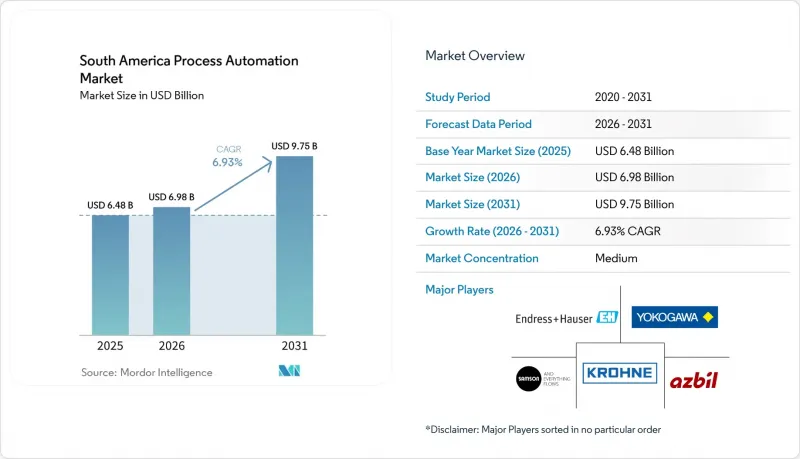
據 Mordor Intelligence 稱,2025 年南美過程自動化市場價值為 64.8 億美元,預計到 2031 年將從 2026 年的 69.8 億美元成長至 97.5 億美元,預測期(2026-2031 年)複合年成長率為 6.93%。
南美洲過程自動化市場趨勢與洞察
工業4.0和工業物聯網實施
在南美洲,工業IoT(IIoT) 的普及使得企業能夠更深入地利用現場設備資訊進行營運和管理決策。製造商透過整合儀器、控制器和營運軟體,提高了整個生產系統的可視性。這些項目推動了營運審查從週期性審查到更頻繁監控的轉變。互聯架構也催生了對互聯感測器、邊緣運算和雲端組件的需求。當更高品質的數據能夠支持維護計劃和生產決策時,採用這種技術的合理性就更加凸顯。因此,隨著專案從購買單一設備轉向整合系統,南美洲的製程自動化市場正在從中受益。
工業資產現代化
隨著許多DCS和PLC系統接近使用壽命終點,舊設備的現代化改造仍是自動化供應商的主要業務來源。維美德公司在巴西伊拉尼纖維素公司(Irani Celulose)旗下的瓦爾根博尼塔工廠,將紙漿生產線、蒸發製程、水處理和鹼液處理區域的現有PLC系統遷移至新平台,且未中斷生產。該專案將各個控制節點整合到一個統一的平台,從而提高了對工廠資料的訪問,以便於進行可靠性管理。這些舉措表明,現代化改造的價值往往不在於硬體的更換,而在於資訊的整合。此外,開放式網路方案可以消除對單一供應商的依賴,並簡化更換決策。如果資產所有者能夠將控制系統升級視為長期資料基礎設施而非一次性維護任務,南美流程自動化市場將從中受益。
自動化專案的前期成本較高
對於食品飲料、化學和包裝行業的中小型製造商而言,初始成本仍然是一大障礙。設備、軟體和現場基礎設施的升級可能需要大量資金,而中小企業可能難以獲得這些資金。巴西中小企業在自動化應用方面落後大型企業的時間長達兩倍,投資成本是主要障礙。外匯貶值會影響專案規劃階段的預期收益,並導致核准延誤。雖然資金籌措、分階段實施計劃和該地貨幣貸款項目可以提供幫助,但這些資源在不同自動化領域的可用性仍然參差不齊。
細分市場分析
到2025年,感測器和變送器將佔南美製程自動化市場20.12%的佔有率。這一佔有率反映了石油天然氣、採礦、紙漿造紙和化學工業對流量、壓力、溫度和液位測量的持續需求。預計其成長率將位居系統類型之首,複合年成長率(CAGR)將達到8.06%。這一成長反映了已安裝核心現場測量設備的運營商的二期投資。
2025年,Eurofarma Laboratorios在聖保羅州伊塔佩維的工廠安裝了Korber的PAS-X MES系統。該系統涵蓋超過200個工作站和五個生產車間。安裝內容包括電子批次記錄、可追溯性、設備設定、清潔流程和電子日誌。由於石油和天然氣設施以及公共產業依賴長期控制契約,對DCS和SCADA的需求仍然強勁。 PLC在食品和製藥製造業的應用也在不斷擴展,因為在這些產業中,本地確定性控制至關重要。製程安全系統為需要認證安全功能的化工廠和鋰礦設施提供支援。閥門、執行器、馬達、人機介面(HMI)、分析儀和狀態監測器構成了系統堆疊,隨著南美洲製程自動化市場資本投資的成長,該系統堆疊也不斷擴展。
到2025年,有線協議將佔據南美過程自動化市場74.31%的佔有率。其久經考驗的可靠性確保了它們在現有流程工廠和需要可預測反應時間的安全關鍵型應用中仍然至關重要。石油和天然氣營運商也優先考慮在危險區域建立受保護的實體訊號路徑。乙太網路APL已證明其能夠在異質工廠架構中透過單一雙線電纜同時傳輸電力和高速資料。這種能力允許在不建造全新電纜網路的情況下提高儀器密度。雖然這可能會減緩有線協議市場佔有率的下降,但並不能消除對無線連接的需求。
預計到2031年,無線協定將以8.29%的複合年成長率成長,成為通訊領域成長最快的產業。偏遠礦山、分散式水處理設施和鋰生產設施可以避免為每個測量點鋪設銅纜的高昂成本。在智利和巴西,專用5G網路正被用於連接自動駕駛運輸系統、環境感測器和遠端控制中心。 ISA100和WirelessHART在需要可靠且安全的現場匯流排替代方案的流程操作員領域正日益普及。無線發射器的價格先前比有線版本高出15-30%。這種轉變正在改變設備配置,並推動南美洲製程自動化市場平均售價的上漲。
其他好處:
- Excel格式的市場預測(ME)表
- 3個月的分析師支持
目錄
第1章:引言
- 研究假設和市場定義
- 調查範圍
第2章:調查方法
第3章執行摘要
第4章 市場狀況
- 市場概覽
- 市場促進因素
- 工業4.0和工業物聯網實施
- 工業資產現代化
- 對能源效率和製程最佳化的需求
- 採礦和金屬產業對自動化的需求日益成長
- 擴大製藥和食品加工能力
- 針對鋰、生質燃料和可再生能源專案進行在地化最佳化設計。
- 市場限制因素
- 自動化專案的前期成本較高
- 熟練的自動化和儀器工程師短缺
- 工業互聯互通與網路安全挑戰
- 分散的棕地基礎設施和整合的複雜性
- 產業價值鏈分析
- 監理情勢
- 技術展望
- 波特五力分析
- 宏觀經濟因素對市場的影響
第5章 市場規模與成長預測
- 依系統類型
- 監控與數據採集(SCADA)
- 可程式邏輯控制器(PLC)
- 分散式控制系統(DCS)
- 製造執行系統(MES)
- 閥門和執行器
- 電動機
- 人機介面(HMI)
- 製程安全系統
- 感測器和發送器
- 其他系統類型
- 透過通訊協定
- 有線協議
- 無線協定
- 按最終用戶行業分類
- 化工/石油化工
- 紙漿和紙漿
- 供水和廢水處理
- 能源公用事業
- 石油和天然氣
- 製藥
- 食品/飲料
- 其他終端用戶產業
- 部署模式
- 現場
- 基於雲端的
- 按地區
- 巴西
- 阿根廷
- 智利
- 哥倫比亞
- 其他南美國家
第6章 競爭情勢
- 市場集中度
- 策略趨勢
- 市佔率分析
- 公司簡介
- Endress+Hauser AG
- Yokogawa Electric Corporation
- Azbil Corporation
- KROHNE Messtechnik GmbH
- Samson AG
- Pepperl+Fuchs SE
- Brooks Instrument LLC
- Badger Meter, Inc.
- Spirax-Sarco Engineering plc
- HIMA Paul Hildebrandt GmbH
- Mettler-Toledo International Inc.
- AMETEK, Inc.
- Valmet Flow Control Oy
- Omega Engineering, Inc.
- R. Stahl AG
- WIKA Alexander Wiegand SE & Co. KG
- SMC Corporation
- Festo SE & Co. KG
- Beckhoff Automation GmbH & Co. KG
- WEG SA
- Metso Corporation
- Burkert Fluid Control Systems
- KSB SE & Co. KGaA
第7章 市場機會與未來趨勢
- 評估閒置頻段和未滿足的需求
According to Mordor Intelligence, the South America process automation market size was valued at USD 6.48 billion in 2025 and estimated to grow from USD 6.98 billion in 2026 to reach USD 9.75 billion by 2031, at a CAGR of 6.93% during the forecast period (2026-2031).
South America Process Automation Market Trends and Insights
Industry 4.0 and IIoT Adoption
Industrial Internet of Things deployments are bringing field-device information closer to operating and management decisions across South America. Manufacturers are connecting instruments, controllers, and operational software to improve visibility across production systems. These projects make it easier to move from periodic operating reviews toward more frequent monitoring. Connected architectures also create demand for sensor, edge, and cloud components that work together. The operating case becomes stronger where better data can support maintenance planning and production decisions. The South America Process Automation Market therefore benefits as projects move from individual equipment purchases toward integrated systems.
Industrial Asset Modernization
Modernizing older facilities remains a major source of work for automation suppliers because many DCS and PLC installations are approaching end-of-support. Valmet migrated Irani Celulose's Vargem Bonita mill in Brazil from existing PLCs across the fiberline, evaporation, water-treatment, and causticizing areas without stopping production. The project consolidated separate control nodes into a single platform and improved access to plant data for reliability management. Such work shows that the value of modernization often comes from integrating information, not only replacing hardware. Open networking approaches also reduce concerns about being tied to a single supplier and can make replacement decisions easier. The South America Process Automation Market gains when asset owners treat control upgrades as long-term data infrastructure rather than as a one-time maintenance event.
High Upfront Cost of Automation Projects
Upfront costs remain a significant obstacle for smaller manufacturers in the food and beverage, chemicals, and packaging sectors. Equipment, software, and site-infrastructure upgrades can require capital that smaller businesses cannot release quickly. Brazilian small and medium-sized enterprises lag large firms by up to 2 times in automation adoption rates, with investment costs being the main barrier. Currency volatility adds pressure because many control systems, sensors, and precision instruments are purchased in USD or EUR. A weaker local currency can alter expected returns during project planning and delay approval. Financing arrangements, phased deployment plans, and public loan programs can help, but their reach remains uneven across automation categories.
Other drivers and restraints analyzed in the detailed report include:
- Demand for Energy Efficiency and Process Optimization
- Rising Automation Demand in Mining and Metals
- Shortage of Skilled Automation and Instrumentation Personnel
For complete list of drivers and restraints, kindly check the Table Of Contents.
Segment Analysis
Sensors and Transmitters accounted for 20.12% of the South America Process Automation Market share in 2025. Their position reflects continuous requirements for flow, pressure, temperature, and level measurement in oil and gas, mining, pulp and paper, and chemicals. New biofuel and direct lithium extraction facilities add demand because these measurements are specified during plant design. Sensors also create the base data that supports advanced control, maintenance systems, and production analytics. Manufacturing Execution Systems are projected to record the fastest system-type growth at an 8.06% CAGR through 2031. This growth reflects a second phase of investment by operators that have already installed core field instrumentation.
Eurofarma Laboratorios deployed Korber's PAS-X MES at its Itapevi facility in Sao Paulo in 2025, covering more than 200 workstations and 5 production buildings. The rollout included electronic batch records, traceability, equipment setup, cleaning processes, and electronic logbooks. DCS and SCADA continue to hold substantial demand because oil and gas sites and utilities depend on long-duration control contracts. PLC adoption is also increasing in food and pharmaceutical manufacturing where local deterministic control is important. Process safety systems support chemical and lithium facilities that require certified safety functions. Valves, actuators, electric motors, HMI, analyzers, and condition-monitoring equipment complete the system stack and generally grow with broader capital spending in the South America Process Automation Market.
Wired Protocol held 74.31% of the South America Process Automation Market share in 2025. Its installed base remains important in established process plants and in safety-critical applications requiring predictable response times. Oil and gas operators also value protected physical signal paths in hazardous locations. Ethernet-APL has demonstrated the ability to combine power and high-speed data over a single two-wire cable in heterogeneous plant architectures. This capability can increase instrumentation density without requiring an entirely new cable network. It may slow the pace of wired-share loss, although it does not remove the need for wireless connectivity.
Wireless Protocol is projected to grow at an 8.29% CAGR through 2031, the fastest rate among communication segments. Remote mines, distributed water-treatment sites, and lithium facilities can avoid high costs by not having to lay copper cable to every measurement point. Chile and Brazil are using private 5G networks to link autonomous haulage systems, environmental sensors, and remote operating centers. ISA100 and WirelessHART are expanding where process operators need dependable and secure alternatives to the fieldbus. Radio-enabled transmitters carried a 15-30% price premium over wired equivalents. This shift changes the equipment mix and supports higher average selling prices within the South America Process Automation Market.
Complete Report Scope:
- By System Type
- Supervisory Control and Data Acquisition (SCADA)
- Programmable Logic Controller (PLC)
- Distributed Control System (DCS)
- Manufacturing Execution System (MES)
- Valves and Actuators
- Electric Motors
- Human Machine Interface (HMI)
- Process Safety Systems
- Sensors and Transmitters
- Other System Types
- By Communication Protocol
- Wired Protocol
- Wireless Protocol
- By End-User Industry
- Chemical and Petrochemical
- Paper and Pulp
- Water and Wastewater Treatment
- Energy and Utilities
- Oil and Gas
- Pharmaceutical
- Food and Beverages
- Other End-User Industries
- By Deployment Mode
- On-premise
- Cloud-based
- By Geography
- Brazil
- Argentina
- Chile
- Colombia
- Rest of South America
List of Companies Covered in this Report:
- Endress+Hauser AG
- Yokogawa Electric Corporation
- Azbil Corporation
- KROHNE Messtechnik GmbH
- Samson AG
- Pepperl+Fuchs SE
- Brooks Instrument LLC
- Badger Meter, Inc.
- Spirax-Sarco Engineering plc
- HIMA Paul Hildebrandt GmbH
- Mettler-Toledo International Inc.
- AMETEK, Inc.
- Valmet Flow Control Oy
- Omega Engineering, Inc.
- R. Stahl AG
- WIKA Alexander Wiegand SE & Co. KG
- SMC Corporation
- Festo SE & Co. KG
- Beckhoff Automation GmbH & Co. KG
- WEG S.A.
- Metso Corporation
- Burkert Fluid Control Systems
- KSB SE & Co. KGaA
Additional Benefits:
- The market estimate (ME) sheet in Excel format
- 3 months of analyst support
TABLE OF CONTENTS
1 INTRODUCTION
- 1.1 Study Assumptions and Market Definition
- 1.2 Scope of the Study
2 RESEARCH METHODOLOGY
3 EXECUTIVE SUMMARY
4 MARKET LANDSCAPE
- 4.1 Market Overview
- 4.2 Market Drivers
- 4.2.1 Industry 4.0 and IIoT Adoption
- 4.2.2 Industrial Asset Modernization
- 4.2.3 Demand for Energy Efficiency and Process Optimization
- 4.2.4 Rising Automation Demand in Mining and Metals
- 4.2.5 Expansion of Pharmaceutical and Food Processing Capacity
- 4.2.6 Localized Engineering for Lithium, Biofuels, and Renewable Energy Projects
- 4.3 Market Restraints
- 4.3.1 High Upfront Cost of Automation Projects
- 4.3.2 Shortage of Skilled Automation and Instrumentation Personnel
- 4.3.3 Industrial Connectivity and Cybersecurity Gaps
- 4.3.4 Fragmented Brownfield Infrastructure and Integration Complexity
- 4.4 Industry Value Chain Analysis
- 4.5 Regulatory Landscape
- 4.6 Technological Outlook
- 4.7 Porter's Five Forces Analysis
- 4.7.1 Bargaining Power of Suppliers
- 4.7.2 Bargaining Power of Buyers
- 4.7.3 Threat of New Entrants
- 4.7.4 Threat of Substitutes
- 4.7.5 Competitive Rivalry
- 4.8 Impact of Macroeconomic Factors on the Market
5 MARKET SIZE AND GROWTH FORECASTS (VALUE)
- 5.1 By System Type
- 5.1.1 Supervisory Control and Data Acquisition (SCADA)
- 5.1.2 Programmable Logic Controller (PLC)
- 5.1.3 Distributed Control System (DCS)
- 5.1.4 Manufacturing Execution System (MES)
- 5.1.5 Valves and Actuators
- 5.1.6 Electric Motors
- 5.1.7 Human Machine Interface (HMI)
- 5.1.8 Process Safety Systems
- 5.1.9 Sensors and Transmitters
- 5.1.10 Other System Types
- 5.2 By Communication Protocol
- 5.2.1 Wired Protocol
- 5.2.2 Wireless Protocol
- 5.3 By End-User Industry
- 5.3.1 Chemical and Petrochemical
- 5.3.2 Paper and Pulp
- 5.3.3 Water and Wastewater Treatment
- 5.3.4 Energy and Utilities
- 5.3.5 Oil and Gas
- 5.3.6 Pharmaceutical
- 5.3.7 Food and Beverages
- 5.3.8 Other End-User Industries
- 5.4 By Deployment Mode
- 5.4.1 On-premise
- 5.4.2 Cloud-based
- 5.5 By Geography
- 5.5.1 Brazil
- 5.5.2 Argentina
- 5.5.3 Chile
- 5.5.4 Colombia
- 5.5.5 Rest of South America
6 COMPETITIVE LANDSCAPE
- 6.1 Market Concentration
- 6.2 Strategic Moves
- 6.3 Market Share Analysis
- 6.4 Company Profiles (includes Global Level Overview, Market Level Overview, Core Segments, Financials as available, Strategic Information, Market Rank/Share, Products and Services, Recent Developments)
- 6.4.1 Endress+Hauser AG
- 6.4.2 Yokogawa Electric Corporation
- 6.4.3 Azbil Corporation
- 6.4.4 KROHNE Messtechnik GmbH
- 6.4.5 Samson AG
- 6.4.6 Pepperl+Fuchs SE
- 6.4.7 Brooks Instrument LLC
- 6.4.8 Badger Meter, Inc.
- 6.4.9 Spirax-Sarco Engineering plc
- 6.4.10 HIMA Paul Hildebrandt GmbH
- 6.4.11 Mettler-Toledo International Inc.
- 6.4.12 AMETEK, Inc.
- 6.4.13 Valmet Flow Control Oy
- 6.4.14 Omega Engineering, Inc.
- 6.4.15 R. Stahl AG
- 6.4.16 WIKA Alexander Wiegand SE & Co. KG
- 6.4.17 SMC Corporation
- 6.4.18 Festo SE & Co. KG
- 6.4.19 Beckhoff Automation GmbH & Co. KG
- 6.4.20 WEG S.A.
- 6.4.21 Metso Corporation
- 6.4.22 Burkert Fluid Control Systems
- 6.4.23 KSB SE & Co. KGaA
7 MARKET OPPORTUNITIES AND FUTURE TRENDS
- 7.1 White-Space and Unmet-Need Assessment

 流程自動化市場預測至2034年-按組件、系統類型、流程類型、最終用戶、企業規模和地區分類的全球分析
 流程自動化與儀器:市場佔有率分析、產業趨勢與統計、成長預測(2026-2031)歐洲過程自動化:市場佔有率分析、產業趨勢與統計及成長預測(2026-2031 年)
 零接觸配置市場:依設備類型、組件、網路複雜度、企業規模、最終用戶、國家及地區分類-全球產業分析、市場規模、市場佔有率及2026年至2033年預測北美流程自動化:市場佔有率分析、產業趨勢與統計及成長預測(2026-2031 年)工業製程自動化控制:市場佔有率分析、產業趨勢與統計及成長預測(2026-2031 年)
 2026年全球零接觸配置市場報告2026年全球工業製程自動化及控制系統市場報告2026年全球流程自動化與儀器市場報告流程自動化和儀器市場:按技術、最終用戶、儀器類型、自動化類型、國家和地區分類-全球產業分析、市場規模、市場佔有率及2025年至2032年預測