


 |
市場調查報告書
商品編碼
2113265
工業製程自動化控制:市場佔有率分析、產業趨勢與統計及成長預測(2026-2031 年)Industrial Control For Process Automation - Market Share Analysis, Industry Trends & Statistics, Growth Forecasts (2026 - 2031) |
||||||

※ 本網頁內容可能與最新版本有所差異。詳細情況請與我們聯繫。
根據 Mordor Intelligence 預測,製程自動化工業控制市場規模將從 2025 年的 764.2 億美元成長到 2026 年的 818.9 億美元,然後在 2031 年達到 1157.2 億美元,2026 年至 2031 年的複合年成長率為 7.15%。
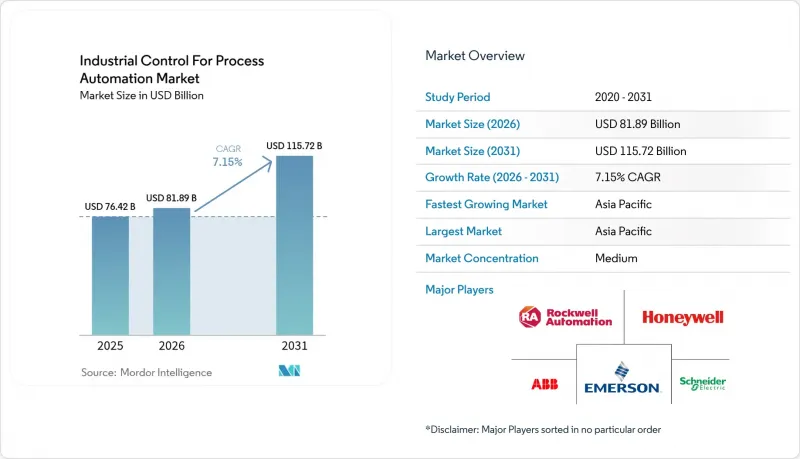
本報告按系統(SCADA、DCS 等)、組件(硬體、軟體等)、服務(諮詢、系統整合和實施等)、最終用戶行業(石油和天然氣等)、通訊網路(有線網路等)以及地區(北美、南美、歐洲等)進行細分。市場預測以美元計價。
全球工業控制市場趨勢及製程自動化洞察
工業自動化的擴展
工業設施持續採用可程式邏輯控制器 (PLC) 和分散式控制系統 (DCS) 來緩解人手不足,並確保高價值資產的持續運作。西門子報告稱,其 Simatic S7-1500 PLC 在 2024 年的訂單同比成長 18%,這主要得益於電池超級工廠對確定性循環時間(小於 10 毫秒)的需求。化工廠正在用具備預測性維護功能的數位閥門定位器取代氣動迴路,從而將意外停機時間減少了 30%。 2024 年版的 IEC 61131-3 標準引入了物件導向的語法,使工程師能夠在多個地點重複使用程式碼,縮短試運行週期,並降低生命週期成本。自動化密度(以每百萬美元工廠資產的控制點數量衡量)自 2020 年以來成長了 12%,這反映了更嚴格的排放法規和日益成長的即時排放監測需求。
智慧流程產業的擴張
工廠業主正透過將控制層與企業資源計畫 (ERP) 系統連接起來,消除資料孤島。施耐德電機報告稱,其 EcoStruxure 平台的許可數量在 2024 年成長了 25%,因為食品和飲料加工商正在尋求閉合迴路最佳化,以使蒸餾切點與下游需求相匹配。工業網際網路聯盟建議使用 OPC UA 作為跨域互通性層,為供應商提供參考藍圖並降低整合風險。中國在 2024 年資助了 150 個智慧過程示範項目,目標是到 2027 年將能源強度降低 20%。早期採用者已經報告稱,投資回收期從五年縮短至三年。智慧工廠的投資現在優先考慮即時調度、電子批次記錄和數位孿生,價值中心正從硬體轉向分析和數據管理。
OT網路安全人員短缺
網路威脅與合格負責人之間的差距日益擴大,正在拖慢專案執行速度。國際自動化協會 (ISA) 的一項調查顯示,到 2024 年,與 IEC 62443 標準相關的職位中,40% 的職位將空缺超過六個月,導致中位薪資成長僅為 22%。許多企業由於缺乏能夠在不中斷生產的情況下檢驗韌體的人員,因此不得不推遲關鍵修補程式的安裝。大學和供應商提供的培訓計畫無法滿足需求,導致本應蓬勃發展的領域出現長達數年的瓶頸。
細分市場分析
預計到2031年,製造執行系統 (MES) 的複合年成長率將達到10.04%,超過製程自動化工業控制市場的整體成長率。雖然可程式邏輯控制器 (PLC) 在2025年佔據了製程自動化工業控制市場31.58%的佔有率,但隨著企業對即時視覺性和電子批次記錄的需求增加,市場價值正轉向更高層次的編配。分散式控制系統 (DCS) 憑藉其容錯能力和內建的模型預測控制功能,繼續為精煉和紙漿生產等連續流程提供支援。在食品、飲料和製藥行業,混合架構正在興起,它將統一的儀錶板與流程數據、品質指標和調度相結合,從而降低操作員的認知負荷並提高應對力。
對原生數位化製造執行系統 (MES) 的需求主要受法規結構的驅動,例如美國 FDA 的 21 CFR 第 11 部分,該部分強制要求創建可追溯的電子記錄。 ISA-95 2024 年修訂版建議使用事件驅動通訊,這可以加速企業資源計畫 (ERP) 系統和工廠車間控制器之間的資料傳輸。因此,與製造執行系統相關的製程自動化工業控制市場正轉向基於分析、品管和數位孿生支援的訂閱收入模式。供應商正透過預先整合批次溯源、配方管理和序列化庫來利用這一成長,從而縮短引進週期並增加轉換成本。
在製程自動化工業控制市場,軟體正以9.37%的複合年成長率快速成長,超過了硬體的成長速度。儘管預計到2025年硬體仍將佔總營收的46.35%,但容器化使得控制策略能夠在邊緣的標準伺服器上運行,從而降低了對專用控制器的需求。隨著食品飲料工廠優先考慮靈活的配方變更和快速的生產線運作,西門子工業邊緣運算軟體的授權收入在2024年成長了35%。同時,具有IEC 61508 SIL 3認證的高可靠性安全儀器模組仍然價格昂貴,這表明硬體市場正呈現兩極分化的趨勢。
邊緣閘道器可以將傳統的現場現場匯流排流量轉換為乙太網路和無線協議,是硬體領域的一大優勢,Moxa 和研華等公司的出貨量均實現了兩位數的成長。然而,整個硬體領域仍然面臨著商品化和利潤率壓縮的困境,導致供應商將分析和網路安全訂閱服務捆綁銷售。因此,工業控制市場在製程自動化領域的成長主要依賴用於進階分析、威脅監控和預測控制的軟體模組。
區域分析
預計亞太地區將主導成長,2025年銷售額佔比將達到38.18%,並持續成長至2031年,年複合成長率將達到8.89%,顯著高於全球整體成長速度。中國的雙控政策促進了先進控制系統的應用,在已實施試點計畫的石化工廠,單位產品能耗降低了高達12%。印度1,500億盧比(約18億美元)的生產連結獎勵計畫計畫(PLI)推動了200家API工廠對分散式控制和製造執行系統(DCMES)的快速投資。在日本,隨著勞動力老化,加工食品和化學工業的自動化進程正在加速,橫河電機國內訂單實現了兩位數成長。在韓國,電池和半導體製造廠正在實施亞奈米級品質控制迴路,並利用西門子和三菱的控制器來實現大規模的均勻化生產。
北美和歐洲仍然是現代化中心。美國網路安全與基礎設施安全局 (CISA) 針對 2024 年的工業控制系統發布了 320 項建議,預計將產生 21 億美元的維修服務需求。歐盟的 NIS2 指令強制要求風險管理符合 IEC 62443 標準,德國化學工業已在數位化舉措上投資 12 億歐元(13 億美元),使每噸反應器排放量減少了 15%。由於資產所有者需要修復網路安全漏洞並為老化的控制層添加分析功能,因此棕地改造支出佔了很大一部分。
預計中東和非洲地區,特別是氫能和碳捕獲的大型企劃,將迎來成長潛力。沙烏地阿拉伯的NEOM綠色氫能工廠將利用西門子的分散式控制系統集中控制一個4吉瓦的電解槽陣列。阿拉伯聯合大公國已在其Al-Reyada碳捕獲設施中採用了艾默生的控制系統。巴西鹽鹽層下油田正在部署海底可程式邏輯控制器(PLC),一家南非礦業公司正在試行私人5G和邊緣閘道。儘管外匯和商品價格波動抑制了技術的廣泛應用,但氫能、碳捕獲、利用與封存(CCUS)和採礦領域的開創性計畫將為未來的成長奠定基礎。
其他好處:
- Excel格式的市場預測(ME)表
- 3個月的分析師支持
目錄
第1章:引言
- 調查結果
- 研究的先決條件
- 調查範圍
第2章:調查方法
第3章執行摘要
第4章 市場狀況
- 市場概覽
- 市場促進因素
- 工業自動化的擴展
- 智慧流程產業的擴張
- 工業物聯網感測器與邊緣人工智慧的整合
- 流程工廠強制節能改造
- 向軟體定義自動化過渡
- 新興氫能和碳捕獲、利用與封存項目
- 市場限制因素
- 營運技術及網路安全人員短缺
- 巨額資本支出和投資報酬率(ROI)的不確定性
- 與舊有系統的互通性問題
- 擴大工業控制系統網路攻擊的威脅範圍
- 產業價值鏈分析
- 宏觀經濟因素對市場的影響
- 監理情勢
- 技術展望
- 波特五力分析
第5章 市場規模與成長預測
- 系統特定
- 監控與資料採集系統(SCADA)
- 分散式控制系統(DCS)
- 可程式邏輯控制器(PLC)
- 製造執行系統(MES)
- 產品生命週期管理(PLM)
- 企業資源規劃(ERP)
- 人機介面(HMI)
- 其他系統
- 按組件
- 硬體
- 軟體
- 服務
- 按服務
- 諮詢
- 系統整合與實施
- 支援與維護
- 按最終用戶行業分類
- 石油和天然氣
- 化工/石油化工
- 電力
- 生命科學
- 食品/飲料
- 金屬和採礦
- 其他
- 透過通訊網路
- 有線網路
- 工業無線網路
- 按地區
- 北美洲
- 美國
- 加拿大
- 墨西哥
- 南美洲
- 巴西
- 阿根廷
- 其他南美國家
- 歐洲
- 德國
- 英國
- 法國
- 義大利
- 西班牙
- 俄羅斯
- 其他歐洲國家
- 亞太地區
- 中國
- 日本
- 印度
- 韓國
- 東南亞
- 其他亞太國家
- 中東和非洲
- 中東
- 沙烏地阿拉伯
- 阿拉伯聯合大公國
- 土耳其
- 其他中東國家
- 非洲
- 南非
- 奈及利亞
- 其他非洲國家
- 中東
- 北美洲
第6章 競爭情勢
- 市場集中度
- 策略趨勢
- 市佔率分析
- 公司簡介
- Siemens AG
- ABB Ltd.
- Schneider Electric SE
- Emerson Electric Co.
- Rockwell Automation Inc.
- Honeywell International Inc.
- Yokogawa Electric Corporation
- Mitsubishi Electric Corporation
- Omron Corporation
- General Electric Company
- Endress+Hauser Group Services AG
- Phoenix Contact GmbH and Co. KG
- HIMA Paul Hildebrandt GmbH
- Bosch Rexroth AG
- FANUC Corporation
- Beckhoff Automation GmbH and Co. KG
- B and R Industrial Automation GmbH
- Advantech Co., Ltd.
- MOXA Inc.
- National Instruments Corporation
- ICONICS, Inc.
- CoreTigo Ltd.
- Spectris plc(Yokogawa's partner-HBM/BTM)
- Johnson Controls International plc
- Aspen Technology, Inc.
第7章 市場機會與未來展望
According to Mordor Intelligence, the industrial control for process automation market size is expected to grow from USD 76.42 billion in 2025 to USD 81.89 billion in 2026 and is forecast to reach USD 115.72 billion by 2031 at 7.15% CAGR over 2026-2031.
This report is Segmented by System (SCADA, DCS, and More), Component (Hardware, Software, and More), Service (Consulting, System Integration and Deployment, and More), End-User Vertical (Oil and Gas, and More), Communication Network (Wired Networks, and More), and Geography (North America, South America, Europe, and More). The Market Forecasts are Provided in Terms of Value (USD).
Global Industrial Control For Process Automation Market Trends and Insights
Increasing Industrial Automation
Industrial facilities continue to implement programmable logic controllers and distributed control systems to mitigate labor constraints and maintain continuous operation of high-value assets. Siemens reported an 18% year-over-year increase in Simatic S7-1500 PLC orders in 2024, primarily driven by battery-cell gigafactories that require deterministic sub-10 millisecond cycle times. Chemical plants are replacing pneumatic loops with digital valve positioners that provide predictive diagnostics, resulting in a 30% reduction in unplanned shutdowns. A 2024 update to IEC 61131-3 introduced object-oriented constructs that enable engineers to reuse code across multi-site rollouts, thereby compressing commissioning schedules and reducing lifecycle costs. Automation density-measured as control points per USD million of plant assets-has increased by 12% since 2020, reflecting stricter environmental discharge limits and an uptick in real-time emissions monitoring.
Expansion of Smart Process Industries
Plant owners are collapsing data silos by linking control layers with enterprise resource planning systems. Schneider Electric reported a 25% growth in licenses for its EcoStruxure platform in 2024, as food and beverage processors sought closed-loop optimization that aligns distillation cut points with downstream demand. The Industrial Internet Consortium has endorsed OPC UA as the cross-domain interoperability layer, providing vendors with a reference blueprint and reducing integration risk.China financed 150 smart process pilots in 2024, targeting a 20% reduction in energy intensity by 2027. Early adopters are already reporting payback periods shrinking from five to three years. Smart-plant investments now prioritize real-time scheduling, electronic batch records, and digital twins, shifting value from hardware to analytics and data stewardship.
Shortage of OT-Cybersecurity Talent
The widening gap between cyber threats and qualified defenders is slowing project execution. The International Society of Automation found that 40% of IEC 62443 posts remained vacant beyond six months in 2024, resulting in a 22% increase in median salaries. Many operators postpone critical patching because they lack staff able to validate firmware without halting production. Universities and vendor academies trail demand, locking in a multi-year bottleneck that tempers otherwise strong growth.
Other drivers and restraints analyzed in the detailed report include:
- Integration of IIoT Sensors and Edge AI
- Energy-Efficiency Mandates in Process Plants
- High Capital Investment and ROI Uncertainty
For complete list of drivers and restraints, kindly check the Table Of Contents.
Segment Analysis
Manufacturing execution systems are projected to grow at a 10.04% CAGR to 2031, outpacing the overall industrial control for process automation market. In 2025, programmable logic controllers held a 31.58% share of the industrial control for process automation market, but incremental value is migrating toward higher-level orchestration as firms seek real-time visibility and electronic batch records. Distributed control systems continue to underpin continuous processes, such as refining and pulp production, due to their fault tolerance and embedded model-predictive control capabilities. Across the food, beverage, and pharmaceutical industries, hybrid architectures are emerging that combine a unified dashboard with process data, quality metrics, and scheduling, thereby reducing operator cognitive load and improving response to deviations.
The demand for digitally native manufacturing execution systems is underpinned by regulatory frameworks, such as the United States' FDA 21 CFR Part 11, which mandates the creation of traceable electronic records. The 2024 update to ISA-95 endorsed event-driven messaging, which speeds handoffs between enterprise resource planning systems and plant-floor controllers. As a result, the industrial control for process automation market size tied to manufacturing execution systems is shifting toward subscription revenue, anchored in analytics, quality management, and digital twin support. Vendors court this growth by pre-integrating libraries for batch genealogy, recipe management, and serialization, shortening deployment cycles and raising switching costs.
Software revenue is expanding at a 9.37% CAGR, eclipsing hardware's contribution to the industrial control for process automation market. Although hardware still accounted for 46.35% of revenue in 2025, containerization is enabling control strategies to run on standard servers at the edge, thereby reducing demand for proprietary controllers. Siemens Industrial Edge saw 35% license growth in 2024 as food and beverage plants prioritized flexible recipe changes and rapid line restarts. Meanwhile, high-reliability safety instrumented modules certified to IEC 61508 SIL 3 maintain premium pricing, creating a two-speed hardware landscape.
Edge gateways that translate legacy fieldbus traffic into Ethernet and wireless protocols are a notable strength in hardware, as demonstrated by double-digit unit gains at Moxa and Advantech. Yet the broader hardware segment continues to grapple with commoditization and margin compression, prompting vendors to bundle analytics and cybersecurity subscriptions. Consequently, industrial control for process automation market size growth is disproportionately concentrated in software modules for advanced analytics, threat monitoring, and predictive control.
Complete Report Scope:
- By System
- Supervisory Control and Data Acquisition System (SCADA)
- Distributed Control System (DCS)
- Programmable Logic Controller (PLC)
- Manufacturing Execution System (MES)
- Product Lifecycle Management (PLM)
- Enterprise Resource Planning (ERP)
- Human Machine Interface (HMI)
- Other Systems
- By Component
- Hardware
- Software
- Services
- By Service
- Consulting
- System Integration and Deployment
- Support and Maintenance
- By End-user Vertical
- Oil and Gas
- Chemical and Petrochemical
- Power
- Life Sciences
- Food and Beverage
- Metals and Mining
- Other End-user Verticals
- By Communication Network
- Wired Networks
- Industrial Wireless Networks
- By Geography
- North America
- United States
- Canada
- Mexico
- South America
- Brazil
- Argentina
- Rest of South America
- Europe
- Germany
- United Kingdom
- France
- Italy
- Spain
- Russia
- Rest of Europe
- Asia-Pacific
- China
- Japan
- India
- South Korea
- South-East Asia
- Rest of Asia-Pacific
- Middle East and Africa
- Middle East
- Saudi Arabia
- United Arab Emirates
- Turkey
- Rest of Middle East
- Africa
- South Africa
- Nigeria
- Rest of Africa
- Middle East
- North America
Geography Analysis
Asia-Pacific dominated with 38.18% of 2025 revenue and is poised to advance at a 8.89% CAGR through 2031, comfortably above the global trajectory. China's dual-control policy spurred advanced control rollouts that sliced energy per unit output by up to 12% in pilot petrochemical sites. India's INR 150 billion Production Linked Incentive scheme (USD 1.8 billion) has triggered rapid investments in distributed control and manufacturing execution across 200 API facilities. Japan's aging workforce accelerated automation in the packaged food and chemicals industries, driving double-digit domestic orders for Yokogawa. South Korea's battery and chip fabs adopted sub-nanometer quality loops, leaning on Siemens and Mitsubishi controllers to achieve uniformity at scale.
North America and Europe remain hotspots for modernization. The U.S. Cybersecurity and Infrastructure Security Agency issued 320 industrial control advisories in 2024, sparking an estimated USD 2.1 billion in retrofit services. The European Union's NIS2 directive enforces IEC 62443-aligned risk management, and Germany's chemical sector has invested EUR 1.2 billion (USD 1.3 billion) in digitalization initiatives, resulting in a 15% reduction in reactor emissions per ton. Brownfield adoption dominates spending as asset owners patch cybersecurity gaps and overlay analytics on aging control layers.
The Middle East and Africa exhibit rising potential tied to hydrogen and carbon capture megaprojects. Saudi Arabia's NEOM green-hydrogen plant will utilize Siemens' distributed control system to orchestrate 4-gigawatt electrolyzer arrays. The United Arab Emirates expanded the Al Reyadah carbon capture facility with Emerson controls. Brazil's pre-salt fields have introduced subsea programmable logic controllers, and South Africa's miners are piloting private 5G and edge gateways. While currency swings and commodity price shifts temper broader adoption, lighthouse projects in hydrogen, CCUS, and mining will seed future growth.
- Siemens AG
- ABB Ltd.
- Schneider Electric SE
- Emerson Electric Co.
- Rockwell Automation Inc.
- Honeywell International Inc.
- Yokogawa Electric Corporation
- Mitsubishi Electric Corporation
- Omron Corporation
- General Electric Company
- Endress+Hauser Group Services AG
- Phoenix Contact GmbH and Co. KG
- HIMA Paul Hildebrandt GmbH
- Bosch Rexroth AG
- FANUC Corporation
- Beckhoff Automation GmbH and Co. KG
- B and R Industrial Automation GmbH
- Advantech Co., Ltd.
- MOXA Inc.
- National Instruments Corporation
- ICONICS, Inc.
- CoreTigo Ltd.
- Spectris plc (Yokogawa's partner - HBM/BTM)
- Johnson Controls International plc
- Aspen Technology, Inc.
Additional Benefits:
- The market estimate (ME) sheet in Excel format
- 3 months of analyst support
TABLE OF CONTENTS
1 INTRODUCTION
- 1.1 Study Deliverables
- 1.2 Study Assumptions
- 1.3 Scope of the Study
2 RESEARCH METHODOLOGY
3 EXECUTIVE SUMMARY
4 MARKET LANDSCAPE
- 4.1 Market Overview
- 4.2 Market Drivers
- 4.2.1 Increasing Industrial Automation
- 4.2.2 Expansion of Smart Process Industries
- 4.2.3 Integration of IIoT Sensors and Edge AI
- 4.2.4 Energy-Efficiency Mandates in Process Plants
- 4.2.5 Shift Toward Software-Defined Automation
- 4.2.6 Emerging Hydrogen and CCUS Projects
- 4.3 Market Restraints
- 4.3.1 Shortage of OT-Cybersecurity Talent
- 4.3.2 High Capital Investment and ROI Uncertainty
- 4.3.3 Legacy System Interoperability Issues
- 4.3.4 Rising Threat Surface for ICS Cyberattacks
- 4.4 Industry Value Chain Analysis
- 4.5 Impact of Macroeconomic Factors on the Market
- 4.6 Regulatory Landscape
- 4.7 Technological Outlook
- 4.8 Porter's Five Forces Analysis
- 4.8.1 Bargaining Power of Buyers
- 4.8.2 Bargaining Power of Suppliers
- 4.8.3 Threat of New Entrants
- 4.8.4 Threat of Substitutes
- 4.8.5 Intensity of Competitive Rivalry
5 MARKET SIZE AND GROWTH FORECASTS (VALUE)
- 5.1 By System
- 5.1.1 Supervisory Control and Data Acquisition System (SCADA)
- 5.1.2 Distributed Control System (DCS)
- 5.1.3 Programmable Logic Controller (PLC)
- 5.1.4 Manufacturing Execution System (MES)
- 5.1.5 Product Lifecycle Management (PLM)
- 5.1.6 Enterprise Resource Planning (ERP)
- 5.1.7 Human Machine Interface (HMI)
- 5.1.8 Other Systems
- 5.2 By Component
- 5.2.1 Hardware
- 5.2.2 Software
- 5.2.3 Services
- 5.3 By Service
- 5.3.1 Consulting
- 5.3.2 System Integration and Deployment
- 5.3.3 Support and Maintenance
- 5.4 By End-user Vertical
- 5.4.1 Oil and Gas
- 5.4.2 Chemical and Petrochemical
- 5.4.3 Power
- 5.4.4 Life Sciences
- 5.4.5 Food and Beverage
- 5.4.6 Metals and Mining
- 5.4.7 Other End-user Verticals
- 5.5 By Communication Network
- 5.5.1 Wired Networks
- 5.5.2 Industrial Wireless Networks
- 5.6 By Geography
- 5.6.1 North America
- 5.6.1.1 United States
- 5.6.1.2 Canada
- 5.6.1.3 Mexico
- 5.6.2 South America
- 5.6.2.1 Brazil
- 5.6.2.2 Argentina
- 5.6.2.3 Rest of South America
- 5.6.3 Europe
- 5.6.3.1 Germany
- 5.6.3.2 United Kingdom
- 5.6.3.3 France
- 5.6.3.4 Italy
- 5.6.3.5 Spain
- 5.6.3.6 Russia
- 5.6.3.7 Rest of Europe
- 5.6.4 Asia-Pacific
- 5.6.4.1 China
- 5.6.4.2 Japan
- 5.6.4.3 India
- 5.6.4.4 South Korea
- 5.6.4.5 South-East Asia
- 5.6.4.6 Rest of Asia-Pacific
- 5.6.5 Middle East and Africa
- 5.6.5.1 Middle East
- 5.6.5.1.1 Saudi Arabia
- 5.6.5.1.2 United Arab Emirates
- 5.6.5.1.3 Turkey
- 5.6.5.1.4 Rest of Middle East
- 5.6.5.2 Africa
- 5.6.5.2.1 South Africa
- 5.6.5.2.2 Nigeria
- 5.6.5.2.3 Rest of Africa
- 5.6.5.1 Middle East
- 5.6.1 North America
6 COMPETITIVE LANDSCAPE
- 6.1 Market Concentration
- 6.2 Strategic Moves
- 6.3 Market Share Analysis
- 6.4 Company Profiles (includes Global Level Overview, Market Level Overview, Core Segments, Financials as available, Strategic Information, Market Rank/Share for Key Companies, Products and Services, and Recent Developments)
- 6.4.1 Siemens AG
- 6.4.2 ABB Ltd.
- 6.4.3 Schneider Electric SE
- 6.4.4 Emerson Electric Co.
- 6.4.5 Rockwell Automation Inc.
- 6.4.6 Honeywell International Inc.
- 6.4.7 Yokogawa Electric Corporation
- 6.4.8 Mitsubishi Electric Corporation
- 6.4.9 Omron Corporation
- 6.4.10 General Electric Company
- 6.4.11 Endress+Hauser Group Services AG
- 6.4.12 Phoenix Contact GmbH and Co. KG
- 6.4.13 HIMA Paul Hildebrandt GmbH
- 6.4.14 Bosch Rexroth AG
- 6.4.15 FANUC Corporation
- 6.4.16 Beckhoff Automation GmbH and Co. KG
- 6.4.17 B and R Industrial Automation GmbH
- 6.4.18 Advantech Co., Ltd.
- 6.4.19 MOXA Inc.
- 6.4.20 National Instruments Corporation
- 6.4.21 ICONICS, Inc.
- 6.4.22 CoreTigo Ltd.
- 6.4.23 Spectris plc (Yokogawa's partner - HBM/BTM)
- 6.4.24 Johnson Controls International plc
- 6.4.25 Aspen Technology, Inc.
7 MARKET OPPORTUNITIES AND FUTURE OUTLOOK
- 7.1 White-Space and Unmet-Need Assessment

 流程自動化與儀器:市場佔有率分析、產業趨勢與統計、成長預測(2026-2031)歐洲過程自動化:市場佔有率分析、產業趨勢與統計及成長預測(2026-2031 年)
 零接觸配置市場:依設備類型、組件、網路複雜度、企業規模、最終用戶、國家及地區分類-全球產業分析、市場規模、市場佔有率及2026年至2033年預測北美流程自動化:市場佔有率分析、產業趨勢與統計及成長預測(2026-2031 年)
 流程自動化和儀器市場:按產品、產品類型、最終用戶和部署模式分類-2026-2032年全球市場預測
 2026年全球零接觸配置市場報告2026年全球工業製程自動化及控制系統市場報告2026年全球流程自動化與儀器市場報告流程自動化:市場佔有率分析、產業趨勢與統計、成長預測(2026-2031)流程自動化和儀器市場:按技術、最終用戶、儀器類型、自動化類型、國家和地區分類-全球產業分析、市場規模、市場佔有率及2025年至2032年預測