


 |
市場調查報告書
商品編碼
2122034
歐洲過程自動化:市場佔有率分析、產業趨勢與統計及成長預測(2026-2031 年)Europe Process Automation - Market Share Analysis, Industry Trends & Statistics, Growth Forecasts (2026 - 2031) |
||||||

※ 本網頁內容可能與最新版本有所差異。詳細情況請與我們聯繫。
根據 Mordor Intelligence 預測,歐洲製程自動化市場預計將在 2026 年達到 203.3 億美元,並在 2031 年擴大到 314.2 億美元,複合年成長率為 9.1%。
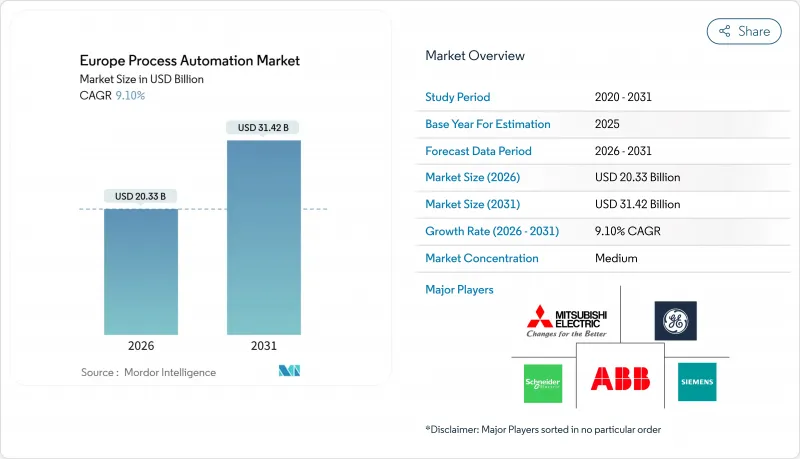
本報告按通訊協定(有線和無線)、系統類型(硬體和軟體)、部署模式(本地部署、雲端部署、邊緣部署)、最終用戶行業(石油和天然氣、化工和石化、電力和公共產業、水和廢水處理、食品和飲料、紙漿和造紙、製藥等)以及國家/地區進行細分。市場預測以美元計價。
歐洲過程自動化市場趨勢與洞察
人們對提高能源效率和降低成本的興趣日益濃厚
在歐洲的工廠中,電價仍比2021年之前的水準高出40%至60%。為了應對這一問題,營運商正在實施變速驅動器、餘熱回收迴路和能源儀表板,以期將機組能耗降低兩位數。隨著2026年碳邊境調節稅的實施,即時能源指標正從單純的成本挑戰轉變為市場准入的必要條件。先進的製程控制軟體曾經僅限於煉油廠,現在也被用於最佳化熔爐、乾燥器和發酵罐,從而揭示批次差異所隱藏的能源浪費。機器學習模型正被整合到歷史資料庫中,以便在損失累積之前預測結垢和壓縮機葉片磨損。由於能源儀錶板和預測模型需要持續更新而非一次性購買,供應商正在轉向基於訂閱的定價模式。
在棕地工廠整合工業4.0和工業物聯網
歐洲流程資產的平均使用年限超過30年,大部分資本投資都用於維修。無線振動探頭和紅外線攝影機無需電纜配線架,使工廠能夠在不因佈線而停產的情況下逐步實現數位轉型。邊緣閘道器透過在本地運行高速環路並將整理後的資料發送到雲端歷史資料庫,實現了延遲和分析能力的平衡。然而,這波改裝也增加了網路安全風險,因此營運商現在將高達12%的預算增加到網路分段、單向防火牆和異常檢測方面。因此,成長的關鍵在於能夠提供具備網路安全功能的感測器邊緣整合方案的供應商,這些方案可立即部署到棕地中。
高額資本投入與複雜的整合過程
中型站點的維修項目通常超過 500 萬歐元(565 萬美元),其中超過一半用於將 PROFIBUS、Modbus 和 HART 環路整合到乙太網路骨幹網路中。對於南歐和東歐的中小企業而言,資金籌措仍然很困難,導致計畫分階段進行,投資回收期延長。邊緣感測器和混合雲端增加了架構的複雜性,迫使負責人管理三個不同的資料平面——本地、邊緣和雲端——每個平面都遵循各自獨特的管治規則。
細分市場分析
預計到2025年,有線連接在製程自動化市場將佔據79.16%的市場。這是因為確定性PROFIBUS、Modbus和HART等協定在安全關鍵型操作中持續保持其主導地位。然而,無線節點預計將以9.46%的複合年成長率成長,這一趨勢在危險的石油、化學和污水處理領域尤為顯著,因為在這些領域鋪設管道並不經濟。艾默生預計,到2025年,其Wireless 1410閘道器在歐洲煉油廠的出貨量將增加29%,這將使營運商能夠在以前難以監控的儲罐和火炬塔上安裝測量儀器。地方政府供水事業正在為遠端泵站採用電池供電的LoRaWAN水位感測器,以減少土木工程量。
由於延遲和認證問題,有線骨幹網仍然是安全儀器系統的主流選擇。製藥視覺系統透過網路傳輸海量高速影像,持續佔用無線頻寬。一種混合模式正在興起:邊緣閘道器聚合並壓縮無線現場數據,然後透過冗餘光纖回程傳輸傳輸到歷史資料庫,從而在降低維修成本的同時保持迴路完整性。
由於分散式控制系統和可程式邏輯控制器 (PLC) 構成連續生產工廠控制的核心,預計到 2025 年,硬體銷售額將佔總銷售額的 56.19%。軟體銷售額以 9.52% 的複合年成長率成長,反映了預測性維護、模型預測控制和數位孿生等技術的興起,這些技術無需拆除已安裝設備即可提高產量。據Honeywell稱,目前歐洲 68% 的 Experion 用戶正在使用雲端分析服務來發現最佳化機會。
在石油化工聚合和生物技術發酵等製程中,分散式控制系統仍然是標準配置,因為其中數百個緊密連接的迴路需要進行確定性掃描。可程式邏輯控制器 (PLC) 正在成為香料和化妝品等批次應用的主流選擇。感測器、閥門和馬達擴大整合演算法,以便在停機前檢測故障。人機介面 (HMI) 正從專用面板轉向基於平板電腦的瀏覽器儀表板,這雖然降低了資本支出 (CAPEX),但也擴大了網路攻擊者的攻擊面。
其他好處:
- Excel格式的市場預測(ME)表
- 3個月的分析師支持
目錄
第1章:引言
- 研究假設和市場定義
- 調查範圍
第2章:調查方法
第3章執行摘要
第4章 市場狀況
- 市場概覽
- 市場促進因素
- 人們越來越關注能源效率和成本降低。
- 安全自動化系統的需求
- 在棕地工廠整合工業4.0和工業物聯網
- 歐盟的脫碳政策正在推動維修工程的自動化。
- 強制性數位產品護照正在推動可追溯性的自動化。
- 需要模組化自動化的綠色氫氣先導工廠
- 市場限制因素
- 巨額資本投資與整合的複雜性
- OT網路中網路安全合規的成本
- 勞動力老化和職業治療/資訊科技技能短缺
- 由於專有架構,人們擔心被供應商鎖定。
- 產業價值鏈分析
- 監理情勢
- 技術展望
- 波特五力分析
- 宏觀經濟因素對市場的影響
- 英國、德國和法國工業自動化中心的分析
- 評估 COVID-19 對歐洲流程自動化產業的影響
第5章 市場規模與成長預測
- 透過通訊協定
- 有線
- 無線的
- 依系統類型
- 硬體
- 監控與資料採集系統(SCADA)
- 分散式控制系統(DCS)
- 可程式邏輯控制器(PLC)
- 製造執行系統(MES)
- 閥門和執行器
- 電動機
- 人機介面(HMI)
- 製程安全系統
- 感測器和發送器
- 軟體
- 高階製程控制(APC)
- 數據分析和報告軟體
- 其他軟體
- 硬體
- 按部署模式
- 現場
- 雲
- 邊緣
- 按最終用戶行業分類
- 石油和天然氣
- 化工/石油化工
- 電力/公共產業
- 水和污水處理
- 食品/飲料
- 紙漿和紙漿
- 製藥
- 其他終端用戶產業
- 國家
- 英國
- 德國
- 法國
- 其他歐洲國家
第6章 競爭情勢
- 市場集中度
- 策略趨勢
- 市佔率分析
- 公司簡介
- ABB Ltd
- Siemens AG
- Schneider Electric SE
- Emerson Electric Co.
- Rockwell Automation Inc.
- Honeywell International Inc.
- Mitsubishi Electric Corporation
- Yokogawa Electric Corporation
- General Electric Co.
- Delta Electronics Inc.
- Eaton Corporation
- Fuji Electric Co. Ltd.
- Endress+Hauser Group
- Bosch Rexroth AG
- Omron Corporation
- KUKA AG
- Phoenix Contact GmbH and Co. KG
- Festo SE and Co. KG
- Valmet Oyj
- Hitachi Ltd.
第7章 市場機會與未來展望
According to Mordor Intelligence, the Europe process automation market size reached USD 20.33 billion in 2026 and is projected to climb to USD 31.42 billion by 2031, reflecting a 9.1% CAGR.
This report is Segmented by Communication Protocol (Wired, and Wireless), System Type (Hardware, and Software), Deployment Model (On-Premise, Cloud, Edge), End-User Industry (Oil and Gas, Chemical and Petrochemical, Power and Utilities, Water and Wastewater, Food and Beverage, Paper and Pulp, Pharmaceutical, and More), and Country. The Market Forecasts are Provided in Terms of Value (USD).
Europe Process Automation Market Trends and Insights
Growing Emphasis on Energy Efficiency and Cost Reduction
European plants are contending with electricity prices that remain 40-60% above pre-2021 levels; therefore, operators are installing variable-speed drives, waste-heat recovery loops, and energy dashboards that reduce specific consumption by double-digit percentages. As carbon-border taxes begin in 2026, real-time energy metrics are transforming from a cost topic into a market-access prerequisite. Advanced process control software, once limited to refineries, now optimizes ovens, dryers, and fermenters, revealing energy waste hidden behind batch variability. Machine-learning models are being layered on historians to predict fouling or compressor-blade wear before losses compound. Vendors are shifting toward subscription pricing because energy dashboards and predictive models require continual updates rather than one-off sales.
Industry 4.0 and IIoT Integration Across Brownfield Plants
With the median European process asset older than three decades, retrofits dominate capex. Wireless vibration probes and infrared cameras bypass cable trays, letting plants digitalize piecemeal instead of shutting down for rewiring. Edge gateways run fast loops locally yet pass curated data to cloud historians, balancing latency and analytics. The retrofit wave, however, increases cybersecurity exposure, so operators now allocate up to 12% more for network segmentation, one-way firewalls, and anomaly detection. Growth, therefore, hinges on suppliers that offer pre-integrated cyber-secure sensor-edge bundles ready for brownfield deployment.
High Capital Expenditure and Integration Complexity
Retrofit projects often top EUR 5 million (USD 5.65 million) for mid-sized sites, and more than half of that sum finances integration labor that stitches PROFIBUS, Modbus, and HART loops into Ethernet backbones. Financing remains scarce for smaller firms in Southern and Eastern Europe, so many projects proceed in phases that extend the payback period. Edge sensors and hybrid clouds increase architectural complexity, forcing operators to manage three distinct data planes: on-premises, edge, and cloud, each with its own governance rules.
Other drivers and restraints analyzed in the detailed report include:
- EU Decarbonisation Policies Driving Retrofit Automation
- Digital Product Passport Mandate Boosting Traceability Automation
- Cybersecurity Compliance Costs in OT Networks
For complete list of drivers and restraints, kindly check the Table Of Contents.
Segment Analysis
Wired links secured 79.16% of the 2025 process automation market share, as deterministic PROFIBUS, Modbus, and HART continue to dominate safety-critical duties. Wireless nodes, however, are set to grow at a 9.46% CAGR, particularly in hazardous oil, chemical, and wastewater zones where conduit trenching is cost-prohibitive. Emerson shipped 29% more Wireless 1410 gateways into European refineries in 2025, enabling operators to instrument tanks and flare stacks that had previously run blind. Municipal water utilities choose battery-powered LoRaWAN level sensors for remote lift stations, cutting civil works.
Latency and certification keep wired backbones entrenched around safety instrumented systems. Pharmaceutical vision systems flood networks with high-speed images that still overload wireless bands. A hybrid future is emerging where edge gateways aggregate wireless field data, compress it, and then forward it to historians over redundant fiber backhauls, maintaining loop integrity while easing retrofit economics.
Hardware captured 56.19% of 2025 revenue as distributed control systems and programmable logic controllers form the control core of continuous plants. Software revenues, growing at a 9.52% CAGR, reflect a pivot toward predictive maintenance, model-predictive control, and digital twins that boost yields without requiring the removal of installed equipment. Honeywell notes that 68% of its European Experion customers now subscribe to cloud analytics that surface optimization opportunities.
Distributed control systems remain the standard for petrochemical polymerization and biotech fermentation, where hundreds of tightly coupled loops demand deterministic scans. Programmable logic controllers dominate batch sectors such as flavors and fragrances. Sensors, valves, and motors are increasingly bundled with algorithms that flag failures before downtime occurs. Human-machine interfaces migrate from proprietary panels to browser dashboards on tablets, shrinking capex but widening the threat surface for cyber attackers.
Complete Report Scope:
- By Communication Protocol
- Wired
- Wireless
- By System Type
- Hardware
- Supervisory Control and Data Acquisition System (SCADA)
- Distributed Control System (DCS)
- Programmable Logic Controller (PLC)
- Manufacturing Execution System (MES)
- Valves and Actuators
- Electric Motors
- Human Machine Interface (HMI)
- Process Safety Systems
- Sensors and Transmitters
- Software
- Advanced Process Control (APC)
- Data Analytics and Reporting Software
- Other Software
- Hardware
- By Deployment Model
- On-Premise
- Cloud
- Edge
- By End-User Industry
- Oil and Gas
- Chemical and Petrochemical
- Power and Utilities
- Water and Wastewater
- Food and Beverage
- Paper and Pulp
- Pharmaceutical
- Other End-User Industry
- By Country
- United Kingdom
- Germany
- France
- Rest of Europe
List of Companies Covered in this Report:
- ABB Ltd
- Siemens AG
- Schneider Electric SE
- Emerson Electric Co.
- Rockwell Automation Inc.
- Honeywell International Inc.
- Mitsubishi Electric Corporation
- Yokogawa Electric Corporation
- General Electric Co.
- Delta Electronics Inc.
- Eaton Corporation
- Fuji Electric Co. Ltd.
- Endress+Hauser Group
- Bosch Rexroth AG
- Omron Corporation
- KUKA AG
- Phoenix Contact GmbH and Co. KG
- Festo SE and Co. KG
- Valmet Oyj
- Hitachi Ltd.
Additional Benefits:
- The market estimate (ME) sheet in Excel format
- 3 months of analyst support
TABLE OF CONTENTS
1 INTRODUCTION
- 1.1 Study Assumptions and Market Definition
- 1.2 Scope of the Study
2 RESEARCH METHODOLOGY
3 EXECUTIVE SUMMARY
4 MARKET LANDSCAPE
- 4.1 Market Overview
- 4.2 Market Drivers
- 4.2.1 Growing Emphasis on Energy Efficiency and Cost Reduction
- 4.2.2 Demand for Safety Automation Systems
- 4.2.3 Industry 4.0 and IIoT Integration Across Brownfield Plants
- 4.2.4 EU Decarbonisation Policies Driving Retrofit Automation
- 4.2.5 Digital Product Passport Mandate Boosting Traceability Automation
- 4.2.6 Green Hydrogen Pilot Plants Requiring Modular Automation
- 4.3 Market Restraints
- 4.3.1 High Capital Expenditure and Integration Complexity
- 4.3.2 Cybersecurity Compliance Costs in OT Networks
- 4.3.3 Ageing Workforce and OT-IT Skills Shortage
- 4.3.4 Vendor Lock-in Concerns With Proprietary Architectures
- 4.4 Industry Value Chain Analysis
- 4.5 Regulatory Landscape
- 4.6 Technological Outlook
- 4.7 Porter's Five Forces Analysis
- 4.7.1 Bargaining Power of Suppliers
- 4.7.2 Bargaining Power of Buyers
- 4.7.3 Threat of New Entrants
- 4.7.4 Threat of Substitutes
- 4.7.5 Intensity of Competitive Rivalry
- 4.8 Impact of Macroeconomic Factors on the Market
- 4.9 Analysis of Industrial Automation Hubs in United Kingdom, Germany and France
- 4.10 Assessment of the Impact of COVID-19 on the Process Automation Industry in Europe
5 MARKET SIZE AND GROWTH FORECASTS (VALUE)
- 5.1 By Communication Protocol
- 5.1.1 Wired
- 5.1.2 Wireless
- 5.2 By System Type
- 5.2.1 Hardware
- 5.2.1.1 Supervisory Control and Data Acquisition System (SCADA)
- 5.2.1.2 Distributed Control System (DCS)
- 5.2.1.3 Programmable Logic Controller (PLC)
- 5.2.1.4 Manufacturing Execution System (MES)
- 5.2.1.5 Valves and Actuators
- 5.2.1.6 Electric Motors
- 5.2.1.7 Human Machine Interface (HMI)
- 5.2.1.8 Process Safety Systems
- 5.2.1.9 Sensors and Transmitters
- 5.2.2 Software
- 5.2.2.1 Advanced Process Control (APC)
- 5.2.2.2 Data Analytics and Reporting Software
- 5.2.2.3 Other Software
- 5.2.1 Hardware
- 5.3 By Deployment Model
- 5.3.1 On-Premise
- 5.3.2 Cloud
- 5.3.3 Edge
- 5.4 By End-User Industry
- 5.4.1 Oil and Gas
- 5.4.2 Chemical and Petrochemical
- 5.4.3 Power and Utilities
- 5.4.4 Water and Wastewater
- 5.4.5 Food and Beverage
- 5.4.6 Paper and Pulp
- 5.4.7 Pharmaceutical
- 5.4.8 Other End-User Industry
- 5.5 By Country
- 5.5.1 United Kingdom
- 5.5.2 Germany
- 5.5.3 France
- 5.5.4 Rest of Europe
6 COMPETITIVE LANDSCAPE
- 6.1 Market Concentration
- 6.2 Strategic Moves
- 6.3 Market Share Analysis
- 6.4 Company Profiles {(includes Global Level Overview, Market Level Overview, Core Segments, Financials as Available, Strategic Information, Market Rank/Share for Key Companies, Products and Services, and Recent Developments)}
- 6.4.1 ABB Ltd
- 6.4.2 Siemens AG
- 6.4.3 Schneider Electric SE
- 6.4.4 Emerson Electric Co.
- 6.4.5 Rockwell Automation Inc.
- 6.4.6 Honeywell International Inc.
- 6.4.7 Mitsubishi Electric Corporation
- 6.4.8 Yokogawa Electric Corporation
- 6.4.9 General Electric Co.
- 6.4.10 Delta Electronics Inc.
- 6.4.11 Eaton Corporation
- 6.4.12 Fuji Electric Co. Ltd.
- 6.4.13 Endress+Hauser Group
- 6.4.14 Bosch Rexroth AG
- 6.4.15 Omron Corporation
- 6.4.16 KUKA AG
- 6.4.17 Phoenix Contact GmbH and Co. KG
- 6.4.18 Festo SE and Co. KG
- 6.4.19 Valmet Oyj
- 6.4.20 Hitachi Ltd.
7 MARKET OPPORTUNITIES AND FUTURE OUTLOOK
- 7.1 White-Space and Unmet-Need Assessment
- 7.2 Investment Analysis and Market Outlook

 流程自動化與儀器:市場佔有率分析、產業趨勢與統計、成長預測(2026-2031)
 零接觸配置市場:依設備類型、組件、網路複雜度、企業規模、最終用戶、國家及地區分類-全球產業分析、市場規模、市場佔有率及2026年至2033年預測北美流程自動化:市場佔有率分析、產業趨勢與統計及成長預測(2026-2031 年)工業製程自動化控制:市場佔有率分析、產業趨勢與統計及成長預測(2026-2031 年)
 流程自動化和儀器市場:按產品、產品類型、最終用戶和部署模式分類-2026-2032年全球市場預測
 2026年全球零接觸配置市場報告2026年全球工業製程自動化及控制系統市場報告2026年全球流程自動化與儀器市場報告流程自動化:市場佔有率分析、產業趨勢與統計、成長預測(2026-2031)流程自動化和儀器市場:按技術、最終用戶、儀器類型、自動化類型、國家和地區分類-全球產業分析、市場規模、市場佔有率及2025年至2032年預測