


 |
市場調查報告書
商品編碼
2123756
流程自動化與儀器:市場佔有率分析、產業趨勢與統計、成長預測(2026-2031)Process Automation And Instrumentation - Market Share Analysis, Industry Trends & Statistics, Growth Forecasts (2026 - 2031) |
||||||

※ 本網頁內容可能與最新版本有所差異。詳細情況請與我們聯繫。
預計到 2026 年,製程自動化和儀器市場價值將達到 811 億美元,高於 2025 年的 770.1 億美元,預計到 2031 年將達到 1,050.8 億美元。
預計從 2026 年到 2031 年,其複合年成長率將達到 5.32%。
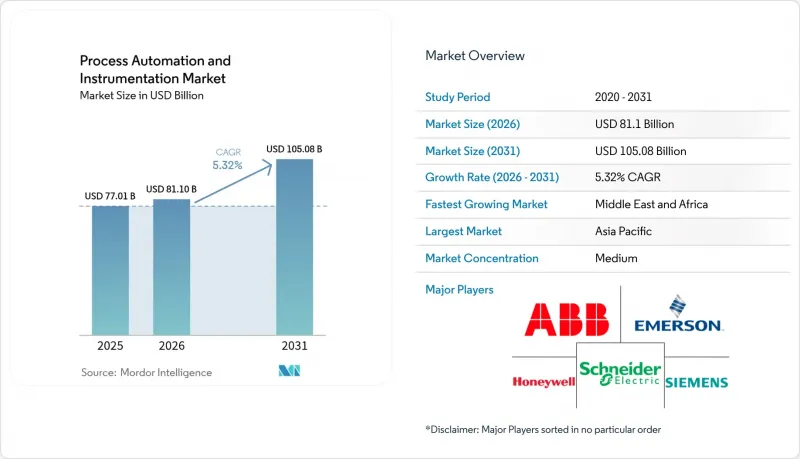
本報告按測量儀器(現場儀表、控制閥、分析儀器)、解決方案(高級製程控制 (APC)、分散式控制系統 (DCS)、安全儀器系統等)、終端用戶產業(石油天然氣、化學、製藥、食品飲料等)和地區進行細分。市場預測以美元計價。
全球過程自動化和儀器市場趨勢及洞察
更嚴格的全球排放法規正在推動先進製程控制系統的應用。
目前,各國政府正將營運許可證與揮發性有機化合物 (VOC) 和溫室氣體排放的即時可見性掛鉤,並強制要求化工廠和煉油廠實施連續排放監測系統。歐盟的《工業排放指令》要求營運商採用最佳的減排技術作為綜合污染控制的一部分,這項要求正在加速對數位閥門、高速分析儀和多變量智慧變送器的投資。艾默生的零排放電動洩壓閥已在拉勒米能源公司的油井中展現出即時的合規性和成本效益,它不僅消除了甲烷排放口,還將單台能耗從 96 瓦降低至 1.2 瓦。美國環保署 (EPA) 正在收緊報告準確性標準,迫使營運商實施整合控制邏輯、歷史資料庫和自動報告生成功能的平台。升級滯後的公司將面臨更高的罰款和處理能力下降的風險,對先進控制系統的投資正從「可選支出」轉變為「強制支出」。
亞洲正迅速從傳統分散式控制系統 (DCS) 轉型為模組化、擴充性且支援工業物聯網 (IIoT) 的平台。
本地供應商極具競爭力的價格以及中國「智慧製造」計畫正在縮短傳統分散式控制系統的產品生命週期。諸如羅克韋爾自動化 (Rockwell Automation) 的 PlantPAx 5.0 等新型平台,結合了 TÜV 認證的網路安全、內建分析功能和通用設備商品搭售,可將工程工作量減少高達 30%。三菱電機 (Mitsubishi Electric) 的 LingLing 產品線專注於為尋求經濟實惠升級方案的二線工廠提供服務,推動了向獨立於硬體、以軟體為中心的架構的轉變。根據《裝配雜誌》(Assembly magazine) 報道,53% 的亞洲工廠預計到 2040 年將實現自主運行,這一比例遠高於歐美工廠,進一步提升了對工業物聯網 (IIoT) 控制系統的迫切需求。
網路安全認證瓶頸正在減緩大規模工業物聯網部署的速度。
ISA/IEC 62443 評估週期導致大型企劃延誤 6 至 12 個月,需要對所有網路段進行徹底的滲透測試。為符合 NIS2 標準而爭相合規的供水事業因第三方審計和「零信任」實施而面臨預算限制,導致感測器連接升級延遲。 Frontiers 的一項研究表明,即插即用的安全框架存在局限性,安全策略與其在實際環境中的部署之間存在越來越大的差距。
細分市場分析
現場儀表預計到2025年將佔總銷售額的43.62%,構成煉油、化工和電力行業中至關重要的測量層,為更高級別的控制系統提供資訊。壓力、溫度和液位傳送器現在都內建了診斷功能,可以偵測感測器漂移和線路故障,從而縮短故障排除時間。預計到2031年,控制閥的複合年成長率將達到6.52%,電氣化使其能夠實現高扭矩驅動,同時消除壓縮空氣損失。艾默生收購Flexim擴大了超音波流量計產品線,並顯示其在多參數感測領域進一步整合。氣體和液體分析儀整合了人工智慧分類功能,可顯著降低誤報率,而Endress+Hauser與SICK的合作則擴展了製程分析儀的全球生命週期支援。乙太網路APL(Ethernet-APL)可在1公里本質安全電纜上實現10 Mbps的通訊,現已成為新計畫競標的標準規範。這些升級維持了在製程自動化和儀器市場中不斷擴大智慧優勢的良性循環。
測量設備領域正朝著「感測器即服務 (SaaS)」模式發展,在這種模式下,診斷資訊、韌體和校準證書直接從供應商的雲端交付給分散式控制系統。連接複用流量計平台縮小了控制面板的面積,而光學分析儀則實現了更小的採樣系統和更低的吹掃氣體成本。在用水和污水領域,智慧壓力感測器可直接與雲端 SCADA 系統整合,從而實現預測性洩漏檢測。雖然這種整合可能會導致供應商鎖定,但它也簡化了生命週期成本追蹤,並強化了現場設備在最佳化整個工廠運行中的核心作用。
區域分析
預計到2025年,亞太地區將佔全球銷售額的37.12%,並且仍然是中階PLC、智慧閥門和嵌入式IPC的主要生產中心。中國政府對工業乙太網網路晶片組進行補貼,使本地OEM廠商能夠以低於進口的價格供應這些晶片組,並加速了供應商整合。在印度、越南和印尼,離散製造和混合製造走廊正在擴張,推動了對可擴展的、支援工業物聯網(IIoT)的控制架構的需求。此外,這些地區的政府正在收緊顆粒物排放上限,促進雷射氣體分析儀和高量程差壓變送器的應用。價格敏感型買家和日益嚴格的監管相結合,正使亞太地區成為流程自動化和儀器市場銷售和創新的領導者。
預計到2031年,中東地區將達到最高成長率,年複合成長率將達到6.63%,主要得益於海灣國家將主權資金投入藍氫氫價值鏈。石化產業叢集對符合IEC 61511標準的安全儀器系統的日益普及,也帶動了對SIL認證變送器和緊急切斷閥的訂單成長。埃及在蘇伊士運河經濟區投資數十億美元的綠氫項目,也反映了南部非洲對製程儀器日益成長的需求。南非的「綠氫地圖集」已確定了30多個潛在樞紐,這將催生對流量計、壓力計和氣相層析儀等設備的新需求。
在北美,將邊緣分析技術整合到現有分散式控制系統 (DCS) 中的棕地維修正日益普及,從而能夠在不造成長時間停機的情況下實現快速投資回報。聯邦政府對基礎設施電氣化的資助正在加速水處理廠、污水處理廠和化學間歇式生產廠控制系統的升級。同時,嚴格的網路安全法規推動了對零信任防火牆和憑證管理閘道的投資增加,儘管一些工業物聯網 (IIoT) 專案有所延遲,但對安全遠端存取模組的支出卻在成長。在歐洲,在傳統基礎設施和脫碳要求的雙重壓力下,用於連接 PROFIBUS 節點和乙太網路 APL 總線的遷移工具包的預算撥款正在增加。該地區還在推進預測性維護先導計畫,從而推動了化學、水泥和鋼鐵廠對自學習型自動程序控制 (APC) 軟體包的需求。南美洲仍然是一個新興市場,智利的鋰鹽水處理和巴西的生質乙醇聯合體展現出與脫碳資金籌措相關的成長潛力。
其他好處:
- Excel格式的市場預測(ME)表
- 3個月的分析師支持
目錄
第1章:引言
- 研究假設和市場定義
- 調查範圍
第2章:調查方法
第3章執行摘要
第4章 市場狀況
- 市場概覽
- 市場促進因素
- 更嚴格的全球排放標準正在推動先進製程控制技術的應用。
- 亞洲正迅速從傳統分散式控制系統 (DCS) 轉型為模組化、擴充性且支援工業物聯網 (IIoT) 的平台。
- 歐洲混合流程產業轉型為預測性維護轉型
- 擴大北美中游油氣產業現有設施的數位維修
- 高風險化工廠(中東)功能安全(IEC 61511)合規性
- 利用可再生能源的氫能計畫正在刺激對設備的新需求(非洲)
- 市場限制因素
- 網路安全認證瓶頸正在減緩工業物聯網的大規模部署。
- 新興亞洲國家缺乏熟練勞動力來調整先進的製程控制系統
- 在歐洲,分散的傳統基礎設施正在推高整體擁有成本。
- 半導體前置作業時間的不斷延長正在限制PLC和DCS的供應鏈。
- 價值鏈分析
- 監管和技術展望
- 波特五力分析
- 投資分析
第5章 市場規模與成長預測
- 透過測量設備
- 現場測量設備
- 壓力變送器
- 溫度變送器
- 液位傳送器
- 流量計
- 控制閥
- 氣動控制閥
- 電動控制閥
- 液壓控制閥
- 分析設備
- 氣體分析儀
- 液體分析儀
- 現場測量設備
- 透過解決方案
- 高階製程控制(APC)
- 分散式控制系統(DCS)
- 人機介面(HMI)
- 製造執行系統(MES)
- 可程式邏輯控制器(PLC)
- 安全儀器系統
- 監控與數據採集(SCADA)
- 資產管理和預測性維護軟體
- 工業通訊和網路解決方案
- 按最終用戶行業分類
- 石油和天然氣
- 化工/石油化工
- 藥品和生物製藥
- 食品/飲料
- 發電和公共產業
- 供水和廢水處理
- 金屬和採礦
- 紙漿和造紙
- 半導體和電子學
- 按地區
- 北美洲
- 美國
- 加拿大
- 墨西哥
- 歐洲
- 英國
- 德國
- 法國
- 義大利
- 其他歐洲國家
- 亞太地區
- 中國
- 日本
- 印度
- 韓國
- 其他亞太國家
- 中東
- 以色列
- 沙烏地阿拉伯
- 阿拉伯聯合大公國
- 土耳其
- 其他中東國家
- 非洲
- 南非
- 埃及
- 其他非洲國家
- 南美洲
- 巴西
- 阿根廷
- 其他南美國家
- 北美洲
第6章 競爭情勢
- 市場集中度
- 策略趨勢
- 市佔率分析
- 公司簡介
- ABB Ltd
- Emerson Electric Co.
- Honeywell International Inc.
- Mitsubishi Electric Corp.
- Rockwell Automation Inc.
- Schneider Electric SE
- Siemens AG
- Yokogawa Electric Corporation
- General Electric Company
- Eaton Corporation plc
- Omron Corporation
- Bosch Rexroth AG
- Phoenix Contact GmbH
- Metso Automation
- Endress+Hauser Group
- FANUC Corporation
- Fuji Electric Co., Ltd.
- Advantech Co., Ltd.
- Hitachi, Ltd.
- National Instruments Corp.
- Delta Electronics Inc.
- Pepperl+Fuchs SE
- KROHNE Messtechnik GmbH
- Belden Inc.
第7章 市場機會與未來展望
According to Mordor Intelligence, the process automation and instrumentation market size in 2026 is estimated at USD 81.10 billion, growing from 2025 value of USD 77.01 billion with 2031 projections showing USD 105.08 billion, growing at 5.32% CAGR over 2026-2031.
This report is Segmented by Instrument (Field Instruments, Control Valves, Analytical Instruments), Solution (Advanced Process Control (APC), Distributed Control System (DCS), Safety Instrumented Systems, and More), End-User Industry (Oil and Gas, Chemicals, Pharmaceuticals, Food and Beverage, and More), and Geography. The Market Forecasts are Provided in Terms of Value (USD).
Global Process Automation And Instrumentation Market Trends and Insights
Tightening Global Emission Norms Propelling Advanced Process Controls Adoption
Governments now link operating permits to real-time visibility of volatile-organic-compound and greenhouse-gas releases, making continuous emission monitoring systems mandatory for chemical and refining sites. The EU Industrial Emissions Directive compels operators to adopt best-available abatement techniques as part of integrated pollution prevention, a requirement that has accelerated investment in digital valves, high-speed analyzers and multivariable smart transmitters. Emerson's zero-emission electric dump valves lowered energy draw from 96 W to 1.2 W per unit while removing methane venting at Laramie Energy wells, illustrating immediate compliance and cost benefits. The United States Environmental Protection Agency has tightened reporting accuracy thresholds, pushing operators toward platforms that integrate control logic, historian and automated report generation. Firms that lag in upgrades risk escalating penalties and curtailed throughput, shifting advanced controls from discretionary to essential spend.
Rapid Migration from Conventional DCS to Modular, Scalable IIoT-Ready Platforms in Asia
Price-competitive local vendors and China's "intelligent manufacturing" programs have shortened product life cycles for legacy distributed control systems. New platforms, such as Rockwell Automation's PlantPAx 5.0, combine TUV-certified cybersecurity, built-in analytics, and universal device bundling, which can cut engineering hours by up to 30%. Mitsubishi Electric's dedicated "LingLing" line targets tier-2 factories seeking affordable upgrades, reinforcing a switch to hardware-agnostic, software-centric architectures. According to Assembly magazine, 53% of Asian factories expect to operate autonomously by 2040, far ahead of their Western peers, which magnifies the immediate demand for IIoT-ready controls.
Cyber-security Certification Bottlenecks Delaying Large-Scale IIoT Roll-outs
ISA/IEC 62443 assessment cycles add six-to-twelve months to mega-projects, demanding exhaustive penetration tests for every network segment. Water utilities juggling NIS2 compliance find budgets stretched by third-party audits and "zero-trust" deployments, delaying sensor connectivity upgrades. Frontiers research notes limited plug-and-play security frameworks, widening gaps between security policy and real-world adoption.
Other drivers and restraints analyzed in the detailed report include:
- Shift Toward Predictive Maintenance in Hybrid Process Industries across Europe
- Growing Brown-field Digital Retrofits in North-American Mid-stream Oil and Gas
- Skilled Workforce Shortage for Advanced Process Control Tuning in Emerging Asia
For complete list of drivers and restraints, kindly check the Table Of Contents.
Segment Analysis
Field instruments captured 43.62% of 2025 revenue, forming the essential measurement layer that feeds higher-level controls across refining, chemicals, and power. Pressure, temperature, and level transmitters now feature embedded diagnostics that flag sensor drift and wiring faults, reducing troubleshooting hours. Control valves, expected to expand at a 6.52% CAGR to 2031, benefit from electrification that removes compressed-air losses while enabling torque-dense actuation. Emerson's acquisition of Flexim broadened its ultrasonic flowmeter line, signalling deeper consolidation around multi-parameter sensing. Analytical gas and liquid analyzers incorporate AI classifiers that slash false alarms, and the Endress+Hauser-SICK partnership extends global lifecycle support for process analyzers. Ethernet-APL, capable of 10 Mbps over 1 km intrinsically safe cabling, is now a default spec in green-field bids. These upgrades keep the process automation and instrumentation market in a cycle of intelligent-edge expansion.
The instrument landscape is converging on "sensor-as-a-service" models, where diagnostics, firmware, and calibration certificates are pushed directly from vendor clouds to distributed control systems. Flowmeter multiplexing platforms reduce cabinet footprints, while optical analyzers shrink sample systems and lower purge-gas costs. In water and wastewater, smart pressure transducers interface directly with cloud SCADA, enabling predictive leak detection. Such integration propels vendor lock-in yet simplifies lifecycle cost tracking, reinforcing the central role of field devices in overall plant optimisation.
Complete Report Scope:
- By Instrument
- Field Instruments
- Pressure Transmitters
- Temperature Transmitters
- Level Transmitters
- Flow Meters
- Control Valves
- Pneumatic Control Valves
- Electric Control Valves
- Hydraulic Control Valves
- Analytical Instruments
- Gas Analyzers
- Liquid Analyzers
- Field Instruments
- By Solution
- Advanced Process Control (APC)
- Distributed Control System (DCS)
- Human-Machine Interface (HMI)
- Manufacturing Execution System (MES)
- Programmable Logic Controller (PLC)
- Safety Instrumented Systems
- Supervisory Control and Data Acquisition (SCADA)
- Asset Management and Predictive Maintenance Software
- Industrial Communication and Networking Solutions
- By End-user Industry
- Oil and Gas
- Chemicals and Petrochemicals
- Pharmaceuticals and Biopharma
- Food and Beverage
- Power Generation and Utilities
- Water and Wastewater Treatment
- Metals and Mining
- Pulp and Paper
- Semiconductor and Electronics
- By Geography
- North America
- United States
- Canada
- Mexico
- Europe
- United Kingdom
- Germany
- France
- Italy
- Rest of Europe
- Asia-Pacific
- China
- Japan
- India
- South Korea
- Rest of Asia-Pacific
- Middle East
- Israel
- Saudi Arabia
- United Arab Emirates
- Turkey
- Rest of Middle East
- Africa
- South Africa
- Egypt
- Rest of Africa
- South America
- Brazil
- Argentina
- Rest of South America
- North America
Geography Analysis
Asia-Pacific generated 37.12% of 2025 revenue and remains the prime production hub for mid-range PLCs, smart valves and embedded IPCs. Chinese authorities subsidise industrial-Ethernet chipsets, helping local OEMs undercut imports and accelerating vendor consolidation. India, Vietnam and Indonesia expand discrete and hybrid manufacturing corridors, boosting demand for scalable, IIoT-ready control architectures. Regional governments also tighten particulate-matter caps, spurring uptake of laser gas analyzers and high-range differential-pressure transmitters. This combination of price-sensitive buyers and stricter regulations positions APAC as both volume and innovation leader for the process automation and instrumentation market.
The Middle East is projected to register the fastest 6.63% CAGR to 2031, as Gulf states channel sovereign funds into blue- and green-hydrogen value chains. The adoption of IEC 61511-mandated safety-instrumented systems across petrochemical clusters propels orders for SIL-rated transmitters and emergency shutdown valves. Egypt's multibillion-dollar green-hydrogen projects in the Suez Canal Economic Zone signal Africa's southern expansion of process instrumentation demand. South Africa's Green Hydrogen Atlas identifies over 30 potential hubs, creating fresh bids for flow, pressure and gas-chromatograph packages.
North America emphasises brown-field retrofits that integrate edge analytics into existing DCS, unlocking quick returns without lengthy shutdowns. Federal funding for infrastructure electrification sparks control upgrades in water, wastewater and chemical batch plants. Concurrently, stringent cyber-security rules drive investment in zero-trust firewalls and certificate-managed gateways delaying some IIoT projects yet expanding spend on secure remote-access modules. Europe, with its legacy infrastructure and decarbonisation mandates, channels budgets toward migration toolkits that link PROFIBUS nodes to Ethernet-APL spurs. The region also champions predictive-maintenance pilots, fostering demand for self-learning APC packages in chemicals, cement and steel mills. South America remains an emerging play; Chile's lithium brine processing and Brazil's bio-ethanol complexes illustrate latent growth potential tied to decarbonisation financing.
List of Companies Covered in this Report:
- ABB Ltd
- Emerson Electric Co.
- Honeywell International Inc.
- Mitsubishi Electric Corp.
- Rockwell Automation Inc.
- Schneider Electric SE
- Siemens AG
- Yokogawa Electric Corporation
- General Electric Company
- Eaton Corporation plc
- Omron Corporation
- Bosch Rexroth AG
- Phoenix Contact GmbH
- Metso Automation
- Endress+Hauser Group
- FANUC Corporation
- Fuji Electric Co., Ltd.
- Advantech Co., Ltd.
- Hitachi, Ltd.
- National Instruments Corp.
- Delta Electronics Inc.
- Pepperl+Fuchs SE
- KROHNE Messtechnik GmbH
- Belden Inc.
Additional Benefits:
- The market estimate (ME) sheet in Excel format
- 3 months of analyst support
TABLE OF CONTENTS
1 INTRODUCTION
- 1.1 Study Assumptions and Market Definition
- 1.2 Scope of the Study
2 RESEARCH METHODOLOGY
3 EXECUTIVE SUMMARY
4 MARKET LANDSCAPE
- 4.1 Market Overview
- 4.2 Market Drivers
- 4.2.1 Tightening Global Emission Norms Propelling Advanced Process Controls Adoption
- 4.2.2 Rapid Migration from Conventional DCS to Modular, Scalable IIoT-Ready Platforms in Asia
- 4.2.3 Shift Toward Predictive Maintenance in Hybrid Process Industries across Europe
- 4.2.4 Growing Brown-field Digital Retrofits in North American Mid-stream Oil and Gas
- 4.2.5 Mandated Functional-Safety (IEC 61511) Compliance in High-Hazard Chemical Plants (Middle East)
- 4.2.6 Renewable-Power-Driven Hydrogen Projects Triggering New Instrument Demand (Africa)
- 4.3 Market Restraints
- 4.3.1 Cyber-security Certification Bottlenecks Delaying Large-Scale IIoT Roll-outs
- 4.3.2 Skilled Workforce Shortage for Advanced Process Control Tuning in Emerging Asia
- 4.3.3 Fragmented Legacy Infrastructure Raising Total Cost of Ownership in Europe
- 4.3.4 Extended Semiconductor Lead-Times Constraining PLC and DCS Supply Chains
- 4.4 Value Chain Analysis
- 4.5 Regulatory and Technological Outlook
- 4.6 Porter's Five Forces Analysis
- 4.6.1 Threat of New Entrants
- 4.6.2 Bargaining Power of Buyers
- 4.6.3 Bargaining Power of Suppliers
- 4.6.4 Threat of Substitutes
- 4.6.5 Intensity of Competitive Rivalry
- 4.7 Investment Analysis
5 MARKET SIZE AND GROWTH FORECASTS (VALUE)
- 5.1 By Instrument
- 5.1.1 Field Instruments
- 5.1.1.1 Pressure Transmitters
- 5.1.1.2 Temperature Transmitters
- 5.1.1.3 Level Transmitters
- 5.1.1.4 Flow Meters
- 5.1.2 Control Valves
- 5.1.2.1 Pneumatic Control Valves
- 5.1.2.2 Electric Control Valves
- 5.1.2.3 Hydraulic Control Valves
- 5.1.3 Analytical Instruments
- 5.1.3.1 Gas Analyzers
- 5.1.3.2 Liquid Analyzers
- 5.1.1 Field Instruments
- 5.2 By Solution
- 5.2.1 Advanced Process Control (APC)
- 5.2.2 Distributed Control System (DCS)
- 5.2.3 Human-Machine Interface (HMI)
- 5.2.4 Manufacturing Execution System (MES)
- 5.2.5 Programmable Logic Controller (PLC)
- 5.2.6 Safety Instrumented Systems
- 5.2.7 Supervisory Control and Data Acquisition (SCADA)
- 5.2.8 Asset Management and Predictive Maintenance Software
- 5.2.9 Industrial Communication and Networking Solutions
- 5.3 By End-user Industry
- 5.3.1 Oil and Gas
- 5.3.2 Chemicals and Petrochemicals
- 5.3.3 Pharmaceuticals and Biopharma
- 5.3.4 Food and Beverage
- 5.3.5 Power Generation and Utilities
- 5.3.6 Water and Wastewater Treatment
- 5.3.7 Metals and Mining
- 5.3.8 Pulp and Paper
- 5.3.9 Semiconductor and Electronics
- 5.4 By Geography
- 5.4.1 North America
- 5.4.1.1 United States
- 5.4.1.2 Canada
- 5.4.1.3 Mexico
- 5.4.2 Europe
- 5.4.2.1 United Kingdom
- 5.4.2.2 Germany
- 5.4.2.3 France
- 5.4.2.4 Italy
- 5.4.2.5 Rest of Europe
- 5.4.3 Asia-Pacific
- 5.4.3.1 China
- 5.4.3.2 Japan
- 5.4.3.3 India
- 5.4.3.4 South Korea
- 5.4.3.5 Rest of Asia-Pacific
- 5.4.4 Middle East
- 5.4.4.1 Israel
- 5.4.4.2 Saudi Arabia
- 5.4.4.3 United Arab Emirates
- 5.4.4.4 Turkey
- 5.4.4.5 Rest of Middle East
- 5.4.5 Africa
- 5.4.5.1 South Africa
- 5.4.5.2 Egypt
- 5.4.5.3 Rest of Africa
- 5.4.6 South America
- 5.4.6.1 Brazil
- 5.4.6.2 Argentina
- 5.4.6.3 Rest of South America
- 5.4.1 North America
6 COMPETITIVE LANDSCAPE
- 6.1 Market Concentration
- 6.2 Strategic Moves
- 6.3 Market Share Analysis
- 6.4 Company Profiles {(includes Global level Overview, Market level overview, Core Segments, Financials as available, Strategic Information, Market Rank/Share for key companies, Products and Services, and Recent Developments)}
- 6.4.1 ABB Ltd
- 6.4.2 Emerson Electric Co.
- 6.4.3 Honeywell International Inc.
- 6.4.4 Mitsubishi Electric Corp.
- 6.4.5 Rockwell Automation Inc.
- 6.4.6 Schneider Electric SE
- 6.4.7 Siemens AG
- 6.4.8 Yokogawa Electric Corporation
- 6.4.9 General Electric Company
- 6.4.10 Eaton Corporation plc
- 6.4.11 Omron Corporation
- 6.4.12 Bosch Rexroth AG
- 6.4.13 Phoenix Contact GmbH
- 6.4.14 Metso Automation
- 6.4.15 Endress+Hauser Group
- 6.4.16 FANUC Corporation
- 6.4.17 Fuji Electric Co., Ltd.
- 6.4.18 Advantech Co., Ltd.
- 6.4.19 Hitachi, Ltd.
- 6.4.20 National Instruments Corp.
- 6.4.21 Delta Electronics Inc.
- 6.4.22 Pepperl+Fuchs SE
- 6.4.23 KROHNE Messtechnik GmbH
- 6.4.24 Belden Inc.
7 MARKET OPPORTUNITIES AND FUTURE OUTLOOK
- 7.1 White-space and Unmet-Need Assessment

 歐洲過程自動化:市場佔有率分析、產業趨勢與統計及成長預測(2026-2031 年)
 零接觸配置市場:依設備類型、組件、網路複雜度、企業規模、最終用戶、國家及地區分類-全球產業分析、市場規模、市場佔有率及2026年至2033年預測北美流程自動化:市場佔有率分析、產業趨勢與統計及成長預測(2026-2031 年)工業製程自動化控制:市場佔有率分析、產業趨勢與統計及成長預測(2026-2031 年)
 流程自動化和儀器市場:按產品、產品類型、最終用戶和部署模式分類-2026-2032年全球市場預測
 2026年全球零接觸配置市場報告2026年全球工業製程自動化及控制系統市場報告2026年全球流程自動化與儀器市場報告流程自動化:市場佔有率分析、產業趨勢與統計、成長預測(2026-2031)流程自動化和儀器市場:按技術、最終用戶、儀器類型、自動化類型、國家和地區分類-全球產業分析、市場規模、市場佔有率及2025年至2032年預測