


 |
市場調查報告書
商品編碼
2154736
鈍化化學品:市場佔有率分析、行業趨勢和統計數據、成長預測(2026-2031 年)Passivation Chemicals - Market Share Analysis, Industry Trends & Statistics, Growth Forecasts (2026 - 2031) |
||||||

※ 本網頁內容可能與最新版本有所差異。詳細情況請與我們聯繫。
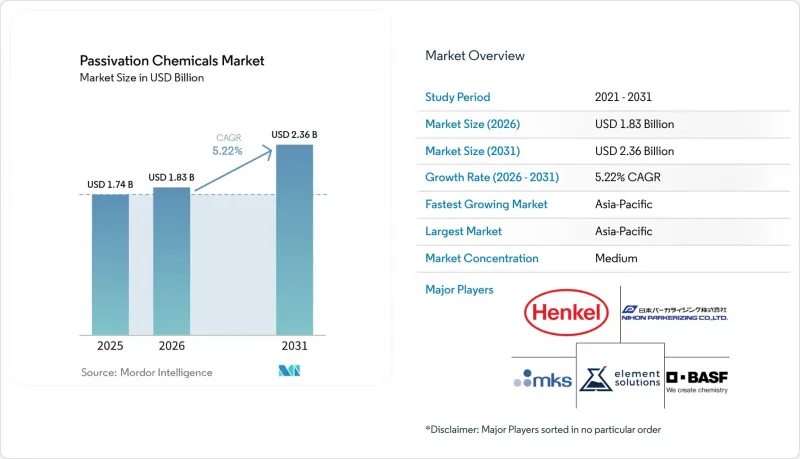
據 Mordor Intelligence 稱,鈍化化學品市場在 2025 年的價值為 17.4 億美元,預計到 2031 年將從 2026 年的 18.3 億美元成長到 23.6 億美元,在預測期(2026-2031 年)內的複合年成長率為 5.22%。
全球鈍化化學品市場趨勢與洞察
不銹鋼和合金部件的防腐蝕要求
不銹鋼在食品、製藥和工業設備領域持續發揮至關重要的作用,因此,鈍化處理貫穿整個組件生命週期,成為供應商合格的必要條件之一。美國材料與試驗協會 (ASTM) 標準 A967(2025 年版)規定了 10 種處理方法,其中包括 5 種硝酸處理方法和 5 種檸檬酸處理方法。該標準還要求透過硫酸銅試驗、鹽霧試驗和高濕度暴露試驗檢驗。這些控制標準使得表面處理效能成為買家關注的關鍵因素,因為他們需要在嚴苛的作業環境下獲得可預測的耐腐蝕性。不銹鋼設備在食品加工、製藥以及石油和天然氣基礎設施等行業中應用廣泛,這些行業對設備的使用壽命要求極高。這確保了對鈍化化學品的穩定需求,同時,化學成分也朝著減少廢棄物並滿足客戶規格的方向發展。然而,這種變化並不能取代既定的檢驗方法,因為買家仍然要求鈍化處理方法符合其材料等級、操作條件和已記錄的品質要求。
電動車輕量化和電池機殼保護
電動車電池組採用鋁製機殼,兼具低密度、高導熱性和耐腐蝕性。鋁製機殼比同等規格的鋼製機殼輕50%,有助於實現車輛續航里程目標。電池組還包含異種金屬連接件,例如匯流排、冷卻板和緊固件,這些連接件需要經過電化學檢驗的處理以防止電流腐蝕。BASF旗下Chemetall公司於2025年10月宣布推出電動車銅箔的無鉻無氟鈍化解決方案。據該公司稱,與六價鉻處理的電池相比,經Gardoline D處理的電池在25 度C下經過1000次充放電循環後,壽命最多可延長6%。因此,中國、歐洲和北美電動車產量的擴張正在推動市場對鋁相容鈍化處理的需求,供應商必須證明這些處理方法在電池組件中各種合金、連接件和運行條件下的有效性。
處理危險酸和遵守廢水法規的相關成本。
硝酸鈍化處理會產生氮氧化物煙霧,因此需要專用通風設備和受控操作。此外,使用過的處理液可能含有溶解的金屬,必須按照美國環保署 (EPA) 的要求進行處理後才能排放。 EPA提案的 2026 年多行業通用許可證草案概述了工業污水排放及相關的合規義務。美國職業安全與健康管理局 (OSHA) 的危害資訊溝通標準增加了對危害資訊溝通、個人防護設備和工人培訓的要求。雖然檸檬酸可以在製程重新認證的情況下減輕廢棄物處理負擔,但現有的硝酸處理生產線可能需要資本投資和新的批准。這些成本可能會限制小規模金屬加工企業在鈍化化學品市場採用替代化學品的速度,尤其是在現有客戶圖紙指定使用硝酸處理,而採用其他製程需要獲得新的客戶批准的情況下。
細分市場分析
2025年,硝酸在鈍化化學品市場佔35.23%的佔有率。這一地位反映了航太認證文件、傳統工業圖紙以及目的地設備製造商(OEM)工藝標準的既定做法。在SAE International於2025年5月發布的AMS 2700G標準中,硝酸被列為相關航太鈍化程序中的「方法1」。磷酸因其低酸度,常用於特殊鋁合金和軟合金應用,可避免基材腐蝕。其他產品類型包括用於電動車電池和電子產品的專有氧化劑混合物和無鉻酸鹽體系。因此,儘管產品組合正在逐步變化,但傳統的化學成分在認證應用中仍發揮重要作用。
預計2026年至2031年,檸檬酸市場將以6.34%的複合年成長率成長。其應用不僅體現在其優異的性能,也反映了其環保特性。在ASTM A967測試條件下,檸檬酸處理可獲得比硝酸處理更高的鉻鐵表面比。這種特性對於暴露於氯化物的應用至關重要,例如食品加工設備、船舶五金和製藥加工。檸檬酸也用於植入製造,以避免氮氧化物排放並支持無塵室文件記錄。致力於減少範圍3排放的主要製造商正日益關注能夠減少廢棄物產生的配方。
區域分析
預計到2025年,亞太地區將佔鈍化化學品市場39.71%的佔有率,並將在2031年之前以6.48%的複合年成長率持續成長。中國的Delta、Delta和渤海經濟區集中了眾多汽車、電子和航太零件製造地。在印度,生產連結獎勵計畫計畫(PLI)推動了汽車零件生產的擴張,吸引了一級企業對錶面處理技術的投資,從而刺激了市場需求。印度的商業MRO(維護、修理和大修)產業也在建構符合AMS 2700標準的鈍化能力。日本和韓國則在半導體級加工和先進電子互連技術方面做出了貢獻。
包括越南、泰國和印尼在內的東南亞國家正成為電子和汽車零件的新興製造地。這些領域的外國直接投資推動了表面處理製程需求的成長。由於北美和歐洲擁有成熟的航太和醫療設備生產基地,它們在鈍化化學品市場中正成為監管合規性更高的地區。北美航太供應商使用獲得AMS 2700G認證的化學品,而醫療設備製造商則根據美國食品藥物管理局(FDA)的指導,加強化學品可追溯性。美國環保署(EPA)提案的2026年多產業通用許可證將進一步提升美國對工業污水管理的重視。
歐盟《化學品註冊、評估、授權和限制指令》(REACH) 和《有害物質限制指令》(RoHS) 的要求正在推動六價鉻的逐步淘汰。德國、法國和義大利是歐洲的核心消費市場,與汽車原始設備製造商 (OEM) 的認證關係影響著這些地區的化學品選擇。在南美洲、中東和非洲,需求基礎正在擴大,主要涉及汽車組裝、石油和天然氣基礎設施以及金屬加工。巴西透過聖保羅州和米納斯吉拉斯州的汽車組裝、農業設備和工業製造來支持南美洲的需求。南非是該次區域工業多元化程度最高的市場,其汽車組裝需求符合國際 OEM 品質標準。
其他好處:
- Excel格式的市場預測(ME)表
- 3個月的分析師支持
目錄
第1章:引言
- 研究假設和市場定義
- 調查範圍
第2章:調查方法
第3章執行摘要
第4章 市場狀況
- 市場概覽
- 市場促進因素
- 不銹鋼和合金部件的防腐蝕要求
- 航太產業的生產、維護、維修和大修 (MRO) 以及認證表面處理
- 電動車輕量化和電池機殼保護
- 醫療設備的生物相容性和對植入合金的需求
- 電子元件小型化和高純度金屬加工
- 市場限制因素
- 處理危險酸和遵守廢水法規的相關成本。
- 替代現有化學技術的技術的合格期
- 原料價格波動和供應中斷
- 價值鏈分析
- 波特五力分析
第5章 市場規模與成長預測
- 依產品類型
- 硝酸
- 檸檬酸
- 磷酸
- 其他產品類型
- 適用材料
- 不銹鋼
- 鋁
- 鈦
- 其他應用材料
- 按最終用途行業分類
- 車
- 航太
- 醫療器材
- 電子設備
- 其他終端用戶產業
- 按地區
- 亞太地區
- 中國
- 印度
- 日本
- 韓國
- 東南亞國協
- 其他亞太國家
- 北美洲
- 美國
- 加拿大
- 墨西哥
- 歐洲
- 德國
- 英國
- 法國
- 義大利
- 北歐國家
- 其他歐洲國家
- 南美洲
- 巴西
- 阿根廷
- 其他南美國家
- 中東和非洲
- 沙烏地阿拉伯
- 南非
- 其他中東和非洲國家
- 亞太地區
第6章 競爭情勢
- 市場集中度
- 策略趨勢
- 市佔率和排名分析
- 公司簡介
- Asterion LLC
- BASF
- Birchwood Laboratories LLC
- Brulin
- Delmet srl
- Element Solutions Inc
- Henkel AG & Co. KGaA
- Hubbard-Hall Inc.
- JAYCO Chemical Solutions
- MKS Inc.
- Nihon Parkerizing Co., Ltd.
- Poligrat GmbH
- Quaker Houghton
- TIB Chemicals AG
第7章 市場機會與未來展望
According to Mordor Intelligence, the passivation chemicals market size was valued at USD 1.74 billion in 2025 and is estimated to grow from USD 1.83 billion in 2026 to reach USD 2.36 billion by 2031, at a CAGR of 5.22% during the forecast period (2026-2031).
Global Passivation Chemicals Market Trends and Insights
Corrosion-Control Requirements for Stainless Steel and Alloy Components
Stainless steel remains important in food-grade, pharmaceutical, and industrial equipment, which places passivation within supplier qualification requirements across the component lifecycle. American Society for Testing and Materials (ASTM) A967, updated in its 2025 edition, sets out 10 treatment methods, including 5 nitric acid and 5 citric acid methods. The standard also requires verification through tests such as copper sulfate, salt spray, and high-humidity exposure. These controls make surface treatment performance relevant to buyers who need predictable corrosion resistance in demanding service environments. Food processing, pharmaceutical production, and oil and gas infrastructure continue to use stainless steel equipment with long service-life requirements. This gives the passivation chemicals market a stable base of demand while the chemistry mix shifts toward formulations that reduce waste and meet customer specifications. The shift does not remove the need for established verification methods, because buyers still need treatments that fit their material grades, operating conditions, and documented quality requirements.
EV Lightweighting and Battery-Enclosure Protection
Electric vehicle battery packs use aluminum enclosures because aluminum combines low density, thermal conductivity, and corrosion resistance. Aluminum enclosures can weigh up to 50% less than comparable steel enclosures, supporting vehicle-range objectives. Battery packs also contain dissimilar-metal joints, including busbars, cooling plates, and fasteners, where galvanic corrosion requires treatments validated for electrochemical conditions. BASF, through Chemetall, introduced a chromium-free and fluoride-free passivation solution for electric vehicle copper foils in October 2025. The company reported that batteries treated with Gardolene D achieved up to 6% longer life after 1,000 cycles at 25 °C than hexavalent chromium treatments. Expanding electric vehicle output in China, Europe, and North America, therefore, supports demand for aluminum-compatible treatments in the passivation chemicals market, and suppliers must also demonstrate that these treatments work across the varied alloys, joints, and operational conditions found in battery assemblies.
Hazardous-Acid Handling and Wastewater Compliance Costs
Nitric acid passivation can generate nitrogen oxide fumes, which require dedicated ventilation and controlled handling. Spent treatment baths can also contain dissolved metals that require treatment before discharge under U.S. Environmental Protection Agency (EPA) requirements. The EPA's proposed 2026 Multi-Sector General Permit addressed industrial stormwater discharges and related compliance obligations. The Occupational Safety and Health Administration Hazard Communication Standard adds requirements for hazard communication, personal protective equipment, and worker training. Citric acid can reduce disposal burdens where process requalification is feasible, but existing nitric acid lines may require capital investment and new approvals. These costs can limit the pace at which smaller metal fabricators adopt alternative chemistries within the passivation chemicals market, and the burden is particularly relevant where existing customer drawings specify nitric acid treatment and a different process needs fresh customer approval.
Other drivers and restraints analyzed in the detailed report include:
- Medical-Device Biocompatibility and Implantable-Alloy Demand
- Aerospace Production, MRO and Certified Surface Treatment
- Qualification Time for Substituting Established Chemistries
For complete list of drivers and restraints, kindly check the Table Of Contents.
Segment Analysis
Nitric acid held 35.23% of the passivation chemicals market share in 2025. Its position reflected established aerospace qualification documents, legacy industrial drawings, and original equipment manufacturer (OEM) process standards. AMS 2700G, issued by SAE International in May 2025, listed nitric acid as Method 1 for relevant aerospace passivation procedures. Phosphoric acid serves specialized aluminum and softer-alloy applications where lower acidity helps avoid substrate attack. Other product types include proprietary oxidizing blends and chromate-free systems used in electric vehicle battery and electronics applications. The product mix is therefore changing gradually, while established chemistries retain a role in certified applications.
Citric acid is projected to advance at a 6.34% CAGR from 2026 to 2031. Its adoption reflects performance characteristics as well as environmental considerations. Citric acid treatment can provide a higher chromium-to-iron surface ratio than nitric acid treatment under ASTM A967 test conditions. This relationship is relevant in chloride-exposed uses such as food equipment, marine hardware, and pharmaceutical processing. Citric acid is also used in implant manufacturing because it avoids nitrogen oxide fumes and supports cleanroom documentation. Large manufacturers with Scope 3 emissions commitments are placing greater attention on formulations that reduce waste streams.
Complete Report Scope:
- By Product Type
- Nitric Acid
- Citric Acid
- Phosphoric Acid
- Other Product Types
- By Application Material
- Stainless Steel
- Aluminum
- Titanium
- Other Application Materials
- By End-Use Industry
- Automotive
- Aerospace
- Medical Devices
- Electronics
- Other End-Use Industries
- By Geography
- Asia-Pacific
- China
- India
- Japan
- South Korea
- ASEAN Countries
- Rest of Asia-Pacific
- North America
- United States
- Canada
- Mexico
- Europe
- Germany
- United Kingdom
- France
- Italy
- NORDIC Countries
- Rest of Europe
- South America
- Brazil
- Argentina
- Rest of South America
- Middle East and Africa
- Saudi Arabia
- South Africa
- Rest of Middle East and Africa
- Asia-Pacific
Geography Analysis
Asia-Pacific held 39.71% of the passivation chemicals market size in 2025 and is projected to advance at a 6.48% CAGR through 2031. China's Yangtze River Delta, Pearl River Delta, and Bohai Economic Rim contain concentrations of automotive, electronics, and aerospace component manufacturing. India is driving demand because automotive component expansion under the Production-Linked Incentive scheme is attracting Tier-1 surface treatment investment. India's commercial MRO sector is also building AMS 2700-compliant passivation capability. Japan and South Korea contribute to semiconductor-grade processing and advanced electronics interconnects.
Southeast Asian countries, including Vietnam, Thailand, and Indonesia, are becoming additional manufacturing locations for electronics and automotive components. Foreign direct investment in these activities adds incremental demand for surface treatment processes. North America and Europe are more compliance-intensive areas of the passivation chemicals market because of their established aerospace and medical device production bases. North American aerospace suppliers use AMS 2700G-certified chemistry, while medical device manufacturers are strengthening chemistry traceability in response to Food and Drug Administration guidance. The EPA's proposed 2026 Multi-Sector General Permit supports greater attention to industrial wastewater management in the United States.
European requirements under Registration, Evaluation, Authorisation and Restriction of Chemicals (REACH) and Restriction of Hazardous Substances (RoHS) have supported the phaseout of hexavalent chromium. Germany, France, and Italy form a core European consumption base, where automotive OEM qualification relationships influence chemistry selection. South America, and Middle East and Africa are expanding demand bases tied to automotive assembly, oil and gas infrastructure, and metal fabrication. Brazil supports South American demand through vehicle assembly, agribusiness equipment, and industrial manufacturing in Sao Paulo and Minas Gerais. South Africa is the most industrially diversified market in its sub-region, with vehicle assembly demand aligned with international OEM quality standards.
- Asterion LLC
- BASF
- Birchwood Laboratories LLC
- Brulin
- Delmet srl
- Element Solutions Inc
- Henkel AG & Co. KGaA
- Hubbard-Hall Inc.
- JAYCO Chemical Solutions
- MKS Inc.
- Nihon Parkerizing Co., Ltd.
- Poligrat GmbH
- Quaker Houghton
- TIB Chemicals AG
Additional Benefits:
- The market estimate (ME) sheet in Excel format
- 3 months of analyst support
TABLE OF CONTENTS
1 Introduction
- 1.1 Study Assumptions and Market Definition
- 1.2 Scope of the Study
2 Research Methodology
3 Executive Summary
4 Market Landscape
- 4.1 Market Overview
- 4.2 Market Drivers
- 4.2.1 Corrosion-Control Requirements for Stainless Steel and Alloy Components
- 4.2.2 Aerospace Production, MRO and Certified Surface Treatment
- 4.2.3 EV Lightweighting and Battery-Enclosure Protection
- 4.2.4 Medical-Device Biocompatibility and Implantable-Alloy Demand
- 4.2.5 Electronics Miniaturization and High-Purity Metal Processing
- 4.3 Market Restraints
- 4.3.1 Hazardous-Acid Handling and Wastewater Compliance Costs
- 4.3.2 Qualification Time for Substituting Established Chemistries
- 4.3.3 Raw-Material Price Volatility and Supply Disruption
- 4.4 Value Chain Analysis
- 4.5 Porter's Five Forces Analysis
- 4.5.1 Bargaining Power of Suppliers
- 4.5.2 Bargaining Power of Buyers
- 4.5.3 Threat of New Entrants
- 4.5.4 Threat of Substitutes
- 4.5.5 Competitive Rivalry
5 Market Size and Growth Forecasts (Value)
- 5.1 By Product Type
- 5.1.1 Nitric Acid
- 5.1.2 Citric Acid
- 5.1.3 Phosphoric Acid
- 5.1.4 Other Product Types
- 5.2 By Application Material
- 5.2.1 Stainless Steel
- 5.2.2 Aluminum
- 5.2.3 Titanium
- 5.2.4 Other Application Materials
- 5.3 By End-Use Industry
- 5.3.1 Automotive
- 5.3.2 Aerospace
- 5.3.3 Medical Devices
- 5.3.4 Electronics
- 5.3.5 Other End-Use Industries
- 5.4 By Geography
- 5.4.1 Asia-Pacific
- 5.4.1.1 China
- 5.4.1.2 India
- 5.4.1.3 Japan
- 5.4.1.4 South Korea
- 5.4.1.5 ASEAN Countries
- 5.4.1.6 Rest of Asia-Pacific
- 5.4.2 North America
- 5.4.2.1 United States
- 5.4.2.2 Canada
- 5.4.2.3 Mexico
- 5.4.3 Europe
- 5.4.3.1 Germany
- 5.4.3.2 United Kingdom
- 5.4.3.3 France
- 5.4.3.4 Italy
- 5.4.3.5 NORDIC Countries
- 5.4.3.6 Rest of Europe
- 5.4.4 South America
- 5.4.4.1 Brazil
- 5.4.4.2 Argentina
- 5.4.4.3 Rest of South America
- 5.4.5 Middle East and Africa
- 5.4.5.1 Saudi Arabia
- 5.4.5.2 South Africa
- 5.4.5.3 Rest of Middle East and Africa
- 5.4.1 Asia-Pacific
6 Competitive Landscape
- 6.1 Market Concentration
- 6.2 Strategic Moves
- 6.3 Market Share (%)/Ranking Analysis
- 6.4 Company Profiles (includes Global Overview, Market Overview, Core Segments, Financials as available, Strategic Information, Products and Services, and Recent Developments)
- 6.4.1 Asterion LLC
- 6.4.2 BASF
- 6.4.3 Birchwood Laboratories LLC
- 6.4.4 Brulin
- 6.4.5 Delmet srl
- 6.4.6 Element Solutions Inc
- 6.4.7 Henkel AG & Co. KGaA
- 6.4.8 Hubbard-Hall Inc.
- 6.4.9 JAYCO Chemical Solutions
- 6.4.10 MKS Inc.
- 6.4.11 Nihon Parkerizing Co., Ltd.
- 6.4.12 Poligrat GmbH
- 6.4.13 Quaker Houghton
- 6.4.14 TIB Chemicals AG
7 Market Opportunities and Future Outlook
- 7.1 White-Space and Unmet-Need Assessment

 酸洗化學品市場:依產品類型、應用、形態、國家及地區分類-全球產業分析、市場規模、市場佔有率及2026年至2033年預測
 奈米塗層和防腐蝕表面處理解決方案市場預測至2034年—按塗層類型、基材、應用、最終用戶和地區分類的全球分析功能性表面處理化學品市場報告:趨勢、預測和競爭分析(至2035年)
 泡菜液用化學品:市場佔有率分析、行業趨勢和統計數據、成長預測(2026-2031 年)表面改質化學品:市場佔有率分析、產業趨勢與統計、成長預測(2026-2031)
 表面處理市場機會、成長要素、產業趨勢分析及2026-2035年預測。表面處理化學品:市場佔有率分析、產業趨勢及統計、成長預測(2026-2031)表面處理和電鍍市場預測至2034年-按製程類型、材料、基材、應用、最終用戶和地區分類的全球分析表面處理化學品市場:依產品類型、基材、應用、最終用途產業、國家及地區分類-全球產業分析、市場規模、市場佔有率及2026年至2033年預測
 混凝土表面處理化學品市場:全球市場按產品類型、化學成分、形態、技術和應用進行預測,2026-2032年